

In this answer
Short answer
Yes. The Health and Safety Executive independently reviewed the Hy4Heat Safety Assessment and wrote a letter of assistance to BEIS confirming its relevance to gas network operator future duty holders for trials1. That is the short answer to the question householders following hydrogen trials tend to search for, and it is worth being precise about what it does and does not mean.
The assessment itself sits inside Hy4Heat work package 7, which focused on assessing the safe use of hydrogen gas in certain types of domestic properties and buildings. That work is now complete and the reports published1. The HSE's involvement was a review of that body of work, followed by a letter to BEIS. It is a confirmation of relevance to duty holders, not a general approval of hydrogen as a domestic heating fuel, and it does not by itself authorise any trial or installation.
The same pattern appears in the live H100 Fife trial, where SGN received a Letter of Assistance from the HSE following independent assessment of its Safety Dossier, which details how 100% hydrogen will be produced, stored, distributed and used safely in homes for the trial2. Read together, the two cases show how hydrogen safety evidence is being handled in the UK: an assessment is produced, a regulator reviews it independently, and a letter of assistance follows.
What the Hy4Heat Safety Assessment is
The Hy4Heat Safety Assessment is the body of work produced under work package 7 of the Hy4Heat programme, focused on assessing the safe use of hydrogen gas in certain types of domestic properties and buildings1. It is not a product certificate and not a single test result. It is an assessment of how hydrogen behaves and can be handled safely in a domestic setting, produced as part of a programme that set out to gather evidence rather than to install anything in homes.
The wider programme's stated evidence goals were end use application, safety, in-use emissions and functionality3. Those four strands explain why the safety assessment is one part of a larger picture: a hydrogen appliance can be shown to work, but the case for domestic use also rests on emissions and on how the appliance performs in real use. The programme supported the development of prototype appliances with the necessary safety approvals and certification for use in community trials3.
Work package 4, the largest in the programme, covered the development of a range of domestic hydrogen appliance types including boilers, cookers, fires and innovative domestic hydrogen gas appliances4. Its objective was to produce prototype appliances which can demonstrate safe use of hydrogen as a fuel in providing domestic heating, hot water and cooking requirements4. The safety assessment and the appliance development work are therefore linked: the assessment addresses the safety case, while work package 4 produced the hardware that would need to satisfy it.
For a household, the practical point is that this is evidence work, not a route to a hydrogen boiler in the home. Nothing in the assessment changes what can be installed today, and the programme's own framing is about proving safety within a test environment rather than in occupied homes5.
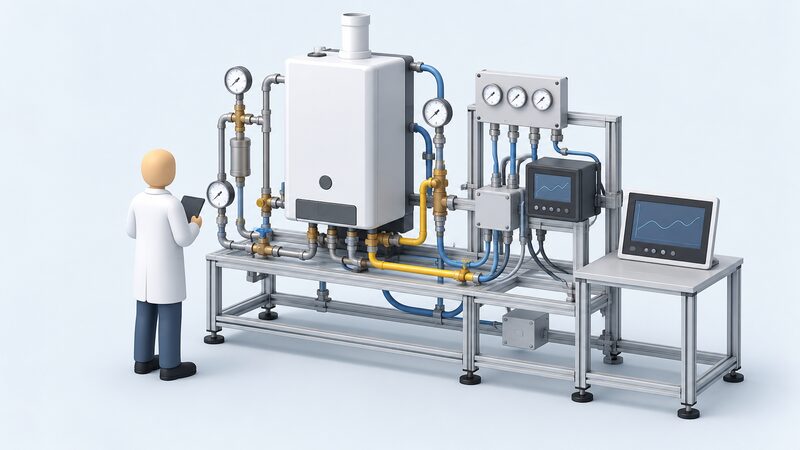
The HSE's independent review of the assessment

The Health and Safety Executive independently reviewed the Hy4Heat Safety Assessment1. Independence matters here because the assessment was produced within a programme whose participants have an interest in the outcome. The HSE is the UK's workplace health and safety regulator, and its review is the point at which an outside body examines the safety case rather than the programme examining itself.
The HSE's role is described in the same terms as its role in the H100 Fife trial, where the requirement is that before H100 Fife can go ahead, the HSE needs to be satisfied that the trial will be run safely2. That is a gatekeeping function. In the Hy4Heat case, the outcome of the review was a letter of assistance to BEIS rather than a trial approval, because Hy4Heat was an evidence programme rather than a live network trial.
The distinction between reviewing an assessment and approving an installation is worth holding on to. A review of a safety assessment examines whether the assessment is sound and relevant. It does not certify a specific appliance for a specific home, and it does not remove the need for the separate approvals that any trial or installation would require. The H100 Fife case shows the two stages operating in sequence: independent assessment of the Safety Dossier first, then the Letter of Assistance2.
For households watching hydrogen developments, the HSE review is best read as one link in a chain of evidence. It tells you that the safety case has been examined by a regulator. It does not tell you that hydrogen heating is available, approved for general use, or coming to a particular street.
The letter of assistance to BEIS and what it confirms
The HSE wrote a letter of assistance to BEIS confirming the assessment's relevance to gas network operator future duty holders for trials1. The phrase "future duty holders" is the operative one. Gas network operators carry legal duties, and a trial involving hydrogen on a network would fall to whoever holds those duties at the time. The letter confirms that the assessment is relevant to them as they prepare for that role.
This is a narrower statement than a general safety endorsement. It says the assessment is relevant to a defined group of duty holders for a defined purpose, trials. It does not say that hydrogen heating is safe for every home, that any appliance is approved, or that a trial may proceed without further consent. The H100 Fife precedent shows what a further step looks like: SGN received a Letter of Assistance for H100 Fife from the Health and Safety Executive, following independent assessment of the Safety Dossier2.
The Safety Dossier in that case details how 100% hydrogen will be produced, stored, distributed and used safely in homes for the trial2. That is the level of detail a live trial requires, covering production through to use in homes. The Hy4Heat letter of assistance relates to an evidence programme rather than a live network, which is why its wording is about relevance to duty holders rather than about a specific trial proceeding.
For a household, the letter of assistance is a signal about regulatory process, not about product availability. It shows that the safety evidence produced by Hy4Heat has been through an independent review and been found relevant to the parties who would carry responsibility in a trial. What it does not do is shorten the distance between an evidence programme and a hydrogen boiler in a home.
"The Health and Safety Executive (HSE) has independently reviewed the Hy4Heat Safety Assessment and has written [a letter of assistance to BEIS]"
Final reports for Stream 2 Phase 2 projects
The final reports for Stream 2 Phase 2 projects are a separate matter from Hy4Heat, and the distinction is easy to lose. The Heat Pump Ready Programme Stream 2 supported the development of tools, technologies and processes to overcome specific barriers to domestic heat pump deployment6. Stream 1 supported the development and trial of innovative methodologies for the optimised deployment of domestic heat pumps at high density, and in total 11 feasibility and 4 mobilisation and deployment projects were funded6.
Stream 2 Wave 2 focused on applied research and development projects, driving down the lifetime costs of domestic heat pump deployment and improving the domestic consumer experience and acceptability of heat pumps through technology, tools, business model and process innovation7. Both streams were supported by Stream 3, trial support and learning, which ensured knowledge transfer and shared learning across the Heat Pump Ready Programme and the broader heat pump sector6.
Stream 1 Phase 2 projects were to complete by 31 January 2025, and the funded work was to support the development and trial of solutions and methodologies for the optimised deployment of domestic heat pumps at high density8. Final reports are published on GOV.UK as projects conclude, and the publication date for each report depends on when that project finished rather than on a single programme-wide date.
The relevance to a household is indirect but real. These reports are where the practical lessons from heat pump deployment at scale are written down: what worked in dense housing, what the costs looked like, and what the consumer experience was. For anyone weighing a heat pump against waiting for hydrogen, that evidence base is the one that speaks to installations happening now, while the Hy4Heat safety work speaks to a technology that is not yet deployable in homes.
What the review means for hydrogen safety evidence
The HSE review gives the Hy4Heat Safety Assessment a status it would not otherwise have. An assessment produced inside a programme is one thing; an assessment independently reviewed by the health and safety regulator, with a letter of assistance confirming its relevance to future duty holders, is another1. That is the strongest form of endorsement available, and it is an endorsement of relevance rather than of a product.
The programme's own findings sit alongside it. Hy4Heat has successfully proven that hydrogen boilers can operate safely within a test environment5. The qualification "within a test environment" is doing real work in that sentence. It is a statement about controlled conditions, not about occupied homes on a live network, and it is consistent with the programme's evidence goals of end use application, safety, in-use emissions and functionality3.
The H100 Fife trial shows what comes next in the sequence. Before it can go ahead, the HSE needs to be satisfied that the trial will be run safely, and SGN received a Letter of Assistance following independent assessment of its Safety Dossier2. That is a live network trial with real homes, and it required its own safety case rather than relying on the Hy4Heat assessment.
A policy decision on hydrogen for heat is expected in 20269. Until that decision is taken, the safety evidence reviewed by the HSE supports the case for further trials rather than for domestic installation. For a household, the honest reading is that the safety assessment has passed an independent review, that this is a meaningful step in the evidence chain, and that it does not yet change what can be installed or when.

Sources9 cited
- Hy4Heat safety pages, Hy4Heat, 2026
- Safety in our homes, SGN, 2026
- Written evidence on the Hy4Heat programme, UK Parliament, 2020
- Hy4Heat appliances, Hy4Heat, 2026
- Written evidence on hydrogen boilers, UK Parliament, 2026
- Information about the Heat Pump Ready Programme, GOV.UK, 2026
- Heat Pump Ready Programme Stream 2 Wave 2 projects, GOV.UK, 2026
- Heat Pump Ready Programme Stream 1 Phase 2 projects, GOV.UK, 2026
- Economics of hydrogen for heat, Cadent Gas, 2025
 Hydrogen Home Heating TrialsHydrogen home heating is still being tested, not sold.
 Hydrogen Safety in the HomeCan hydrogen actually be used to heat UK homes, and is it safe?
 Hydrogen Appliance TestingHow domestic hydrogen boilers, hobs and fires are tested and certified in the UK, the hydrogen content covered, the bodies involved, and the standards work still outstanding before general sale.
 Hydrogen Heating PolicyWill hydrogen ever heat your home, and when will the government decide?
 Hydrogen in the Gas GridHydrogen might be mixed into the gas you already use, but what would that actually mean for your bills, your boiler and your safety?
 Demonstration and Test HomesBefore new heating systems reach your home, they get tested in real houses with real people living in them.