

In this answer
Short answer
A stove fitted by someone who is not registered with a Competent Persons Scheme leaves the household with two separate problems: the installation may not meet the Building Regulations, and there may be no certificate to prove it does. Getting a stove installed requires it to be notified to the local authority, and a registered installer can sign the work off themselves and notify the local authority, meeting building regulations1. An installer who is not registered cannot do that, so the notification duty falls back on the firm or the householder.
HETAS registration is voluntary. HETAS describes itself as a voluntary Competent Persons Scheme for installers to sign up to should they wish to do so2. That matters before any report is made: an installer who is not on the register has not necessarily broken the law, but the route to compliance changes, and the paperwork a household should expect changes with it.
HETAS operates a whistleblowing procedure for reporting of non-compliance issues on an anonymous basis3. Where HETAS investigates a complaint, it aims to establish whether the installation meets regulations and is compliant, and if non-compliance is identified, it tasks the registrant with addressing it3. Reports about installers who are not HETAS registrants sit outside that process and belong with building control or trading standards.
Why HETAS registration matters when a stove is installed
Registration is not a badge. It is the mechanism by which a solid fuel installation is certified without a separate building control visit. A registered installer will be approved to carry out the work to comply with building regulations without involving local authority building control, and a certificate is issued on completion4. The household ends up with a document trail that a mortgage lender, an insurer or a future buyer can read.
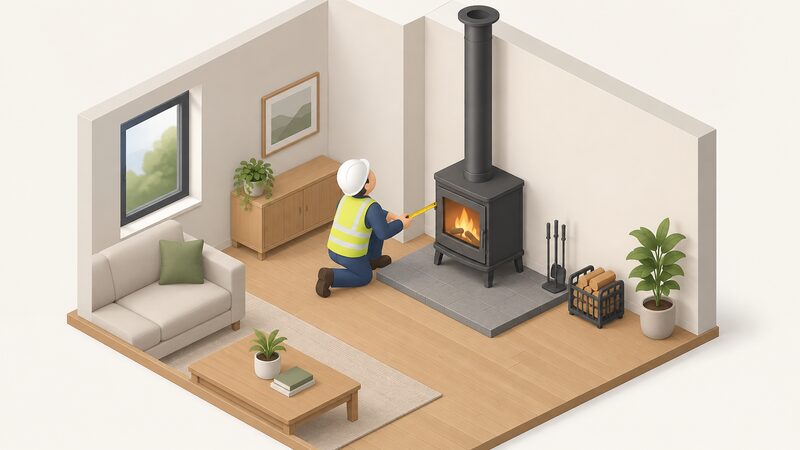
The practical work behind that certificate is specific. A HETAS Registered Installer will make sure the stove is fitted safely and give the documents for peace of mind, checking that the hearth is correctly fitted and all clearance distances are met5. On a thatched property, a HETAS Registered Installer should be consulted for advice on the best location for the appliance, to ensure compliance with the Building Regulations and negate the risk of ignition of combustible roof materials6. Those are the points where an unregistered fitter most often falls short, because the checks depend on knowing the rules rather than on the physical skill of joining a flue.
There is also a servicing and maintenance layer. HETAS has launched a registration scheme for engineers to demonstrate competency in the servicing and maintenance of domestic and commercial biomass appliances7. A registered installer is able to offer further seasonal tips when completing an installation, annual service or regular sweep9. None of this is a legal requirement for the installer, but it is what the registration buys.
For a household's energy independence, the stove itself is a genuine asset: fuel can be bought, stored and burned on site, and the appliance does not depend on a supplier or the gas network. The dependence that remains is regulatory and documentary. Without a compliant certificate, the installation is a liability rather than an asset, and it can be difficult to sell or insure around.
Who can report an installer, and on what basis

Nothing in the scheme rules limits who may raise a concern. HETAS operates a whistleblowing procedure for reporting of non-compliance issues on an anonymous basis3, and FENSA's separate route accepts information about misuse of its logo submitted online anonymously10. A householder, a competing installer or a non-registered installer can all use those routes.
The legal position differs by fuel, and this is where most confusion sits. Installers of appliances burning fuels other than gas are not required to be registered by law11. Gas is the exception: by law anyone carrying out work on gas appliances or fittings as part of their business must be competent and registered with the Gas Safe Register12, and only a Gas Safe-registered engineer can install a new boiler13. For solid fuel, oil and wood, registration is a route to self-certification rather than a licence to trade.
In Northern Ireland the position is set out separately. Although qualifications are not mandatory, any person fitting a solid fuel stove must be competent to do so and should be familiar with the correct procedures and associated regulatory requirements14. That is a competence duty, not a registration duty, and it applies to the person doing the work whoever they are.
The practical consequence is that a report should describe what is wrong with the installation, not simply that the installer is absent from a register. A missing registration is only actionable where it has left the work uncertified or non-compliant.
How the HETAS whistleblowing process works
The process is a complaints and investigation route rather than a prosecution. Where HETAS investigates a complaint, it aims to establish whether the installation meets regulations and is compliant, and if non-compliance is identified, it tasks the registrant with addressing it3. The remedy is corrective work, not a penalty.
The sequence starts with the installer. Where concerns are raised, HETAS encourages consumers to first discuss the issues directly with the installer3, and the first step in its process is to make sure the installer is aware and allow a reasonable timescale for concerns to be resolved3. Only after that does the scheme's own investigation begin.
Two limits are worth stating plainly. First, the process covers HETAS registrants. An installer who has never registered is outside it, and the report has to go elsewhere. Second, HETAS runs the scheme and investigates its own registrants, so the process is not independent of the scheme in the way a regulator or an ombudsman would be. Building control and trading standards sit outside that structure and can act on the same facts.
Where a stove is producing excessive smoke, HETAS advises contacting a local HETAS professional to investigate and fix any faults15. That is a servicing route rather than an enforcement one, but it produces a written assessment that can support a later complaint.
What to include in a report
A report is only as strong as the paperwork behind it. The documents a compliant installation should have produced are the evidence that it did not. A HETAS Registered Installer should provide a notice plate, a carbon monoxide alarm and the manufacturer's instructions before the appliance is used2. A commissioning certificate such as a Benchmark certificate should also be produced, with the local authority building control department notified either directly or, if the installer is a member of a Competent Person Scheme, via the scheme operator4.
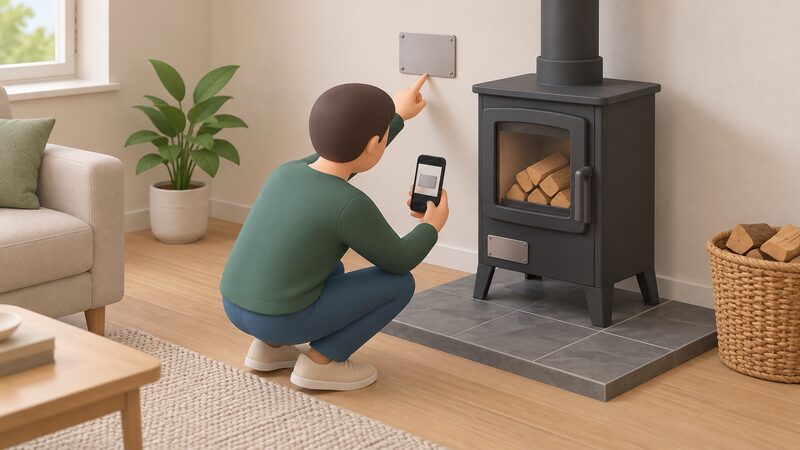
Where a stove has been disabled pending maintenance or further inspection, it is described as uncommissioned, and it will carry a warning label in clear view indicating the appliance must not be used until the HETAS Registered Installer has recommissioned it16. A photograph of that label, or of its absence where one should be, is useful evidence.
A report should set out, in order:
- The installer's name, trading name and any registration number quoted.
- The date work started and finished, and the address.
- Which documents were promised and which were received.
- Photographs of the appliance, hearth, flue, notice plate and any warning label.
- Copies of quotes, invoices and any correspondence about certification.
Carbon monoxide is the reason this matters. A carbon monoxide alarm is one of the items a registered installer should provide before the appliance is used2, and the general guidance on carbon monoxide in properties treats it as a serious incident category17. Gas appliances are covered by a separate register: Gas Safe Register is the example qualified register for gas appliances18, and gas work must be carried out by someone on it12. Northern Ireland guidance on gas safety and carbon monoxide follows the same principle19.
Reporting to other bodies: building control and trading standards

Where the installer is not on a Competent Persons Scheme, the notification route changes. The installer cannot self-certify, and the firm or householder must give notice to the local authority of the intention to carry out the boiler work in advance and pay a notification fee20. The same structure applies to solid fuel: an installer should be registered with one of the relevant Competent Person Schemes for solid fuel fired boiler work20, and in Wales, solid fuel fired boiler work requires an installer registered with the Competent Person Schemes21.
The general rule is that a building control body does not need to be notified for certain services or fittings if the owner employs an installer registered with a relevant competent person scheme designated in the regulations, including fuel-burning appliances22. Remove the registration and the exemption falls away, leaving a notifiable project.
| Situation | Who notifies | Route |
|---|---|---|
| Installer registered with a Competent Person Scheme | Installer | Self-certifies and notifies the scheme operator4 |
| Installer not registered | Firm or householder | Notice to the local authority in advance, with a notification fee20 |
| Work already completed without notification | Householder | Building control regularisation, via the council or a registered building control approver23 |
Building regulations approval from the council or a registered building control approver is the alternative where the installer is not on a Competent Persons Scheme23. For electrical work associated with the installation, installers who are not a registered competent person may use a registered third-party certifier to certify work as an alternative to using a building control body24. In Northern Ireland, a commissioning certificate or safety notice for a solid fuel stove and flue is to be completed by the installer or other competent person accepting responsibility for certifying the safety of the installation, and that notice must not be removed or covered25.
Trading standards is the other route, and it is the one that reaches installers who never registered anywhere. It deals with the trader's conduct rather than the technical compliance of the work, so the two reports can run in parallel on the same facts.
Checking registration before work starts
The check is straightforward and should happen before a quote is accepted. HETAS registration is voluntary, so absence from the register is not itself an offence, but it determines who carries the notification duty and what paperwork the household should expect at the end2.
For other fuels the equivalent registers differ. Oil fired boiler work requires an installer registered with one of the relevant Competent Person Schemes20, and the same applies to solid fuel fired boilers21. Gas work requires Gas Safe registration by law12. A household comparing installers across fuels is therefore comparing different registration regimes, not a single one.
The wider consumer protection picture is under review. Citizens Advice has responded to a government consultation on reforming consumer protection for home upgrade schemes, and its response describes an installer register managed by the consumer service provider26. That is a proposal, not a current requirement, and it does not change what applies to a stove installation today.
For a household, the independence question is simple. A registered installer produces the certificate that makes the installation a documented asset. An unregistered installer leaves the household holding the notification duty, the building control fee and the risk that the work has to be opened up and corrected. The stove still burns wood bought and stored at home, but the paperwork that makes it saleable and insurable is missing until the work is regularised.
Sources26 cited
- 6 log burner rules, HETAS, 2026
- Consumer FAQs, HETAS, 2026
- Complaints and concerns, HETAS, 2026
- Building regulations for boilers and heating, Planning Portal, 2026
- Log burner decorating, HETAS, 2025
- Installations in thatch properties, HETAS, 2026
- Servicing, HETAS, 2026
- Biomass maintenance, HETAS, 2026
- Cold plug winter safety advice for stove users, HETAS, 2026
- Cowboy conundrums, FENSA, 2026
- Carbon monoxide prevention, CO-Gas Safety, 2015
- Gas safety in the workplace, Health and Safety Executive, 2011
- Potterton boilers review, Which?, 2025
- Stove guidance for householders, Building Control Northern Ireland, 2015
- Can my neighbour complain about my log burner?, HETAS, 2026
- What is an uncommissioned stove?, HETAS, 2026
- Carbon monoxide: general information, UK Health Security Agency, 2022
- Gas safety and carbon monoxide, nidirect, 2025
- Electrical safety standards in the private and social rented sectors, Ministry of Housing, Communities and Local Government, 2025
- Building regulations: boilers and heating, Planning Portal, 2026
- Building regulations: boilers and heating, Welsh Government, 2026
- Approved Document L, Volume 1: Dwellings, Ministry of Housing, Communities and Local Government, 2023
- Upgrading and replacing your boiler, Centre for Sustainable Energy, 2026
- Approved Document P: Electrical safety, Planning Portal, 2013
- Commissioning certificate and safety notice guidance, Building Control Northern Ireland, 2015
- Response to the DESNZ consultation on reforming consumer protection, Citizens Advice, 2026
 Using an Installer in EnglandHow do you check an installer is registered to sign off their own work, and what happens if they are not?
 Installer QualificationsWhat training and qualifications should a heat pump installer actually have?
 Installer in Northern IrelandHow do you check an installer in Northern Ireland is properly registered, and who do you complain to if the work goes wrong?
 Installing Heating ControlsSwapping a thermostat or programmer looks simple, but which jobs can you safely do yourself and which need a registered installer?
 Installer Schemes and CodesCheck whether your installer is on TrustMark, and whether they belong to HIES or the Renewable Energy Consumer Code.
 Checking an InstallerBefore you sign anything, how do you know your installer is genuine?