
In this answer
Short answer
HETAS logos are not one mark but several, and they sit on different things: a business, an appliance, a bag of fuel, a chimney sweep's van. HETAS describes itself as the only specialist organisation approving biomass and solid fuel heating appliances, fuels and services, and it runs the list of authorised fuels for Defra1. The logos exist so a householder can tell, at a glance, which part of the solid fuel chain has been checked.
The mark most people meet first is the HETAS Registered Installer logo, which signals that a business has been trained and assessed to carry out installations safely and in line with relevant regulations2. A separate family of marks covers products and fuels: the Cleaner Choice approval for appliances, and the HETAS Approved Solid Fuel logo for fuel that has been tested and approved3. A third group belongs to training and to the individuals who hold current certification, since only those who have completed the relevant courses and have up to date training may display the logos2.
The practical point is that a logo tells you what has been checked, not everything you might assume. A HETAS mark does not by itself make a stove legal in a smoke control area, does not give HETAS enforcement powers, and does not replace the Building Regulations certificate that a householder should hold. This page sets out which logo belongs to whom, what each one certifies, and how to verify one that looks wrong.
What HETAS is and why its logos matter
HETAS stands for Heating Equipment Testing and Approvals Scheme. It describes itself as a not-for-profit company limited by guarantee without share capital, working together for a cleaner and safer environment7. Its remit is narrow and technical: solid fuel and biomass, rather than the whole of home heating. It has run the list of authorised fuels for Defra since 2018, and it holds a Primary Authority partnership with Trading Standards, which it says allows it to tackle effectively the few businesses that misuse its marks8.
That partnership matters to a householder because it explains why the logos carry weight. A mark is only useful if someone can act when it is copied. HETAS also operates a whistleblowing procedure for reporting non-compliance issues on an anonymous basis, and it works with suppliers on labelling duties: its chief executive Bruce Allen said in 2021 that suppliers must meet the new legislative requirements for fuel and product labelling by 1st May9.
The logos matter for a second reason. Solid fuel sits at the centre of air quality policy, and HETAS positions its registrants as a route by which local communities can act beyond the remit of policy to improve their local air quality11. For a household, the marks are the visible end of that system: they are how a consumer distinguishes a checked installer, appliance or fuel from an unchecked one.

The HETAS registered installer mark: what it certifies

The installer mark is the one that carries the most weight for a household, because it is tied to a document. HETAS Registered Installers have been trained and assessed to carry out installations safely and in line with relevant regulations2. The scheme is a voluntary Competent Persons Scheme for installers to sign up to should they wish to do so, which is why HETAS says it is not made aware of work carried out by businesses outside it1.
Where the registration is held, the installer can notify the work and issue a HETAS Certificate of Compliance. That certificate demonstrates that the installation complies with the relevant Building Regulations12. It is the paper that matters at the point of sale of a house, and it is the reason the installer mark is worth checking rather than assuming.
The mark also carries a maintenance role. A registered installer can offer further seasonal tips when they complete an installation, annual service or regular sweep, and HETAS runs a separate biomass maintenance service for appliances13. That is a practical difference between a registered and an unregistered route: the relationship continues past the installation day.
Product approval logos: appliances, fuels and chimneys
Product marks are where the logo family gets confusing, because several of them look similar and sit on different objects.
The Cleaner Choice Product Approval Scheme is aimed at appliances. HETAS introduced it to raise industry standards and drive consumers towards the cleanest burning biomass and solid fuel appliances that minimise harmful particle emissions15. Certified products must contain clear guidance on installation and operation, and the scheme's assurance covers safety and performance requirements alongside manufacturer instructions on correct operation and installation16. HETAS states that it is a third party independent and impartial certification body that relies on first-hand review of test data from notified laboratories3.
Fuel carries its own mark. Testing and approval combined with a quality assurance scheme enables the fuel to carry the HETAS Approved Solid Fuel logo, which HETAS says the consumer should look for4. For solid mineral fuels, all listed fuels have been tested and approved by HETAS on behalf of the fuel producer18. The fuel schemes sit under a single consumer-facing structure covering the different fuel types19.
| Logo or scheme | Sits on | What it certifies |
|---|---|---|
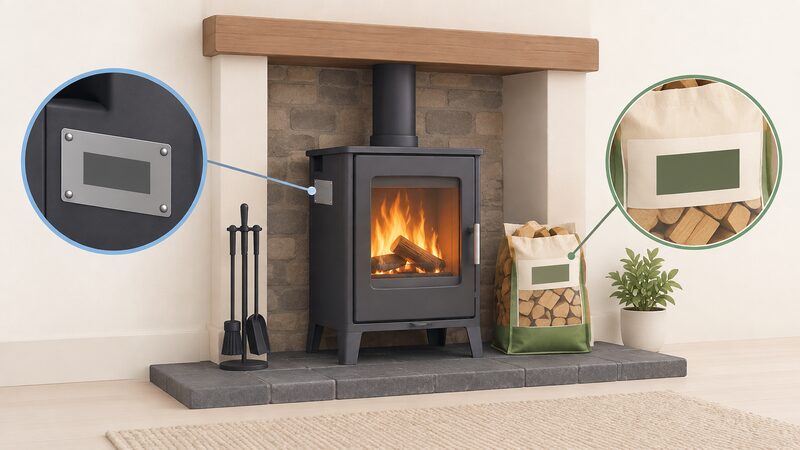
| HETAS Registered Installer | A business | Trained and assessed to install safely and in line with relevant regulations2 |
| HETAS Certificate of Compliance | The installation | Compliance with the relevant Building Regulations12 |
| Cleaner Choice Product Approval | An appliance | Particulate performance plus safety, performance, operation and installation assurance3 |
| HETAS Approved Solid Fuel | Fuel bags and packaging | Testing and approval plus a quality assurance scheme4 |
| HETAS Appliance Approval | An appliance | Approval dealing with CE marking in a way HETAS says is unique to its scheme20 |
Which logo belongs to whom: installer, product or training
The simplest way to read the family is by who holds it. Installer marks belong to a business and to the individuals within it. Product marks belong to a manufacturer and travel with the appliance. Fuel marks belong to a fuel producer or supplier. Training sits behind all of them, because only individuals who have completed the relevant courses and have up to date training may display the logos2.
That training requirement is what makes the installer mark meaningful rather than decorative. Installers are supplied with the means, meaning documentation, training and technical support, to competently carry out and notify installation, commissioning and servicing work in accordance with manufacturer's instructions21. The mark is the visible signal of that package.
It is worth separating HETAS from the other registers a household may meet. Gas Safe Register is the official hallmark for gas safety, and registered people hold a Gas Safe ID card22. HETAS covers solid fuel and biomass. A business can hold both, and a household with a gas boiler and a wood stove may deal with two different registrations in the same house. For the solid fuel side specifically, the HETAS registered installers page sets out the scheme in more detail, and the wider installer competent person schemes page explains how self-certification works across the trades.
What a HETAS logo does not guarantee
A logo is a claim about a specific check, and it is worth being exact about the edges.
It does not make a stove legal in a smoke control area. For that, a stove must meet both the current requirements for exemption and have attained listing on the Defra website3. The Cleaner Choice scheme is focused on particulate emissions, and while it also provides assurance that the appliance meets the relevant UK regulations including safety and performance, correct operation and correct installation for HETAS registrants, the exemption and the Defra listing are separate conditions a householder has to confirm3.
It does not give HETAS enforcement powers. HETAS does not issue fines or warning notices; that is the role of local authorities6. Where a logo has been misused, the route runs through Trading Standards and the local authority rather than through HETAS alone.
It does not freeze the rules. HETAS has said that no changes are needed to its certification processes, including Cleaner Choice and HETAS approval, following extended CE marking recognition20. On fuel labelling, HETAS has suggested that the label's design, wording and visuals should be assessed and refreshed at set intervals to prevent a successful label becoming stale24. A mark seen on an older appliance or bag reflects the rules at the time it was applied.
Checking a logo: verification and what to do if it looks wrong
Verification is straightforward and takes a few minutes. HETAS advises using its search to find the business via postcode, business name or business ID number, looking for the relevant HETAS logo, asking to see the HETAS Identity Card, checking the logo matches the work, and calling or emailing HETAS if anything does not add up2. The same logic applies to fuel: a "checked by" search function accepts a certification number found on the supplier's bags to confirm they are a certified business25.
If a certificate is missing or wrong, the route depends on timing. If the installation is less than 6 months old and the installer is still HETAS Registered, HETAS recommends contacting the installer to request a new certificate; otherwise contact the HETAS support team1. For an installation older than 6 months, or where the installer is no longer HETAS Registered, the support team can be reached by email or on 01684 2152155. Where no certificate exists at all, HETAS recommends contacting a HETAS Registered Installer, who may be able to re-commission the installation and issue a new notification12.
There is also a documented state between installed and usable. An uncommissioned stove is one that has been disabled by a HETAS Registered Installer pending maintenance or further inspection, and while it is uncommissioned it will have a warning label in clear view indicating the appliance must not be used until the HETAS Registered Installer has recommissioned it26. That label is itself a form of logo reading: it tells a householder that the appliance is not in service.
Before an appliance is used, HETAS advises that the registered installer should have provided a Notice Plate, a carbon monoxide alarm and the manufacturer's instructions1. If a logo check raises a doubt, the report an unregistered stove installer page covers the reporting route, and complaining about an installer sets out the escalation steps.
Sources26 cited
- HETAS consumer FAQs, HETAS, 2026-04-01
- Keeping you safe: rogue traders, logo misuse and imitation businesses, HETAS, 2026
- What is the Cleaner Choice scheme?, HETAS, 2026
- Woodsure scheme, HETAS, 2024-02-09
- Certificates of compliance, HETAS, 2026-03-31
- Beyond the headlines: understanding complaints about wood burning, HETAS, 2025-11-07
- The changing face of solid fuel, HETAS, 2022-07-12
- New legislation for wood and manufactured solid fuels, HETAS, 2024-08-19
- Tackling rogues, HETAS, 2022-12-20
- HETAS appointed by Defra to run Ready to Burn scheme for manufactured solid fuels, HETAS, 2021-05-01
- Researchers call for embedding public participation in air quality management, HETAS, 2025-11-13
- Moving home, HETAS, 2026
- Cold plug winter safety advice for stove users, HETAS, 2026-02-12
- Biomass maintenance, HETAS, 2026
- The Cleaner Choice approval scheme is growing, HETAS, 2024-01-29
- Chesneys have made the Cleaner Choice, HETAS, 2025-11-06
- Solid mineral fuel, HETAS, 2025-02-26
- Fuel schemes, HETAS, 2024-10-29
- Consumer hub, HETAS, 2024-01-29
- Extended CE marking recognition, HETAS, 2022-07-12
- HHIC document, HHIC, 2026-09-17
- Domestic gas installation and health and safety, nidirect, 2025-10-28
- Registration to carry out gas work, GOV.UK, 2026-09-17
- New wood burner fuel labels explained, HETAS, 2026-04-23
- How can I check that a supplier is certified?, HETAS, 2026
- What is an uncommissioned stove?, HETAS, 2026
 Comparing Specs Like for LikeTwo solar panels or heat pumps can look different on paper even when they do the same job.
 Who Owns Which Energy BrandMaps the corporate groups that sit behind familiar UK boiler, cylinder, heating and renewables brands, and which names are badges rather than separate factories.
 Product Markings and StandardsExplains what conformity markings and voluntary quality marks on home energy products actually mean, who issues them and what testing sits behind each.
 Appliance Standards and MarkingWhich marks should a boiler, heat pump or cylinder have before you buy, and what do they actually prove?
 HMOs and Shared HousesWho is responsible for the electrics, the gas and the fire alarms when you rent a room in a shared house?
 Installer Schemes and CodesCheck whether your installer is on TrustMark, and whether they belong to HIES or the Renewable Energy Consumer Code.