

In this answer
Short answer
No. The Energy Company Obligation does not apply in Northern Ireland. ECO is a supplier obligation that operates across Great Britain, and Northern Ireland sits outside it, with its own regulatory system, its own supplier-funded programme and its own set of grants and vouchers.
The practical consequence is that the funding route most often quoted to householders in England, Scotland and Wales is simply not available. Northern Ireland's equivalent is the Northern Ireland Sustainable Energy Programme, an £8 million fund collected from domestic and commercial electricity customers through a public service obligation1. It is administered by the Energy Saving Trust on behalf of the Utility Regulator2.
What Northern Ireland does have is a different mix: NISEP for energy efficiency measures, the Affordable Warmth Scheme, a home heating oil voucher, and free independent advice through NI Energy Advice. What it does not have is the Warm Home Discount, which does not run in Northern Ireland3.
Why Northern Ireland sits outside the GB scheme
The reason is structural rather than political accident. Energy efficiency obligations in Great Britain are imposed by the UK Government on suppliers operating in the GB market, and Northern Ireland's electricity and gas markets are regulated separately. The Utility Regulator, not Ofgem, oversees the supplier obligation there, which is why NISEP exists as a distinct programme with its own list of approved schemes published each year7.
The separation runs through the wider regulatory framework too. UKCA marking guidance notes that sales of goods within Northern Ireland operate under a different regime, UK(NI)8. Electrical installation rules diverge as well: there is currently no equivalent statutory requirement in Northern Ireland to the Part P notification regime that applies in England and Wales9. Building energy performance methodologies are also split, with the England and Wales notice of approval explicitly not applying to national calculation methodologies in Northern Ireland, Scotland and Wales10.
Even where a scheme is UK-wide, Northern Ireland can fall outside the statistics. The heat pump deployment quarterly statistics note that while the schemes cover installations in the UK, some devolved administration schemes in Scotland and Northern Ireland are currently not included11. The same limitation appears in the 2025 Q3 release12.
For a household, the effect is that grant eligibility is determined by where you live in a way that has nothing to do with the property itself. A solid-walled semi in Belfast and an identical one in Carlisle face different funding landscapes. The pillar guide to how the four nations differ sets out the wider picture, and which energy powers are devolved and which are reserved explains why the split falls where it does.
NISEP: Northern Ireland's own energy efficiency obligation
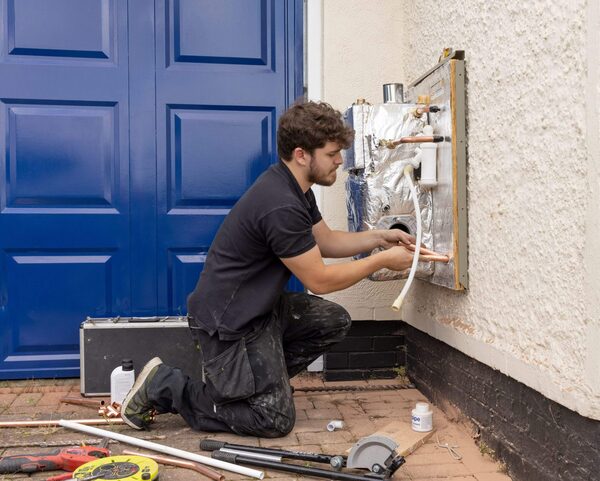
NISEP is an energy efficiency programme for domestic and non-domestic customers13. It is funded by an £8 million levy collected from both domestic and commercial electricity customers through a public service obligation1. Energy Saving Trust administers it on behalf of the Utility Regulator2.
The scale is modest by comparison with ECO, but consistent. Each year since 2010, NISEP has installed at least 15,000 energy efficiency measures, benefiting over 3,500 properties per year4. Funding covers schemes such as boiler upgrades, LED light bulbs and draught proofing15. Some schemes are fully funded by NISEP, while others may require a financial contribution by the applicant4.
The programme is not limited to homes. The 2026/27 list of schemes includes the Commercial Energy Saving Scheme, open to all commercial and non-domestic properties in Northern Ireland7.
The 2024/2025 annual report, published on 3 July 2026, sets out outturns for spend, savings and properties treated13. For a household, NISEP is the closest thing to an obligation-driven retrofit funding stream, but it is a levy on electricity bills rather than a charge on suppliers' profits, and it is smaller. The full guide to NISEP covers eligibility and how to apply.
What support Northern Ireland households do and do not get
The Warm Home Discount does not run in Northern Ireland3. It applies to England and Wales16, and Scotland operates a separate version. In its place, the Affordable Warmth Scheme is available in Northern Ireland3.
The Home Heating Oil Support Scheme is the other distinctive measure. Once activated, the voucher can then be used to purchase home heating oil with any Northern Ireland oil supplier17. It is open to people living in Northern Ireland who may be eligible to apply online18. The scheme was announced by the Communities Minister19.
| Support | Northern Ireland position |
|---|---|
| Energy Company Obligation | Does not apply3 |
| Warm Home Discount | Does not run in Northern Ireland3 |
| Affordable Warmth Scheme | Available3 |
| NISEP | £8 million fund, domestic and non-domestic1 |
| Home Heating Oil Support Scheme | Voucher usable with any NI oil supplier17 |
| Free advice | NI Energy Advice, independent and impartial20 |
On funding levels, an energy bill reduction scheme is being paid for through £81 million in funding21. All households in Northern Ireland also received a one-off £600 payment to help with energy bills in winter 2022/23, made up of the £400 Energy Bills Support Scheme plus the £200 Alternative Fuel Payment22.
For insulation and low carbon heating, the published route is narrower. Households in Northern Ireland can get heat pump ready and apply for funding for insulation via NI Energy Advice20. The Affordable Warmth Scheme guide and the Home Heating Oil Scheme guide cover the detail.
Fuel poverty in Northern Ireland: the 10% indicator and no statutory targets

Fuel poverty in Northern Ireland is measured using the 10% indicator, where a household is fuel poor if the fuel costs required to maintain a satisfactory heating regime exceed 10% of household income23. The regime is defined as 21°C in the main living room and 18°C in other occupied rooms21.
That definition differs from the approach used in England, where the statutory target is for the eradication of fuel poverty, as far as reasonably practicable, in vulnerable households, meaning the elderly, families with young children and the long term sick and disabled24.
Northern Ireland currently has no statutory fuel poverty targets and no minimum energy efficiency standards6. That absence matters for household energy independence: without a statutory target, there is no legal mechanism forcing retrofit at a particular rate, and the funding that exists is discretionary and levy-funded rather than obligation-driven.
"Northern Ireland currently has no statutory fuel poverty targets and no minimum energy efficiency standards"
The fuel poverty in Northern Ireland guide sets out the rate and strategy in full, and the Northern Ireland fuel poverty strategy page covers the policy position.
Why most Northern Ireland homes heat with oil
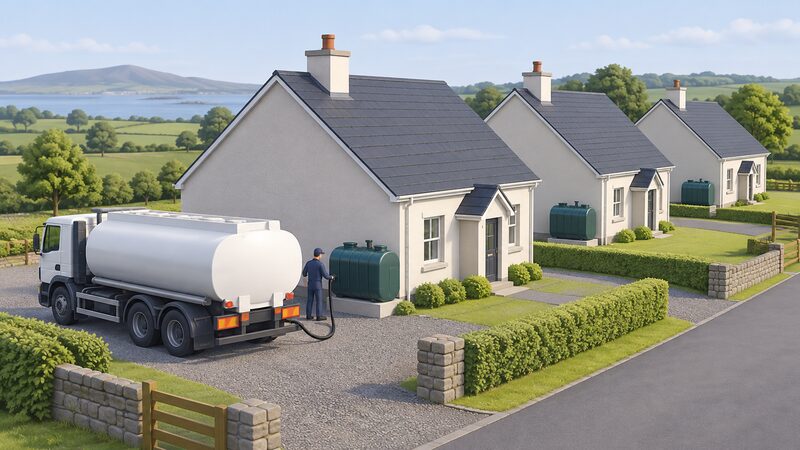
More than two-thirds of Northern Ireland households use oil boilers as their main source of heating5. Approximately 500,000 homes in Northern Ireland rely on oil as a primary heating source19, and around half a million homes rely on oil for heating20.
That reliance is the single biggest determinant of what support looks like. A supplier obligation built around gas and electricity meters fits awkwardly with a housing stock where the main heating fuel is delivered by tanker. It explains why the home heating oil voucher exists at all, and why NISEP's funded measures lean towards insulation, draught proofing and boiler upgrades rather than a wholesale switch of heating technology.
The guide to how Northern Ireland homes are heated and the oil versus gas comparison go further into the fuel mix.
What this means for household energy independence
The independence picture in Northern Ireland is unusual. On one hand, oil heating means no reliance on the gas grid and no standing charge to a gas supplier. On the other, it means dependence on delivered fuel, on a distributor, and on a price set in a market the household cannot influence. A tank is a store of energy, but it is also a recurring purchase.
The electricity side carries its own dependencies. Smart meters have not yet been installed in Northern Ireland homes, with the rollout announced to begin in 2028, so time-of-use tariffs and the load-shifting that goes with them are not yet available to households there. Connection arrangements also differ from Great Britain25.
What households do have is advice. NI Energy Advice offers independent and impartial energy advice to domestic householders in Northern Ireland, plus referrals to energy grants and other sources of help26. The Consumer Council NI and Northern Ireland Energy Advice give free, independent and impartial energy advice to all domestic householders in Northern Ireland29.
For a Northern Ireland household, the realistic path to lower dependence runs through insulation, draught proofing and heating controls funded by NISEP or the Affordable Warmth Scheme, plus the oil voucher where eligible. The Northern Ireland retrofit pilot page covers the proposed domestic scheme, and Northern Ireland's climate targets set out the wider policy direction.
Sources30 cited
- NISEP programme, Energy Saving Trust, 2026-09-07
- Energy Company Obligation and the Green Deal, House of Commons Library, 2026-05-13
- Warm Home Discount Scheme, Ofgem, 2026-09-17
- Energy grants Northern Ireland, Energy Saving Trust, 2026-09-17
- Central heating, nidirect, 2026-09-17
- NEA NI Manifesto for Homes 2024, National Energy Action, 2024
- NISEP List of Schemes 2026-27, Utility Regulator, 2026-04
- All you need to know about UKCA marking, HETAS, 2025-11-17
- Part P of the Building Regulations, Electrical Safety First, 2026-09-17
- Notice of approval of the methodologies of calculation, GOV.UK, 2026-03-24
- Heat pump deployment quarterly statistics, UK 2025 Q2, GOV.UK, 2025-09-04
- Heat pump deployment quarterly statistics, UK 2025 Q3, GOV.UK, 2025-12-04
- 2024/2025 NISEP Annual Report published, Utility Regulator, 2026-07-03
- NISEP List of Schemes 2024-25, Utility Regulator, 2024-10
- Energy saving grants in your area, nidirect, 2026-09-20
- Warm Home Discount: if you live in England and Wales, GOV.UK, 2026-09-17
- Home Heating Oil Support Scheme, Department for Communities, 2026-09-17
- Home Heating Oil Support, nidirect, 2026-09-17
- Lyons announces agreement on Home Heating Oil Support, Department for Communities, 2026-04-16
- Is now a good time to get a heat pump, Energy Saving Trust, 2025-12-12
- Fuel poverty statistics briefing, House of Commons Library, 2026-08-06
- Energy bills support briefing, House of Commons Library, 2026-08-28
- Fuel poverty modelled estimates for Wales, Welsh Government, 2025-10-16
- Fuel poverty statutory target, Parliament, 2026-09-20
- Connection charging announcement FAQs, NIE Networks, 2026-09-20
- Insulation, nidirect, 2026-09-02
- Hydropower, nidirect, 2026-09-17
- Biomass, nidirect, 2026-09-17
- Low carbon heating, nidirect, 2026-09-17
- ECO4 Flex open, South Cambridgeshire District Council, 2026-09-17
 Utility Regulator NIWho sets your energy prices in Northern Ireland and who can you complain to?
 The Full Energy Suppliers GuideWho the UK's domestic gas and electricity suppliers are, how the market is structured across Great Britain and Northern Ireland, what a supplier is licensed and obliged to do, how the price cap limits bills, what happens when a supplier fails, and who regulates it all.
 Energy Supply in NICan you get gas where you live in Northern Ireland, and what happens if your power goes off?
 National Home Energy InstallersWho actually turns up to fit your boiler or solar panels when you book with a big national company?
 Community Energy in NICan a community group in Northern Ireland sell power to its neighbours, and is there funding to get a project off the ground?
 Energy Bills in Northern IrelandNorthern Ireland has no price cap.