

In this answer
Short answer
The Moyle interconnector links Northern Ireland to Great Britain, and the East-West interconnector links the Republic of Ireland to Great Britain. Both are subsea high voltage direct current cables that move electricity between two transmission systems rather than generating any themselves. They are the physical reason the island of Ireland and Great Britain can share power, and they sit alongside the wider portfolio of links that gives Great Britain 10.3GW of operational electricity interconnector capacity across ten interconnectors1.
For a household, the practical effect is indirect but real. Interconnectors widen the pool of generation a system can call on, which bears on wholesale prices and therefore on the tariffs suppliers set. They do not change what a meter measures or who bills a property. A household still buys from a licensed supplier, and the bill still depends on the type of energy used, the type of meter installed and how the bill is paid2.
The limits matter as much as the benefits. A cable can be unavailable, and the plant at the far end can be short at the same moment. Great Britain's Capacity Market exists to ensure security of GB electricity supply at least cost to consumers, and it is the mechanism that procures firm capacity rather than the interconnectors themselves1.
What the Moyle and East-West interconnectors are
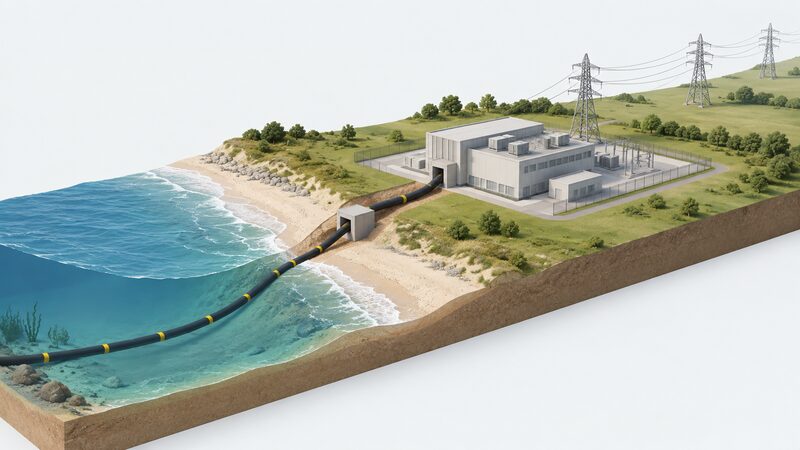
An interconnector is not a power station. It is a transmission asset: a cable with converter stations at each end that allows two separately operated grids to exchange power in either direction. The Moyle link runs under the Irish Sea between Northern Ireland and Great Britain. The East-West link runs between the Republic of Ireland and Great Britain. Both are part of the same trading picture, and both are distinct from the domestic distribution networks that physically reach a property.
That distinction is easy to lose. Network operators are different to your energy supplier, and the businesses that own and run transmission assets are not the businesses that send a bill5. The same separation applies to the work a household might commission: an Independent Connection Provider can be used for various elements of the work involved in getting an electricity connection or making changes to an existing electricity connection, which is a different function again from operating an interconnector6.
The island of Ireland has its own system operator arrangements, and Northern Ireland's network business, NIE Networks, handles connections on that side of the water. A temporary supply point can be arranged to carry out construction work before the permanent supply to each property is needed, which is the kind of connection activity that sits at the opposite end of the scale from a subsea interconnector8.
Why the links matter for UK electricity supply

Interconnectors matter because they change the size of the pool. When British generation is expensive and neighbouring generation is cheap, imports flow in. When the reverse is true, British surplus is exported. That trade is one of the reasons the grid has to become smarter and more flexible, because flows now respond to price signals across borders as well as within them9.
The security of supply framework treats this as one input among several. The Capacity Market exists to ensure security of GB electricity supply at least cost to consumers, and it is the standing mechanism for firm capacity1. Interconnectors can contribute to that picture, but they are not a substitute for it, because a link is only as firm as the generation behind it at the other end.
There is also a resilience argument that runs the other way. Distribution networks in Great Britain are built to a high standard, and Electricity North West describes its network as one of the most reliable and cost-effective networks in the UK, while noting that power cuts can still happen10. Interconnectors do not remove that local reality. A household's supply still depends on the distribution network in its street, whatever is flowing under the sea.
For Northern Ireland specifically, the connection charging arrangements have been revised, and the Department of Economy has forecast that the change will add approximately £3.05 to a domestic bill payer's bill a year by 20304. That is a network charging effect rather than an interconnector flow effect, but it illustrates how transmission and connection policy reaches household bills.
How the interconnectors work in practice
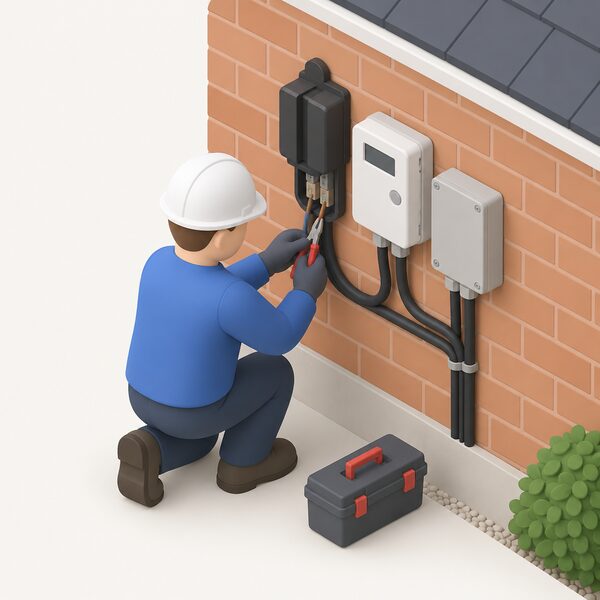
In operation, an interconnector is a controlled exchange. Power flows when the price difference between the two markets covers the cost of using the link, and the direction can reverse within a trading period. Nothing about this is visible at a household meter. The meter records consumption, and an import MPAN is required for each new standard electricity meter, to measure the consumption of electricity and allow individual billing, for example a separate flat or landlord meter11.
Where a household does interact with this world is through its own connection and its own generation. A qualified electrician must verify that the existing supply can handle additional electrical load before an import MPAN is requested, which is the gate that sits in front of any significant new load11. On the export side, the tools that show export payments do not show details of a property's incoming electricity supply or who it pays its electricity bills to, which require the import MPAN12.
Behind-the-meter systems follow a similar logic. A grid connection is not mandatory, but it enhances value by enabling export of surplus electricity, and where generation and consumption are to be linked directly, a physical electrical connection (private wire) is required to transfer the electricity between where the energy is generated and where it is used13. Those are the household-scale equivalents of what an interconnector does at national scale: move power from where it is produced to where it is needed.
"While not mandatory, a grid connection enhances the value of BTM systems by enabling the export of surplus electricity."
What the links mean for household energy independence
Interconnectors do not give a household independence, and it is worth being exact about why. A home connected to the grid draws from a shared system whose supply at any moment is a mix of domestic generation, storage, demand flexibility and imports. The interconnectors are part of that mix. They improve the odds that power is available and priced competitively, but they also mean a household's supply is tied to decisions made in other markets.
What a household can control is its own side of the meter. A plug-in microgenerator is intended for connection to a low voltage consumer's installation by means of a standard plug and socket, which is the smallest scale at which a home can put electricity back into its own installation14. The interim product specification for such devices sets a limit: the current at the point of connection does not exceed 3.5 A under all test conditions, at supply voltages of 0.94 Un, 1 Un and 1.1 Un, where Un is 230V15. Such a device is not designed to import electrical energy from a low voltage consumer's installation for the purpose of storing energy for later supply, other than for control or auxiliary functions permitted by that specification16.
Larger household measures exist, and they are grant-supported rather than interconnector-related. The Heat Pump Ready programme lists projects with named subcontractors, including Connect 3, Blairgowrie and Rattray Development Trust, Geospatial Insight Ltd, Strathclyde University's Energy Systems Research Unit, MCA Renewables, Zuos Ltd and Scottish and South Energy Networks17. A separate project, Green Homeowner Loans, lists Home Infrastructure Technology Limited as lead organisation and no project partners18. These are delivery arrangements, not supply arrangements, and they do not change where a household's electricity comes from.
The honest position is that interconnectors strengthen national security of supply and leave household dependence on the grid intact. A home that wants to reduce that dependence has to look at its own generation, its own storage and its own flexibility, and accept that the grid connection remains the thing that makes most of it worthwhile.
Limits and constraints of the interconnectors
The first constraint is physical. A cable carries what it is rated to carry, and no more. Great Britain's operational capacity stands at 10.3GW across ten interconnectors, with NeuConnect's 1.4GW to Germany bringing the total to 11.7GW, and MaresConnect at 0.75GW among the projects in development1. Those figures describe the portfolio, not a guaranteed flow: actual transfers depend on market conditions and on both systems being able to accept the power.
The second constraint is availability. A link can be out of service for maintenance or repair, and the generation at the far end can be short at the same time. That is why the Capacity Market exists as a separate mechanism to ensure security of GB electricity supply at least cost to consumers, rather than relying on imports1. It is also why the flexibility agenda matters: the grid has to become smarter and more flexible to manage a system where supply and demand are increasingly variable9.
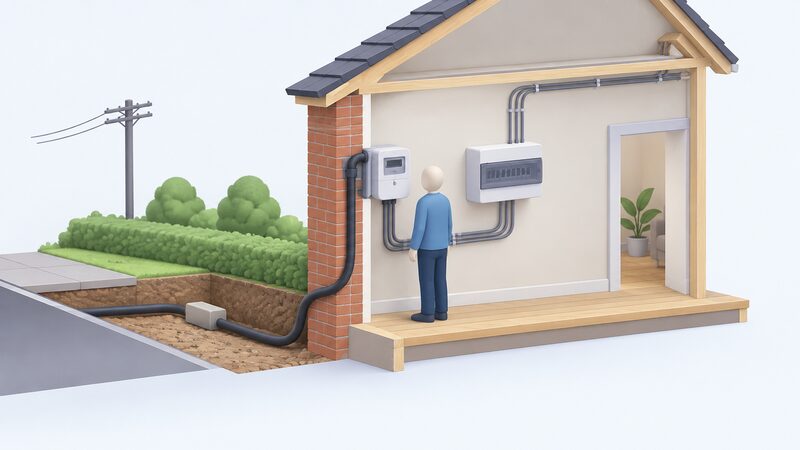
The third constraint is that interconnectors do not reach a household directly. A home's supply depends on its distribution network, and on the connection arrangements that apply to it. Where a property needs more capacity, the process runs through the network operator, and an Independent Connection Provider can be used for various elements of the work involved in getting an electricity connection or making changes to an existing electricity connection6. Disconnection and reconnection follow their own procedures, and a temporary supply can be arranged where construction work needs power before a permanent supply is in place8.
Finally, there is the question of what interconnectors are for. They are trade and security assets, not generation. They lower the cost of meeting demand when neighbouring power is cheaper, and they provide an outlet when British power is surplus. They do not remove the need for domestic generation, storage or firm capacity, and they do not change what a household pays at the meter beyond their effect on wholesale prices and network charges.
Sources18 cited
- Statutory security of supply report 2025, GOV.UK, 2025-12-17
- How your electricity or gas bill is calculated, Ofgem, 2026
- Clean Flexibility Roadmap: July 2026 update, GOV.UK, 2026-09-17
- Connection charging announcement FAQs, NIE Networks
- Power cut 105, Power Cut 105, 2026-09-17
- Adding more power, UK Power Networks, 2026-09-17
- Disconnect your supply, UK Power Networks, 2026-09-17
- What you need to start your application, NIE Networks, 2026-09-19
- Trading sunlight, Solar Energy UK, 2026-09-17
- Why do we experience power cuts?, Electricity North West, 2026-09-19
- Import MPAN guidance, UK Power Networks, 2026-09-17
- Export payments, UK Power Networks, 2026-09-17
- Behind-the-meter energy systems guidance, Welsh Government, 2026-06-29
- The Plug-in Solar Devices Regulations 2026, legislation.gov.uk, 2026-07-16
- Plug-in solar interim product specification, GOV.UK, 2026-06
- The Plug-in Solar Devices Regulations 2026, regulation 2, legislation.gov.uk, 2026
- Heat Pump Ready Programme stream 2 projects, GOV.UK, 2026-05-28
- Heat Pump Ready Programme stream 1 phase 1 projects, GOV.UK, 2026-05-28
 Electricity InterconnectorsWhere does Britain's electricity come from when the wind drops, and how much do we buy from abroad?
 Who Supplies Your Energy?Not sure who bills you for gas or electricity?
 Devolved vs Reserved PowersWho decides what you pay for gas and electricity, and who decides how your home is insulated or improved?
 The Full Energy Bills and the Price Cap GuideWondering why your bill went up even when you used less power?
 What Makes Up a BillBreaks a domestic energy bill into wholesale costs, network charges, policy levies, operating costs, supplier margin and VAT, with the share each takes and how those shares have moved since the energy crisis.
 Negative Electricity PricesWhen wholesale electricity prices go below zero, does that mean you get paid to use power?