

In this guide
Every certified small-scale renewable installation in the UK is logged on the MCS Installations Database, and total installation volumes and uptake can be found in near-real-time by each home nation and also by each local authority1. That is the practical answer to the question of how many solar panels, heat pumps or batteries have gone into homes in a given council area: the MCS Data Dashboard, launched in 2022 and free for anyone to view and use, is the tool that carries it2.
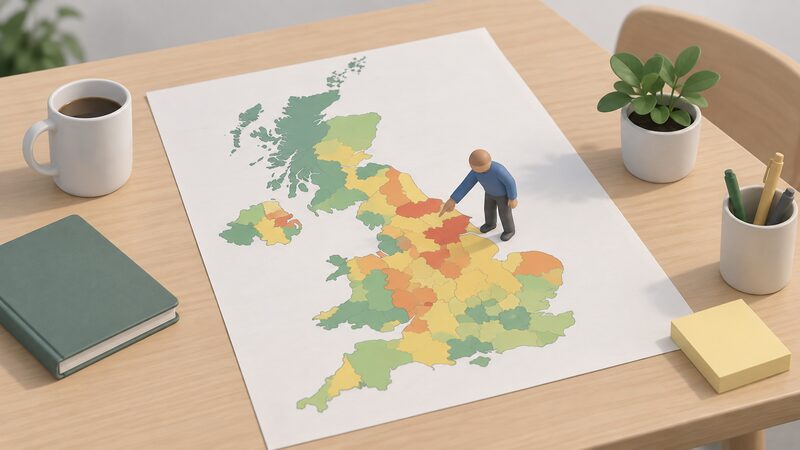
On the geography, the pattern is consistent across recent reporting. In 2026 the highest numbers of MCS certified renewable installations were registered in Cornwall, Somerset and North Yorkshire, while on installations as a proportion of households the leaders were Neath Port Talbot, Na h-Eileanan Siar and Midlothian3. Those two lists barely overlap, and the reason matters for anyone comparing councils: raw totals favour large, populous, house-dominated authorities, while uptake per household reveals where the technology has actually saturated the local housing stock.
For a household, this data does two things. It shows whether generation, heat and storage equipment is already common enough locally that installers, parts and experience are close at hand, and it shows what the certification trail behind each of those installations means if a system fails. The dependence that remains is real: the dashboard counts only certified work, MCS is one private certification scheme, and a certificate is a record of standards followed at design and handover rather than a guarantee of measured performance.
What the local authority data actually counts
The counts are built from installation certificates raised by MCS certified installers for each specific system they have delivered6. That is the unit: one certificate, one installation, attributed to the address where the system was commissioned, which is what allows the data to be aggregated to a council boundary.
The scope is deliberately narrow. MCS certifies, quality assures and provides consumer protection for microgeneration installations and installers, covering small-scale renewable electricity technologies such as solar photovoltaic panels, biomass, wind, heat pumps and heat products. For electricity-generating technologies such as solar PV the scheme's scope runs up to 50 kWe2. Anything larger, anything installed by a non-certified contractor, and any DIY work sits outside the figures entirely. A council area with a lot of uncertified or self-installed solar will therefore read low.
What the certificate carries also shapes what can be analysed: the type of system installed, the number of installations delivered under a government scheme, and the cost of the renewable technology7. That last field is why the dashboard can report installation cost and, since Phase 3, installed capacity alongside volumes5.
Two caveats belong on any local comparison. First, MCS data has been described as holding information on every installation that has received a government grant, which makes it strong on grant-supported work and weaker as a census of all renewable activity8. Second, a council-level count says nothing about size: 100 certificates for small solar arrays and 100 for whole-house heat pump retrofits look identical in a volume chart. Filtering by technology type is the only way to avoid that trap. For the wider national series, see the MCS installation statistics page.
What MCS is and why its records function as statistics
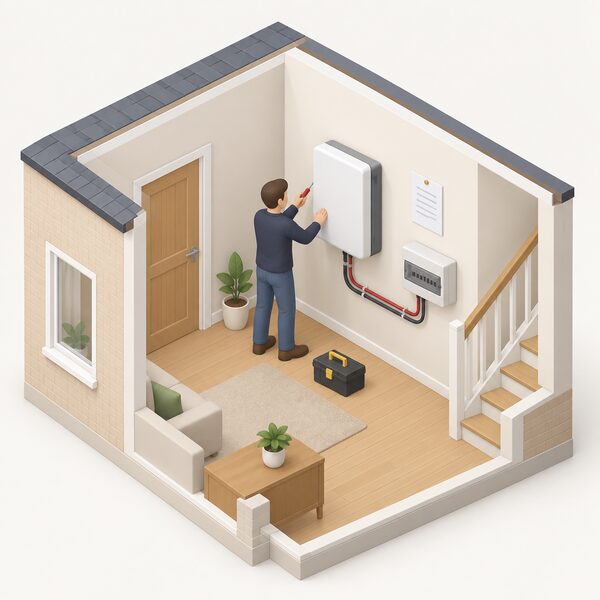
MCS is an independent certification scheme for microgeneration installation companies and products, aiming to ensure consistent standards and provide confidence to consumers9. Its roles include setting and maintaining technical standards for installations and products, certifying installers and products against those standards, issuing MCS certificates for completed eligible installations, and assisting certification bodies to review and address cases and consumer issues relating to installers or products9. It describes itself as a charity-owned company focused solely on improving quality and consumer protection10, and its product and installation standards are owned by The MCS Foundation and produced by MCS11.
Because certification is a precondition for several public schemes, the database became an administrative record of deployment rather than a survey. Government statistics now draw on it directly: the MCS certified domestic battery installation statistics are sourced from the MCS database and monitor the installation of domestic batteries recorded on the scheme, including capacity and cost12.
The scheme itself uses the data to track industry growth. Research bodies use it too: one Nesta analysis combined MCS records into a dataset of over 50,000 installations14.
Where installations are highest: Cornwall, Somerset and North Yorkshire
Cornwall and Somerset trade places depending on the technology and the period. On certified solar, MCS reported Somerset and Cornwall leading with 3,741 and 3,726 certified installations respectively for the year so far as at 13 November 202515. On heat pumps, an official ground source heating and cooling market review recorded the highest air-source heat pump installation counts by local authority as Cornwall (5,458), Highland (4,751) and Argyll and Bute (2,764), on data to March 202316.
North Yorkshire is the clearest example of depth rather than headline size. MCS reported in June 2024 that the area had surpassed 28,000 certified renewable installations, that 1 in 10 households there had an MCS certified renewable energy installation, and that over 1,300 certified installations had been delivered in the area in 2024 to that point17.
| Area | Measure | Figure | Period |
|---|---|---|---|
| Somerset | Certified solar installations15 | 3,741 | 2025 year to date, at 13 Nov 2025 |
| Cornwall | Certified solar installations15 | 3,726 | 2025 year to date, at 13 Nov 2025 |
| Cornwall | ASHP installations, MCS accredited16 | 5,458 | to March 2023 |
| Highland | ASHP installations, MCS accredited16 | 4,751 | to March 2023 |
| Argyll and Bute | ASHP installations, MCS accredited16 | 2,764 | to March 2023 |
| North Yorkshire | Certified renewable installations17 | over 28,000 | at June 2024 |
| Powys | ASHPs installed, MCS database18 | 1,396 | published Dec 2023 |
| Ceredigion | ASHPs installed, MCS database18 | 1,132 | published Dec 2023 |
The common thread is rural, off-gas-grid and detached housing with roof space and land. Cornwall, Highland, Argyll and Bute, Powys and Ceredigion are all sparsely populated authorities where mains gas is least available and where a heat pump replaces oil rather than a condensing gas boiler. That is the mechanism behind the geography, and it is explored further on rural versus urban renewable uptake.
Uptake per household reorders everything. Neath Port Talbot, Na h-Eileanan Siar and Midlothian came out on top in 2026 when installations were measured as a proportion of households3, and none of them appears in the raw-total top three. For a household judging whether local capability exists, the proportional measure is the more informative of the two.
How the nations compare
At regional level, official heat pump deployment statistics for the year ending June 2025 put the largest proportions of government-supported installations in the South West (15%) and South East (15%), followed by Wales (13%)19. A separate official press release in August 2026 gave the East Midlands 15,981 installations in the year to that point20.
The closed Feed-in Tariff scheme provides the longest-running national split, though it covers Great Britain only. Over the scheme lifetime, installations were 85.87% in England, 7.52% in Scotland and 6.53% in Wales21. Scotland's 65,432 accredited installations placed it only eighth regionally in terms of installations accredited under the scheme22. That is a snapshot of the subsidised solar era rather than current activity, and the Feed-in Tariff installation statistics page sets out the scheme's limits.
Current MCS reporting shows Scotland moving faster than those historic shares imply: MCS installers carried out over 20,000 installations in Scotland in 2026, up almost 8% on the same time the previous year3. Wales passed a notable threshold of its own, with MCS reporting more than 100,000 Welsh home and business owners turning to renewable energy1.
Northern Ireland is the weak point in almost every dataset on this subject. MCS is a UK-wide scheme and its dashboard covers each home nation1, but the FIT split above is a Great Britain series and many England and Wales analyses, such as the National Energy Efficiency Data-Framework impact tables, are explicitly limited to England and Wales. Separate treatment is on certified renewable installations in Northern Ireland, and the nation-by-nation comparison on which UK nation has the highest renewable uptake.
What the Data Dashboard lets you look up

The dashboard is an interactive online tool providing near-real-time updates on MCS certified installations for small-scale renewables across the UK, drawing data from the MCS Installations Database2. MCS describes it as a dynamic view of every certified installation since 2009, and elsewhere as holding the details of every certified installation since 200823.
It is divided into two sections, Installation Insights and Scheme Insights, and both can be filtered by month, year, location, technology type and installation type2. That filter set is what turns a national series into a local one: selecting a single authority, one technology and one year gives the figure a householder or a councillor is usually after.
Phase 3 went live on Monday 24 August 2026 and added three things5:
- a Capacity graph in the Installation Cost section, showing total installed capacity
- total installers by technology in the Technology Type Breakdown graphic
- unique identifiers and timestamps on downloads from the dashboard
The installer-count addition is the one that most changes what a local search can answer. Volume tells a household how many systems exist nearby; installer counts by technology indicate whether the supply chain to service them exists nearby too. A longer walkthrough sits on what the MCS Data Dashboard shows. Where the dashboard cannot answer a question, MCS operates a separate data request route6.
Record years: how the numbers have grown
The trajectory behind every local figure is steep. An MCS report noted over 1.2 million installations across 14 years, saving almost 10 million tonnes of carbon dioxide equivalent, and observed that 1.2 million installs over 12 years suggests a rate of 100,000 per annum24. By October 2025 the cumulative figure had passed 2.2 million certified installations, delivered by close to 6,000 certified installers10; a case study in August 2026 referred to over 2 million certified installations across the UK25.
Annual volumes are what moved. MCS reported that annual certified installations increased by more than 500% under Ian Rippin's leadership as chief executive, and that 2026 was already tracking to be the sixth consecutive record-breaking year for certified installations26. 2025 itself saw record numbers of certified installations, including 100,000 certified installations carried out on new homes in that year27. Battery storage is the fastest-moving category: official statistics record that MCS certified installations of domestic retrofit electric batteries have been increasing12.
Detail by technology sits on UK solar PV deployment statistics, UK heat pump installation statistics and home battery storage installation statistics.
Technologies covered by the count
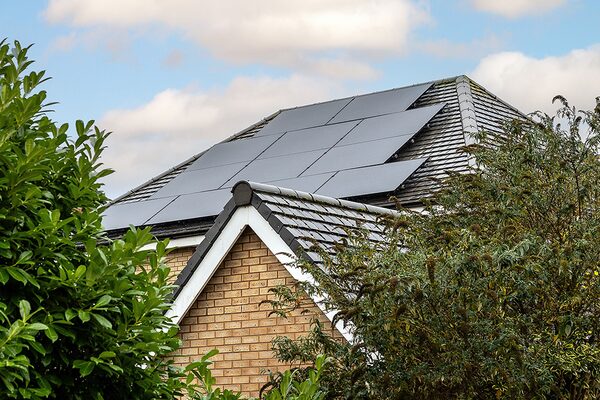
MCS product certification is available for solar PV, solar mounting, small wind turbines, heat pumps, biomass, solar heating and micro CHP28. MCS lists battery storage, biomass, micro CHP, solar heating and small wind turbines as additional technologies alongside the core categories6. In consumer-facing terms the scheme covers installations of small-scale renewables from solar panels to heat pumps to small wind turbines, in homes and small businesses throughout the UK25.
Air-to-air heat pumps are the notable gap. Warm Homes: Local Grant policy guidance published in July 2026 states that air-to-air heat pumps are not eligible for that grant until they are able to be certified by MCS, expected in 202629. A household installing an air-to-air system today will not appear in the local authority counts and will not access that grant route.
For battery figures, the cost value associated with each installation on the scheme includes the cost of the battery, the cost of installing and connecting it to the electricity supply, and VAT where applicable12. That is a fuller cost basis than a hardware price, which matters when comparing local average costs between areas.
What an MCS certificate means for the household
The certificate is a record that the installation was carried out by a certified installer using certified products, and it is required when accessing some grants and incentives30. Certified installers must follow the criteria set out in the MCS Installation Standards31, and for ground and water source systems must use MCS certified heat pumps that have been tested for quality, reliability and performance30.
The limits are set out plainly in official work. A report on the heat pump transition records that MCS requires installers to provide a design-stage prediction of system efficiency, not to verify actual performance, and that MCS does not require remediation of systems that are underperforming relative to their design32. The same report notes that weather compensation is not mandatory under current MCS requirements, that third party non-modulating controls are not prohibited, and that MCS specifies handover documentation but not the quality of verbal explanation, household understanding, structured follow-up or ongoing support32.
That is the honest reading of a certificate in the local authority count: it evidences a standards-compliant design and a compliant handover, not a measured outcome in the home. The gap between design and measurement is the subject of measured versus modelled home energy performance.
How certification links to grants
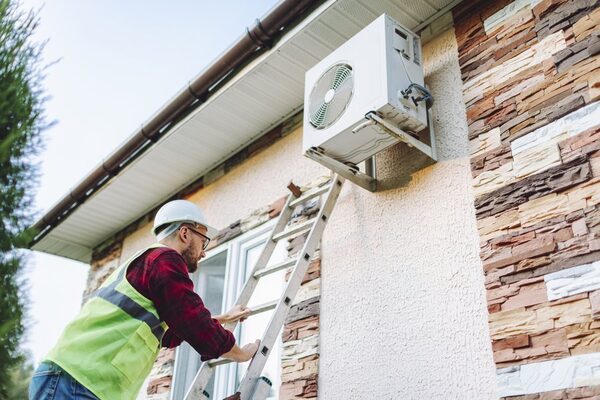
MCS certification is a requirement for accessing many UK government incentives23. Under the Boiler Upgrade Scheme, installers must be MCS certified and certified to install heat pumps and biomass boilers33. To access grants such as the Boiler Upgrade Scheme or Home Energy Scotland funding, the installer must be from an MCS-certified business34. Historic schemes worked the same way: installation contractors had to be certified by MCS and install MCS certified products to qualify for the Renewable Heat Incentive or the Green Homes Grant35.
This is the main reason local authority counts track grant activity so closely. Where a scheme is generous and locally promoted, certified volumes rise; where it is not, work either does not happen or happens outside the count. Scheme-level data is on Boiler Upgrade Scheme statistics and Renewable Heat Incentive statistics.
Certified installers must also explain how a grant or incentive the customer qualifies for is applied to the cost of the installation. Post-installation, MCS undertakes its own checks on installations completed by certified installers, separate from Ofgem's audit programme, and may contact the property owner directly or arrange a visit36; property owners are asked to respond within seven days where contacted for such checks.
If something goes wrong: complaints and consumer protection
Using an MCS certified installer gives a household a defined route if something goes wrong37. The installer must be approached first; MCS then acts as the single point of contact for complaints about certified installers or installations38.
MCS defines a complaint as:
"An expression of dissatisfaction, however made, about an installation, the standard of service, actions or lack of action by the installer, its staff, or those acting on its behalf, affecting a customer."
Complaints MCS will consider cover system performance and design, quality of work, incomplete installation, delayed installation, commissioning and handover, installer conduct, damage to property, mis-selling, contractual issues, issues with a product, and breaches of the MCS Customer Commitment38. During an investigation, MCS will speak to third parties on the household's behalf, carry out a technical review of the installation if needed, and work with the installer to reach a resolution40. It asks for details of what went wrong, photographic evidence, supporting documents, and willingness to engage and allow the installer access to remediate40.
Certified installers must acknowledge a complaint within two working days and respond effectively, give clear information on how to contact them with questions, concerns or complaints, and signpost customers to the MCS complaints process if they are unhappy with the outcome39. Details of a complaint are shared with the installer's certification body and, where applicable, its consumer code38.
MCS certified installers must also be registered with a consumer protection scheme such as RECC or HIES42, and membership of a CTSI Approved Consumer Code of Practice scheme is a requirement for companies seeking MCS certification in the first instance43. Contact points are the complaints address mcscomplaints@mcscertified.com44 and the telephone number 0333 103 813045; a separate line, 0333 103 8198, is used for routine post-installation verification carried out on behalf of Ofgem45. Where a complaint reaches an impasse, Ofgem's guidance is that a household can approach the MCS Administrator, who will advise how to make a complaint about the installer41. Whistleblowing reports, including an installation that does not meet MCS standards, use the same complaints mailbox44.
What the local picture means for energy independence

A high certified installation count in an area is a signal of installed generation, heat and storage capacity, and of a local supply chain able to deliver and service it. It is not independence on its own. Almost every counted system remains connected: solar PV exports to the grid and imports at night, heat pumps draw grid electricity, and batteries shift rather than remove supplier dependence.
The certification chain adds its own dependencies. The count exists because a private scheme issues certificates; grant access depends on that scheme's approval; remedy for poor work depends on the installer, its certification body and its consumer code remaining in business within the complaint window. The scheme is changing around households too: the redeveloped MCS installer scheme is being rolled out to thousands of businesses26, with rollout continuing over coming months27, and it introduces a legally binding commitment for installers to adhere to consumer protection law3. Government has also signalled a consumer protection service with powers to enforce better service through contracts holding installers and delivery partners to account, including bans from working on government schemes if they do not meet high standards.
Installer capacity is the constraint the geography exposes most sharply. A parliamentary committee reported around 930 air-source heat pump installation companies accredited by MCS, of which around 600 also install ground-source heat pumps46, against nearly 6,000 MCS certified businesses overall26. The same committee record noted a 65 per cent reduction in MCS accredited installers between 2014 and 201746, a reminder that the installer base has contracted before when policy support was withdrawn. In a council area with few certified heat pump companies, a household's practical choice is narrow regardless of how many solar certificates the area has accumulated. Broader context sits on what the data says about household energy independence and who publishes UK home energy data.
Sources46 cited
- More than 100,000 Welsh home and business owners turn to renewable energy, MCS, 2023-11-01
- MCS Data Dashboard, MCS, 2026-05-21
- Low Carbon Landscape 2026, MCS, 2026
- The MCS Data Dashboard one year on, MCS, 2023-11-07
- Phase 3 of MCS Data Dashboard launches, MCS, 2026-08-24
- MCS data requests, MCS, 2026-04-20
- MCS certificates: why data matters, MCS, 2025-03-11
- A calculator to estimate the cost of a heat pump, Nesta, 2025-06-30
- Boiler Upgrade Scheme, Ofgem, 2026-09-17
- MCS responds to consultation outcome on certification requirements for clean heat schemes, MCS, 2025-10-31
- Scheme governance, MCS, 2026-07-06
- MCS domestic retrofit battery installations 2025 to 2026, GOV.UK, 2026-05-28
- MCS certified domestic battery installation statistics, GOV.UK, 2025-05-29
- How to make heat pumps more affordable: assumptions and methods, Nesta, 2024-06-13
- UK rooftop solar installations hit record high, MCS, 2025-11-13
- Ground source heating and cooling: status, policy and market review, GOV.UK, 2024-09
- North Yorkshire advances in renewable energy installations, MCS, 2024-06-12
- ASHP noise and permitted development rights in Wales: phase 1 report, Welsh Government, 2023-12-13
- Heat pump deployment quarterly statistics, United Kingdom 2025 Q2, GOV.UK, 2025
- First regional solar breakdown as installations hit record highs, GOV.UK, 2026-08-27
- Feed-in Tariffs quarterly report, issue 64, Ofgem, 2026-06-29
- Feed-in Tariffs annual report, scheme year 13, Ofgem, 2023-12
- MCS for consumers, MCS, 2026-06-23
- Renewing Britain report, MCS, 2021-09
- Tomlinson Longstaff: powering the rooftop revolution in the North East, MCS, 2026-08-20
- Ian Rippin to step down as MCS CEO, Lisa Cooke appointed new Managing Director, MCS, 2026-07-07
- The Future Homes Standard: a landmark moment for the small-scale renewables sector, MCS, 2026-03-24
- Certifying your product, MCS, 2026-05-18
- Warm Homes: Local Grant policy guidance, GOV.UK, 2026-07
- Ground and water source heat pumps, MCS, 2026-06-09
- Why MCS certification matters, MCS, 2026-08-17
- Report on the heat pump transition, GOV.UK, 2026-05
- Boiler Upgrade Scheme guidance for installers v5.1, Ofgem, 2026-07-02
- How can I find a trustworthy installer, Nesta, 2025-01-21
- Register energy devices in homes or small businesses, GOV.UK, 2021-03-31
- Boiler Upgrade Scheme guidance for property owners v5.1, Ofgem, 2026-07
- Your renewable installation, MCS, 2026-08-03
- Consumer complaints, MCS, 2026-09-07
- Complaints handling for installers, MCS, 2026-05-13
- What to do if things go wrong, MCS, 2026-09-07
- Domestic RHI: who to contact, Ofgem, 2026-09-17
- Find a heat pump installer, GOV.UK, 2022-07-05
- Renewable Energy Consumer Code, Chartered Trading Standards Institute, 2026-09-20
- Whistleblowing, MCS, 2026-05-13
- Boiler Upgrade Scheme guidance for property owners v5 draft, Ofgem, 2026-03-25
- Environmental Audit Committee report, UK Parliament, 2026-09-20
 MCS Installation StatisticsHow many homes have had solar panels, heat pumps or batteries fitted by certified installers, and is that number still rising?
 Installation Cost TrendsTracks the published median and average installed costs of domestic solar, heat pumps and batteries and how they have moved.
 The Full Statistics GuideHow many homes in the UK have solar panels, heat pumps or batteries?
 Regional Energy ConsumptionHow much gas and electricity does your area use compared with the rest of the country?
 Baseline Your Energy UseBefore spending money on a heat pump, solar panels or a battery, you need to know what your home actually uses now.
 MCS ExplainedMCS is the quality mark for solar panels, heat pumps and other home renewables.