
In this answer
Short answer
An MCS umbrella scheme is an arrangement in which an MCS certified organisation, the umbrella operator, takes on the design, compliance and certification of a heat pump installation while a network of subcontractors carries out the work. The certification sits with the operator, not the firm on the driveway. MCS states that such arrangements can be compliant with MCS requirements if they are properly structured and managed1.
The distinction matters because the Boiler Upgrade Scheme is installer-led: MCS certified installers apply for and redeem vouchers on behalf of property owners2. Only Microgeneration Certification Scheme registered installers can access the scheme2. An umbrella scheme does not change that rule. It changes who holds the registration.
For a household, the practical consequence is that the company named on the MCS certificate is the umbrella operator, and that operator is responsible for the full scope of work carried out, not the subcontractors1. The sections below set out how the arrangement works, where it is compliant, who is liable, and how it interacts with grants and guarantees.
What an MCS umbrella scheme is
MCS itself is a certification scheme for microgeneration installation companies and products2. It is described by the Energy Saving Trust as a UK Government-backed quality assurance scheme that certifies renewable products and installers6. It is a voluntary certification scheme in the sector7.
An umbrella scheme is a particular way of organising work under that certification. MCS's own consultation findings describe umbrella schemes as operated by MCS certified organisations who typically complete the design and commissioning of a new system but subcontract all, or elements of, the installation of the system8. The same document notes that rather than directly employing its own personnel, an MCS Contractor appoints a network of subcontractors1.
The scope of work that can sit under an umbrella arrangement is broad. It may include site survey and sales activity, installation, commissioning, or a combination of these activities1. That breadth is what makes the model attractive to firms that have heating engineering skills but not the certification, the paperwork systems or the quality management that MCS requires.
The certification itself is not transferred. MCS certificates are raised by the umbrella operator1. The operator is the MCS Contractor of record, and the subcontractor network works under that registration rather than holding its own.

Who it is for: smaller installers without full MCS certification
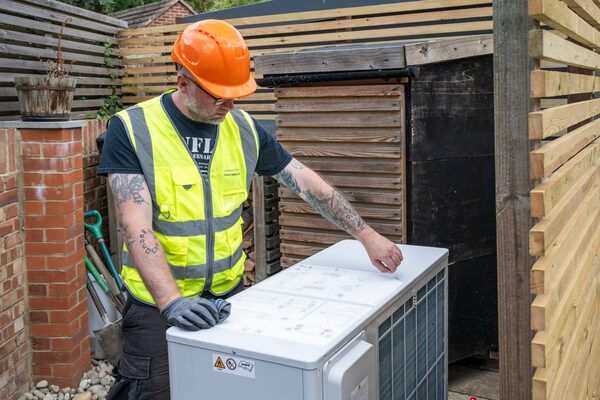
The model exists for businesses that want to install heat pumps and access grants without holding MCS certification in their own name. Maker guidance states that an MCS Umbrella scheme allows an installer to carry out heat pump installations and access grants for homeowners without the need to be MCS certified themselves9.
That is a significant commercial opening for gas boiler engineers and small heating firms. Baxi offers an MCS Umbrella Scheme for air source heat pump installers, described as taking care of MCS compliance for installers without MCS registration10. Worcester Bosch describes a third party MCS umbrella scheme in which the scheme handles design, training and MCS accreditation paperwork for businesses that are not MCS certified11.
The limits of the model are worth stating plainly. MCS certification covers microgeneration installation companies and products, and the installations that fall outside it include heat pumps installed with a thermal output larger than 45kW and the majority of installations in new-build properties12. For electricity-generating technologies such as solar PV, the scope covered by MCS is up to 50kWe13.
So the umbrella route suits domestic-scale retrofit work: air source heat pumps in existing homes, within the thermal output limit, where the household wants grant funding. It is not a route to certifying large commercial plant or most new-build work.
How it works: design, compliance and certification
The division of labour in an umbrella scheme is fairly consistent across the operators that publish details. The operator handles the technical and administrative core; the subcontractor handles the physical work.
Baxi's scheme states that it handles the design, paperwork and compliance10. Worcester Bosch's description of a third party umbrella scheme says the scheme handles design, training and MCS accreditation paperwork11. Baxi's installer-facing description of its umbrella scheme says the design, compliance and administration parts have all been taken care of9.
The most detailed published example is the Mitsubishi Electric and Alto Energy scheme. Under that arrangement, installers submit project details to Alto Energy, which then provides a bespoke system design and quotation. Once the installation is complete, Alto Energy commissions the system to MCS standards, provides sign-off and manages government grant applications where applicable15. Insurance-backed guarantee support is listed as part of the package15.
That sequence shows where the certification actually lives. The design is produced by the operator, the commissioning and sign-off are carried out by the operator, and the grant application is managed by the operator. The subcontractor's role is the installation itself, plus whatever survey and sales activity the arrangement covers1.
For a household, this means the technical accountability for system sizing, commissioning and certification rests with a company that may never send anyone to the property. The firm that does the physical work is a subcontractor to that company.
Compliance status: when an umbrella arrangement meets MCS requirements
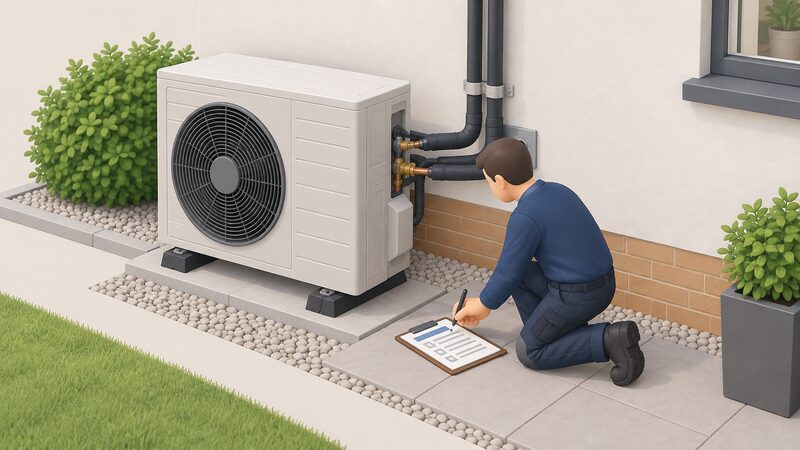
Umbrella arrangements are not prohibited, but they are conditional. MCS states that such arrangements can be compliant with MCS requirements if they are properly structured and managed1. The wording is deliberately qualified: structure and management are what separate a compliant scheme from an non-compliant one.
MCS has acted against installers that fell the wrong side of that line. It removed certification from non-compliant heat pump installers following an investigation, stating that the activity in question was not compliant with MCS Scheme requirements16.
The compliance framework has been tightening. MCS product certification ensures compliance with UK regulations17, and the scheme's consumer protection arrangements have been redeveloped, with MCS now managing complaints in-house and providing alternative dispute resolution where parties cannot reach a resolution18. The transition to the redeveloped Scheme runs to 31 March 20275.
Financial protection is part of the compliance picture. MCS deems the use of its approved financial protection products compliant under the current Scheme19. That matters for umbrella arrangements because the consumer's protection depends on the operator maintaining those products, not on the subcontractor.
"such arrangements can be compliant with MCS requirements if they are properly structured and managed."
Who is responsible for the work: the operator, not the subcontractor

This is the central fact of the model. The umbrella scheme operator is responsible for the full scope of work carried out, not the subcontractors1. The MCS Contractor that signs a contract with a consumer will be responsible at all times for fulfilling that contract and must create the MCS certificate on its own MCS user account3.
The subcontractor conditions are set out in the Renewable Energy Consumer Code. There must be a formal subcontract agreement in place between the parties, and the MCS Contractor must ensure the subcontractor has the capacity, competency and appropriate insurances3. Code Members must ensure that any subcontractor, third party, or person carrying out work on their behalf complies with the Code and MCS Installer Standards3.
An MCS Contractor is defined as an organisation certified under the MCS Installer Standards responsible for supply, design, installation, set to work, commissioning and handover of microgeneration systems and technologies3. That is a wide definition, and it is the operator that carries it.
There is a separate restriction on the Boiler Upgrade Scheme installer account. Additional users must be direct employees of the registered MCS installer, and not sub-contractors20. So while subcontractors can carry out installation work under an umbrella arrangement, they cannot be given access to the grant account itself.
Notification duties also sit with the certified party. Where responsible for notification under the Building Regulations, the MCS Contractor must ensure notification has been completed prior to handing over the installation21.
| Role | Who holds it | What it covers |
|---|---|---|
| MCS certification | Umbrella operator | Raised on the operator's own MCS user account3 |
| Contract with the consumer | Umbrella operator | Responsible at all times for fulfilling it3 |
| Design and commissioning | Umbrella operator | Bespoke design, commissioning to MCS standards, sign-off15 |
| Installation work | Subcontractor network | Formal subcontract agreement, competency and insurances required3 |
| Grant application | Umbrella operator | Managed where applicable15 |
| BUS installer account access | Direct employees only | Sub-contractors excluded20 |
Accessing grants: the Boiler Upgrade Scheme through an umbrella scheme
The Boiler Upgrade Scheme provides upfront capital grants to support the installation of heat pumps and biomass boilers in homes and non-domestic buildings22. It is installer-led: installers who are MCS certified can apply for and redeem vouchers on behalf of property owners2. Property owners considering installing a heat pump or biomass boiler can apply to the scheme through an MCS certified installer to help reduce the upfront cost23.
The certification requirement is absolute. Heat pump installations funded by the Boiler Upgrade Scheme need to be carried out by an MCS-certified installer24. The installer must be MCS-certified and the heat pump must be MCS-certified or certified to an equivalent scheme recognised by MCS. As one certification body puts it, no certification means no grant, full stop24. Installers must be MCS certified to deliver work under the BUS23, and all installations under the scheme must be MCS certified, meaning delivered by an MCS installer using MCS certified products and installed to MCS Standards25.
Under an umbrella scheme, the MCS certified installer is the umbrella operator. The household's route to the grant therefore runs through the operator, even though the installation was physically carried out by a subcontractor.
The application process itself is straightforward from the household's side. Contact suitable MCS certified installers, confirm eligibility, agree a quote, and the installer applies on the householder's behalf through Ofgem, which will then contact the householder to confirm the installer is acting on their behalf21.
Insurance-backed guarantees and what they cover
An insurance-backed guarantee provides a consumer with cover for an installation in the event that their MCS certified contractor ceases to trade during the term of the guarantee4. It is important for the contractor to pay for the policy at the point of registering the consumer's installation with MCS4.
In an umbrella arrangement, the MCS certified contractor is the operator. So the guarantee is written against the operator's continued trading, not the subcontractor's. If the subcontractor that did the work disappears, the guarantee is unaffected; if the operator fails, the guarantee is the mechanism that responds.
The Mitsubishi Electric and Alto Energy scheme lists insurance-backed guarantee support among its provisions15. MCS deems the use of its approved financial protection products compliant under the current Scheme19.
Householders should establish which company the guarantee names, and confirm the policy was paid for at registration. A guarantee that has not been paid for is not cover.

What this means for a household's energy independence

An umbrella scheme changes who a household deals with, not what the installation does. The heat pump still runs on electricity, still depends on the grid, and still needs a supplier. What the arrangement determines is who is accountable when something goes wrong, and whether the paperwork that underpins a grant and a guarantee is valid.
The independence the scheme delivers is procedural rather than physical. It widens the pool of firms able to install a certified heat pump, which matters in a market where the Government target reported by MCS is 600,000 heat pump installations a year by 202826. It also gives smaller heating firms a route into grant-funded work without building their own certification from scratch.
The dependence it creates is on the operator. The household's MCS certificate, its grant application and its insurance-backed guarantee all rest on one company's registration and continued compliance. That company may be a manufacturer, a distributor or a specialist scheme operator, and it may never attend the property.
For householders weighing an umbrella-scheme installation, the questions that matter are who is named on the MCS certificate, who signed the contract, who holds the guarantee, and whether the operator's certification is current. Those are the points where the arrangement's protections either hold or do not.
Sources26 cited
- MCS umbrella schemes, MCS Certified, 2021-01-27
- Boiler Upgrade Scheme, Ofgem, 2026-09-17
- Renewable Energy Consumer Code, RECC, 2026-07-01
- Insurance backed guarantee products, MCS Certified, 2026-05-13
- Redeveloped installer Scheme, MCS Certified, 2026-09-10
- Heat pump installation: a step by step guide, Energy Saving Trust, 2026-07-15
- MCS data requests, MCS Certified, 2026-04-20
- Findings of the umbrella scheme consultation, MCS Certified, 2021-12-15
- What is an MCS umbrella scheme, Baxi, 2026-09-17
- MCS Umbrella Scheme for air source heat pump installers, Baxi, 2026-09-17
- Heat pump funding for installers, Worcester Bosch, 2026-09-17
- Heat pump deployment quarterly statistics, UK 2026 Q1, Department for Energy Security and Net Zero, 2026-06-11
- MCS data dashboard, MCS Certified, 2026-05-21
- Should I be Gas Safe registered to install an air source heat pump, Baxi, 2026-09-17
- Mitsubishi Electric and Alto Energy launch scheme, Mitsubishi Electric, 2026-06-17
- MCS certification removed from non-compliant heat pump installers, MCS Certified, 2025-11-20
- Certifying your product, MCS Certified, 2026-05-18
- How MCS is transforming consumer protection for renewables, MCS Certified, 2026-09-10
- MCS approved financial protection products, MCS Certified, 2026-09-17
- Boiler Upgrade Scheme guidance for installers v5.1, Ofgem, 2026-07-02
- Building regulations and renewables guidance, Bedford Borough Council, 2026-09-17
- Boiler Upgrade Scheme quarterly report issue 17, Ofgem, 2026-08-31
- Boiler Upgrade Scheme installer guidance, MCS Certified, 2026-07-21
- What the Warm Homes Plan means for installers, Eurovent Certification, 2026-05-21
- MCS outreach reveals high satisfaction rates for Boiler Upgrade Scheme installations, MCS Certified, 2026-02-02
- Nesta report: how to scale a highly skilled heat pump industry, MCS Certified, 2028
 Installer QualificationsWhat training and qualifications should a heat pump installer actually have?
 MCS ExplainedMCS is the quality mark for solar panels, heat pumps and other home renewables.
 Standards and CertificationHow do you know a heat pump will really perform as promised?
 Buying Direct or Via InstallerCan you buy a heat pump yourself and still get the grant, or does it have to go through an installer?
 Manufacturer Approved NetworksDoes an approved installer badge mean better work, or just a longer warranty on the boiler or heat pump?
 Appliance Standards and MarkingWhich marks should a boiler, heat pump or cylinder have before you buy, and what do they actually prove?