

In this answer
Short answer
There is no national grant that pays for a household gas connection. The support that exists is general energy-bill help, and it is aimed at running costs rather than the capital cost of laying a pipe. The Utility Regulator in Northern Ireland publishes information on the help and support available for those worried about paying their electricity or gas bill1, and the Discretionary Assistance Fund in Wales provides an Emergency Assistance Payment to help pay for essential costs such as food, gas, electricity, heating oil or emergency travel2. Neither is a connection grant.
The one place the tax system touches a connection is narrow. Where a mains gas connection or reconnection is paid for under a grant-funded scheme, and the person qualifies, the supply is treated as grant-funded for VAT purposes3. That is a VAT treatment of a scheme that already exists, not a scheme in itself.
The connection charge itself is the household's cost. A new gas connection for a house or small business starts from £3,912 plus VAT on Wales & West Utilities4, and SGN's standard estimates for southern England run from £2,559 plus VAT where the customer digs the trenches to £3,336 plus VAT where SGN does, inside the M255. A standard connection typically takes 6 to 8 weeks from the point payment is made to the work being completed4.
What help actually exists for paying for a gas connection
The honest answer is that the help is indirect. Energy suppliers are expected to agree a payment plan, payment break or reduction with households that are struggling8, and that support is directed at the bill, not at a capital connection charge. The Energy Advice and Support Service offers help with energy bills and advice on how to stay warm and safe at home, and can also give advice about benefits and ways to increase income9, which is the route by which a household's overall capacity to pay a connection charge might change rather than the charge itself.
In Northern Ireland the Utility Regulator holds information on help and support for those worried about paying their electricity or gas bill1, and the Winter Fuel Payment is available to help pay winter heating bills10. In Wales the Discretionary Assistance Fund's Emergency Assistance Payment is a grant to help pay for essential costs, such as food, gas, electricity, heating oil or emergency travel2. Both are running-cost support.
The VAT point is the only measure that names connections. The treatment applies where the connection or reconnection is paid for under a grant-funded scheme3. A household that is not part of such a scheme gets no relief through this route.
What this means for independence is straightforward. A connection ties the household to a distribution network, a supplier and the wholesale gas market. The Energy UK spark gap, the ratio of the domestic electricity unit price to the gas unit price, was 4.7:1 between January and March 2026, meaning a unit of electricity cost almost five times a unit of gas11. That ratio is the financial case for connecting, and it is also the measure of what the household is exposed to when gas prices move. See where Britain's gas comes from for what sits behind the pipe.
What a new connection costs: from £3,912 plus VAT
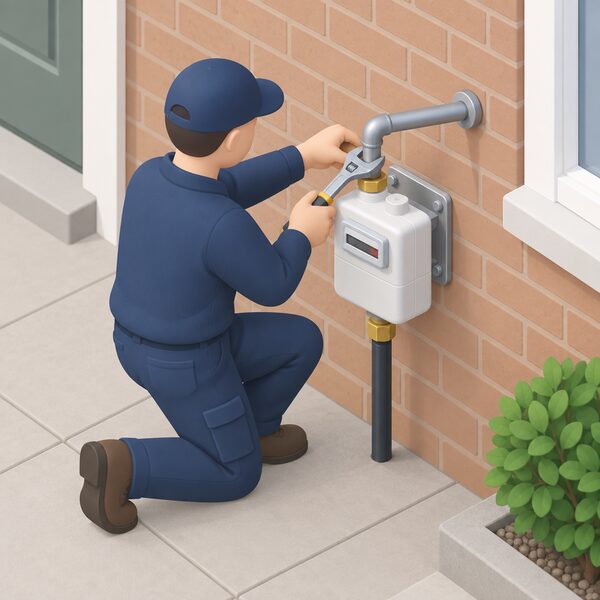
Prices are published as starting points and estimates, not fixed tariffs. Wales & West Utilities states that a new gas connection for a house or small business starts from £3,912 plus VAT4. SGN publishes standard quote estimates for southern England: £3,336 plus VAT if SGN digs the trenches and £2,669 plus VAT if the customer does, inside the M25; £3,198 plus VAT and £2,559 plus VAT respectively outside it5. Electricity North West, which covers a different network area, gives an average of £1,790 including VAT for one new domestic connection and a figure of £2,600 for others, covering multiple domestic and small commercial properties12.
Alterations are cheaper than new connections. Altering a domestic connection starts at £1,000 plus VAT on Wales & West Utilities13. SGN charges £222 plus VAT to refit the meter and reconnect meter outlet pipework in its southern England area14. Northern Gas Networks gives basic one-metre alterations starting from around £810 without digging and rising to £1,362 with digging, with each additional metre costing an additional £24 to £11415.
| Work | Published figure | Network |
|---|---|---|
| New connection, house or small business | from £3,912 plus VAT | Wales & West Utilities4 |
| Standard new connection, inside M25 | £3,336 plus VAT (SGN digs) / £2,669 plus VAT (you dig) | SGN5 |
| Standard new connection, outside M25 | £3,198 plus VAT (SGN digs) / £2,559 plus VAT (you dig) | SGN5 |
| One new domestic connection, average | £1,790 including VAT | Electricity North West12 |
| Altering a domestic connection | from £1,000 plus VAT | Wales & West Utilities13 |
| Meter refit and reconnect | £222 plus VAT | SGN14 |
| One-metre alteration | from around £810 (no digging) to £1,362 (with digging) | Northern Gas Networks15 |
The spread between these figures is not a disagreement about the same job. They are different networks, different regions and different definitions of a standard connection, and the SGN pair shows how much of the total is labour and reinstatement rather than pipe.
Quote options: who digs the trenches changes the price
The single biggest lever a household controls is who does the digging. SGN's two prices for the same standard connection differ by £667 plus VAT inside the M25 and £639 plus VAT outside it, purely on whether SGN or the customer excavates5. Electricity North West breaks its indicative costs down by share, with 40% attributed to digging work: excavation, replacement of ground materials and reinstatement16.
SGN publishes a guide to safe excavations for customers looking to dig their own trenches and restore the surface areas themselves after the network has completed its work17. That is the formal description of the self-dig option, and it carries obligations as well as savings.
The trade is time and risk against money. A household that digs its own trench takes on the excavation, the reinstatement and the risk of striking something, and the network's approval process still applies. A household that pays the network to dig avoids that exposure and pays the higher figure. Neither route changes the connection charge components that remain: the service cable, the meter and the work needed to connect directly to the network are still paid for by the customer, and a change to connection charging rules only removes the cost of wider reinforcement18.
What affects the price: distance from the main and groundworks
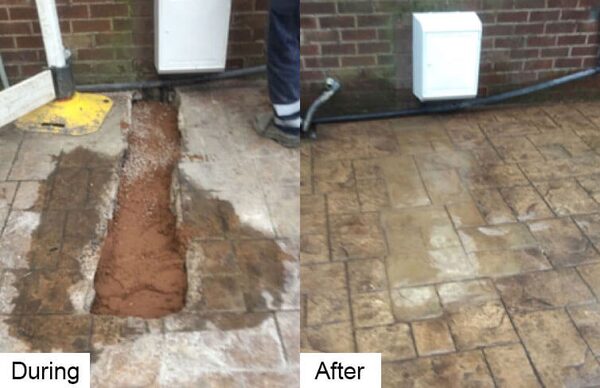
Wales & West Utilities states that the exact price depends on factors like the distance from the existing gas main and any groundworks needed, so the online figure is a starting point rather than a quotation4. Northern Gas Networks frames the same point differently: the cost is determined by the type of property being connected, the position of the nearest viable main and how much pipework is required to connect the property19.
Those three variables explain most of the variation between quotes. Distance from the main drives the length of service pipe. The type of property determines the size of the supply and the route the pipe can take. Groundworks cover what has to be opened and put back, which is where surfaces, driveways and planting all enter the price.
Meter box choice is not one of the variables on Wales & West Utilities: the cost will be the same irrespective of which meter box is chosen for the home6. Position is still constrained by the network's requirements and by where the service pipe can run, but on that network it does not move the charge.
For a household weighing independence, the price structure matters. A long run from the main is a cost paid once, and after that the household holds a connection it cannot take with it if it moves. The alternative, staying off the gas network, keeps the capital but leaves the household on whatever fuel it already uses. Heating oil and LPG supply covers the off-grid position.
Timescales: 6 to 8 weeks, up to 12 weeks or 90 days with a road closure
The standard figure is consistent across networks. A standard new gas connection typically takes 6 to 8 weeks from the point payment is made to the work being completed on Wales & West Utilities4, and Cadent gives the same 6 to 8 weeks from payment on average20. Northern Gas Networks states that connecting a new home may take between 6 and 12 weeks21.
Road closures are the main extension. Wales & West Utilities states that if it needs to close a road to do the work, it may take up to 90 days6. That is the outer bound a household should plan around where the service pipe has to cross or run along a highway.
The clock starts at payment, not at application. SGN states that once a quote is accepted it will be in touch within 7 working days to arrange the connection5, which is the planning stage rather than the work itself. Between quote, payment, planning and completion there are several points at which the household is waiting on the network rather than the other way round.
The network connects the pipe; a supplier installs the meter
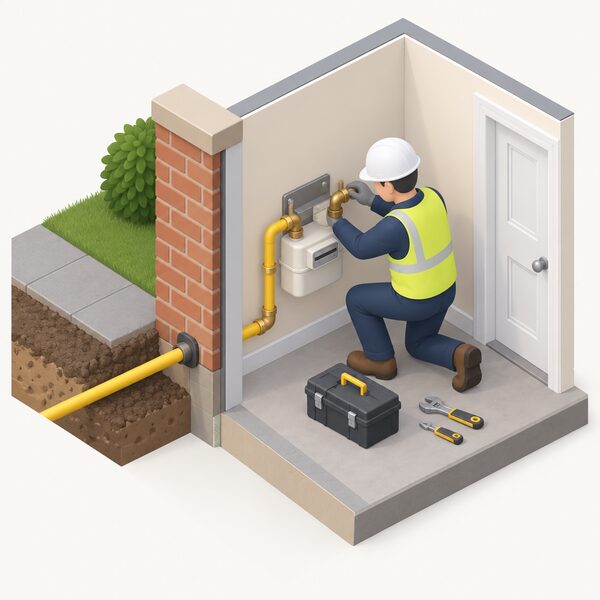
The gas distribution network owns and lays the pipe to the property boundary and provides the Meter Point Reference Number. The meter is a separate job. Wales & West Utilities states that once the connection has been paid for it will give the household a Meter Point Reference Number6, and Cadent provides the MPRN after the quotation is accepted, which is what is needed to arrange meter installation with an energy supplier20.
Northern Gas Networks is explicit that it does not supply gas meters and that the applicant must contact a preferred gas supplier to arrange meter fitting22. SGN states that for a new connection the customer must arrange for their energy supplier to install a gas meter23. The supplier owns the meter and the gas and is responsible for installation and maintenance of the meter and billing20, and is responsible for the meter and any faults on it24.
That split is the practical sequence: apply to the network, accept the quote, pay, receive the MPRN, then approach a supplier for the meter. The network's role ends at the pipe and the reference number.
For independence, the split is the point. The household can choose a supplier for the meter and can switch supplier later, but the pipe belongs to a monopoly distribution network and the gas in it is bought on a market the household does not control. Gas distribution networks sets out who owns the pipes, and getting a new gas connection covers the process end to end.
Sources24 cited
- Advice if you're struggling to pay your energy bills, nidirect, 2026-09-17
- Discretionary Assistance Fund, Welsh Government, 2026-09-17
- VAT energy saving materials and grant-funded heating supplies, HMRC, 2026-09-17
- New gas connections, Wales & West Utilities, 2026-09-20
- Apply for a new gas connection, SGN, 2026
- Connections FAQ, Wales & West Utilities, 2026-09-20
- Disconnection FAQs and guidance, Northern Gas Networks, 2025-10-30
- Getting help if you can't afford your energy bills, Ofgem, 2026-09-17
- Energy schemes: useful resources, Turn2us, 2026-09-20
- Winter Fuel Payment, nidirect, 2026-09-17
- Energy UK explains the spark gap, Energy UK, 2026
- How much will my new supply cost?, Electricity North West, 2026-09-20
- Make changes, Wales & West Utilities, 2026-09-20
- Alter your gas connection, SGN, 2026
- How to move your gas or electricity meter, Uswitch, 2026-08
- Indicative costs, Electricity North West, 2026-09-19
- Connections documents and charges, SGN, 2026
- Connection charging announcement FAQs, NIE Networks, 2026-09-20
- Gas connections, Wales & West Utilities, 2026-09-20
- New gas connection, Cadent, 2026-09-20
- Connections, NIE Networks, 2026-09-19
- Apply now, Northern Gas Networks, 2026-09-17
- Connections: how it works, SGN, 2026
- Emergency engineer visit, Cadent, 2026-09-20
 Getting a New Gas ConnectionHow a household applies for a new or upgraded gas connection, who carries out the work, the quotation and contribution rules, typical timescales, and what a connection means for a home's energy independence.
 New Electricity ConnectionWho do you contact for a new or upgraded electricity connection, and what will it cost?
 Disconnecting From the Gas GridThe practical route to removing a gas connection, including abandonment versus capping, who does the work, what it costs and the standing charge saved.
 Living Off the Gas GridNo mains gas at your home?
 Gas Distribution NetworksWho actually owns the pipes under your street, and who do you call when gas smells or the supply fails?
 Cost of Energy IndependenceA heat pump and better insulation are the usual starting point, but what does the whole job really cost, and what help is there with the bill?