In this guide
LONGi is one of the largest solar manufacturers in the world and one of the most commonly fitted module brands on UK roofs, though it rarely appears on the list of names a householder sets out to buy. The company specialises in high-efficiency photovoltaic products and renewable energy solutions across all market segments, and its latest-generation residential module is a bifacial panel with a maximum power of 760W and a maximum module efficiency of 24.47%1.
For a UK household, the practical question is not whether LONGi makes good panels, but what buying them means for control of your own electricity. A LONGi array generates on your roof and reduces what you draw from the grid, but it does not remove your dependence on a supplier, on the grid connection, or on the installer and manufacturer behind the warranty. The panels are made in China and internationally, and the company is headquartered in Yunnan, China, with factories in Kuching, Malaysia and Vietnam1.
This page sets out who LONGi is, what the range covers, how the efficiency and warranty figures compare with other brands sold in the UK, and what the brand means for a household's energy independence.
LONGi at a glance: scale, focus and bankability
LONGi's business is solar technology, high-efficiency photovoltaic products and renewable energy solutions for all market segments1. That focus matters for a household because it means the company's engineering effort sits in modules rather than spread across a wide electrical catalogue. The company has held the highest AAA rating in PV ModuleTech's bankability reports across multiple consecutive quarters, a measure that lenders and insurers use when assessing whether a manufacturer is likely to be around to honour a 25-year performance warranty.
The scale of the global supply chain behind a LONGi panel is worth understanding. Official consultation material notes that there is an abundant global supply of solar panels, and that China dominates solar PV manufacturing globally5. That concentration is why module prices have fallen so far, and also why a household buying panels is buying into a long international supply chain for parts, replacements and warranty claims.
For a UK buyer, the bankability question is the one that matters most over a 25-year horizon. A performance warranty is only as good as the company standing behind it, and the tier-one and bankability ratings used across the industry exist precisely to give buyers a way of judging that. LONGi's position at the top of those ratings is the strongest single argument for the brand, and it is a claim about the company's financial standing rather than about any individual panel.
Who LONGi is and where its panels are made
LONGi manufactures across state-of-the-art facilities in China and internationally1. Independent product research is more specific: the main manufacturing facilities are based across China, and the company also has factories in Kuching, Malaysia and in Vietnam3. Its headquarters are in Yunnan, China3.
That geographic spread has two consequences for a UK household. The first is supply: a global manufacturing base with multiple sites is generally more resilient to disruption at any one plant than a single-factory operation. The second is that there is no UK manufacturing of LONGi modules, so the panel on a British roof has travelled, and any replacement under warranty will travel too. That is a longer chain than a UK-assembled product, though it is the norm for the module market rather than an exception.
The company's own framing of its manufacturing emphasises rigorous quality standards and sustainability practices1. Independent survey work gives a sense of how the brand reaches UK roofs in practice: nearly half of those who owned LONGi solar panels in a Which? survey said they had chosen them as the only brand fitted by their chosen installer, and 10% chose it from a choice of brands or based on price6. That is a useful corrective to the idea that households pick a module brand deliberately. Most LONGi owners did not choose LONGi; their installer did.
The panel range: standard and custom solutions for UK roofs
LONGi sells standard solar panel setups for flat and pitched roofs, as well as custom solutions for more complex roofs6. That is a simpler product story than some competitors, and it reflects the fact that the company sells into the installation trade rather than running a consumer retail range.
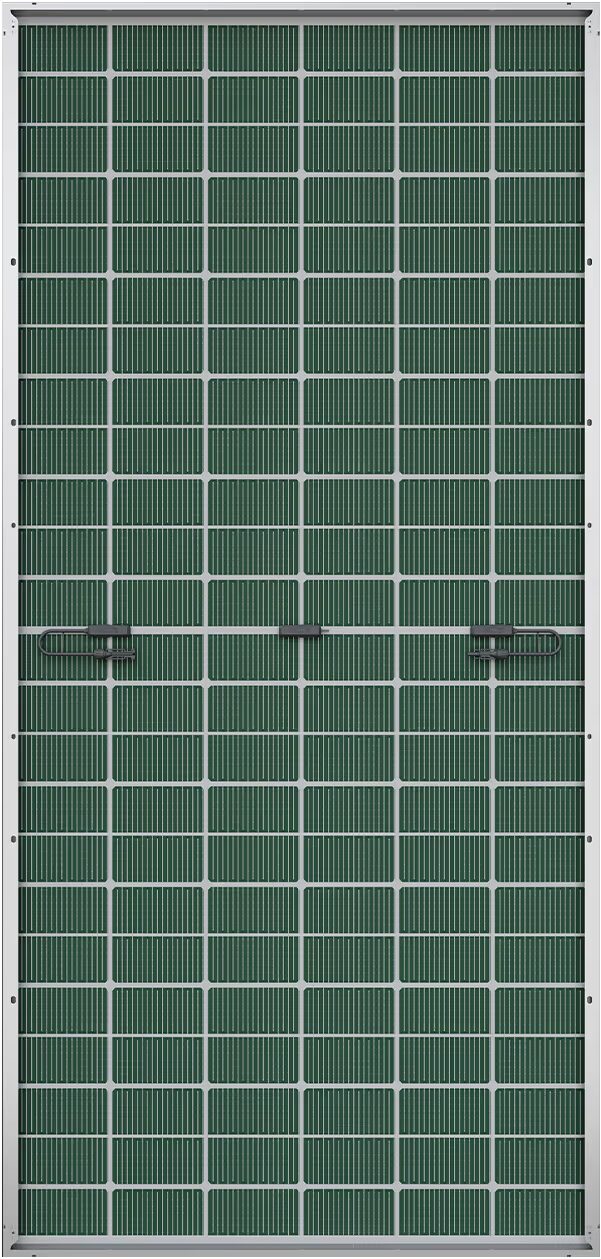
The latest-generation residential panel is a bifacial module using HPBC 2.0 back contact technology, with dual glass construction of 2.0 plus 2.0mm semi-tempered glass, a TaiRay wafer type, 66 cells, an anodised aluminium alloy frame in silver, and dimensions of 2384 by 1303 by 33mm2. It weighs 37.3kg2. Bifacial means it can capture sunlight from both sides, which is a genuine advantage on a flat roof or a ground mount where light reaches the underside, and largely irrelevant on a standard pitched roof mounted close to the tiles1.
| Specification | Latest-generation residential panel |
|---|---|
| Max power | 760W2 |
| Max module efficiency | 24.47%2 |
| Cell technology | HPBC 2.0 back contact2 |
| Bifacial or monofacial | Bifacial2 |
| Glass | Dual glass, 2.0+2.0mm semi-tempered2 |
| Cells | 662 |
| Dimensions | 2384 x 1303 x 33mm2 |
| Weight | 37.3kg2 |
| Frame | Anodised aluminium alloy, silver2 |
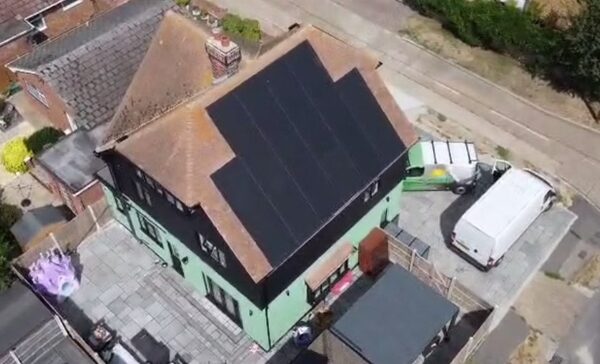
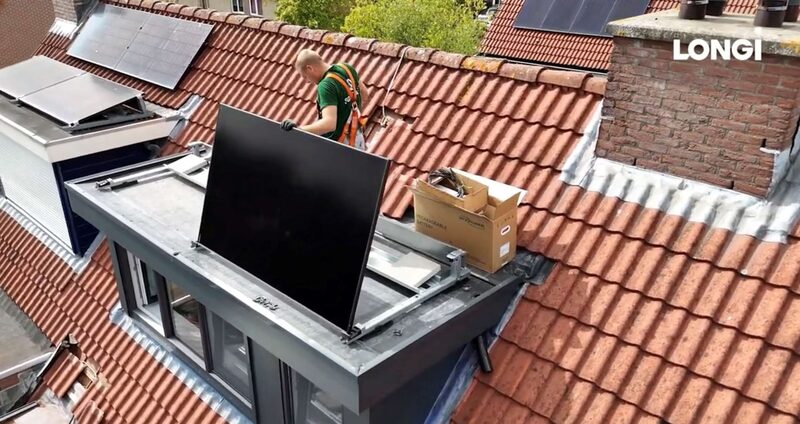
Roof suitability is not really a brand question. Independent guidance is that solar panels are suitable across the UK, and that the average UK home's roof slopes at 30 degrees7. Flat roofs work too: panels can be installed on flat roofs, normally tilted up to maximise production, though the job is more complex because panels may need additional mounting systems and the roof must support the extra weight, so it can cost more than a pitched installation4. On a pitched roof, official guidance is that panels should match the colour of the existing roof covering as closely as possible, and building regulations will normally apply to a roof-mounted installation10.
Efficiency: up to 23.5% in tested panels, with records beyond
The efficiency picture has two layers, and they are often confused. The first is what a UK buyer can actually have fitted. Independent testing found LONGi's most efficient recently tested panel at 480W and 23.5%3. The second is what the maker publishes for its current flagship: a maximum module efficiency of 24.47% and a maximum power of 760W on the latest-generation residential panel2. The gap between the two is explained by model generation and by test basis, not by a dispute.
For context, the same independent testing programme put Trina Solar at 450W and 22.5%, and JA Solar at 600W with a stated efficiency figure of 23.2%12. LONGi's tested figure sits above both, which is consistent with its positioning at the higher-efficiency end of the market.
Beyond the products on sale, LONGi has a long record of laboratory efficiency announcements. LONGi has demonstrated 31.1% efficiency for a small module, and in October 2024 reached a 25.4% world record module efficiency with its Hi-MO X10, having raised absolute cell efficiency by 1% between 2022 and 202414. These are research milestones rather than products a household can buy, and they are better read as evidence of engineering capability than as a specification for anything on a roof today.
What determines real-world output is not the headline efficiency figure but the installation. Orientation, pitch, shading, inverter choice and system design all shape what a roof actually generates. A 24.47% module on a shaded north-facing roof will underperform a lower-rated module on an unshaded south-facing one. Efficiency figures are a tiebreaker between panels, not a predictor of household generation.
Warranties: 25-year product and 25-year 92% output cover
LONGi's warranty terms vary by model and by document, and the honest position is that the published figures do not all agree. The maker's support pages describe a 12-year product warranty and a 25 to 30-year linear performance warranty, depending on the model1. The latest-generation residential panel page lists a materials and product warranty of 12 years and a linear power output warranty of 30 years2. Independent product research on the LONGi range describes a 20-year product warranty and a 25-year power output warranty at 92%3.
Those three sets of numbers cannot all describe the same product. The most that can be said with confidence is that the product warranty sits somewhere between 12 and 20 years depending on the model and the document, and the performance warranty runs 25 to 30 years. Where the figures differ, both stand.
For comparison, REC Solar's power output warranty is 25 years at 92%, and independent guidance describes well-known manufacturers as typically offering warranties of 25 to 30 years15. UK buying guidance describes solar panels as usually carrying a 25-year performance warranty and a five to 10-year product warranty, which puts LONGi's product term at the longer end of the market17. Most solar panels come with a 25-year performance guarantee18.
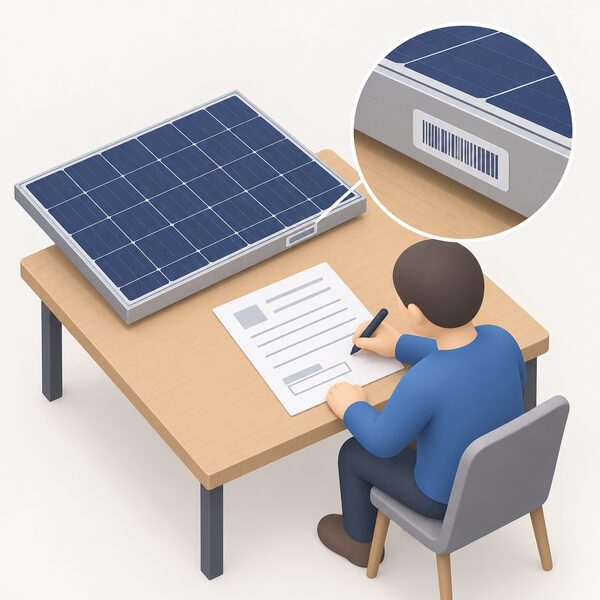
Registration is the step that makes any of this enforceable. As with any electrical appliance, a plug-in solar system should be registered with the manufacturer to activate any warranty and to be contacted about a problem or safety recall19. The same principle applies to a roof-mounted array: the commissioning paperwork and the serial number are what allow a claim to be traced to a specific module.
What LONGi panels mean for household energy independence
A LONGi array does one thing very well: it generates electricity on your roof, which reduces the units you buy from a supplier. Independent guidance puts a typical domestic system at around 4.5 kWp and around £7,600, and notes that a solar installation cuts a household's carbon footprint by 750kg a year in Great Britain and 550kg in Northern Ireland4.
What it does not do is make a home independent. The array still needs a grid connection to export to and to draw from at night, a supplier to bill the import and credit the export, and an inverter to convert the direct current the panels produce. The panels themselves are passive: they have no firmware, no app and no cloud dependency, which is a genuine advantage over battery and inverter equipment that can be orphaned when a manufacturer withdraws support. The dependence sits in the rest of the system, not in the module.
There is also a Northern Ireland dimension. Support for generating your own electricity differs across the UK, and households in Northern Ireland are directed to seek independent advice on solar panels, heat pumps and other efficiency measures from organisations that provide it21. Where a scheme or a grant differs between England, Scotland, Wales and Northern Ireland, the household's route to support differs with it.
The wider context is that solar has moved to the centre of UK energy policy. Industry bodies have described solar as being put at the heart of the response to the energy crisis, and government statistics show installations hitting record highs22. For a household, that means the regulatory and grid environment around a solar installation is more settled than it was, but it does not change the fundamental position: a LONGi roof lowers bills and emissions, and leaves the grid connection and the supplier relationship intact.
Sustainability and end-of-life: what the maker commits to
LONGi states that it is committed to green manufacturing, low-carbon innovation and social responsibility, and that its work is aligned with the UN Sustainable Development Goals1. It also states that it supports industry programmes that enable responsible end-of-life handling1. These are company commitments rather than independently verified outcomes, and they should be read as such.
The end-of-life question is more concrete than the sustainability language suggests. Independent guidance puts the average lifespan of solar panels before they show significant degradation at about 25 years16. Official guidance for domestic installations is blunt: solar panels should be removed as soon as they are no longer needed24. A LONGi array fitted today is therefore a 25-year commitment to a roof, followed by a decommissioning step that someone has to organise and pay for.
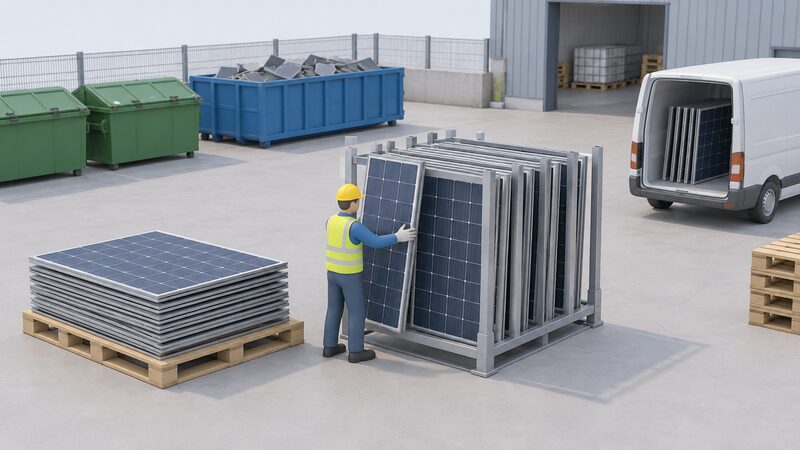
The practical point for a household is that end-of-life handling is not covered by the performance warranty. A warranty guarantees output while the panel is on the roof; it does not arrange removal. LONGi's stated support for industry programmes is a commitment to the principle, not a collection service. Households weighing a 25-year installation should treat removal and disposal as a cost to plan for, and should ask the installer what happens at the end of the system's life.
Choosing LONGi: what UK households should weigh
The case for LONGi rests on three things: efficiency at the top of the tested range, a bankability rating that supports a long performance warranty, and a product range that covers flat and pitched roofs without complexity. The case against is subtler. The brand is rarely chosen by the householder, the warranty documents do not agree with each other, and there is no UK manufacturing base.
On cost, the figures available are for domestic solar generally rather than for LONGi specifically. Independent guidance puts a typical 4.5 kWp domestic system at around £7,6004. There is no published LONGi list price for a UK installation, so quotes are installer-led and depend on roof type, scaffolding, inverter choice and whether a battery is included. A flat roof installation can cost more than a pitched one because of the additional mounting systems and the load assessment9.
The comparison set matters too. Independent testing places LONGi above Trina Solar and JA Solar on tested efficiency, and REC Solar carries a comparable 25-year output warranty at 92%3. LONGi's advantage is real but narrow, and the difference between a 23.5% and a 22.5% module is small next to the difference between a well-designed and a poorly-designed system.
For a household, the sensible sequence is to establish what the roof can take, what the installer is accredited for, and what the warranty registration route looks like, before comparing module brands at all. The module is one component in a system whose performance depends more on design and installation quality than on the badge on the frame. Households wanting to compare LONGi against the wider market can start with solar panel manufacturers, and those weighing the warranty terms specifically should read manufacturer warranties and registering a warranty.
Sources24 cited
- LONGi support and frequently asked questions, LONGi, 2026-09-17
- LONGi Hi-MO S10 residential module, LONGi, 2026-09-17
- LONGi solar panels review, Which?, 2026-08-12
- Solar panels advice, Energy Saving Trust, 2026-08-27
- Solar carparks and EV charging call for evidence, UK Government, 2025-05
- LONGi solar panels, Which?, 2024-04
- Solar panel installation, Energy Saving Trust, 2026-09-07
- Buying advice for solar panels, Which?, 2026-08-12
- Solar panel myths: five common concerns debunked, Which?, 2026-06-09
- Solar panels planning permission checklist, Islington Council, 2026-09-17
- Solar panels guidance, Islington Council, 2026-09-17
- Trina Solar solar panels review, Which?, 2026-08-12
- JA Solar solar panels review, Which?, 2026-08-12
- POST note on solar technology, UK Parliament, 2026-06-25
- REC Solar panels review, Which?, 2026-08-12
- How long do solar panels last?, Uswitch, 2026-07-13
- Buying a house with solar panels, Energy Saving Trust, 2026-08-13
- Solar panels, Uswitch, 2026-09-16
- Plug-in solar consumer guide, Electrical Safety First, 2026-08
- Energy saving upgrades for home renovation, Energy Saving Trust, 2026-05-05
- Support to generate your own electricity, nidirect, 2025-09-22
- Solar put at heart of response to energy crisis, Solar Energy UK
- First regional solar breakdown as installations hit record highs, UK Government
- Renewable energy planning advice, Rother District Council, 2026-09-17