
In this answer
Short answer
The short answer is that no evidence of harm to health has been found. Public Health England, the government's public health agency, carried out an extensive programme of research and found that smart meters are safe and pose no risk to public health1. Its published position is that "The evidence to date suggests exposures to the radio waves produced by smart meters do not pose a risk to health"2. The UK Health Security Agency, which inherited that work, is cited to the same effect3.
The reason the question persists is that smart meters do emit radio waves, and they do so from a box on the wall of the home. What the research measures is how much. Exposure to radio waves from smart meters is much lower than from other electronic appliances such as mobile phones and Wi-Fi equipment4, and the level produced is typically one million times less than guideline levels5. Public Health England's research confirmed exposure well below the guidelines set by the International Commission on Non-Ionizing Radiation Protection1.
For a household thinking about energy independence, the health question sits alongside a practical one: a smart meter is the device that turns consumption into data the household can act on, but it also depends on a communications network and a supplier to do so. The safety evidence is settled; the dependence is real and worth understanding.
What Public Health England and the UKHSA have found
Public Health England ran a two-part research programme rather than relying on modelling. The first phase measured exposure to radio waves from a selection of smart meter devices under laboratory conditions1. The results confirmed the agency's existing advice that exposure to radio waves from smart meters is well below the guidelines set by the International Commission on Non-Ionizing Radiation Protection1. The conclusion drawn from the programme as a whole is that smart meters are safe and pose no risk to public health1.
That finding is repeated across independent consumer guidance. Which? states that the evidence to date suggests exposure to radio waves produced by smart meters does not pose a risk to health7. The Energy Ombudsman quotes the same Public Health England position verbatim2. Smart Energy GB, the industry-funded body that promotes the rollout, reports that Public Health England sees no risk or dangers to health from smart meters, with radio wave exposure many times lower than from Wi-Fi and mobile phones and well within guideline levels9.
The UK Health Security Agency, which took over Public Health England's functions, is cited in supplier and manufacturer material as showing that smart meters are not a risk to health3. That is a maker's summary of a public body's work rather than the agency's own page, so it carries less weight than the Public Health England findings above, but it points the same way.
"The evidence to date suggests exposures to the radio waves produced by smart meters do not pose a risk to health."
The independence question is fair to ask, because Smart Energy GB is funded by the energy industry and has been criticised for its claims. In 2019 the Advertising Standards Authority banned a Smart Energy GB radio advert for making misleading claims that consumers could save money simply by getting a smart meter installed10. That ruling concerned savings claims, not safety, and the safety position rests on Public Health England's research rather than on any promotional body.
Radio wave exposure: how smart meters compare with everyday devices
The comparison that matters to most households is with the devices already in the home. Exposure to radio waves from smart meters is much lower than from other electronic appliances, such as mobile phones and Wi-Fi equipment4. Public Health England found that exposure to low-frequency emissions from smart meters is lower than that caused by appliances such as microwaves and televisions6. The same agency's advice, quoted in independent guidance, is that exposure from smart meters is many times lower than the exposure from Wi-Fi and mobile phones and is well within guideline levels11.
| Source of exposure | Level relative to smart meter | Who states it |
|---|---|---|
| Mobile phones and Wi-Fi equipment | Higher than smart meters | Public Health England, via independent guidance4 |
| Microwaves and televisions | Higher than smart meters | Public Health England6 |
| ICNIRP guideline levels | Smart meters typically one million times less | Public Health England research5 |
The pattern across every source is the same direction of travel: the meter is the smallest emitter in the comparison, not the largest. The reason is partly duty cycle. A smart meter sends readings automatically and wirelessly to the supplier at least once a month6, and in Scotland the same monthly pattern is described, with an in-home display and a secure data network doing the work12. A device that transmits briefly and infrequently produces far less cumulative exposure than a phone held to the head or a router running continuously.
Why smart meters use radio waves at all
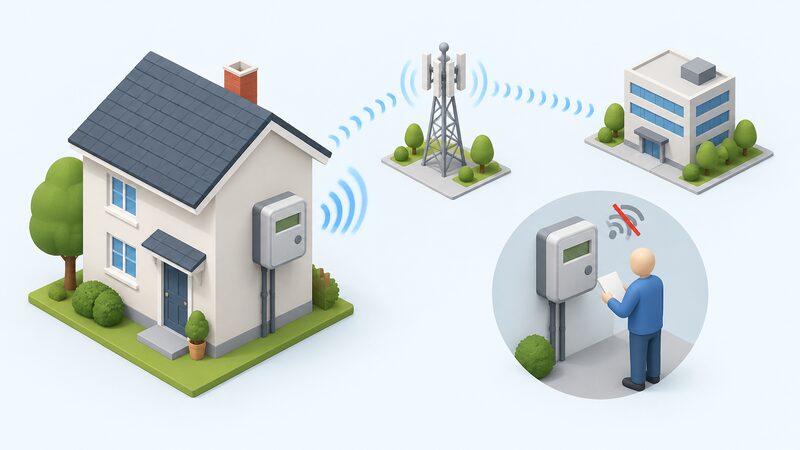
Smart meters use radio waves to send the information they collect to the supplier1. That is the whole purpose of the communications function: it allows remote readings to be taken from gas and electricity meters, so a household does not need to submit meter readings itself13. The alternative would be a meter that still requires a person to read it and a supplier to bill on estimates.
The radio link is also what makes the meter useful for anything beyond billing. A meter that reports at least monthly, and in practice far more often, is what allows time-of-use tariffs, demand flexibility schemes and accurate consumption data to reach the household at all. The communications function is therefore not an incidental feature bolted onto a measuring device; it is the part that turns the meter into an energy management tool.
That same function is the source of the dependence. A smart meter relies on the Data Communications Company network, and in some premises on the mobile network, to deliver its readings. Where a household cannot get or does not want a smart meter, a supplier may offer to install smart meter technology but disable the communications function, so it will not send readings automatically14. That option keeps the safety profile of the hardware while removing the radio transmission entirely, at the cost of losing automatic readings.
Safety standards, testing and the installation check
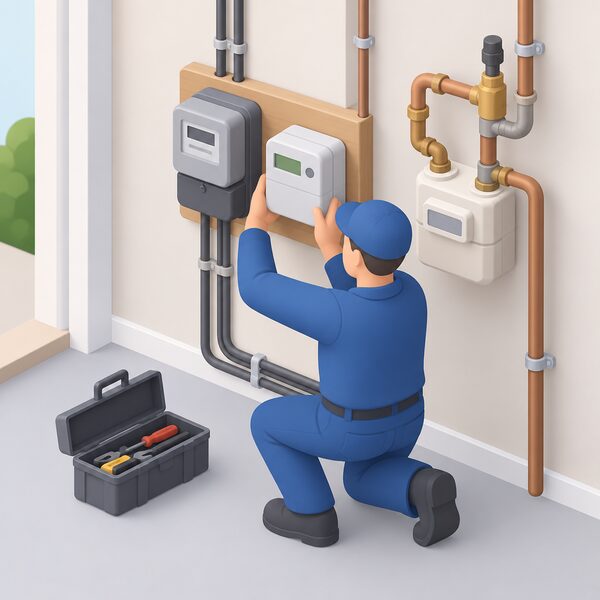
Smart meters used across Britain have undergone one of the most rigorous safety testing regimes in the world and are installed by trained professionals1. All smart meters meet safety rules for the UK and the EU15, and they exceed every UK and EU safety standard and must comply with the safety legislation set in Great Britain before installation16. The Department for Energy Security and Net Zero is cited saying that all smart meters are subject to the same safety regulations and testing as any in-home technological device, including baby monitors and mobile phones6.
The installation visit carries a second safety function. When installers come to a home to install a smart meter, they are also looking for potential problems with the electricity and gas supply, such as defective wiring, broken fuses or faulty boilers17. This is a free visual safety check, and from the start of 2017 to the end of December 2025, over 3,076,000 safety issues unrelated to smart metering were identified this way17. The safety checks performed during installation could also find other unsafe situations unrelated to smart meters16.
On the narrower question of what the device can do, smart meters were designed in consultation with the UK's top security experts and can only measure the amount of energy used18. A meter is a measuring and reporting device, not a monitoring device in the surveillance sense, which is relevant to the wider concern that sometimes attaches to the technology.
Can a household refuse, and what happens if it does
Installation is not compulsory. Smart meters are not compulsory and there is no obligation to have one installed6, and independent guidance confirms that if a supplier offers one, it can be refused19. The Energy Ombudsman states that while it is a household's right to refuse the installation of a smart meter, replacement options may be limited if a traditional meter needs to be replaced because it is faulty or unsafe2.
Where a meter is refused or cannot be fitted, the practical consequences are worth setting out plainly:
- The household keeps a traditional meter and continues to read it, or receives estimated bills.
- A supplier may offer smart meter technology with the communications function disabled, so no readings are sent automatically14.
- Older smart meters can go dumb, particularly older models, preventing automatic readings and requiring manual submission20.
- If a supplier goes out of business, a meter may not work in smart mode when the household moves to the new supplier, and readings may need to be taken and submitted manually21.
The rollout timetable is the backdrop to all of this. Energy suppliers are required to offer a smart meter to all households and small businesses by the end of 20308. The current framework ran from 1 January 2022 to 31 December 2025 as a four-year obligation on suppliers22. The obligation is on suppliers to offer, not on households to accept, which is why the refusal right survives the deadline.
Where the rollout stands, and what it means for a household
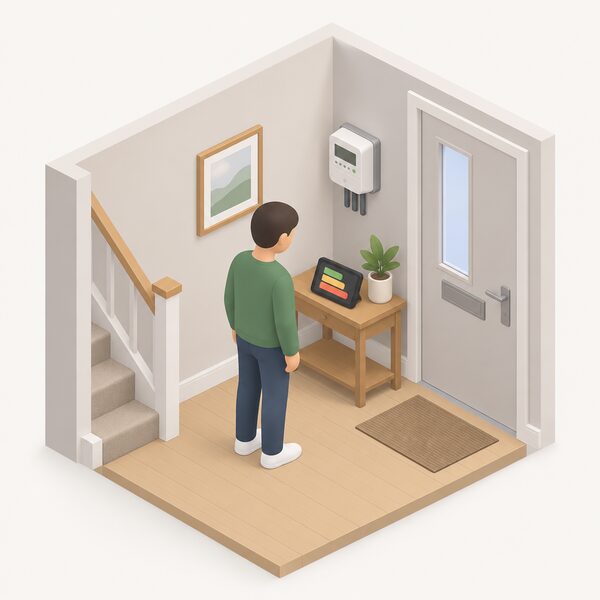
The rollout has been slower and less reliable than the timetable implies. By the end of March 2023, in England, Scotland and Wales combined, only 57% of all electricity and gas meters were smart23. As of March 2021 there were 24.2 million smart meters in homes and small businesses in Great Britain24. Around 10% of the smart electricity and gas meters in homes in England, Scotland and Wales were not working as they should, as reported in September 202425.
Smart meters are being offered to every household in England, Wales and Scotland26. Wales has its own government guidance on the choice27. Northern Ireland sits outside the Great Britain rollout and the sources here do not cover it, so a household there should treat the position as different.
For energy independence, the honest summary is this. A smart meter gives a household its own consumption data at a granularity that a traditional meter cannot, and that data is the foundation for tariffs, flexibility payments and any later decision about solar, battery or heat pump sizing. What it does not do is remove dependence: the meter depends on a communications network, on a supplier to receive and act on the readings, and on a data network operated by the Data Communications Company. The health evidence is not the constraint. The dependence is the trade, and it is a trade a household can decline.
Sources27 cited
- Smart meters and health, Smart Energy GB, 2026-03-16
- Smart meters, Energy Ombudsman, 2026-09-20
- Smart meters, Hive, 2025-12-18
- Myth busting smart meter problems, Smart Energy GB, 2026-09-17
- Smart facts, Smart Energy GB, 2026-03-16
- Smart meters explained, Uswitch, 2026-07-29
- Do I have to accept a smart meter?, Which?, 2026-05-12
- A guide to smart meters, Age UK, 2026-08-24
- Smart meters, Smart Energy GB, 2025-08-08
- Smart meter advert banned for misleading consumers, Which?, 2019-03-06
- Safety and security, Smart Energy GB, 2026-03-16
- Saving energy and money with smart meters, Home Energy Scotland, 2026-09-20
- Get help with your smart meter, Ofgem, 2026-09-17
- Radio Teleswitch Service switch-off, Energy Saving Trust, 2026-05-08
- What is a smart meter? Easy read, Smart Energy GB, 2026-03-16
- Smart meters are safe, Smart Energy GB, 2026-03-16
- Making your home safer, Smart Energy GB, 2026-04-01
- What is a smart meter?, Smart Energy GB, 2026-08-10
- Guide to smart meters, Energy Saving Trust, 2026-07-15
- How to read your gas and electricity meter, Confused.com, 2025-12-15
- What happens if your energy supplier goes out of business, Ofgem, 2026
- Supplier smart metering installation targets, Ofgem, 2026-09-17
- Public Accounts Committee report on the smart meter rollout, UK Parliament, 2023-03
- Smart metering, Parliamentary Office of Science and Technology, 2021-03
- Why smart meter customer service is falling short, Which?, 2024-09-23
- Meters, Age UK, 2026-09-10
- Smart meters, Welsh Government, 2026
 The Full Smart Meters GuideDo smart meters really save you money, and how do you use one to cut your bills?
 Can a Smart Meter Be Hacked?Can someone break into your smart meter, see your personal details or switch off your power?
 How a Smart Meter WorksHow a British smart meter measures gas and electricity, how the in-home display and the DCC's secure network fit together, what data leaves the house, what it costs, and where smart mode goes wrong.
 Meter Standards and AccuracyHow UK smart meters are certified for accuracy, how their readings become a bill, what happens when a meter stops communicating, and how a metering or billing dispute is escalated to a supplier and then to the Energy Ombudsman.
 Smart Meters in WalesCan you get a smart meter fitted free in Wales, and will it work if you live in a rural area or an older home?
 Smart Meter Data and Who Sees ItWhat does your smart meter actually record, and who gets to see it?