

In this guide
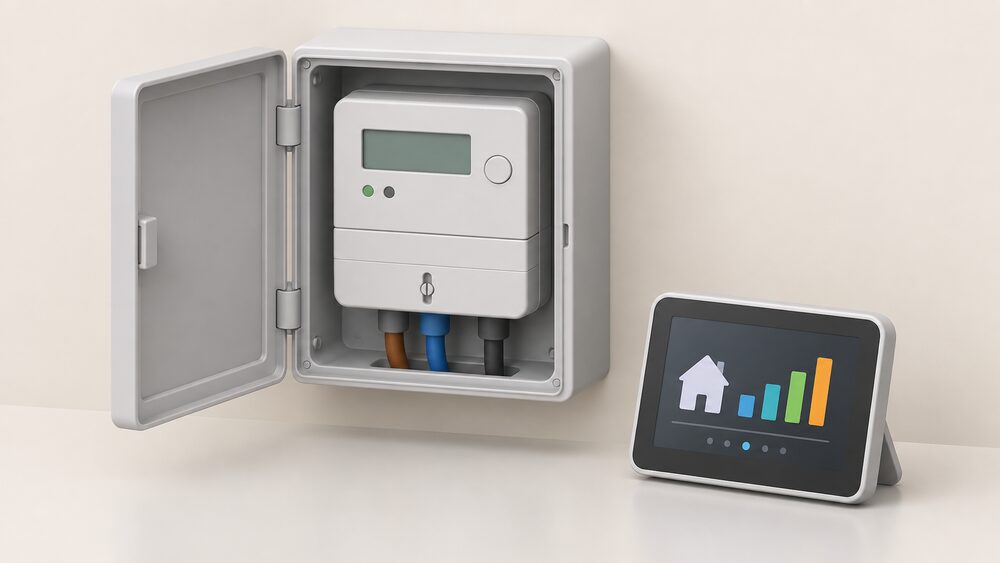
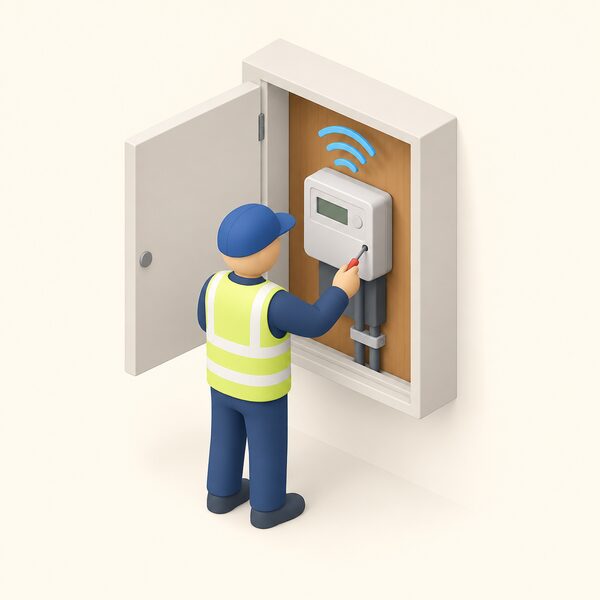
ScottishPower installs smart meters and in-home display units in customers' homes across Great Britain, at no extra cost to the customer1. The meter replaces both the gas and the electricity meter, sends readings automatically either half-hourly, daily or monthly, and comes with an in-home display so the household can watch consumption as it happens1. Installation usually takes around an hour per meter1.
The programme is part of the government's smart meter rollout, which seeks to install a smart meter in every home and small business across Great Britain4. ScottishPower's own published milestones show 334,147 new installations in total, alongside 959,340 SMETS1 replacements, split between customers on the Priority Services Register and those who are not5. The company states that there is no legal obligation to have a smart meter installed, and that it is the householder's decision unless the existing meter is faulty, at the end of its certified life, or affected by the Radio Teleswitch Service switch-off1.
For a household weighing energy independence, the position is mixed. A smart meter removes manual reading and gives the household its own consumption data at half-hourly resolution, which is the raw material for shifting load and for time-of-use tariffs. It does not change the fuel, the grid connection or the supplier relationship, and the meter itself depends on a mobile or radio signal to report. This page sets out what ScottishPower offers, the specifications, the warranty position, the cost, the company's status and what the arrangement means for independence.
What ScottishPower offers in the UK
ScottishPower's smart meter service covers every home and small business across Great Britain, which is the territorial extent of the rollout it describes4. The company installs both a gas and an electricity meter, but only one in-home display is needed to view usage for both services3. The meters are typically installed in the current location of the existing gas and electricity meters, so the visit is usually a swap rather than a re-siting3.
Eligibility is broad. ScottishPower states that almost anyone can get a smart meter, including renters and landlords, people living in flats, Pay As You Go customers and those on a two-rate tariff1. Prepayment customers can top up through the ScottishPower App rather than needing to visit a shop1. The company also sells Tado smart thermostats, smart radiator thermostats that control the heat in each room separately, and smart hot water controls, which sit alongside the meter rather than replacing any of its functions8.
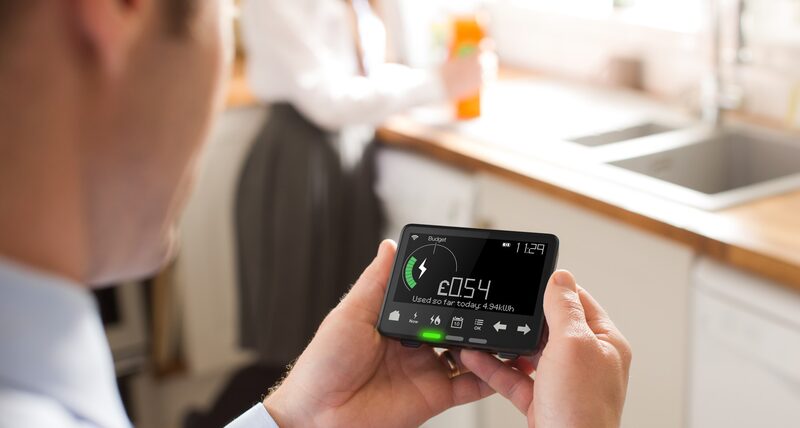
The in-home display is included as part of the installation, and ScottishPower describes it as allowing the household to monitor energy usage3. The display can be used to set energy saving goals and budgets9. Beyond the display, the household's data appears in the online account, where readings are received automatically in line with the meter read frequency selected10.
Two support routes exist for problems. ScottishPower's smart meter help pages are written for ScottishPower customers specifically, and non-customers are directed to contact their own supplier11. For faults, the company's troubleshooting guidance sits under its solving smart meter issues pages4. The company states that its smart people aim to answer calls within 3 minutes1.
Specifications: readings, communications and the display
The meter's core specification is its reporting frequency. ScottishPower states that the smart meter can provide half-hourly, daily or monthly readings, and that the household chooses which applies1. The meter sends readings automatically through the mobile phone network, and ScottishPower notes that estimates may occur if the signal is interrupted3. The company repeats the point elsewhere: there may be times when it is unable to communicate with the meter and would need to rely on an estimate12.
No internet connection is required. ScottishPower states plainly that you do not need to have an internet connection for smart meters to work, and that depending on location the meter communicates by mobile or radio signals3. That distinguishes the meter from the app and from any home energy management system built on top of it.
| Specification | Detail |
|---|---|
| Reading frequency | Half-hourly, daily or monthly1 |
| Communications | Mobile phone network, or radio signals depending on location3 |
| Internet required | No3 |
| Installation time | Around an hour per meter1 |
| Meters replaced | Both gas and electricity, one in-home display covers both3 |
| Installation location | Typically the current location of the existing meters3 |
| Manual readings | Still possible, at the householder's choice13 |
The meter can also be programmed to switch between peak and off-peak times, which ScottishPower describes as making it the only available replacement for a Radio Teleswitch Service meter12. That matters because the RTS signal was switched off across the UK on 30 June 2026, and ScottishPower urged affected customers to check their heating and book a free smart meter upgrade12.
Changing the read frequency has a limit worth knowing. ScottishPower states that moving from monthly to daily or half-hourly gives greater detail on graphs, but that historic consumption data from before the change cannot be repopulated at greater detail3. The detail is prospective, not retrospective.
Warranty, safety and what happens when something goes wrong
ScottishPower does not publish a household warranty term for the smart meter in the way a boiler maker publishes a guarantee. What it does state is that smart meters are covered under UK and EU product safety legislation, which requires manufacturers to ensure that any product placed on the market is safe3. That is a regulatory baseline rather than a consumer warranty, and it places the safety duty on the manufacturer rather than creating a repair or replacement promise to the household.
In practice, faults are handled through the supplier. ScottishPower's troubleshooting pages sit under its solving smart meter issues guidance4, and the company's general service standards are set by the energy regulator Ofgem, which ScottishPower acknowledges it must meet14. The Guaranteed Standards framework sets response times for certain supply failures, and the company also sends an Important Information leaflet with bills, in English and in Welsh, covering where to get impartial advice and what to do when moving home14.
For households on the Priority Services Register, ScottishPower offers frequent meter reading services as part of the support available15. The register itself carries no additional cost, and the company states that it offers a range of specialist services for no additional cost16. A UK-wide team of Community Liaison Officers is able to visit customers in their homes16.
If a household asks for the meter to be removed, ScottishPower states that you will not be charged, and directs the request to a specific contact number to arrange what happens next3. That is the clearest published statement on the end of the arrangement.
What it costs
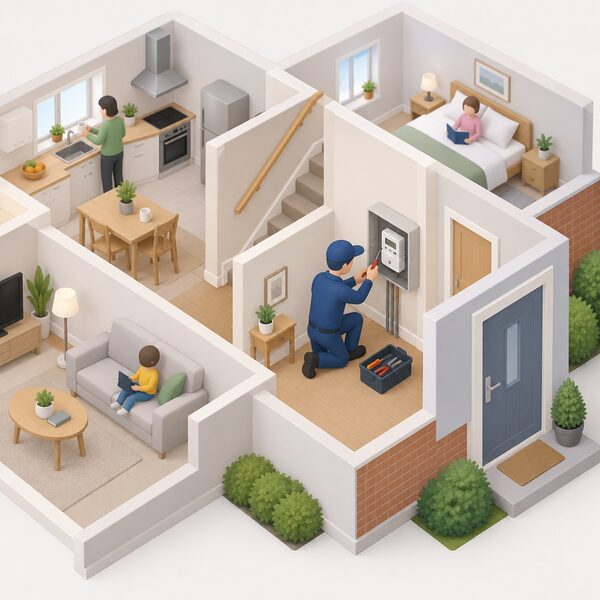
The installation is free. ScottishPower states that the installation of your smart meter is completely free3, and repeats across its pages that smart meters are being installed in homes across Great Britain at no extra cost to customers1. There is no published price for the meter, the display or the visit, because none is charged to the household.
The cost position on the bill is separate. ScottishPower states that your unit rate and daily standing charge will remain the same unless you switch tariff or are impacted by a price change1. So the meter does not itself change what a unit of electricity or gas costs, and it does not add a line to the bill.
Where cost does arise is in what the household chooses to do next. ScottishPower's Energy Insights product is available free of charge to smart meter customers who opt in to half-hourly data reads, though the company reserves the right to charge for it in future, eligibility criteria apply, and customers with a prepayment meter are excluded17. The company also acts as an introducer to Heatable for boilers, receiving a commission for the introduction, and acts as a credit broker rather than a lender on that route18.
Switching to ScottishPower is separate from the meter. The company states it can complete a switch in as little as five working days, that there is no need to contact the old supplier, and that there is no disruption to supply during the switch19. Customers can switch between ScottishPower tariffs at any time without paying exit fees20.
The company's status
ScottishPower is an established supplier rather than a new entrant. It states that for 30 years it has been working in the best interests of its customers, and it occupies the sixth and final spot in the UK's big energy suppliers list21. Its registered office is at 320 St Vincent Street, Glasgow, G2 5AD, and Andrew Ward is CEO UK Retail16.
The generation side matters to the independence question. ScottishPower states that it only generates renewable electricity, that all its domestic green tariffs are backed by 100% green electricity made by its windfarms in the UK, and that it has over 2,000MW of installed wind power capacity, enough to power over 1m homes16. It states a net zero target year of 205016.
On service quality, the independent picture is mixed. Citizens Advice records bills accuracy for smart meters at 97.55% for January to March 2026, and records smart meters working correctly as not available for the same period7. Which? gives ScottishPower a smart meters score of 4 out of 1022. Two independent sources give different contact waiting time ratings, 2.8 out of 5 and 4.0 out of 5, so neither should be treated as settled7.
ScottishPower's own published figures are more favourable. It reports that customers rate it 4.7 out of 5.0 in post-install surveys, and that its trusted partner engineers rate 4.9 out of 5.0, both covering March to September 20241. It also states it is the first energy provider to have Plain Numbers bill approval and that it aims to answer calls within 2 minutes23.
On its regulatory record, Ofgem's Smart Export Guarantee annual report for Year 5 records ScottishPower with 14,216 registered installations, 5.3% of the total, and notes that ScottishPower submitted its annual data after the 30 June deadline, recorded as an incident in the supplier performance report24.
What it means for energy independence

A smart meter changes what a household knows, not what it depends on. ScottishPower states that a smart meter can reduce your energy usage by up to 5%6. That is a maker claim, and it depends on the household acting on what the display and the app show. The Energy Saving Trust describes ScottishPower as installing smart meters and in-home display units in customers' homes as part of its energy advice work, which places the meter at the start of a behaviour change rather than as the change itself2.
The independence gain is data. Half-hourly readings let a household see when it uses power, which is the precondition for shifting load away from peak times and for using a time-of-use tariff. ScottishPower's Energy Insights, free to customers who opt in to half-hourly reads, is built on exactly that data17. The company also states that it will begin to collect half-hourly electricity consumption data from smart meters, with customers' permission, for the industry settlement process, and that it will write to customers to ask for that permission25. Half-hourly settlement is what allows suppliers to price and reward flexibility properly.
The dependence that remains is substantial. The meter reports over a mobile or radio network, so a signal gap produces an estimate rather than an actual reading3. The household stays on the grid and on a supplier, and the meter does not generate anything. Switching supplier can cost functionality: ScottishPower states that you may find you lose some of your functionality, for instance having to submit meter readings again, with detailed usage available only through the in-home display1. The app and the online account are the supplier's, not the household's.
"smart meters are the foundation of a smarter energy system, With the information they offer, they will help us better integrate renewable power such as wind, solar and hydropower and reduce reliance on fossil fuels"
For a household, the honest summary is that a ScottishPower smart meter is a free, low-friction way to get half-hourly visibility of its own consumption and to qualify for tariffs and reward schemes that pay for flexibility. It is not a step towards generating or storing energy, and it does not reduce reliance on the grid or on ScottishPower as a supplier. The pillar guide to smart meters and home energy management sets out where the meter sits in a wider system, and how smart meters work explains the communications chain in more detail.
Sources26 cited
- Smart meters, ScottishPower, 2026
- Scottish Power energy advice case study, Energy Saving Trust, 2025
- Smart meter FAQs, ScottishPower, 2026
- Solving smart meter issues, ScottishPower, 2026
- Smart meter annual milestones, ScottishPower, 2026
- Smart meters and energy efficiency, ScottishPower, 2026
- ScottishPower customer service details, Citizens Advice Scotland, 2026
- How to choose the best energy company, Which?, 2026
- Smart meter guide, ScottishPower, 2026
- Online account help, ScottishPower, 2026
- Meter FAQs, ScottishPower, 2026
- Meter upgrade, ScottishPower, 2026
- Get a smart meter, ScottishPower, 2026
- Standards of service, ScottishPower, 2026
- Energy for those with sight loss, Uswitch, 2026
- Treating customers fairly, ScottishPower, 2026
- Avoid surprise bills, ScottishPower, 2026
- Heatable boilers, ScottishPower, 2026
- Switching to ScottishPower, ScottishPower, 2025
- Our tariffs, ScottishPower, 2026
- Which energy suppliers are British?, Uswitch, 2026
- Which? energy survey results, Which?, 2026
- ScottishPower, ScottishPower, 2026
- Smart Export Guarantee Annual Report Year 5, Ofgem, 2025
- Smart data sharing, ScottishPower, 2025
- How to get a smart meter, Smart Energy GB, 2026
 ScottishPowerScottishPower is a big-six household supplier owned by Iberdrola, with 8% of the domestic electricity market, a Glasgow headquarters and a mixed customer service record.
 ScottishPower TariffsScottishPower sells fixed deals, a standard variable rate and a two-part Flexi tariff, plus SmartGen for selling solar power back.