

In this guide
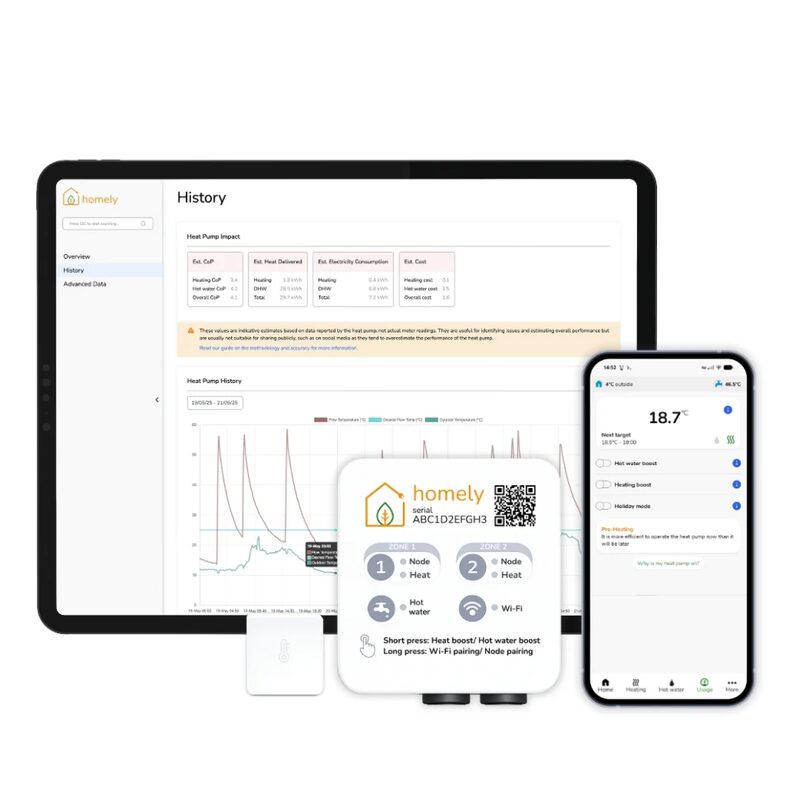
Homely is a smart thermostat built to be used exclusively with heat pumps, and it is approved under the ECO4 innovation route with ScottishPower named as the awarded supplier1. It does not replace the heat pump's own controls so much as sit above them: Homely itself only controls the heat pump, so any additional valves or pumps must be controlled by the heat pump for Homely to work2. That single sentence explains most of the compatibility limits on this page.
The controller's job is to adjust heating schedules, flow temperatures and hot water settings while the thermostat signals when heating is needed, and to do so against a time-of-use tariff3. It runs in three modes, Standard, Smart and Smart+, and the mode determines how much the controller decides on its own. It is not a universal fit: it is incompatible with hybrid and cascade systems, with Joule cylinders, and with Daikin heat pumps beyond a single zone2.
For a household, the independence question is sharp. Homely can cut the running cost of a heat pump by shifting when it runs, but it adds a permanent dependence on home broadband, on the maker's servers and on a smart tariff from an energy supplier. It optimises a heat pump; it does not remove the need for one, for electricity, or for the grid.
What Homely is and what it controls
Homely is a control layer for a heat pump, not a boiler thermostat. The measure approved under ECO4 is described as a smart thermostat designed to be used exclusively with heat pumps, which is a narrower brief than most smart heating products carry1. Where a general smart thermostat might be marketed as working with both boiler and heat pump systems, Homely is specified for heat pumps alone1.
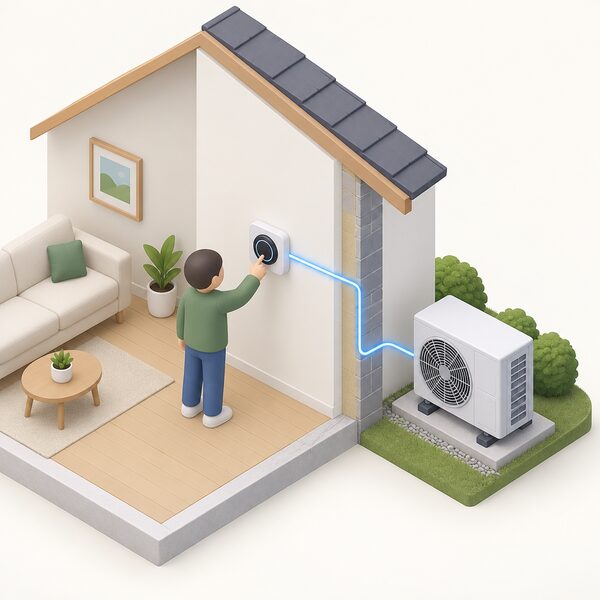
The division of labour matters. Homely itself only controls the heat pump, so any additional valves or pumps must be controlled by the heat pump for Homely to work2. In practice that means the heat pump's own controller has to be capable of managing zone valves, diverter valves and secondary pumps, with Homely setting the targets and the heat pump executing them. A household with a complicated hydraulic layout, several zones or a separate hot water circuit should expect the heat pump's own controls to remain in charge of the plumbing.
The technology has also been adapted for lower-income and vulnerable users. A custom version of Homely's heat pump smart optimisation technology was created for the Inclusive Smart Solutions programme, dynamically adjusting flow temperatures for that group5. The same optimiser was trialled in that programme, which was aimed at low income and vulnerable users6. That is a useful signal about the design intent: the product is built to reduce running cost automatically rather than to hand a household a dashboard of settings to manage.
The three modes: Standard, Smart and Smart+
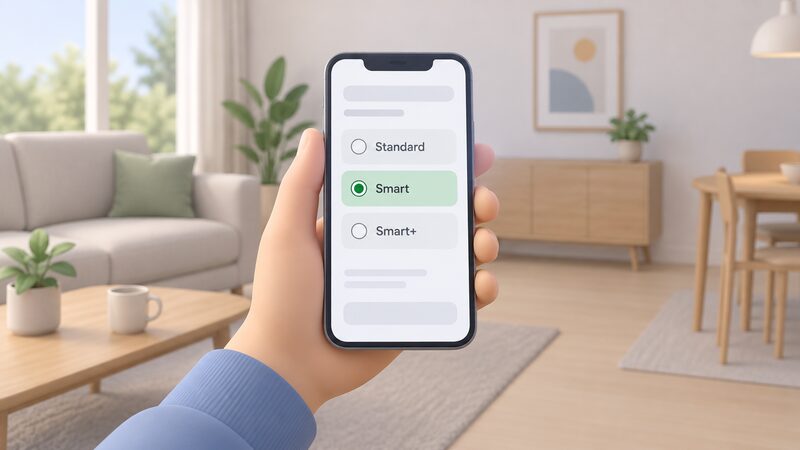
Homely runs in three modes, and the mode is the main decision a household makes about how much autonomy to hand over.
| Mode | What the controller does |
|---|---|
| Standard | Holds the settings it has been given, closest to a conventional thermostat2 |
| Smart | Adjusts flow temperatures and scheduling in pursuit of efficiency2 |
| Smart+ | Aligns operation with tariff prices as well as with demand2 |
The distinction matters because a heat pump's efficiency depends on system design, operating temperatures, building fabric performance, emitter sizing, controls strategy and commissioning quality7. A controller can only act on the parts of that list it can reach: operating temperatures and controls strategy. It cannot change the fabric of the house or the size of the radiators. Smart and Smart+ modes are therefore best understood as squeezing the available efficiency out of a system that has already been designed and commissioned, rather than as fixing a system that was sized or set up badly.
The installer's role in setting the baseline is explicit in independent guidance: the installer should set the heat pump to work as efficiently as possible and leave an information pack with instructions on how to adjust the more common settings on the heat pump8. Homely's modes sit on top of that baseline. A household that changes mode is changing how aggressively the controller intervenes, not overriding the commissioning.
How the optimisation works: prices, forecasts and learning
The optimisation rests on three things: half-hourly or time-of-use prices, a forecast of what the home will need, and a model of how the specific heat pump and building respond. Independent guidance describes the category plainly: there are apps and thermostats available that automatically optimise your heat pump's schedule with your energy tariff9. Smart heating controls more generally are described as automatically optimising your heating settings to save you money and energy10.
The evidence base for this kind of control is being built in real homes. The Energy Systems Catapult Living Lab relays controls to EVs, heat pumps and batteries to test optimisation algorithms in real homes11. The same organisation ran the Inclusive Smart Solutions programme in which the Homely heat pump optimiser was trialled6. That is a testing environment rather than a product guarantee, but it is the kind of evidence that separates a controller with a measured trial behind it from one with only a marketing claim.
Official analysis points the same way. Digitalisation and integration of control systems to enhance system optimisation, inclusive of the use of AI, is identified as an innovation need for heat pumps over 2025 to 2030, alongside cost reduction and barrier reduction12. Automated controls that optimise performance are also named as a feature to look for in the wider controls market13.
What the controller is doing, in plain terms, is deciding when to run the heat pump harder and when to let the building drift. Independent advice on heat pump operation recommends using a setback temperature, a slightly lower setting during off peak hours, which can save energy without reducing comfort3. That is the mechanism a tariff-aware optimiser automates: pre-heating before a price rise, easing back during an expensive period, and holding comfort within a band rather than chasing a fixed setpoint.
Savings: what Homely can and cannot optimise
The savings case for a heat pump optimiser is real but bounded, and it is worth being precise about which parts of a bill it can touch.
- Can shift: electrical demand into cheaper periods, and flow temperatures to keep the heat pump condensing3
- Cannot change: the heat loss of the building, the size of the radiators, or the price per unit the supplier sets7
Independent analysis of smart tariffs and low-carbon technologies looked at over a million heat pump, tariff and technology combinations, and concluded that there are tariffs available now that can unlock these kinds of savings14. That is a statement about tariff and technology combinations generally, not a figure for Homely specifically, and no verified percentage saving for Homely is available here.
The wider cost picture is sobering. Official analysis states that large cost reductions are unlikely for domestic heat pumps15. That is about the technology as a whole rather than about controls, but it sets the frame: a controller that trims running cost is working at the margin of a system whose capital and running costs are dominated by other factors.
Tariffs: any tariff works, smart tariffs work best
Homely will run on any tariff, but the optimisation is built around price signals, so a time-of-use tariff gives it more to work with. The enabling piece is the meter. A smart meter allows a household to access more flexible tariffs, including dual-rate tariffs16. Without one, the tariff options that make a heat pump optimiser worthwhile are largely closed off.
There is a limit on what any household controls here. Except by switching, you do not control the tariff your energy supplier sets, though you can change how much energy you use17. A controller sits on the second half of that sentence: it cannot change the price, only the timing and quantity of consumption. Smart meters are also described as supporting automated controls that optimise performance, which is the function Homely performs13.
On a flat single-rate tariff, the optimiser's room to manoeuvre narrows to weather compensation and flow temperature management. On a dual-rate or dynamic tariff, it can move load between periods. The practical position is that Homely works either way, but the case for fitting it is strongest where the household already has a smart meter and a tariff with more than one price.
More on how controls interact with pricing is set out in heating controls and time-of-use tariffs.
Compatibility limits: hybrid, cascade, Joule cylinders and dual-zone
The compatibility list is short and firm.
| System | Homely compatibility |
|---|---|
| Single heat pump, single zone | Supported2 |
| Hybrid heat pump and gas boiler | Not compatible2 |
| Cascade of multiple heat pumps | Not compatible2 |
| Joule cylinder | Not compatible2 |
| Daikin heat pump, dual zone | Single zone only2 |
Each of those limits has a reason behind it. Hybrid systems pair a heat pump with a gas boiler, and there is currently no agreed control specifications or inclusion of hybrid control systems in standards18. A controller cannot optimise a hybrid reliably when the control layer for hybrids is not standardised. Hybrid heat pumps can work with another heating system in a building, such as a gas boiler, but the control arrangements are less settled19.
Cascade systems, where multiple heat pumps run together, are outside Homely's scope. For grant purposes a BUS eligible heat pump can be up to 70kWth when installed as a cascade system, so cascades exist in the domestic and small commercial space, but they are not a Homely application20. Integrated fossil fuel hybrid systems are also ineligible for BUS, and integrated and compact hybrids where the heat pump and gas boiler components sit in a single unit are not eligible measures because they contain a new gas boiler21.
The Joule position deserves care. Homely is not compatible with Joule cylinders2. Joule's ModulAir heat pump has been the subject of a product safety alert: the product does not meet the requirements of the Electrical Equipment (Safety) Regulations 201623. It is a domestic ModulAir heat pump system, installed in domestic settings, and categorised as a domestic heating heat pump system23. A household with that equipment has a safety question to resolve before any controls question.
Installation: distributors, installers and the WiFi requirement
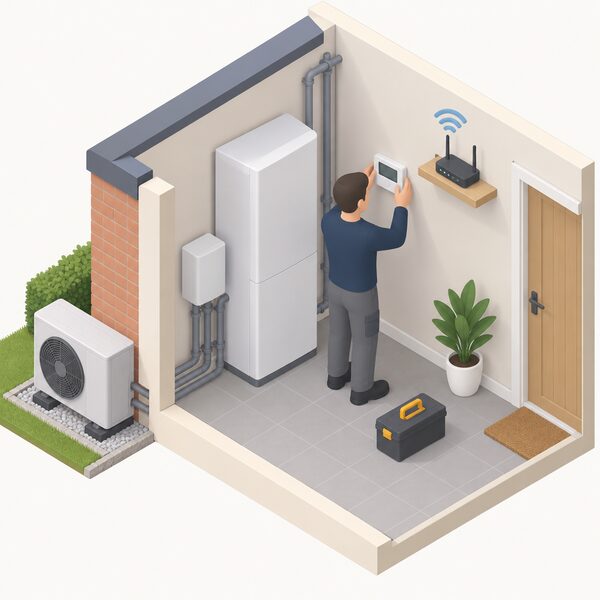
Homely must be installed with WiFi or a second mobile device providing a wireless hotspot2. The ECO4 measure specification is stricter still: the measure must only be installed where the homeowner already has a WiFi connection1. That is a condition of the approved measure, not a preference.
Installation is a trade task rather than a DIY one. The installation of heat pumps and associated heating systems is work covered by building regulations and should only be undertaken by competent technicians that have undertaken appropriate training and assessment25. It is advisable to contact an installer who can provide the necessary advice, preferably one who belongs to either the Microgeneration Certification Scheme or the relevant Competent Person Scheme26. For grant-funded work, the installer applies for the grant on the householder's behalf through Ofgem, and quotes come via the MCS find a heat pump installer tool or an energy supplier27.
The installer also handles the notification side. Your installer should help with informing your local district network operator that you are planning to install a heat pump, and will often complete the relevant forms for you28. Support is also available for installers and manufacturers to expand supply chains, which is where availability of controllers and components is being addressed15.
Roadmap: Solar Sense, batteries and the wider energy dashboard
Homely has announced Solar Sense, a feature for homes with solar panels that helps them use their own generation29. That extends the controller's logic from price signals to self-consumption: instead of shifting load to cheap periods, it shifts load to periods when the roof is generating. For a household with panels, that is a different and often better objective, because self-consumed generation avoids both import and export pricing.
The wider context is a grid and market being reshaped around flexibility. Streamlining the grid connection process for solar and making the solar supply chain resilient, diverse and sustainable are both named actions in the solar roadmap30. On the demand side, the Energy Systems Catapult Living Lab relays controls to EVs, heat pumps and batteries to test optimisation algorithms in real homes, which is the same architecture a home energy dashboard would use11. Making home energy management work for consumers is a live area of work11.
The direction of travel is a single controller coordinating heat pump, battery, solar and EV against one price and carbon signal. Homely's current product is a heat pump controller with a solar feature announced; the battery and dashboard elements are the stated direction rather than shipped capability. A household weighing this should treat the roadmap as intent, not as a specification.
For the wider picture on where control sits and where dependence remains, see heating controls and energy independence and smart thermostat subscriptions.
Sources30 cited
- Homely Smart Thermostat Version 3.0, ECO4 innovation measures, Ofgem, 2026-01
- Homely compatibility list, Homely Energy, 2026-06-16
- Does turning off the heat pump affect heating, Nesta, 2025-01-21
- Smart heating, zoning and training at InstallerShow 2026, CIPHE, 2026-06-09
- Four UK projects announced to help make benefits of domestic energy flexibility accessible, Energy Systems Catapult, 2024-09-02
- What can the Living Lab tell us about home energy technology adoption, Energy Systems Catapult, 2026-03-16
- Heat pumps, CIBSE, 2026-09-17
- How to ensure a heat pump runs efficiently, Energy Saving Trust, 2026-05-19
- How smart meters work with heat pumps, Smart Energy GB, 2026-04-24
- Guide to smart meters, Energy Saving Trust, 2026-07-15
- Making home energy management work for consumers, Energy Systems Catapult, 2026-02-12
- EINAS 2025: heat and buildings, Department for Energy Security and Net Zero, 2025
- Smart meters, MCS Certified, 2026-07-24
- Flexible futures: integrating smart tariffs with low-carbon home technologies, Energy Saving Trust, 2026-07-10
- Heat pumps research briefing, UK Parliament POST, 2026-09-19
- Get help with your smart meter, Ofgem, 2026-09-17
- How do smart meters save energy, Smart DCC, 2026
- HHIC guidance, HHIC, 2026-09-17
- Heat pumps, nidirect, 2025-02-24
- Boiler Upgrade Scheme installers, Ofgem, 2026-09-17
- BUS guidance V2.3, Ofgem, 2023-09-25
- Warm Homes Local Grant policy guidance, Ministry of Housing, Communities and Local Government, 2026-07
- Joule Hot Water Systems ModulAir heat pump recall, Electrical Safety First, 2026-09-17
- Product safety report: Joule Hot Water Systems ModulAir heat pump, Office for Product Safety and Standards, 2024-07-09
- Your home guide to heat pumps, OFTEC, 2026-09-17
- Building regulations for heat pumps, Planning Portal, 2026-09-17
- Heat pump, UK Government, 2026-09-10
- In-depth guide to heat pumps, Energy Saving Trust, 2026-07-16
- Solar Sense, Homely Energy, 2026-09-15
- Solar roadmap, Solar Energy UK, 2026-09-17