
In this guide
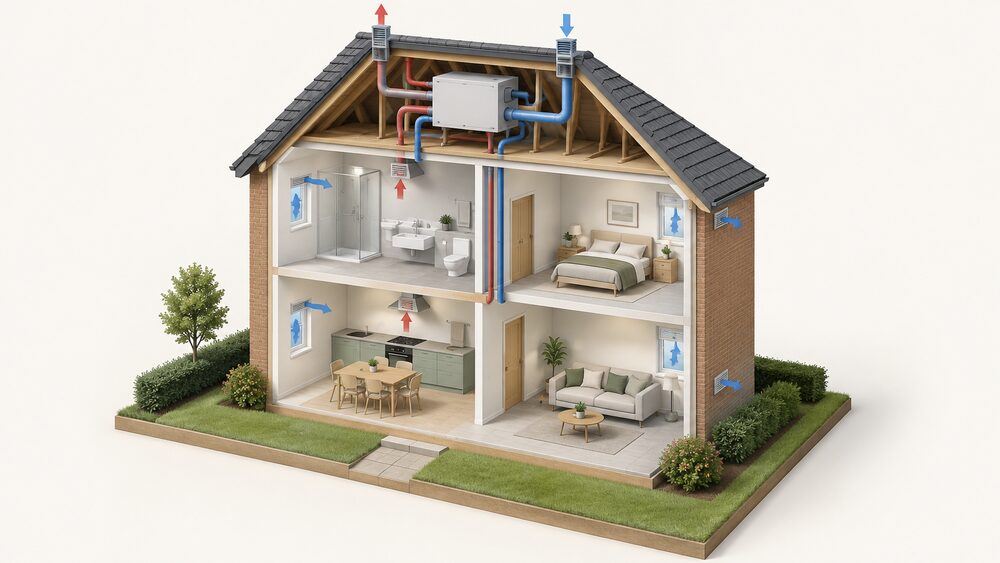
Vent-Axia is a British ventilation manufacturer that has traded since 1936 and is headquartered in Crawley, West Sussex. It makes the three main categories of domestic ventilation equipment sold in the UK: intermittent and continuous extract fans for kitchens and bathrooms, mechanical extract ventilation (MEV) for whole-house extraction, and mechanical ventilation with heat recovery (MVHR), which recovers heat from stale air before it leaves the building.
For a household, ventilation sits awkwardly beside the usual energy independence story. Insulation, solar and a heat pump reduce how much energy a home buys in. Ventilation does the opposite of sealing a house: it deliberately moves air, and with it heat, out of the building. The trade-off is not optional. Poor ventilation can trap moisture and everyday pollutants indoors, making conditions like asthma and allergies worse over time1, and poor indoor air quality is linked to a range of health conditions such as allergy and asthma, lung cancer, chronic obstructive pulmonary disease and cardiovascular disease2.
The choice between extract fans, MEV and MVHR is therefore a choice about how much heat a home is willing to lose in exchange for clean air, and how much control it wants over that exchange. MVHR is the only one of the three that recovers heat, and it works best in buildings that are relatively airtight, such as new-build homes or older properties that are being fully refurbished3.
What Vent-Axia makes for UK homes
Vent-Axia's domestic range covers the full span of ventilation duties a house has. At the simplest end are extract fans, applied in rooms where water vapour or pollutants are most likely to be released, for example, bathrooms and kitchens, and available as either intermittent or continuous units5. These are the familiar wall or ceiling fans switched on with a light or a humidistat.
Above that sit the whole-house mechanical systems. The recognised options in UK domestic ventilation are mechanical ventilation with heat recovery (MVHR), energy recovery ventilators (ERVs), positive input ventilation (PIV), mechanical extract ventilation (MEV), and natural or passive ventilation6. Vent-Axia manufactures across the mechanical end of that list, which means a household can specify a single maker for extraction in wet rooms and for the whole-house unit that serves the rest of the property.
The practical significance of a single maker across both is ducting and controls. A whole-house system is a permanent installation: ductwork runs through floors and roof voids, terminals penetrate the envelope, and the unit itself is usually sited in a loft or utility space. Once that is in, the household's relationship with the maker continues for the life of the system, through filters, fans and any replacement parts. A British manufacturer with a long trading history is a lower risk on that point than a newer entrant, though it does not remove the dependence.
Extract fans, MEV and MVHR: which does what
The three categories differ in how much of the home they serve and what they do with the heat in the air they remove.
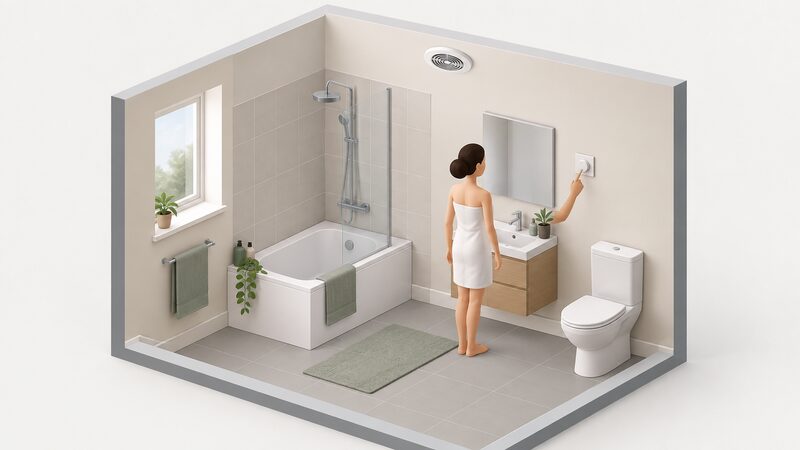
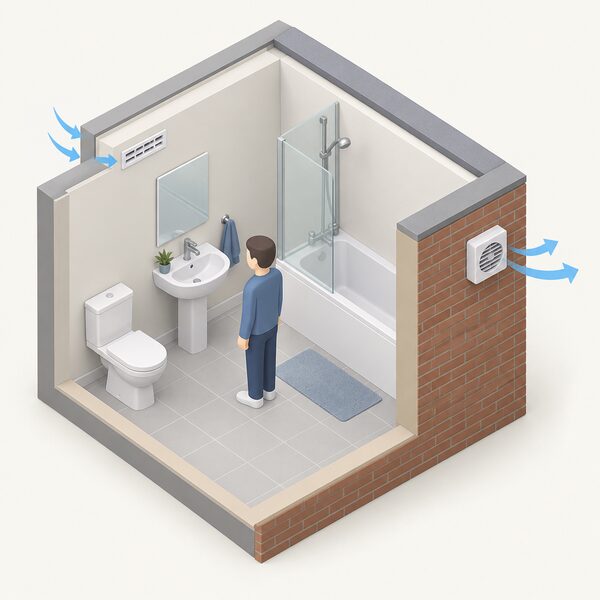
An extract fan serves one room. It is applied where water vapour or pollutants are most likely to be released, for example, bathrooms and kitchens, and can run intermittently or continuously5. It removes air and the heat in it, and replacement air comes in through background openings such as trickle vents or air bricks.
MEV extends the same principle to the whole house. A central unit draws air continuously from several wet rooms through ducting, with replacement air entering through background ventilators. It gives more consistent results than a single fan, especially in newer, more airtight homes4. It does not recover heat.
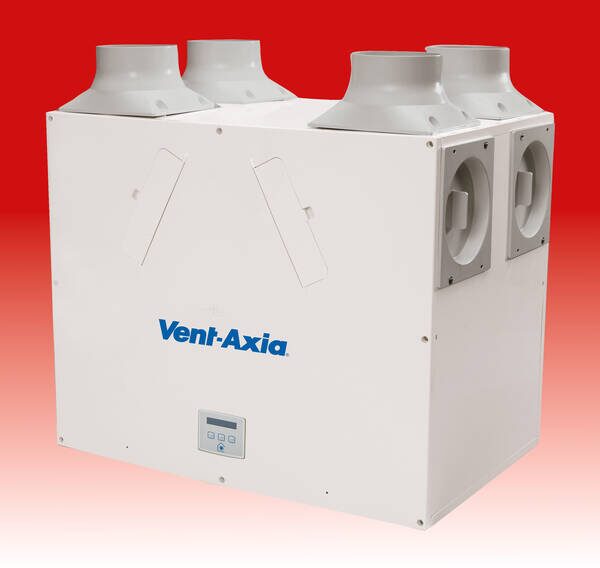
MVHR adds a heat exchanger. Stale warm air leaving the building passes across a matrix that warms the incoming fresh air, so the home keeps most of the heat it would otherwise have extracted. It works best in buildings that are relatively airtight, such as new-build homes or older properties that are being fully refurbished3. In a leaky house, the uncontrolled draughts do much of the air changing already, and the recovery benefit is diluted.
| System | Coverage | Heat recovery | Best fit |
|---|---|---|---|
| Extract fan | Single room | None | Kitchens and bathrooms, any home5 |
| MEV | Whole house, continuous extract | None | Newer, more airtight homes4 |
| MVHR | Whole house, balanced supply and extract | Yes | Airtight homes, new build or full refurbishment3 |
The distinction between PIV, MEV, d-MEV and MVHR is a common point of confusion, and the systems are not interchangeable7. PIV pushes filtered air in and relies on leakage to let air out; MEV and MVHR both extract, but only MVHR balances supply against extract and recovers heat. A household choosing between whole-house options can compare MVHR and positive input ventilation directly.
Indoor air quality: the problem the products address
Ventilation exists because modern homes generate pollutants and moisture faster than they can escape. Poor indoor air quality is linked to a range of health conditions such as allergy and asthma, lung cancer, chronic obstructive pulmonary disease, cardiovascular disease and more recently even investigated for its links to dementia2. That is a broad list, and it reflects the range of things a home produces: moisture from cooking, bathing and drying clothes, particulates from cooking and combustion, carbon dioxide from occupancy, and volatile organic compounds from furnishings and cleaning products.
The purpose of ventilation is to ensure good indoor air quality, extract indoor pollutants, and remove particulates (PM10, PM2.5, PM1), CO2 and VOCs6. Those are the measurable outputs, and they are what a specification should be judged on rather than the presence of a fan.
Condensation and mould are the visible symptom. Guidance on the serious health impacts caused by a build-up of condensation and mould in the home sets out three key ventilation solutions to help tackle the problem: extractor fans, trickle vents and whole home ventilation systems8. The three map onto the three levels of intervention: local extraction, background ventilation, and a whole-house mechanical system.
"Poor ventilation can trap moisture and everyday pollutants indoors, making conditions like asthma and allergies worse over time."
There is also an overheating dimension. Ventilation is increasingly discussed alongside summer comfort rather than only winter damp, and industry events now cover smart ventilation and emerging technology focusing on the use of AI tools to improve indoor air quality9. For a household, the practical point is that a ventilation strategy set only for winter condensation may be inadequate in a hot summer, particularly in a flat with limited opening windows. Homes in that position are covered in ventilation in flats and apartments.
Where Vent-Axia fits in a household's move toward energy independence
Ventilation is the part of a retrofit that works against the airtightness target rather than with it. Insulation and draught-proofing reduce uncontrolled air movement; ventilation then has to reintroduce controlled air movement so the home stays healthy. The two are a pair, and the industry's own framing is that insulation and ventilation belong together6.
That is where MVHR earns its place in an energy independence plan. A home that has been made airtight cannot rely on leakage for air changes, and continuous extraction without heat recovery would then throw away a meaningful share of the heat the insulation was installed to keep. MVHR recovers that heat, so the household gets fresh air without paying for it twice. The same logic applies to an exhaust air heat pump: if a home has an existing MVHR system, it may be possible to upgrade it to an exhaust air heat pump, and the installer should be asked whether the existing ducting system is suitable10. That route turns the ventilation system into part of the heating system, which is a genuine step toward independence from a gas supply.
The dependence that remains is worth stating plainly. A mechanical ventilation system runs on electricity, so it keeps the household on the grid or on a battery and inverter. It depends on a manufacturer for filters, fans and parts, and on an installer for commissioning and servicing. MVHR systems do require servicing, as all equipment such as filters and fans must be kept clean to ensure effective operation3. A household that does not keep up with that servicing gets a system that moves air less effectively and may cost more to run.
There is also a measurement dependence. Air tightness and background ventilation are tested quantities, and the testing services that support them include background ventilation testing, air tightness testing, air quality monitoring, heat transfer coefficient testing and thermography11. A household commissioning a whole-house system is relying on someone else's measurements to know whether it performs as specified.
Support for the wider retrofit exists. Home Energy Scotland can offer free advice on improving the energy efficiency of your home12, and there are currently several schemes offering financial support to help fund some of these upgrades13. Ventilation work is rarely the headline measure in those schemes, but it is often a condition of doing the fabric work properly.
A British maker since 1936
Vent-Axia has manufactured ventilation equipment in Britain since 1936 and is based in Crawley, West Sussex. That is a long record in a category where many products are imported, and it matters for the reasons set out above: a whole-house system is a permanent installation, and the household needs filters, fans and parts to remain obtainable over a service life measured in decades.
Longevity is not the same as a guarantee. The relevant questions for any ventilation purchase are whether the maker publishes performance data for the specific unit, whether filters are a standard consumable the household can source, and whether servicing is available locally. A British manufacturer with a long trading history answers the first two more comfortably than a newer entrant, but the third still depends on the installer network in the household's area.
For a household weighing independence, the position is straightforward. Vent-Axia equipment keeps a home dependent on electricity for air movement, on the maker for consumables and parts, and on an installer for commissioning and servicing. What it buys in return is control over indoor air quality in a home that has been sealed against draughts, and, in the MVHR case, the recovery of heat that would otherwise leave through the extract. That is a different kind of independence from generating your own power: it is independence from the damp, mould and poor air that follow when a home is tightened without being ventilated.
Contacting Vent-Axia
Vent-Axia publishes its own UK contact details, including a telephone number and email address, on its website, and those are the correct route for product, technical and service enquiries. Contact details change, so the maker's own site is the place to check rather than a third-party listing.
For households seeking energy efficiency advice rather than a product enquiry, Act on Energy can be called free on 0800 988 288114. In Scotland, Home Energy Scotland offers free advice on improving the energy efficiency of your home12. Households in Edinburgh can also access financial help for energy efficiency and low carbon heating improvements through the council12.
Sources14 cited
- When home improvements don't deliver comfort, Low Carbon Hub, 2026
- Ventilation and health, BEAMA, 2026
- Mechanical ventilation with heat recovery, Centre for Sustainable Energy, 2026
- Home ventilation guide: stop condensation, damp and mould, IAA, 2026
- Ventilation, BESA, 2026
- Insulate and ventilate, BESA, 2024
- Ventilation and air quality guide: building regulations explained, IAA, 2026
- Mould and condensation infographic, BEAMA, 2026
- World Ventilation Day takes on overheating, BESA, 2026
- Exhaust air heat pumps, Energy Saving Trust, 2025
- Ventilation and air tightness testing, IAA, 2026
- Financial help for energy efficiency and low carbon heating improvements, City of Edinburgh Council, 2026
- The energy efficient house of the future, Energy Saving Trust, 2026
- RTS: what you need to know, Act on Energy, 2026
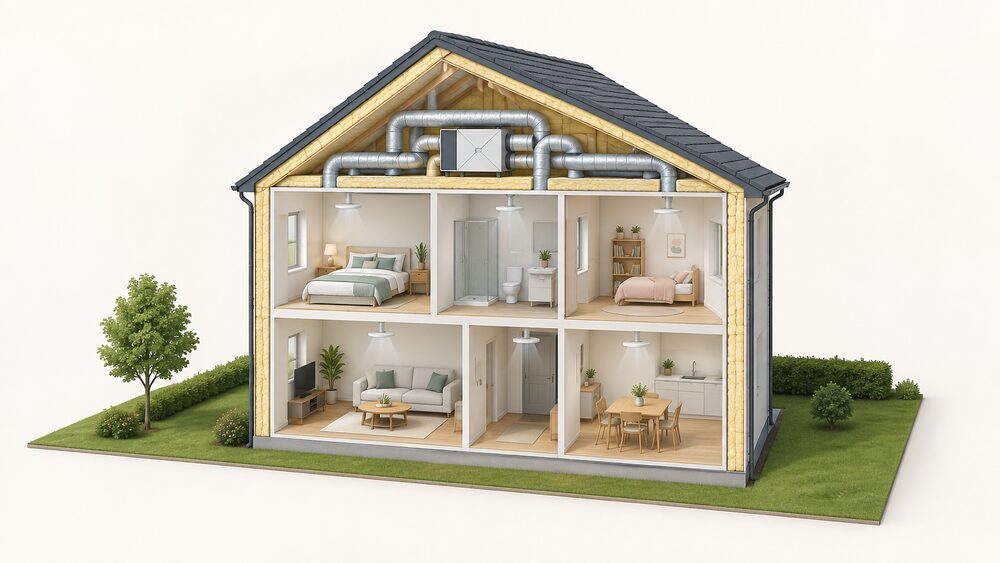 Vent-Axia ventilation fans and MVHRVent-Axia makes fans that pull damp air out of a single room, and systems that warm the fresh air coming into a whole house.