
In this guide
Vent-Axia is a UK ventilation manufacturer whose range covers single-room extract fans, through-the-wall heat recovery units, decentralised mechanical ventilation with heat recovery (dMVHR) and whole-house MVHR. The heat recovery figures published for individual units run from up to 70% on the Integra Plus EC to up to 75% on the HR200WK, up to 80% on the Lo-Carbon Calido and up to 84% on the Lo-Carbon Heat Save1.
The choice between systems follows the building, not the badge. Extractor fans work well for individual rooms, while whole-house systems such as mechanical extract ventilation or MVHR offer more consistent results, especially in newer, more airtight homes5. MVHR works best in buildings that are relatively airtight, such as new-build homes or older properties being fully refurbished6.
For a household, ventilation sits on the other side of the airtightness ledger from insulation. Sealing a home reduces draughts and heat loss, but it also traps moisture and indoor pollutants, and the Building Regulations respond by requiring controlled ventilation instead. Vent-Axia's range is one way of meeting that requirement. What it does not do is remove a home from the electricity grid: every fan and MVHR unit in the range runs on mains power, and the heat recovery only reduces the heating penalty of ventilating, it does not eliminate it.
Vent-Axia at a glance: what the range covers
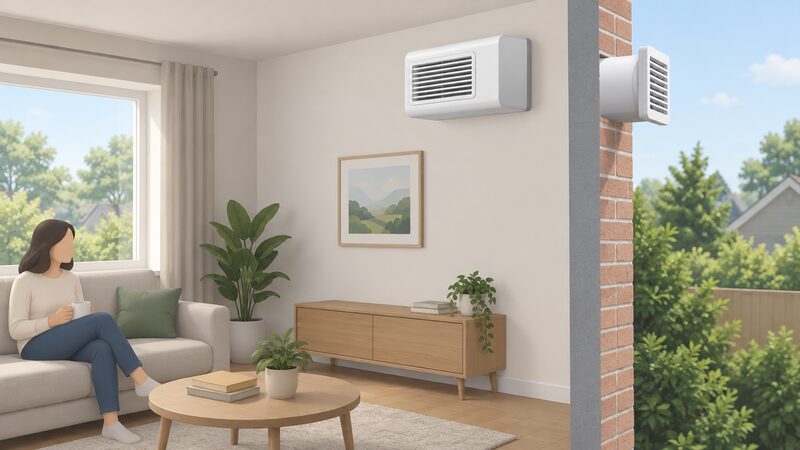
The range divides by how much of the home it serves. At the smallest scale are through-the-wall units that simultaneously extract stale air and introduce fresh air, warming the incoming airflow with heat recovered from the exhaust stream1. The Lo-Carbon Heat Save is a ventilation unit designed for living rooms and bedrooms in single and multi-family buildings, usually located in an exterior wall to provide new air to the room, with a wall sleeve included up to 460mm that can be cut down to size to fit any wall thickness2. The HR200WK is a single-room residential heat recovery unit for kitchens and utility rooms, specifically designed to meet the Building Regulations, with a wall extension sleeve available for walls up to 550mm thick3.
The Lo-Carbon Calido is a dMVHR unit with three air flow options, aimed at residential ventilation, social housing and retrofit applications4. The Integra Plus EC is a larger unit designed for mounting in ceiling voids, lofts and above a suspended ceiling, supplied with four 150mm spigots for connection to insulated flexible or rigid ducting and a 22mm condensate outlet5.
| Unit | Type | Heat recovery | Notes |
|---|---|---|---|
| Lo-Carbon Heat Save | Through-the-wall, living rooms and bedrooms | Up to 84%2 | Wall sleeve included up to 460mm2 |
| Lo-Carbon Calido | dMVHR | Up to 80%4 | Three air flow options4 |
| HR200WK | Single-room, kitchens and utility rooms | Up to 75%3 | Integral washable filter3 |
| Integra Plus EC | Ceiling void or loft | Up to 70%5 | Four 150mm spigots, 22mm condensate outlet5 |
Extractor fans, MVHR or dMEV: which fits which home
The system types in common use are positive input ventilation, mechanical extract ventilation, decentralised mechanical extract ventilation and MVHR8. Ventilation competency schemes list intermittent extract, dMEV, cMEV and MVHR as the recognised categories9. The distinction matters because each suits a different building.
Extractor fans work well for individual rooms5. Decentralised mechanical extract ventilation describes extractor-like fans that run continuously, providing constant low levels of ventilation which increase when the system senses high humidity; they are more effective at regulating indoor air quality than basic extractor fans and cheaper than centralised mechanical extract ventilation10. Whole-house systems such as MEV or MVHR offer more consistent results, especially in newer, more airtight homes5.
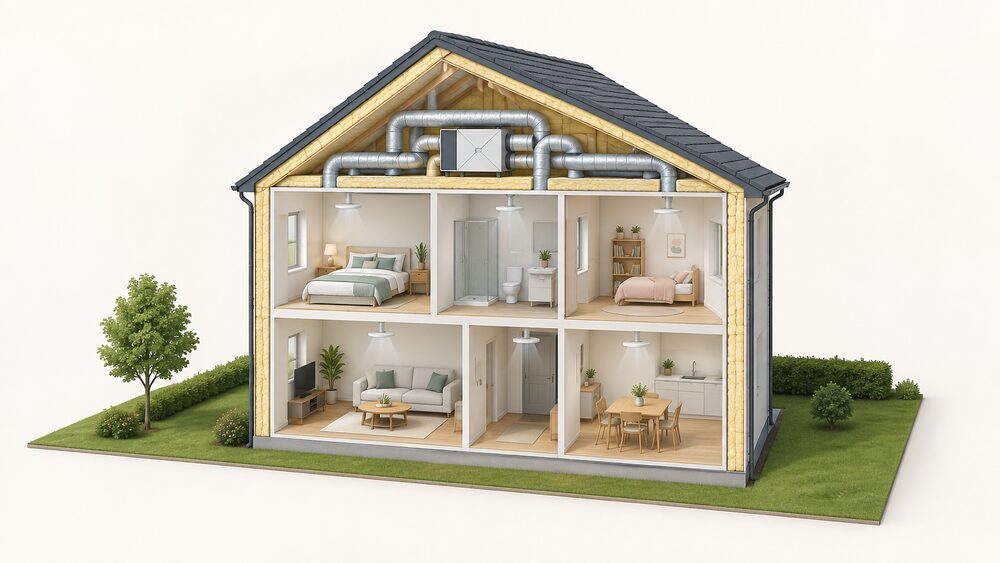
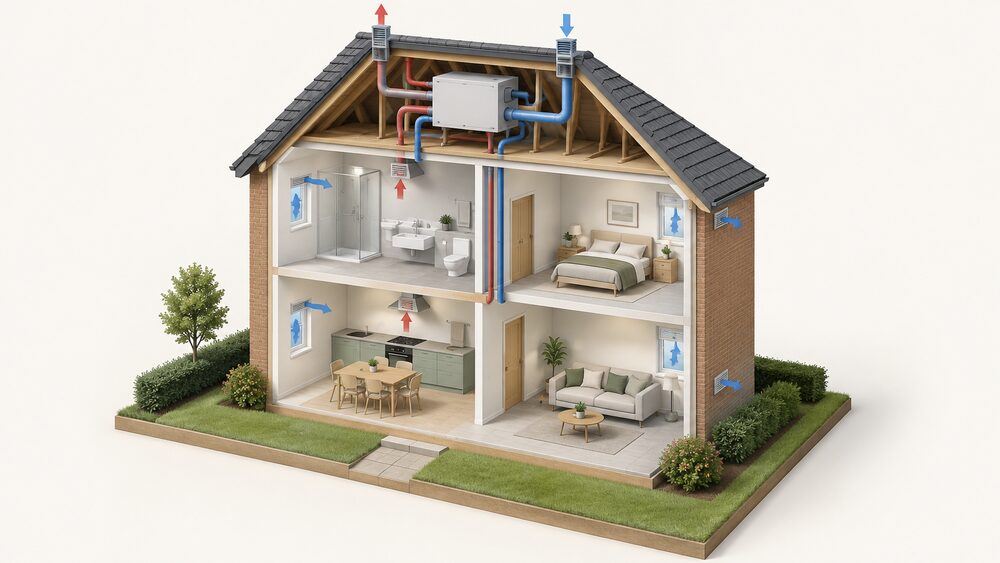
MVHR is the whole-house option with heat recovery. It extracts warm damp air and draws in fresh air, with the warm air passing through a heat exchanger that recovers heat passed on to the incoming air; it is more commonly found in new-builds or whole-house retrofits, and small decentralised MVHR systems can be installed in individual rooms10. Modern energy efficient homes are more airtight than older buildings because they have to follow specifications for air-tightness set out in the Building Regulations, which is why MVHR is sometimes fitted6.
For a household, the practical question is how much of the home needs continuous ventilation. A single damp bathroom or an internal kitchen with no external wall is a one-room problem. A newly insulated and draught-proofed house with replacement windows is a whole-house problem, and the home ventilation page sets out the wider rules. Where airtightness work is planned, airtightness and air leakage explains what changes.
MVHR: how heat recovery works and what efficiency to expect
Heat recovery works by passing the outgoing warm air and the incoming cold air across a heat exchanger, so that the units simultaneously recover valuable heat energy for maximum efficiency11. The recovered heat is transferred to the incoming air, which means the ventilation air arrives warmer than the outdoor temperature rather than at it.
The published efficiency figures for Vent-Axia units vary by product. The Lo-Carbon Heat Save is listed at up to 84% heat recovery, the Lo-Carbon Calido at up to 80%, the HR200WK at up to 75% and the Integra Plus EC at up to 70%2. These are maker figures for specific products, and they are not directly comparable with each other because the units serve different duties and are tested on different bases.
That installation condition is the one most often missed. A unit mounted in a cold loft loses some of the recovered heat from its own casing and ductwork before the air reaches the room, which is why independent guidance is explicit about the insulation layer12. MVHR also works best in buildings that are relatively airtight, such as new-build homes or older properties being fully refurbished6. In a leaky house, the ventilation air is not the only air moving through the fabric, and the recovery has less to work with.
The wider case for the technology is that it recovers heat that would otherwise be expelled. Independent guidance states that householders can spend less on heating their property, reducing costs by 10 to 30%6. A separate assessment puts the figure at up to 26% of heating costs saved by households using energy efficient ventilation systems13. The two figures come from different documents and are not the same measure, so they should be read as a range of estimates rather than a single saving. The MVHR page covers the system in more detail.
Noise levels: what the decibel figures mean in practice
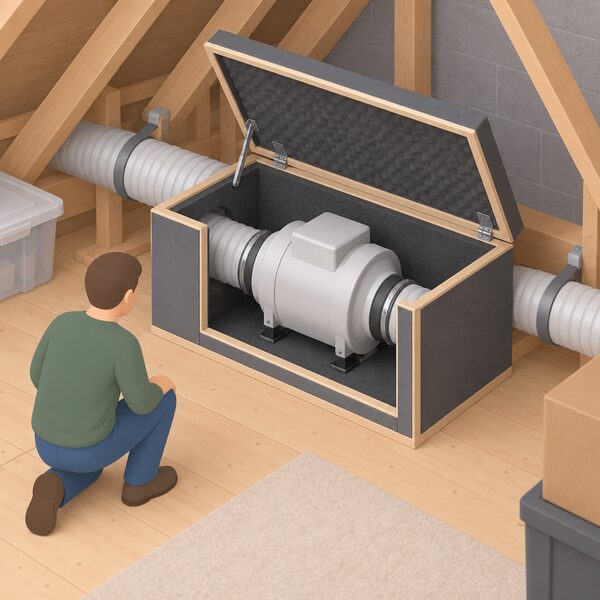
Noise is the reason many households switch a fan off, which defeats the purpose. The quietest published figure in the Vent-Axia range is on the Sentinel Econiq MCP LH, at sound levels as low as 15.5 dB(A) breakout, independently tested and verified by SRL7.
To make sense of that number, the reference points matter. A quiet forest measures around 15 dB, a library around 35 dB, a business office around 65 dB, heavy traffic around 90 dB, a pneumatic drill around 105 dB and a plane around 125 dB, with the threshold of hearing at 0 dB14. A unit at 15.5 dB(A) is therefore at the level of a quiet forest, which is below the background noise of most homes.
For context on how noise limits are set elsewhere in the home, permitted development for air source heat pumps in Wales includes a noise level equal to or lower than 42 dB15. Acoustic absorbing material on a wall can achieve a maximum of 4 dB(A) noise reduction where a heat pump sits in a corner16. Those figures show how much a few decibels matter in practice, and why a fan running continuously at a low level is a different proposition from one that cycles loudly.
Vent-Axia also offers acoustic options on its Sentinel-X controls platform, including an acoustic enclosure, an acoustic top box, or both7. Trickle ventilators provide ventilation without the need to open windows, reducing noise levels as a consequence, and acoustic options are also available in noisier locations17. For a home on a busy road, that combination is often the reason background ventilation is chosen over opening a window.
Running costs and energy use
Every mechanical system in the range uses electricity, and the running cost is the fan's power draw multiplied by the hours it runs. Continuous running is the design intent for dMVHR and MVHR, so the unit runs whenever the home is occupied.
The published electrical details are limited. The HR200WK carries a 1.5 Amp fuse rating3. Vent-Axia does not publish a running cost figure for these units, and no energy consumption figure in kWh appears in the material available, so a household cannot calculate an annual cost from the maker's own data. What can be said is that the units are mechanical and therefore draw power continuously, unlike natural ventilation, which supplies air to and removes air from a building without the use of mechanical equipment such as fans, and which has no mechanical parts, reducing system energy use and therefore energy costs11.
The counterweight is the heat recovery. A unit recovering up to 84% of the heat in the exhaust stream is returning most of that heat to the home rather than losing it, which is the mechanism behind the 10 to 30% heating cost reduction cited for MVHR2. The electricity used to move the air is a small fraction of the heat value moved, which is why heat recovery ventilation is treated as a net benefit in an airtight home and a marginal one in a leaky home.
For a household, the honest position is that ventilation adds a small, continuous electrical load and reduces a larger heating load, and the balance depends on the airtightness of the building. A well-insulated and ventilated home will also help with keeping the heat out in summer18. The insulation savings and payback page covers how such measures are assessed together.
Controls, boost modes and humidity tracking
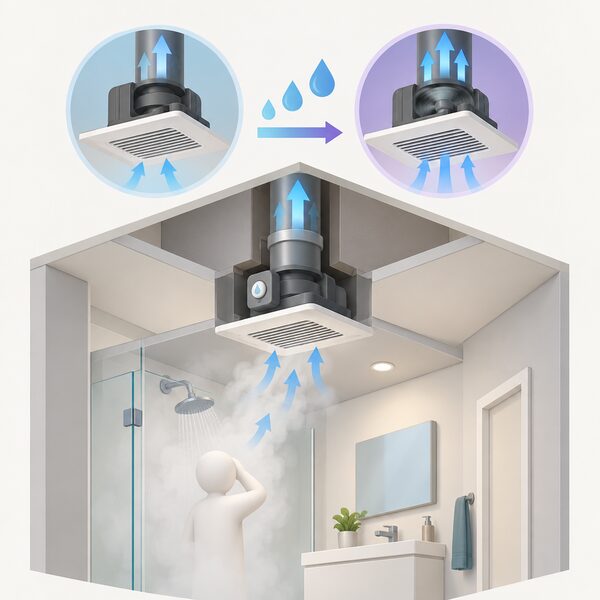
Vent-Axia's control options run from simple switches to wireless platforms. On the HR200WK, an Ambient Response Humidity Sensor or a simple changeover switch can be used to provide switching between any two speeds3. The Integra Plus EC provides effective condensation control, and switching on the controller allows activation of the Summer Mode5. The Lo-Carbon Calido uses intelligent controls to eliminate condensation within the unit4.
The Sentinel-X wireless control platform is the newer controls layer. One accessory variant allows for 2 additional ports, another allows for 4 additional inputs, and the platform provides 2 inputs with a relative humidity range of 0 to 90%7. Acoustic enclosure and acoustic top box options are available alongside it7.
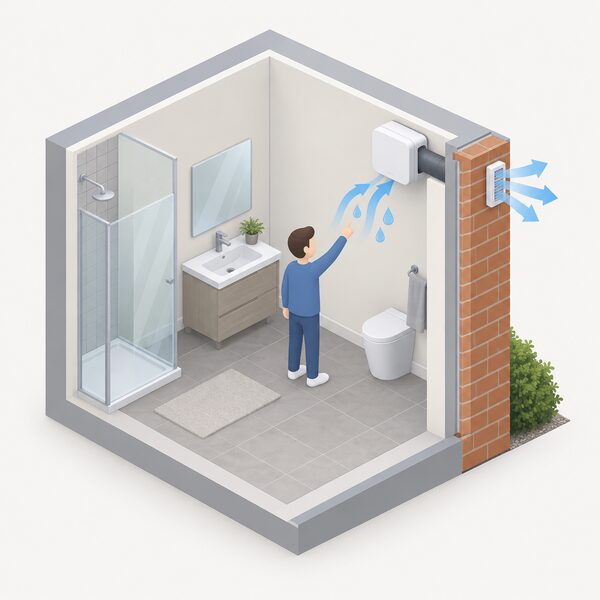
Humidity tracking is the function that matters most in a bathroom or kitchen, because it lets the fan respond to the condition rather than to a timer. A humidity sensor that switches between two speeds means the unit runs at background rate normally and boosts when moisture rises. That is the mechanism behind the claim that dMVHR units work by continuously extracting moist air from rooms in the home, which is especially important in bathrooms, utility rooms and kitchens1.
For a household, the practical point is that controls determine whether the system is used. A fan that requires a manual switch after every shower will be switched off. A humidity-triggered boost runs without intervention. The extractor fan run time page covers how long a bathroom fan should run after showering.
Installation, maintenance and filter replacement
Maintenance is the part of MVHR ownership that is most often underestimated. Independent guidance is that with an MVHR system the filters need checking every few months and cleaning or replacing as necessary, and that a more thorough servicing and cleaning of the heat exchanger and fans may be needed every few years12. MVHR systems do require servicing, as all equipment such as filters and fans must be kept clean to ensure effective operation6.
Vent-Axia builds for this to varying degrees. The Lo-Carbon Heat Save is easily maintained with a cleanable filter and ceramic heat exchanger2. The Lo-Carbon Calido has a filter replacement indicator to ensure continuous good indoor air quality4. The HR200WK uses an integral washable filter3.
Access is a design requirement, not an afterthought. Official consultation guidance on Approved Document F states that reasonable access should be provided for maintaining ventilation systems, including access to replace filters, fans and coils, access points for cleaning duct work, and access for general maintenance of plant19. Where a unit is mounted in a ceiling void or loft, that access has to be planned in.
Retrofit is possible but constrained. Vent-Axia's Heat Recovery Retrofit Solution uses easy to install wall and ceiling units that reduce the complexity of a retrofit installation and the cost20. Decentralised MVHR is described by the maker as easier to retrofit than a whole-house ventilation system1. Independent guidance notes that mechanical ventilation systems can be more easily retrofitted to existing buildings11. The MVHR page covers whole-house retrofit in more detail.
Do Vent-Axia fans need a trickle vent or air brick as well?
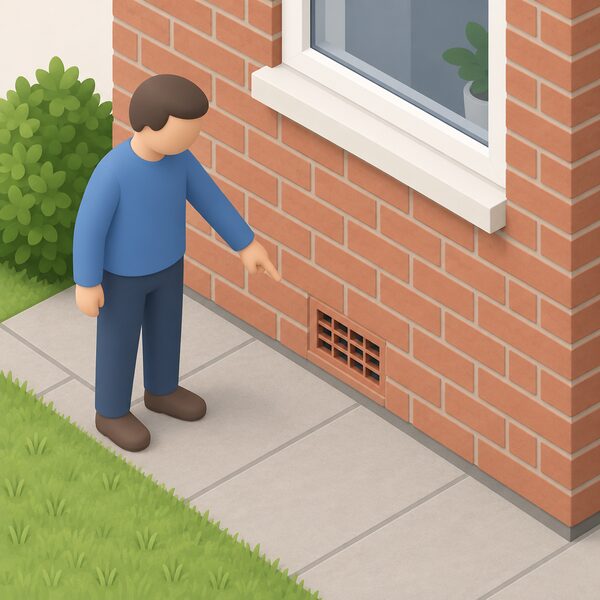
Mechanical extract needs somewhere for replacement air to come from. Background ventilation can be provided by simple built-in features like trickle vents on windows or air bricks in walls, and on their own trickle vents do not provide sufficient ventilation10. Draught-proofing guidance lists extractor fans, airbricks, wall vents and trickle vents in modern windows as the routes by which a home is ventilated21.
The Building Regulations split the requirement by room. Rooms where steam will be produced, such as kitchens, bathrooms and utility rooms, should be provided with higher levels of ventilation, normally mechanical fans and windows, than other rooms where suitably sized window openings and background trickle ventilators may suffice22. Following the installation of replacement windows and doors, adequate ventilation is important to remove airborne vapour, otherwise vapour may condense on the coldest surface, which could be an outside wall24.
That warning matters because draught-proofing work often targets exactly these openings. Where a flueless gas appliance is installed, adequate means of ventilation must be available for dispersing to the outside air the water vapour and other products of combustion26. Roof ventilation follows the same logic: a cold deck pitch roof should have vents installed along the eaves to both front and rear or from side to side, and where there is no ceiling with insulation between rafters, the ridge should also have vent tiles installed to allow through ventilation27. The should I seal air bricks page covers the question directly.
What ventilation means for household energy independence
Ventilation is the measure that makes airtightness workable, and airtightness is what makes a home's heat demand controllable. Whole dwelling ventilation provides outdoor air to the home, diluting and dispersing indoor pollutants and water vapour that has not been extracted by other means11. Without it, an insulated and draught-proofed home traps moisture, and the condensation that follows is a fabric problem rather than a comfort one.
The independence gain is real but partial. A heat recovery unit reduces the heating penalty of bringing fresh air into a sealed home, which lowers the energy a household needs to buy. Independent guidance puts the reduction in heating costs at 10 to 30% for MVHR6, and a separate assessment puts the saving at up to 26% of heating costs for households using energy efficient ventilation systems13. Those are modelled or estimated figures rather than metered outcomes for a specific house.
The dependence that remains is straightforward. Every unit in the range runs on mains electricity, so the household stays connected to the grid and to an electricity supplier. The heat recovery reduces the amount of gas or electricity needed for heating, but it does not change the fuel. Filters are consumables that come from the manufacturer or its distributors, and the servicing regime depends on the household or a contractor carrying it out. Where controls are wireless, the system depends on those controls continuing to work.
The wider policy direction points the same way. The Decent Homes Standard consultation response argues the standard should ensure that adequate ventilation is provided, not just that ventilation systems are in a good state where they are already present, and recommends this be expanded to all ventilation systems including local extract fans30. Technical suitability assessments for energy efficiency measures are proposed to cover the current state of the building fabric including insulation and ventilation, and to recommend energy efficiency and ventilation measures with suitable justifications31. Ventilation is being treated as part of the fabric package, not an optional extra.
For a household, the sequence is the same as elsewhere in retrofit: reduce heat loss, then provide controlled ventilation to match the new airtightness, then choose the system that fits the building. The home ventilation page sets out the rules, and condensation, damp and mould covers what happens when the two are out of step.
Sources31 cited
- Decentralised Mechanical Ventilation with Heat Recovery (dMVHR), Vent-Axia, 2026
- Lo-Carbon Heat Save, Vent-Axia, 2026
- HR200WK 3 Speed Heat Recovery, Vent-Axia, 2026
- Lo-Carbon Calido MVHR, Vent-Axia, 2026
- Integra Plus EC MVHR, Vent-Axia, 2026
- Mechanical Ventilation with Heat Recovery, Centre for Sustainable Energy, 2026-07
- Sentinel Econiq MCP LH, Vent-Axia, 2026
- Ventilation and Air Quality Guide: Building Regulations Explained, The IAAs, 2026-09-20
- Ventilation and Indoor Air Quality, Future Homes, 2026-09-17
- Ventilation, Centre for Sustainable Energy, 2025-07
- Ventilation, BESA, 2026-09-20
- Airtightness and Ventilation, CAT, 2025-06-27
- BEAMA EPC Reform Position Paper, BEAMA, 2024-11
- Jargon Buster, MIMA, 2026-09-20
- Air Source Heat Pump Guide, Eastleigh Borough Council, 2025-05
- ASHP Noise and Permitted Development Rights in Wales: Phase 1 Report, Welsh Government, 2023-12-13
- Ventilation and Trickle Vents, Glass and Glazing Federation, 2026-09-20
- How Fuel Poverty Is Still an Issue During the Summer, National Energy Action, 2025-08-31
- Building Regulations Part L and F Review Stage 2a: Approved Document F, Welsh Government, 2020-11
- Heat Recovery Retrofit Solution, Vent-Axia, 2026
- Draught-Proofing Your Home, Smart Energy GB, 2026-03-16
- Building Regulations: Doors and Windows, Planning Portal, 2026
- Building Regulations: Doors and Windows, Welsh Government, 2026-09-17
- Windows, Glass and Glazing Federation, 2026-09-20
- Draught-Proofing, Which?, 2026-05-05
- Quick Guide to the Building Regulations: Q and A, Welsh Government, 2021-12
- Building Regulations: New Roofs, Thermal Resistance and Insulation, Planning Portal, 2026
- Building Regulations: Roof, Thermal Resistance and Insulation, Welsh Government, 2026-09-17
- Building Regulations: Roof, Insulation and Thermal Elements, Welsh Government, 2026-09-17
- A Reformed Decent Homes Standard for Social and Privately Rented Homes Consultation, CIBSE, 2026-09-17
- HEETSA Scoping Consultation: NIA Response, National Insulation Association, 2025-09-03
 Vent-AxiaVent-Axia has made home ventilation since 1936, including kitchen and bathroom fans and whole-house systems that recover heat.