
In this guide
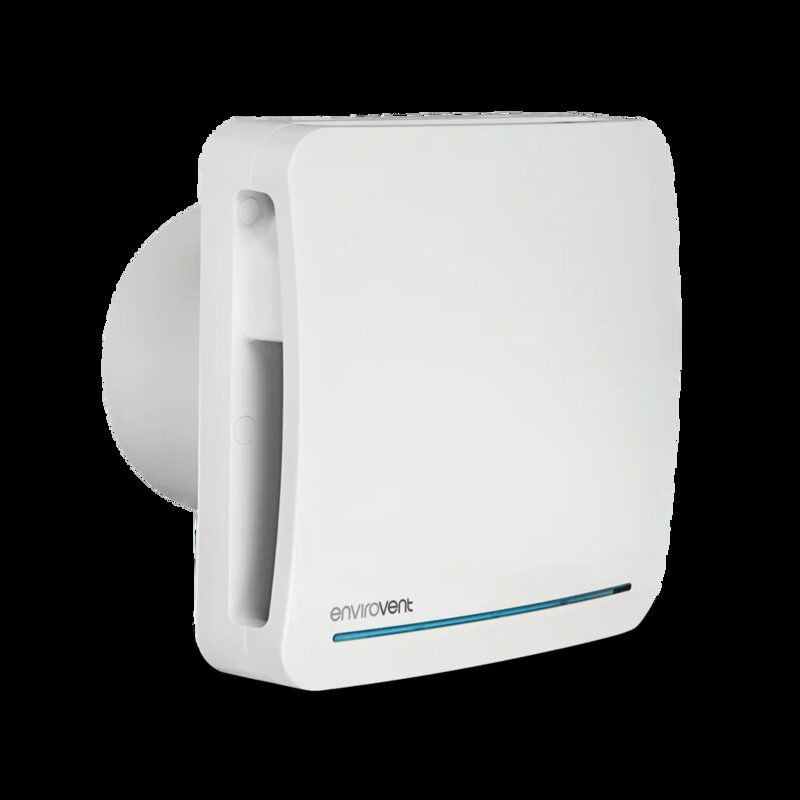
EnviroVent is a UK ventilation manufacturer that specialises in whole-house ventilation systems and extractor fans, and it holds the status of a Which? Trusted Trader1. That places it in a different category from the boiler and heat pump brands that dominate home energy equipment: its products do not heat a home or generate anything, they move air through it. For a household, the practical value is moisture and pollutant control, and the practical dependence is on mains electricity, on ducting that has to be installed correctly, and on a manufacturer's support line when something stops working.
The range splits into two jobs. Single-room extract fans clear steam and smells from a bathroom, kitchen or utility room, and whole-house systems such as mechanical extract ventilation and mechanical ventilation with heat recovery run continuously to ventilate an entire, often airtight, property2. EnviroVent's own support material describes its positive input ventilation units as designed to run continuously at a controlled low rate, which is the same principle applied to a whole house rather than one room4.
Two administrative points matter more than they look. EnviroVent states that all its warranties are logged automatically on its central system, so a householder does not need to register anything to bring cover into effect5. And the maker's troubleshooting guidance is unusually specific about the first things to check when a fan stops, which is where most support calls begin4.
Who EnviroVent are, and what that status means
EnviroVent is described by Which? as a Which? Trusted Trader that specialises in whole-house ventilation systems and extractor fans1. The Trusted Trader scheme is one of the certification routes Which? treats as providing adequate consumer protection, alongside TrustMark and the Insulation Assurance Authority6. That is a consumer-protection judgement about the business and its processes, not a product certification, and it sits separately from the technical approvals a ventilation unit itself carries.
On the technical side, EnviroVent states that all its products comply with the most robust testing and compliance requirements, including CE marking and other standards, directives and regulations where applicable5. That is the maker's own statement about its own products, and it is the appropriate source for it. What it does not do is name a specific standard or a specific approval body for a specific unit, so a householder comparing two fans should look for the declared standard on the datasheet of the model in question rather than relying on a brand-level claim.
The company's public activity is not limited to product support. Its site lists a blog article titled "Best Places to Work 2026" dated 22 May 2026, which is a corporate rather than a technical signal, but it does indicate an active UK operation rather than a dormant brand5.
For a household's energy independence, the position is narrow but real. A ventilation unit does not reduce reliance on a gas supplier or the grid, and it adds a small continuous electrical load. What it does is protect the fabric of the building: uncontrolled moisture damages plaster, timber and insulation, and the cost of that damage is a household cost. Ventilation is therefore a maintenance of the home's value rather than a route to self-sufficiency, and it should be judged on that basis.
Extractor fans and whole-house systems: what the range covers
The two product families do genuinely different jobs, and the guidance is consistent about which suits which property. Extract ventilation is applied in rooms where water vapour or pollutants are most likely to be released, for example bathrooms and kitchens, and extract fans can be intermittent or continuous2. Extractor fans work well for individual rooms3. That is the single-room case, and it is the cheaper and simpler one.
Whole-house systems are the other end. Mechanical extract ventilation and mechanical ventilation with heat recovery offer more consistent results, especially in newer, more airtight homes3. The reason is that a modern airtight property has less incidental air leakage, so moisture and pollutants accumulate unless ventilation is designed in rather than left to gaps.
Between those two poles sits decentralised mechanical extract ventilation, described as extractor-like fans that run continuously, providing constant low levels of ventilation which increase when the system senses high humidity. That approach is more effective at regulating indoor air quality than basic extractor fans, and cheaper than centralised mechanical extract ventilation7. It is the middle option for a household that wants continuous background ventilation without the ducting network of a full MVHR system.
Intermittent extract ventilation is the simplest form: individual extractor fans in bathrooms, kitchens and utility rooms, usually controlled by a light switch, a timer or humidity sensor. It is relatively cheap to install and reasonably effective, but not always sufficient for very air-tight or damp-prone properties7. That last qualification is the one that catches households out, because the same fan that works in a draughty Victorian terrace may be inadequate in a newly sealed extension.
| Approach | How it runs | Best suited to | Main limitation |
|---|---|---|---|
| Intermittent extract | Switched, timed or humidity triggered | Contained problems in one room | Not always sufficient in very air-tight or damp-prone properties7 |
| Decentralised mechanical extract | Continuous low rate, boosts on humidity | Continuous background ventilation without full ducting | Cheaper than centralised MEV, less consistent than MVHR7 |
| Centralised MEV | Continuous, whole house | Airtight homes needing consistent extraction | Ducting network required3 |
| MVHR | Continuous, with heat recovery | Newer, more airtight homes | Ducting network required3 |
Warranty: logged automatically, with no registration step
The most useful warranty fact about EnviroVent is administrative rather than numerical. The company states that all EnviroVent warranties are logged automatically on its central system, so a householder does not need to register anything to bring cover into effect5. That is unusual in home energy equipment, where registration is normally the condition that converts a short default term into a longer one, and where a missed deadline is the most common reason cover is lost.
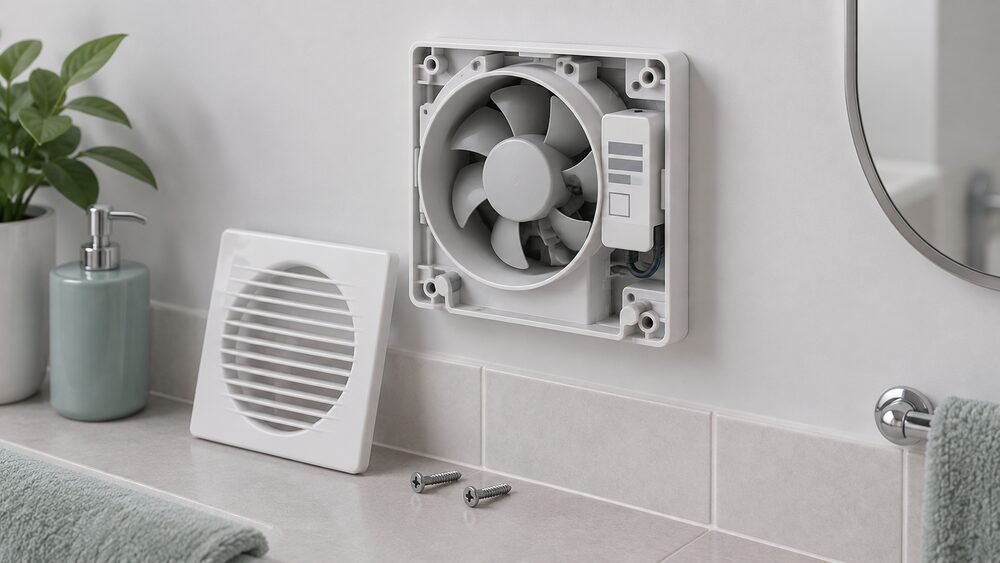
The practical consequence is that the paperwork a householder keeps matters less for the warranty itself and more for the fault report. When a fault is raised, the maker needs to identify the unit, and the support pages direct householders to the unit and its documentation. On positive input ventilation units, the cover is held by two screws at the base end of the fan cabinet, which are loosened until they are clear of the fan case, so the label can be read with the cover off4.
EnviroVent does not publish a single warranty term covering every unit in the material available here, and terms vary by product. Because the term is product-specific, the length of cover for a particular fan or system should be confirmed against the documentation supplied with that unit rather than assumed from the brand. For the general mechanics of keeping manufacturer cover valid, including the conditions that void it, see Registering a warranty and keeping it valid.
IP ratings and where a fan can safely be fitted
The IP rating a fan needs is set by its position relative to a bath or shower, and those zone rules come from the wiring regulations rather than from the fan manufacturer. EnviroVent does not publish IP ratings for its units in the material available here, so a householder cannot read a protection level off a brand page and assume it applies to a particular model.
What the maker does publish is the intended environment. Its fans are intended for bathrooms, kitchens and utility rooms, the rooms where water vapour or pollutants are most likely to be released2. The maker also states that its products comply with CE marking and other applicable standards, directives and regulations where applicable5. That is a compliance statement about the product range, not a per-model ingress protection figure.
For context on what an IP rating means in a wet environment, an outdoor socket with an IP66 rating or above is designed to be dust-tight and protected against powerful jets of water8. That is a different product category and a different set of rules, but it illustrates the scale: the first digit covers solids and dust, the second covers water, and higher numbers mean more protection. A bathroom fan does not need the same level as an outdoor socket, but the zone it sits in determines the minimum.
The practical point for a household is that the IP rating should be confirmed for the specific model and the specific mounting position before installation, and that this is a question for the installer who is signing off the work rather than something to infer from a brand. Where a fan is fitted inside a zone, the protection level and the electrical supply arrangements are both part of the same compliance question.
Ducting: connection sizes and why runs go wrong
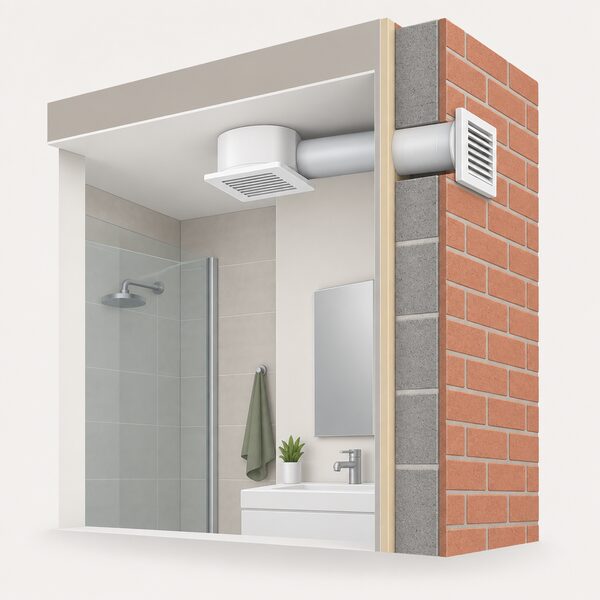
Ducting size is determined by the spigot on the individual unit, and EnviroVent does not publish a single connection size across its range in the material available here. A householder therefore cannot assume that a replacement fan will mate with existing ducting, and the connection diameter should be checked against the model being fitted.
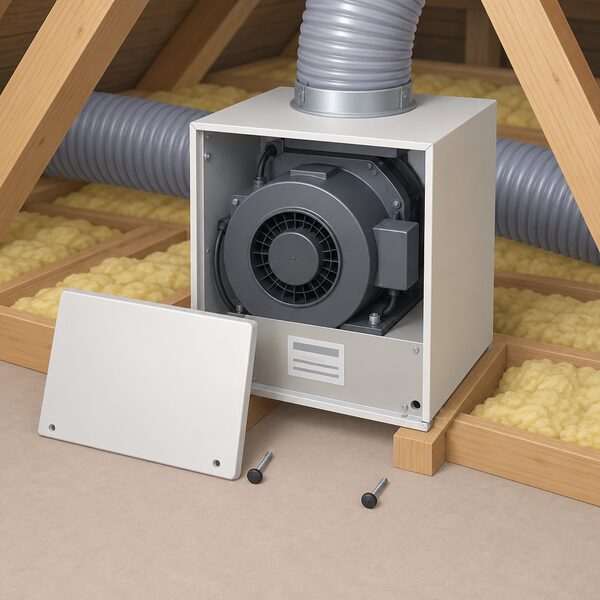
What the maker does publish is what goes wrong. Excessive amounts of ducting, whether rigid or flexible, incorrect external terminations and blocked fly screens will all hinder extraction4. That is a short list, and it accounts for a large share of complaints about fans that run but do not clear a room. A long, convoluted or undersized run adds resistance that a small fan cannot overcome, and a blocked or wrongly specified external termination does the same at the other end.
The general guidance on ducting points the same way. Ductable extract fans are described as suitable for short runs9. That is a statement about a specific product, but the principle applies across the category: the shorter and straighter the run, the closer the installed performance comes to the rated performance.
For a household, this is the single most important installation variable, and it is invisible once the ceiling is back up. A fan that is correctly sized but badly ducted will underperform for its whole life, and the symptom, persistent condensation, looks like a fan fault rather than an installation fault. Checking the run before the unit is fitted is cheaper than replacing the unit afterwards.
Low energy running and what ventilation does for a healthy home
Ventilation units are continuous electrical loads, and the honest framing is that they consume a small amount of electricity to protect the building and its occupants. The benefit side is well documented. A mechanical heat recovery ventilation system provides a constant supply of clean, fresh air which contributes to a healthy, comfortable living environment, with additional benefits and efficiencies from combining heat recovery with ventilation10. Heat recovery is the mechanism that makes continuous ventilation less costly in energy terms, because heat is transferred from the outgoing air to the incoming air rather than simply lost.
The health case is made by the industry as well as by government. The My Health My Home campaign aims to raise householder, and house builder, awareness of the potential impacts of poor indoor air quality on human health and the importance of effective ventilation in managing indoor air quality11. That is a campaign rather than a study, but it reflects a settled position that indoor air quality is a health issue and not only a comfort one.
The regulatory direction of travel supports the same conclusion. In consultation on a reformed Decent Homes Standard for social and privately rented homes, there was a recommendation that the scope be expanded to all ventilation systems, including local extract fans12. If that recommendation is adopted, the presence and performance of extract fans becomes a compliance matter for landlords rather than a discretionary improvement, which would raise the standard of ventilation in a large part of the UK housing stock.
For a household's independence, the trade is straightforward. A ventilation unit adds a small, continuous draw on the grid and cannot be run without mains electricity. In return it protects the building fabric from moisture damage and manages indoor air quality, which is a maintenance benefit rather than an energy one. It does not reduce reliance on a supplier, and it should not be presented as doing so.
Choosing a single-room fan or a whole-house system
The choice follows the property, not the preference. Extractor fans work well for individual rooms3, and intermittent extract ventilation, meaning individual fans in bathrooms, kitchens and utility rooms usually controlled by a light switch, a timer or humidity sensor, is relatively cheap to install and reasonably effective, but not always sufficient for very air-tight or damp-prone properties7. That is the case for a single-room fan: a specific, contained problem in a property that otherwise ventilates adequately.
Whole-house systems are for the opposite situation. Mechanical extract ventilation and mechanical ventilation with heat recovery offer more consistent results, especially in newer, more airtight homes3. Where a property has been sealed, whether through new build airtightness or a retrofit programme, incidental ventilation falls and a designed system becomes the reliable route.
The middle option is decentralised mechanical extract ventilation: extractor-like fans that run continuously, providing constant low levels of ventilation which increase when the system senses high humidity. It is more effective at regulating indoor air quality than basic extractor fans, and cheaper than centralised mechanical extract ventilation7. For a household that wants continuous background ventilation without the ducting network of a full MVHR installation, that is the compromise.
EnviroVent's own position on its positive input ventilation units is that suitability should be checked before purchase. The maker states that the best way to check is with a survey from one of its local specialists, who will check whether installing PIV will be suitable4. That is a maker's recommendation about its own product, and it points to the same conclusion as the independent guidance: the property determines the system, and a survey is the mechanism that establishes which one fits.
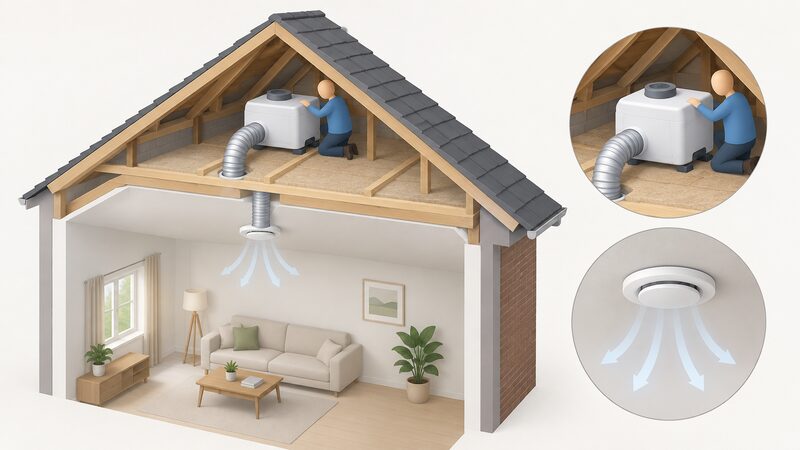
Installation, availability and the rules that apply
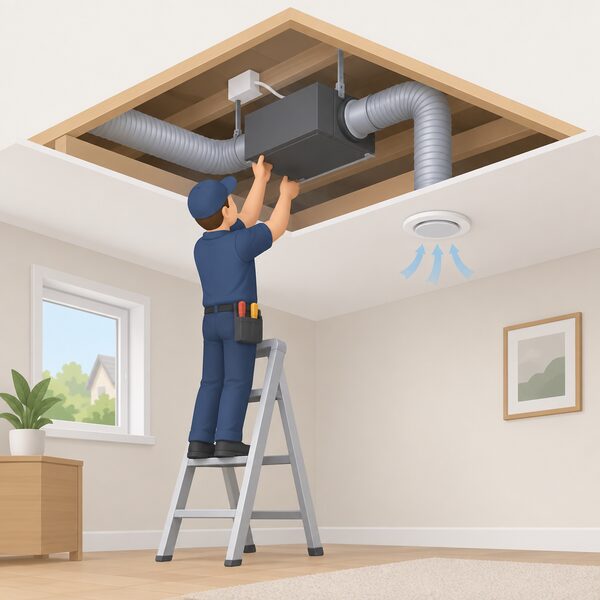
Installation is not a purely DIY question, and the guidance is consistent. Installation should always be carried out by a competent, qualified installer3. On the regulatory side, those installing and commissioning ventilation systems should typically be a member of a Competent Person Scheme or an equivalent body, though for lower risk work such as a single intermittent extract fan, adequate training is expected without scheme membership13. That distinction is the practical one: a like-for-like replacement of a single bathroom fan sits at the lighter end, while a whole-house system with commissioning sits at the heavier end.
The same principle appears in related guidance. Installation of external flues, chimneys, and soil and vent pipes should be carried out by a suitably qualified installer14, and air conditioning installation must comply with building regulations, with the advice to contact an installer who belongs to the Microgeneration Certification Scheme or a relevant Competent Person Scheme15. Those are different technologies, but they show the pattern: work that penetrates the building envelope or connects to fixed wiring is treated as installer work.
On availability, EnviroVent is a UK manufacturer and its products are sold through UK channels. The wider supply chain for home energy equipment is supported by government programmes that help installers and manufacturers expand supply chains16, and heat pumps are supplied and installed by some energy suppliers, including to non-customers17. Those facts describe the broader market rather than EnviroVent specifically, and they are included only to show that the installer-led route is the norm across home energy equipment.
For a household, the independence question is modest. A ventilation unit is a mains-powered appliance with no fuel choice and no generation, so it does not move a home towards self-sufficiency. What it does is protect the building and its occupants, and the quality of the installation determines whether it delivers that. For the wider picture of how manufacturers fit into household energy independence, see Manufacturers and household energy independence.
Sources17 cited
- How to stop condensation, Which?, 2026-05-26
- BESA focus areas: ventilation, BESA, 2026-09-20
- Home ventilation guide: stop condensation, damp and mould, IAA, 2026-09-20
- Troubleshooting, EnviroVent, 2026-09-20
- Customer experience hub, EnviroVent, 2026-09-20
- Priority places for insulation index, Which?, 2024-01-09
- Advice: ventilation, Centre for Sustainable Energy, 2025-07
- Plug-in solar panels: five top tips, REA, 2026-08-04
- Airflow iCONsmart 30 extractor fan, Quiet Mark, 2026-09-17
- Ventilation systems, nidirect, 2026-09-17
- Ventilation and health, BEAMA, 2026-09-19
- A reformed Decent Homes Standard consultation, CIBSE, 2026-09-17
- Future Homes and Buildings Standards consultation response, MHCLG, 2026-03
- Do I need permission for solar panels in a conservation area?, Planning Portal, 2026-09-17
- Is permission needed for installing new roof tiles?, Planning Portal, 2026-09-17
- Post note 0699, UK Parliament, 2026-09-19
- Air source heat pump costs and savings, Which?, 2026-04-14