
In this guide
Elnur is a Spanish electric heating brand whose controls are sold in the UK under two names: Elnur and Gabarron. The controls themselves are not a single product. They run from a mechanical input dial on a night storage heater through to the G-Control Hub, a WiFi gateway that puts heaters on a daily and weekly schedule from a phone and can manage surplus output from a photovoltaic array1.
The practical question for most households is what a given control can and cannot do. A thermostat sets a target temperature. A programmer sets when the heater runs. On a storage heater, the input dial decides how much heat is bought overnight and the output dial decides how fast it is released, and those two decisions are made a day apart2. That timing gap is the defining feature of storage heating, and no control removes it.
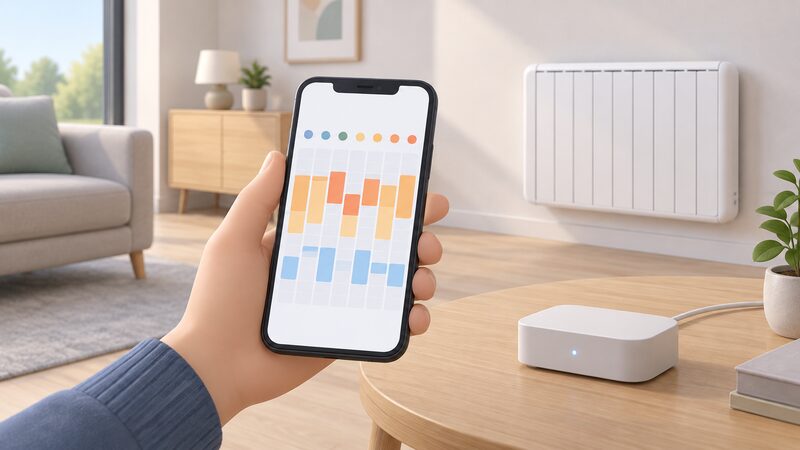
Elnur's own controls sit at the automated end. The G-Control Hub pairs with the free Elnur Gabarron WiFi Control App, which sets a daily and weekly schedule for heaters with chosen temperatures at selected times across the week, and the hub also reads an electricity meter and manages surplus energy from photovoltaic installations1. Voice control runs through Alexa or Google Home Assistant1.
What Elnur controls and programmers do
An electric heating control does three jobs: it decides when the heater draws power, it decides what temperature the room reaches, and on a storage heater it decides how much heat is banked in advance. Elnur's G-Control Hub covers the first two remotely and adds two functions that matter for a household generating its own electricity. It reads an electricity meter, and it manages surplus energy in photovoltaic installations1.
The scheduling layer is the Elnur Gabarron WiFi Control App, which the maker describes as free, and which sets a daily and weekly schedule for heaters with chosen temperatures at the selected times all week1. That is a fuller schedule than a mechanical dial offers, and it is the main reason a household would replace a control rather than a heater.
The hub also supports voice control through Alexa from Amazon or Google Home Assistant1. Voice assistants are a common feature of the wider smart thermostat market rather than an Elnur speciality: independent guidance notes that smart thermostats connect to Amazon Alexa, Siri and Google Home, naming Google Nest and Hive Smart Thermostat among them7. The difference is that a smart thermostat usually replaces a boiler's room control, while the G-Control Hub sits alongside electric heaters that are already installed.
What the hub does not do is change the fuel or the tariff. It schedules and monitors. The heater still runs on mains electricity bought from a supplier, and the savings come from running it at different times rather than from using less energy in total. For the wider picture of what controls can and cannot shift, see heating controls and energy independence and controls for electric radiators, panel heaters and infrared.
Thermostat accuracy and temperature control: 18 to 21°C
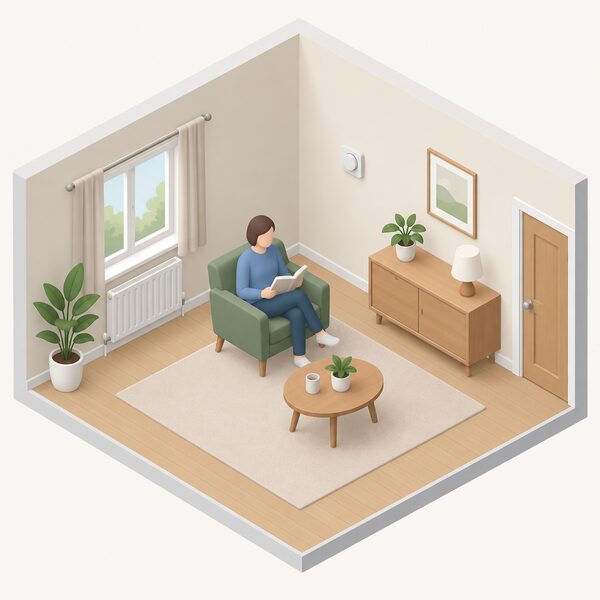
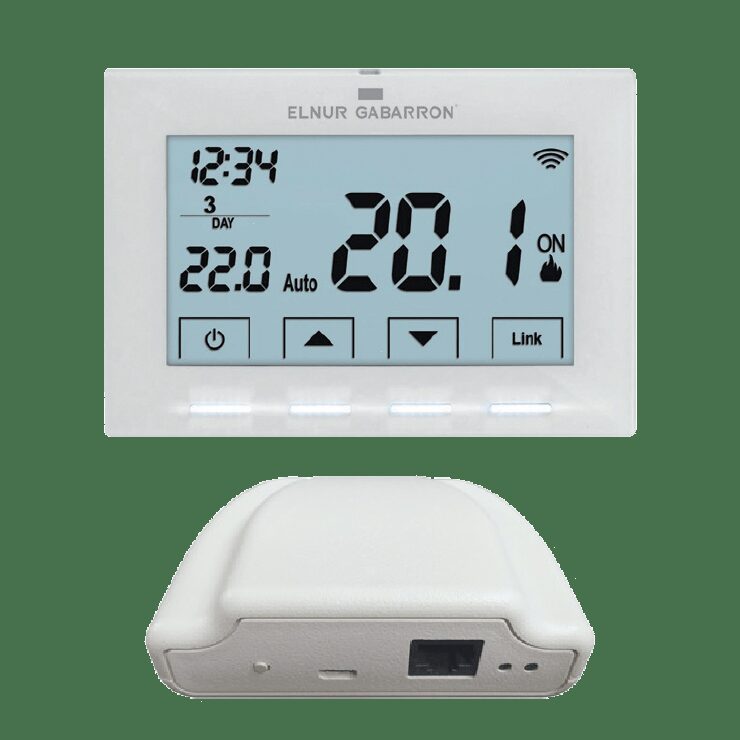
The temperature a thermostat is set to matters more than the accuracy of the sensor in most homes, because the comfort band is wide. Cadent Gas advises that a thermostat should be set between 18°C and 21°C to help keep occupants safe and well4. Energy saving guidance for UK households gives the same band, 18°C to 21°C, for comfort and efficiency5.
That is a range of three degrees, which is wider than the tolerance of most domestic thermostats. The practical consequence is that a household chasing a fraction of a degree is adjusting something the guidance does not ask to be adjusted that finely. What the band does is set the outer limits: below 18°C the advice is that health and comfort suffer, and above 21°C the running cost rises without a matching benefit.
Where a thermostat is placed changes what it reads. Independent guidance on smart thermostats states that the best place to put one is where the temperature is relatively consistent8. A thermostat on an outside wall, above a radiator or in a draught reads a temperature that is not the room's, and the heater responds to that reading rather than to the occupant's experience.
For electric heating specifically, the control is usually on the appliance rather than on a wall. That makes siting less of an issue and zoning more of one, since each heater carries its own thermostat and its own schedule. The general principles of siting and wiring are set out in room thermostats explained and thermostats and heating controls.
Programmes, eco modes and open window detection
Scheduling is where electric heating controls earn their place, because electricity is priced by time of day on the tariffs these heaters are usually run on. Storage heaters work with special electricity tariffs that provide cheaper rates at certain times of the day2, and they charge during off-peak hours when electricity is cheaper, usually overnight3.
The features that appear on modern controls include open window detection, frost protection, GPS tracking and on-valve controls, as listed for one smart radiator thermostat on the market9. Open window detection responds to a sudden temperature drop by pausing the heat, which prevents a heater running against an open window. Frost protection keeps a minimum temperature in an unoccupied room.
Eco modes and setback work on the same principle as any other heating schedule: a lower target when the room is empty or the household is asleep, and a return to comfort before it is needed. The Energy Saving Trust's guidance on thermostats and heating controls covers the general approach10, and the detail of setback periods is set out in heating schedules, setback and leaving the heating on.
On a storage heater the schedule has a hard edge that a gas system does not. The heater has two phases, a charging phase and a heating phase3, and the charging decision is made the night before. A programme that asks for more heat at 4pm cannot buy it at 4pm.
App and smart home control: Google Home, Alexa and the Haverland app
Remote control of an Elnur or Gabarron heater runs through the G-Control Hub and the Elnur Gabarron WiFi Control App. The hub provides timer and programmer control through the app and temperature control through the app, alongside electricity metering and photovoltaic surplus management1. Voice control is through Alexa from Amazon or Google Home Assistant1.
The dependence this creates is worth stating plainly. Scheduling from outside the home, energy monitoring and any remote diagnostics depend on a working broadband connection, the manufacturer's servers and a manufacturer's app. Local control at the heater continues without any of that, but the features that justify the hub do not. The same pattern applies across the smart heating market, and it is examined in smart heating controls: security, data and product support and smart thermostat subscriptions and app charges.
Compatibility with the wider smart home is a separate question from compatibility with the heater. Smart thermostats in general connect to Amazon Alexa, Siri and Google Home, with Google Nest and Hive Smart Thermostat named among them7. A household already running one of those ecosystems will find the voice layer familiar, but the heating layer is the maker's own.
Controls on storage heaters: input and output dials versus automated controls
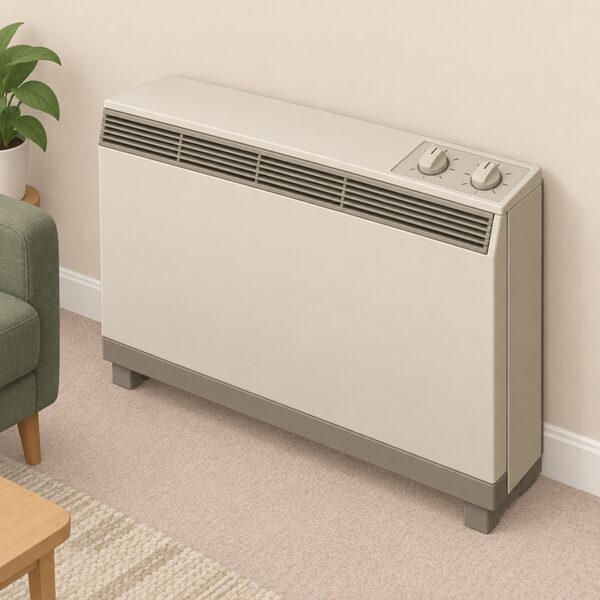
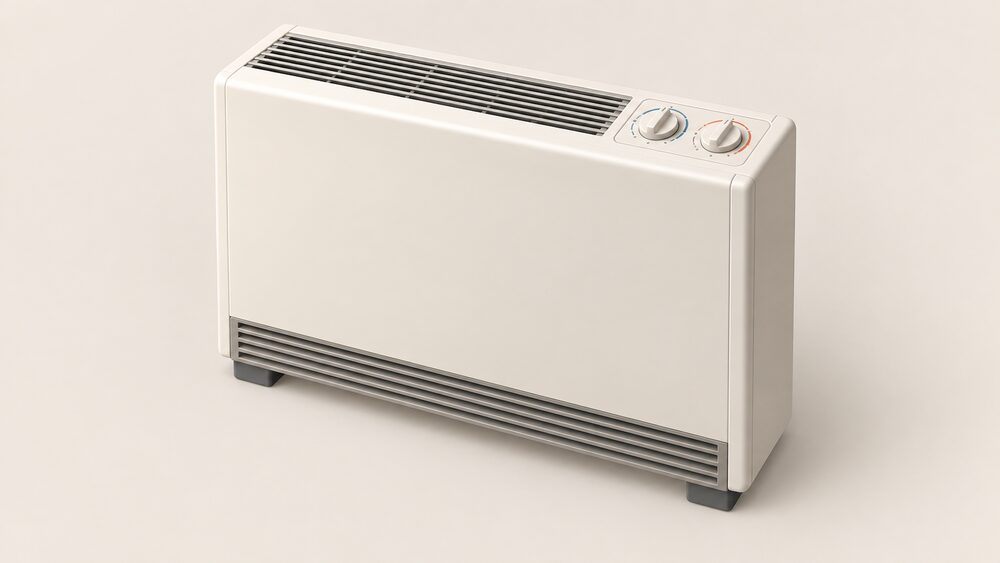
Older storage heaters use input and output dials to control heat2. The input dial, sometimes known as charge, controls how much heat the heater stores as it charges overnight: a higher input means hotter bricks and more heat for the next day3. The output dial controls how much heat the heater releases during the day, and the higher it is set, the quicker the heater releases its stored heat3. Older heaters release heat continuously, and the output dial governs the flow3. Some models also have a boost setting11.
Modern storage heaters generally come with improved heating controls, including an automatic charge control, a thermostat and a programmer2. The automatic charge control works out how much electricity it needs to store to meet the programme and uses only the amount of electrical charge it needs2. Modern heaters use thermostats and fans to release heat when the room temperature is lower than what has been set3.
The regulatory direction is towards automation. Building guidance states that automatic control of input charge should be provided, and requires automatic control of input charge and an adjustable heat release rate for electric storage heaters12. The 2026 Approved Document L volume for Wales carries the same requirement14.
| Control type | What it sets | When it takes effect |
|---|---|---|
| Input dial (charge) | How much heat is stored overnight3 | The following day15 |
| Output dial | How fast stored heat is released3 | Immediately3 |
| Automatic charge control | How much electricity is stored to meet the programme2 | The following day15 |
| Thermostat and fan | When heat is released into the room3 | Immediately3 |
| App schedule | Times and temperatures across the week1 | Per the schedule1 |
Charging a day ahead: the timing limit of storage heater controls
Storage heaters charge during off-peak hours when electricity is cheaper, usually overnight3, and they use electricity at a cheaper rate to store heat for later use16. The charging period is fixed by the tariff, and the required tariff is a 7, 10 or 24 hour supply17. Economy 7 is the common example, and storage heaters are sometimes called Economy 7 heaters for that reason18.
The limit is that changes to the input do not take effect until the next day. Guidance for both types of storage heater states that they need to charge the night before and that any changes to the input will not happen until the next day15. A household that turns the input up on a cold afternoon gets the benefit the following afternoon, not that evening.
That is why the output of a storage heater usually declines in the evening, just when many homeowners need it most19. The pattern is well documented: storage heaters can leave a home very warm in the morning and struggle to stay warm in the evening6. The store is sized for an average day, and a colder day than expected exhausts it early.
The tariff side is where the household has real leverage. Storage heaters work with special electricity tariffs that provide cheaper rates at certain times of the day2, and the automatic charge control on a modern unit regulates how much energy is used by storing more or less heat at night3. Matching the charge to the next day's weather and occupancy is the whole skill of running them. The interaction between controls and time-of-use pricing is covered in using heating controls with time-of-use and smart tariffs and storage heater controls: input, output and smart charging.
Zoning: heating rooms independently
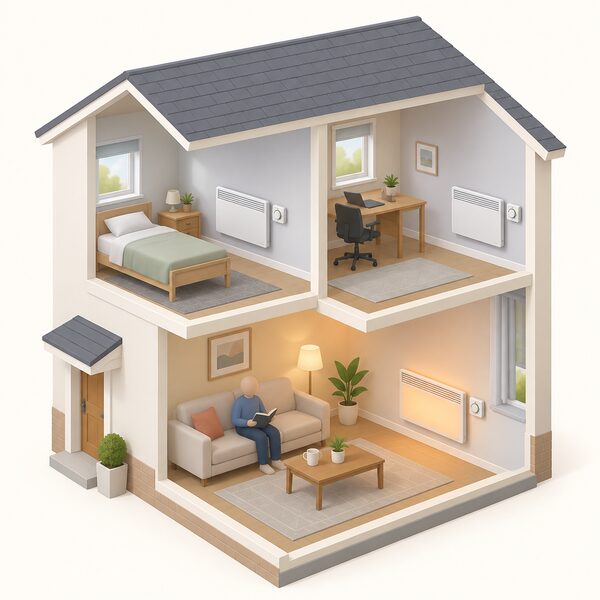
Electric heating zones naturally, because each heater is a separate appliance with its own control. Each room can be treated as a separate zone and controlled individually21. Zone controls heat different rooms at different times of the day automatically through separate programmable heating circuits for different parts of the house22.
The formal definition of a zone control is a device that enables independent programming of temperature and heating times in at least two different areas or zones of a premises22. That is the standard the guidance sets, and a set of independently controlled electric heaters meets it more easily than a wet system does, because no pipework or valves are involved.
Zoning also allows control of individual room temperatures, and smart, programmable thermostats can keep a home heated on a schedule to help minimise bills23. The saving comes from not heating rooms that are not in use, which is a behavioural change the control makes possible rather than a change it makes by itself.
For a household on electric heating, zoning is the main route to cutting consumption without cutting comfort. The general principles are set out in heating zones: zoning a home for heating and hot water, and the radiator-level version in smart TRVs: radiator thermostats with app and zone control.
Safety features and clearances around controlled heaters
Electric heaters carry safety features that wet radiators do not need. Elnur's MAS15 electric system boiler has a heating temperature limiter set at 100ºC24. On electric radiators, overnight use is acceptable as long as the heater has built-in safety features such as thermostatic control and overheat protection25.
The rules differ by appliance type, and the differences matter. Safety guidance recommends against using a portable heater overnight26. Electric blankets can be dangerous if left on overnight unless they have a safe all-night setting, and should never be used with a hot water bottle27; where a blanket is used overnight it should have temperature control settings and safety features such as automatic shut-off and overheat protection28.
Clearance around a heater is a control issue as well as a safety one. Approved Document L states that thermostatic radiator valves should not be used in the same room as the thermostat, and that heat emitters in the same room as the thermostat should have manual controls14. That rule prevents two controls fighting over the same room, with the valve throttling the emitter while the thermostat calls for more heat. It also means the room holding the thermostat needs a clear path between emitter and sensor, so that the sensor reads the room rather than a pocket of still air behind furniture.
Do electric radiators need bleeding or servicing?
No. Electric radiators do not circulate hot water through the home and do not trap air, so they do not need to be bled29. There is no water inside them of the kind found in a traditional central heating system25.
Wet radiators are the opposite case. An individual radiator that is warmer in some places than others may need bleeding, which a householder can do30, and radiators need bleeding every couple of years to remove trapped air bubbles30. Maintenance guidance is to check radiators at least once a year to see whether they need bleeding31.
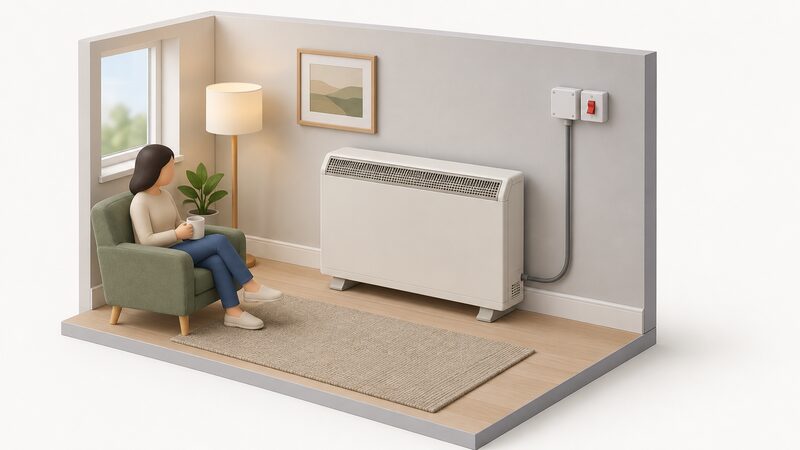
The practical difference for a household is that electric heating has no annual service ritual and no water treatment. What it does have is a fixed electrical connection: storage heaters need a connection to the correct circuit in the home and are hard-wired to the circuit2. Replacement is not a DIY job, and a registered electrician should replace storage heaters2. Larger models weigh more than 150kg, which is a second reason the work is not a one-person task2.
Where the controls leave a household
The independence an Elnur or Gabarron control gives a household is real but partial. Scheduling, zoning and automatic charge control all reduce waste, and the G-Control Hub's photovoltaic surplus management lets a home with solar panels divert generation into heat rather than exporting it1. That is a genuine step towards using energy on site.
What remains is the grid and a supplier. Every one of these heaters runs on mains electricity, and the cheap-rate window that makes storage heating economic is set by the tariff rather than by the household. The controls decide how much is bought in that window; they do not create the window. Remote features add a further dependence on broadband and the maker's app, and the automation that building guidance now requires12 is a dependence on the control working as designed.
For a home off the gas grid, storage heaters are cheaper to operate than standard electric heaters6, and basic models cost as little as £150, with higher specification costing more6. The controls are the part that determines whether that running cost advantage is realised. The wider comparison between electric and stored heat is set out in storage heater controls and controls for electric radiators, panel heaters and infrared.
Sources31 cited
- Elnur G-Control Hub for WiFi control, Elnur, 2024
- Electric storage heaters, Energy Saving Trust, 2026
- A guide to using electric storage heater controls, Energy Saving Trust, 2026
- Energy efficiency advice, Cadent Gas, 2026
- What are the best energy saving tips for UK households, British Gas Energy Trust, 2026
- Electric heaters vs storage heaters, Energy Helpline, 2026
- Best boilers, Confused.com, 2026
- What are smart thermostats, Uswitch, 2026
- Best smart radiator valves, Which?, 2026
- Thermostats and heating controls, Energy Saving Trust, 2026
- Night storage heaters, Centre for Sustainable Energy, 2025
- Approved Document L Volume 1 consultation version, Welsh Government, 2025
- Approved Document L Volume 1, 2021 edition incorporating 2023 amendments, UK Government, 2023
- Building Regulations Approved Document L Volume 1 2026, Welsh Government, 2026
- How to save energy when you've got electric storage heaters, Home Energy Scotland, 2025
- Renewable heat: right for your home, Energy Saving Trust, 2026
- SAP 10.3 full specification, BRE Group, 2026
- What is Economy 7, Smart Energy GB, 2026
- What heating options are available off the grid, OFTEC, 2026
- Off gas grid heating guides, OFTEC, 2026
- Electric space heating, BEAMA, 2026
- ECO4 new measures and products guidance, Ofgem, 2026
- Underfloor heating system, NICEIC, 2026
- MAS15 electric system boiler, Elnur, 2026
- Electric radiators, EDF Energy, 2026
- Portable heaters, Electrical Safety First, 2026
- Stay warm at winter, Belfast City Council, 2026
- Electric blankets, Electrical Safety First, 2026
- How to bleed a radiator, Smart Energy GB, 2026
- How to keep your boiler working in cold weather, Which?, 2025
- Boiler maintenance, Uswitch, 2026
 Elnur heatingElnur makes electric heaters that run without gas, including storage heaters and thermal radiators.