In this guide
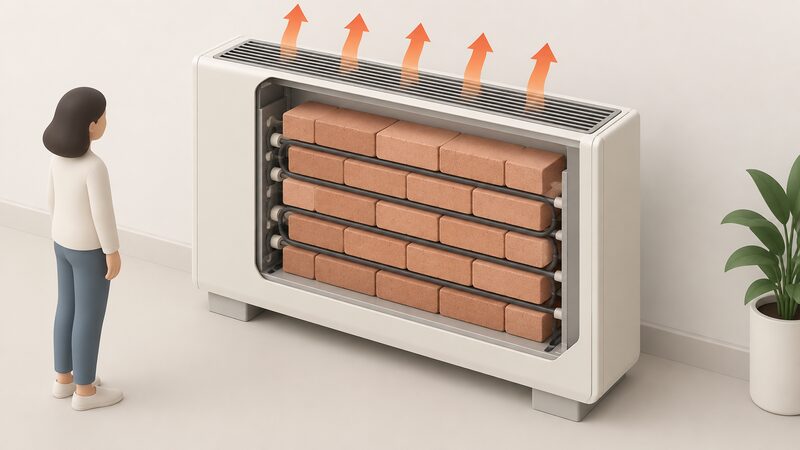
Creda storage heaters are a legacy name in UK electric heating, and the units themselves are still working in a great many homes. The technology behind them is simple: electric storage heaters use electricity to generate heat and store it inside a core, often made from heavy clay blocks, so that cheaper overnight electricity can be turned into daytime warmth1. They charge during off-peak hours, usually overnight, and release that heat during the day2.
The economics are the whole point, and they are also the whole risk. Storage heaters are designed to work with Economy 7, a tariff where night-time electricity is much cheaper, typically about half the price, but day-time electricity is more expensive3. Used that way, and with the controls understood and updated regularly, they are described as a cheap form of electric heating4. Used on a standard tariff, the same appliance loses its advantage.
For a household thinking about independence, a storage heater is a mixed proposition. It runs on electricity, so it is free of the gas grid, of a gas supplier and of flue work, and it needs no fuel deliveries. What it does not escape is the electricity grid, an electricity supplier and a time-of-use tariff structure. The heat is also finite: the bricks hold what was put into them overnight, and nothing more.
Creda storage heaters: what the range covers
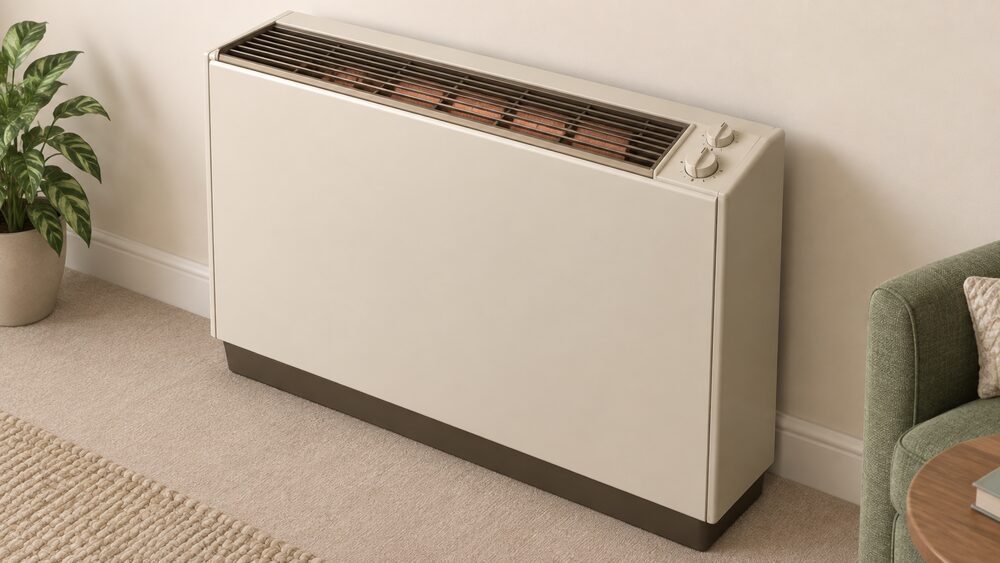
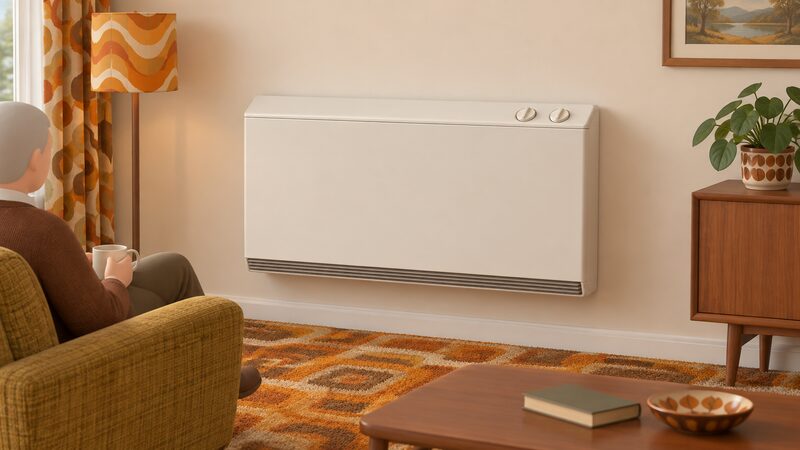
Creda is a legacy brand rather than a current product family with published specifications in the UK market. The units most often found in homes are older night storage heaters with manual input and output dials, the type that independent guidance describes as using input and output dials to control heat1. That generation of heater is the one that gives storage heating its reputation for being awkward: the householder has to judge overnight how much heat tomorrow will need.
The wider storage heater category has moved on considerably. Modern storage heaters generally come with improved heating controls, including an automatic charge control, thermostat and programmer, and have higher heat retention, meaning they hold heat for longer1. They can also release heat more quickly when needed, sometimes using a fan to send out warm air1. Digital models use sensors and smart controls to store just the right amount of heat, and most have timer modes such as "out all day" or "home all day"2.
That gap between an older Creda unit and a current high heat retention model is the single most important thing to understand about this subject. The brand name on the case tells you very little about how the appliance behaves; the control type and the heat retention do. A household with an old manual Creda heater is running a fundamentally different appliance from one with a modern automatic unit, even though both are called storage heaters.
The TRSE and what a modern storage heater does differently
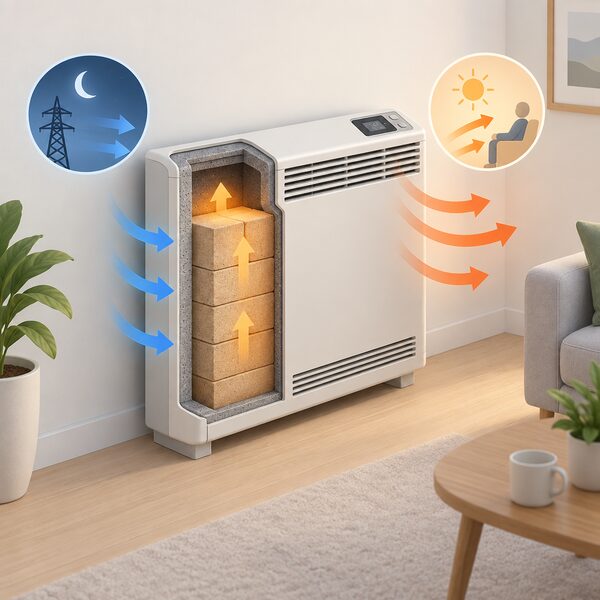
The modern storage heater, whatever the badge, works on the same two-phase principle as the Creda units it replaces. Storage heaters have a charging phase and a heating phase2. During the charging phase the core is heated using off-peak electricity; during the heating phase that stored heat is released into the room.
What has changed is the control intelligence. On a manual heater, the householder sets the input dial to decide how much heat to store, where a higher input means hotter bricks and more heat for the next day2. On a digital heater, sensors and smart controls store just the right amount of heat, looking at the temperatures inside and outside as well as how much heat was needed the previous day2. A thermostat lets the householder set the temperature the heater should bring the room to2.
The regulatory floor has also risen. Storage heaters made after 2018 must meet stricter efficiency standards and come with better controls1. High heat retention storage heaters have automated controls and retain more heat than other storage heaters1. They may appear as recommendations in a home's Energy Performance Certificate1.
"Automatic control of input charge should be provided."
That requirement is not optional in new work. Approved Document L states that automatic control of input charge should be provided for electric storage heaters9. The same principle appears in the Welsh volume8. In practice this means a compliant new installation will not rely on a householder remembering to turn a dial.
Specifications to check before you buy
The standards behind storage heaters are worth knowing because they determine what a unit can claim. The characteristics of storage heaters are set out in BS EN 60531:199910, and manufacturers of storage heaters suggest using the definitions in BS EN 60531:2000+A11:2019, which is already used in the relevant regulations11.
Two features separate a basic unit from a better one. Combination storage heaters come with an additional built-in convection heater, usually incorporated as a grille at the top of the unit, that can give on-demand heating if the stored heat runs out too soon7. High heat retention storage heaters retain more heat than other storage heaters and have automated controls1.
| Feature | What it means in practice |
|---|---|
| Automatic charge control | Required by Approved Document L for electric storage heaters9 |
| Adjustable heat release rate | Required alongside automatic input charge control9 |
| High heat retention | Retains more heat than other storage heaters, automated controls1 |
| Combination heater | Built-in convection heater as a top grille, for when stored heat runs out7 |
| Digital controls | Sensors and smart controls store just the right amount of heat2 |
| Timer modes | "Out all day" or "home all day" settings2 |
The sales rule matters as much as the specification. Older models made before January 2018 can still be sold, so check carefully before you purchase7. A unit on a merchant's shelf today may predate the stricter standards and better controls that apply to storage heaters made after 20181. The date of manufacture, not the date of sale, is the thing to establish.
Cost, running costs and off-peak tariffs
Running cost is where storage heating is decided. Official statistics put electric storage heaters at £3,000 to £3,800 annual cost for a three-bed semi-detached house, the most expensive fuel type across Great Britain regions, as of March 20265. That figure is the reason the tariff question is not a detail.
Storage heaters use Economy 7 or Economy 10 tariffs for cheaper energy at night12. Guidance states they should always be used on an Economy 7 tariff to take advantage of cheaper overnight electricity4. The tariff structure is the trade: night-time electricity is much cheaper, typically about half the price, but day-time electricity is more expensive3.
The comparison between heater types is stark. High heat retention storage heaters are up to 27% cheaper to run than standard storage heaters3. Dynamic storage heaters, by contrast, do not work with Economy 7, and their running costs are still higher than night storage heaters for that reason; one documented figure is £1,080 annual space heating cost on a single-rate tariff for an average flat or small home, with the heater itself priced at £400 to £6004.
Support exists for upgrading. In Scotland, high heat retention storage heaters attract a £5,500 loan and a £2,500 grant per improvement6. In Northern Ireland, electric storage heaters on an off-peak or Economy 7 tariff are listed as qualifying efficient heating under the decent homes standard13. Tariff design and grant availability differ across England, Scotland, Wales and Northern Ireland, so the same heater can have a different payback in each.
Installation and what owning one means day to day
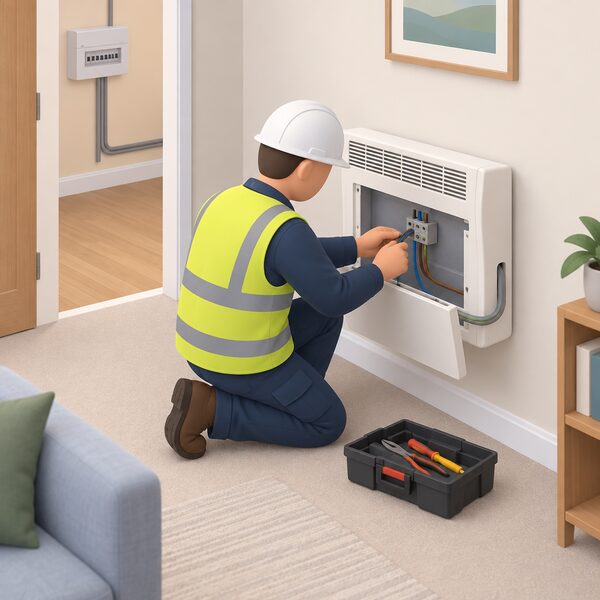
Storage heaters need a connection to the correct circuit in the home and are hard-wired to the circuit, and a registered electrician should replace them1. Installation and fit of a storage heater, including the final circuit, is notifiable where it falls outside and within a bath, shower room, kitchen or special location14. In Scotland, the statutory definition of an electric storage heater covers a free-standing storage heater, an electric fan-assisted storage warm air system, an electric wired underfloor heating system set in solid floors, or an electric ceiling heating system15.
Day to day, the operating rhythm is the thing to plan around. Storage heaters do not produce heat instantly like a regular electric heater; they rely on the heat stored overnight, so planning ahead is essential2. The documented pattern is that they can leave a home very warm in the morning and struggle to stay warm in the evening16. Coverage is usually one heater per room7.
The controls follow a simple logic. The input or charge control regulates the amount of heat stored up during the night, set higher in cold weather and turned down or off in warmer weather12. The output control releases that heat, and overnight it is set to the lowest setting or the frost control symbol12. On a manual heater, the higher the input, the more electricity the heater uses and the more heat it stores2.
Replacing older storage heaters with a cleaner setup
Replacement is a live question for anyone with an ageing Creda unit, and the evidence base is mostly about what replaces storage heaters rather than what replaces Creda specifically. One documented case study describes a householder who purchased an 1870s home with an old electric storage heating system and upgraded it with an air source heat pump17. A council retrofit project in Thurrock is recorded as a retrofit replacing storage heaters18.
The direction of travel in policy is clear. Scotland's Heat in Buildings Bill consultation lists modern, efficient electric storage heaters alongside heat pumps, heat networks, wet electric heating and other direct electric heating technologies as clean heating systems19. That places storage heaters inside the accepted set of solutions rather than outside it, provided they are the efficient kind.
The technology around storage is also developing. Thermal energy storage systems, which include heat batteries, have emerged as an important technology in the UK's transition to net-zero20, and MCS has announced a pilot for a new thermal energy storage systems installation standard20. The Home Energy Model has updated storage heater and heat battery models21. In Northern Ireland, 134 heating replacements were recorded under an innovative schemes programme in 2024/2522.
For a household, the practical question is whether to replace like with like or change technology. A modern high heat retention storage heater keeps the existing wiring, the existing tariff structure and the room-by-room approach, and is up to 27% cheaper to run than a standard unit3. A heat pump changes the fuel source and the whole system. Both routes are documented; neither is a recommendation here.
Creda alongside other electric heating options
Electric heating is not one thing. Some heaters use electricity at a cheaper rate to store heat for later use, while others use electricity when the room needs heating23. Storage heating sits in the first group, and it can be static or fan-assisted, providing the base load heat requirement of a home24.
The alternatives each carry a different tariff consequence. Direct acting systems on a standard electric tariff can be more expensive to operate than a storage heater on an economy tariff24. Secondary electric heating covers portable electric heaters and electric towel rails25. For a household weighing options, the comparison pages on direct acting electric heating versus storage heaters and infrared panels versus storage heaters set out the trade-offs, and the wider storage heaters page explains the technology from first principles.
The independence picture is consistent across all of them. Electric heating of any kind removes the gas grid, the gas supplier and the flue, and it removes fuel deliveries. It does not remove the electricity grid or an electricity supplier, and storage heating adds a dependence on a time-of-use tariff being available and correctly configured. A storage heater that is not on an off-peak tariff is an expensive direct electric heater with extra bricks.
Sources26 cited
- Electric storage heaters, Energy Saving Trust, 2026-05-20
- A guide to using electric storage heater controls, Energy Saving Trust, 2026-05-21
- Night storage heaters, Centre for Sustainable Energy, 2025-10
- Electric heating, Centre for Sustainable Energy, 2026-06
- Research briefing CBP-9838, UK Parliament, 2026
- Funding, grants and loans, Home Energy Scotland, 2026-09-17
- Electric central heating, Which?, 2025-09-22
- Approved Document L Volume 1 consultation version, Welsh Government, 2025-08
- Approved Document L Volume 1, 2021 edition incorporating 2023 amendments, UK Government, 2023
- SAP 10.3 full specification, BRE Group, 2026-01-13
- BEAMA response to Energy Smart Appliances Regulations consultation, BEAMA, 2026-02-05
- Getting the most from Economy 7, National Energy Action, 2026-09-10
- Current decent homes standard summary table, Northern Ireland Department for Communities, 2025-08-05
- Amended Part P electrical safety, Wigan Council, 2004-12
- The Central Heating Programme (Part 3), legislation.gov.uk, 2006-11-29
- Electric heaters vs storage heaters, Energy Helpline, 2026-09-20
- Joanna O'Loan: upgrading storage heaters with an air source heat pump, Energy Saving Trust, 2026-02-19
- Kensa Thurrock Council Chadwell St Mary case study, Heat Pumping Technologies, 2026-09-17
- Delivering net zero for Scotland's buildings, Scottish Government, 2023-11
- MCS announces pilot for new thermal energy storage systems installation standard, MCS Certified, 2025-09-15
- Home Energy Model consultation government response published, Future Homes Hub, 2025-10-09
- NISEP Annual Report 2024-25, Utility Regulator Northern Ireland, 2026-07
- Heating your home, Energy Saving Trust, 2026-05-19
- Electric space heating, BEAMA, 2026-09-19
- Electric heating, Energy Saving Trust, 2026-07-01
- Fireball Turbofan 3000 electric heater recall, Electrical Safety First, 2026-09-17