
In this answer
Short answer
A direct debit is a supplier's estimate of what a household will use over a year, divided into equal monthly payments. It is not a bill for energy already used, and it is not capped at the price cap figure. When it rises, the usual cause is that the household has used more energy than the supplier expected, so the payments are being reset to recover the difference and cover the year ahead1.
The cap itself sets the ceiling on unit rates and standing charges for a default tariff, not the total a household pays. For 1 October to 31 December 2026 the cap is £1,723 a year for an average-use household paying by Direct Debit, up £60 from £1,6632. A household that uses more than the typical benchmark pays more than that figure, and a household that uses less pays less.
What follows is how the estimate is built, what notice and repayment rules bind a supplier, what a deemed contract means, and how far arrears across the market are pushing payments up.
Why direct debits rise: the price cap and your supplier's estimate
A direct debit moves for two separate reasons, and households often conflate them. The first is price: the cap level changes at each quarterly review, and the unit rate and standing charge a supplier charges move with it. The second is volume: the supplier's estimate of annual use turns out to be wrong, and the monthly figure is reset to recover the gap.
Citizens Advice is direct about the second: payments have probably gone up because the household is using more energy than the supplier expected7. The same guidance notes that payments may rise for that reason while the price of energy and the daily fee stay the same, which is the case for fixed tariff customers7. A fixed tariff does not protect a household from the direct debit amount increasing or decreasing8.
The mechanism is straightforward. A direct debit is typically calculated using past energy use and spread evenly over 12 months9. If the past year included a cold winter, a period of working from home, or a run of estimated readings, the baseline is already high, and the following year's payments inherit it. Credit builds when a household pays for more energy than it has used, which is exactly what a set monthly amount produces in the warmer months10.
Suppliers may also increase the amount over the winter months to cover additional usage, while the rates charged per unit of energy do not change11. That is a cash-flow adjustment, not a price rise, and it is one of the most common sources of confusion when a household compares its monthly payment with the cap figure it has read about.
The price cap: £1,723 a year for a typical home

The cap figure that dominates headlines is an annual illustration, not a monthly charge and not a ceiling on any individual bill. For 1 October to 31 December 2026 it stands at £1,723 a year for an average-use household paying by Direct Debit, a rise of £60 from £1,6632. The Welsh Government's consumer guidance puts the current cap at around £1,758 for a dual-fuel home with typical usage in Great Britain paying by direct debit12.
Independent guidance records the cap at £1,723 for 1 October to 31 December 20262, while other independent guidance gives £1,663 per year for an average household paying by Direct Debit as of July 20263. Independent statistics put the cap at £1,862 per year from 1 July to 30 September 2026, based on average unit rate and standing charge for Direct Debit customers in England, Scotland and Wales13. The figures differ because they cover different cap periods and different payment assumptions.
What the cap does and does not do matters more than the headline number. It applies to default tariffs regardless of how a household pays, whether by direct debit or prepayment, and it does not cover fixed, green or time of use tariffs12. It limits the unit rate and standing charge, so a household using more than the typical benchmark pays more than the cap figure and one using less pays less. The typical household figure is a benchmark, not a bill.
The cap also moves in small increments that households rarely notice month to month. From 1 January to 31 March 2026 there was a monthly increase of 28 pence for a typical dual fuel Direct Debit household4. Earlier, the cap for average households on dual fuel Direct Debit increased to £1,849 in April 2025 due to higher wholesale costs14.
How suppliers calculate your direct debit
The calculation rests on three inputs: past consumption, the current unit rate and standing charge, and an assumption about the year ahead. Direct debit amounts are typically calculated using past energy use and spread evenly over 12 months9. Suppliers should review the amount annually5.
Where the estimate goes wrong, the consequences land on the household. A Which? survey covering September to October 2025 found that 7% of respondents had experienced direct debit payments set too high or too low by their supplier in the past year5. A separate Warm This Winter Opinium survey found that 26% of bill payers felt their direct debit payments had been set too high, with 29% of Eon Next customers and 29% of British Gas customers reporting that view15.
Two structural features of the market push the estimate upward. First, suppliers are not allowed to offer discounts to people who pay by direct debit, but they can restrict access to their cheapest tariffs to direct debit customers, so the payment method is effectively tied to the best available rate16. Second, the standing charge element of the cap has risen sharply: the standing charge allowance for both single rate and multi-rate direct debit electricity consumers in Great Britain saw a 116.4% real terms average increase between January 2019 and September 202417. A higher fixed daily charge means a larger floor under every monthly payment, whatever the household uses.
What your supplier must do if you can't afford the payments

The rules here are procedural rather than generous, and they are worth knowing precisely. A supplier should give reasonable notice of any changes to direct debit payments and explain why the change is necessary7. It should also explain why the change is necessary when a household queries it1.
Where a household cannot meet the payments, the guidance is consistent across sources: agree a plan rather than cancel the direct debit. Cancelling lets debt build up, and it is better to agree a payment plan with the supplier19. If a direct debit is returned unpaid because there are not enough funds in the account, it may result in a charge from the bank to cover additional administration11.
For prepayment customers who cannot afford to top up, the supplier must offer help, for example by giving extra credit in a vulnerable situation20. That obligation sits alongside the wider debt picture: nearly three quarters of domestic consumer energy debt is held by customers who have no repayment plan in place, known as arrears21.
Deemed contracts: when you never chose a tariff
A deemed contract is normally in place when a customer moves to new premises and starts to consume gas or electricity, or both, without agreeing a contract with a supplier22. It is the default state of a new household that has not yet chosen anything, and it is common after a move.
The important protection is that the price cap still applies on a deemed contract23. A household in that position is not outside the cap and is not exposed to uncapped pricing, though it will be on the supplier's default tariff, which is generally the most expensive type of energy deal24. Default tariffs do not charge a fixed amount per unit of energy, so the cost of bills could potentially increase8.
Getting off a deemed contract means choosing a tariff with the existing supplier or switching to another one. Where a household switches, it will be asked to set up the direct debit ahead of the date the new supplier takes over, and should cancel the old direct debit after paying the final bills11. Debt on the account can complicate a switch, which is why the switching process and any arrears are usually dealt with together.
Debt and arrears: a growing pressure on bills
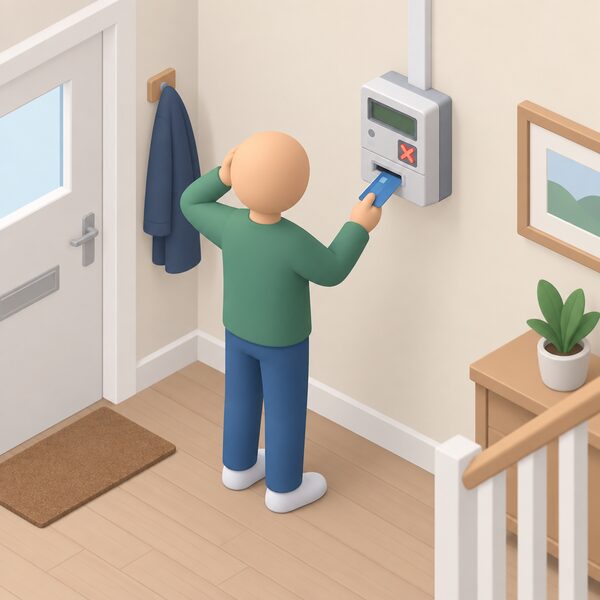
Arrears are no longer a marginal issue in the domestic market, and they feed directly into the level of direct debits paid by households that are up to date. The total energy debt and arrears in households has more than doubled in the last three years6. Prepayment arrears alone show an 86% increase from three years ago25.
The cost of that debt is shared. Bad debt is a growing problem in the energy sector, which is adding to the cost of everyone's bills26. That is the mechanism by which a household paying on time still sees its direct debit rise: the supplier recovers the cost of unpaid debt across its customer base, and the cap allows for it.
The longer trend in payment methods is also relevant. Electricity bills paid by Direct Debit instalment increased by 128.84% between 2014 and 2023, while standard credit bills rose by 120.63% and prepayment electricity bills by 106.43%27. Direct debit customers have seen the steepest increase of the three payment methods over that period.
Where to complain when your direct debit seems wrong
The first step is the supplier. Ofgem lists the matters a supplier must handle: late, incorrect or missing bills, back billing, being overcharged, a faulty meter, poor customer service, and refusing to refund credit from an account28. A household that has supplied recent meter readings and still cannot get the direct debit explained has a complaint.
If the supplier cannot justify the direct debit or share meter readings, the complaint can be escalated to the energy ombudsman29. That is the route for a household that has exhausted the supplier's own process.
Two practical points sit alongside the complaint route. A supplier may refuse a credit refund where the direct debit payments would not cover future bills without a credit balance, where no recent meter reading has been supplied, or where a smart meter is not working correctly18, so a refund request is stronger with an up-to-date reading behind it. And where a supplier has gone out of business, Ofgem's guidance covers what happens to the account and any credit balance30.
For households in Northern Ireland, the advice route differs from Great Britain, and the relevant guidance is published separately19.
Sources30 cited
- Energy supplier has increased your direct debit, Citizens Advice
- Ofgem price cap guide, Uswitch, 2026-08-26
- Energy tariff ending guide, Uswitch, 2026-07
- Changes to the energy price cap between 1 January and 31 March 2026, Ofgem, 2025-11-21
- Top energy company issues and how to solve them, Which?, 2026-03-03
- What is fuel poverty, National Energy Action, 2026-08-23
- Your gas or electricity supplier has put up its prices, Citizens Advice
- Energy tariffs explained, Uswitch, 2026-02-17
- Understanding your gas or electricity bill, Centre for Sustainable Energy, 2026-02
- Understand your electricity and gas bills, Ofgem, 2026
- Direct debit energy payments, Uswitch, 2025-10-22
- Energy price cap explained, Welsh Government, 2026-03-04
- Current gas and electricity prices, Centre for Sustainable Energy, 2026
- State of the energy market report: retail, Ofgem, 2025
- Two thirds of bill payers call for automatic energy credit refunds, End Fuel Poverty Coalition, 2024-06
- Dealing with your energy supplier, Centre for Sustainable Energy, 2026-01
- Ofgem call for input on standing charges: domestic retail options, Consumer Scotland, 2024-09
- Energy credit guide, Confused.com, 2026-07-03
- Advice if you're struggling to pay your energy bills, nidirect, 2026-09-17
- Get help with your prepayment meter, Ofgem, 2026
- Debt strategy update: supporting a reduction in energy debt, Ofgem, 2025-11-06
- Deemed contracts and rates, Energy Ombudsman, 2026-09-20
- What happens if your energy supplier goes out of business, Ofgem, 2026
- A step by step guide to setting up gas and electricity in a new home, Energy Helpline, 2026-09-20
- Future of prepayment discussion paper, Citizens Advice, 2026-06-25
- Improved bill support: the case for a social discount, Energy UK, 2026
- Energy statistics, Uswitch, 2025-12-17
- Complain about your energy supplier or network operator, Ofgem, 2026
- Explained: why are energy direct debits so high, Which?, 2022-09-29
- You haven't received a gas or electricity bill in a while, Citizens Advice, 2026-09-20
 Price Cap RatesPaying by direct debit, prepayment or standard credit changes what you pay under the price cap, so which method is cheapest?
 The Full Energy Bills and the Price Cap GuideWondering why your bill went up even when you used less power?
 Prepayment Meters and DebtCan your energy supplier force you onto a prepayment meter because you owe them money?
 Electricity Network ChargesWhy are network charges on my bill so high, and who decides how much they are?
 Ways to Pay an Energy SupplierHow you pay for gas and electricity changes what you are charged, and by how much.
 Direct Debit and CreditExplains how fixed monthly direct debits are set and reviewed, why balances build over the year, and the rules on refunding credit.