
In this comparison
A kettle is usually the cheaper way to boil a small amount of water, because it heats the water directly and loses very little of the energy on the way. An electric hob heats a pan, and the pan heats the water, so heat escapes to the air, into the pan body and around its base. The published efficiency figures make the gap plain: induction cooking is given as around 85% efficient, electric hobs around 75% and gas hobs around 40%1.
The cost of a single boil is small either way. Consumer guidance puts a kettle boil at a few pence, depending on the tariff, the kettle's wattage and how much water is in it2. A 3,000W kettle taking three minutes to boil is given as 5p on average, and one taking two minutes as 3p, at the prices used in that calculation; four boils a day at those figures come to around £59 and £44 a year respectively3.
The bigger and more reliable saving is not the appliance but the amount of water. Overfilling a kettle is put at around £10 a year in Great Britain and £12 in Northern Ireland4, with a separate estimate of around £10 a year in England, Scotland and Wales and £11 in Northern Ireland5. An ECO kettle designed to boil only what is required is stated to use 20% less energy than a conventional electric kettle6.
The short answer: a kettle is usually cheaper for small amounts
For a mug, a pan of pasta or a hot-water bottle, the kettle is the lower-loss appliance. It has one job, and it does it by immersing a resistive element in the water, so almost all the electricity becomes heat in the water rather than in the room. The hob has an extra step in the chain, and every step loses something.
The scale of the difference is set by the efficiency figures rather than by the wattage. Induction cooking is given as around 85% efficient, meaning only about 15% of its energy is wasted, and as using 57% less energy than gas hobs1. Electric hobs are put at around 75% and gas hobs at around 40%1. A kettle is not given a comparable percentage in the published guidance, but its direct heating method is the reason it wins on small volumes.
What a household should expect in practice is a difference of pence per boil, not pounds. The published running costs are 5p for a three-minute boil and 3p for a two-minute boil, which at four boils a day come to around £59 and £44 a year3. Those figures are from 2023 and depend on the tariff in force at the time, so they are a shape rather than a current price.
The independence point is modest but real. Boiling water is a load a household controls completely, and it can be shifted to a sunny afternoon when a home has its own generation, or reduced outright by filling the kettle to the line. It is one of the no-cost and low-cost measures that need no installer and no assessment.
How the two compare: power rating and heating element
An average electric kettle is given as having a power rating of 2,500 to 3,000 watts2. That is a high draw for a domestic appliance, but it is applied for a short time, and the guidance notes that smaller appliances such as kettles and plugged-in chargers use much less energy overall, at 1 kWh or lower7. High power and low total energy are not in conflict: the kettle is simply fast.
Consumer guidance suggests looking for rapid-boil models in the 2.5 to 3.0kWh range, designed to boil small amounts of water quickly1. The logic is that a fast boil spends less time losing heat from the water surface and the kettle body, so the shorter the boil, the smaller the standing loss.
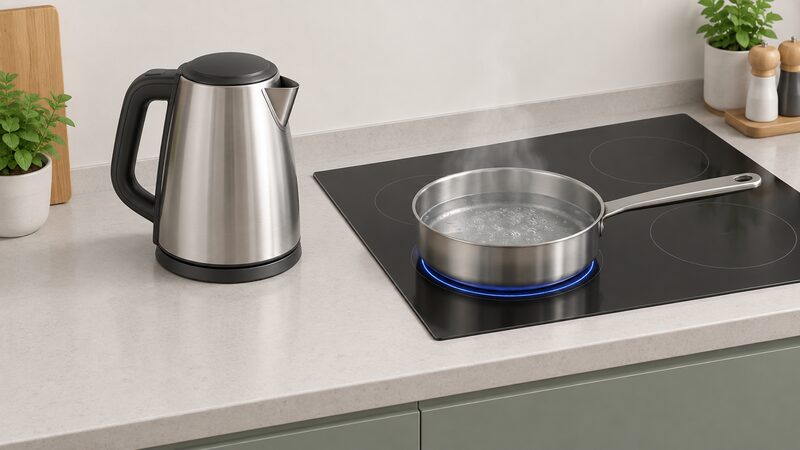
A hob works differently. The ring heats a pan, and the pan's base transfers heat to its contents. The element or flame is not in contact with the water, so the transfer depends on the flatness of the pan base, the material and how much of the ring's area the pan covers. A pan narrower than the ring spills heat into the air; a warped base leaves an air gap.
"Gas and electric hobs are much less energy-efficient, at around 40% and 75% efficiency respectively."
The practical consequence is that the kettle's advantage grows as the volume falls. For a single mug, the hob has to heat a pan as well as the water, and that pan then has to be washed. For a large pan of vegetables, the hob is doing work the kettle cannot do at all, and the comparison stops being meaningful.
Efficiency: the kettle wins on heat transfer
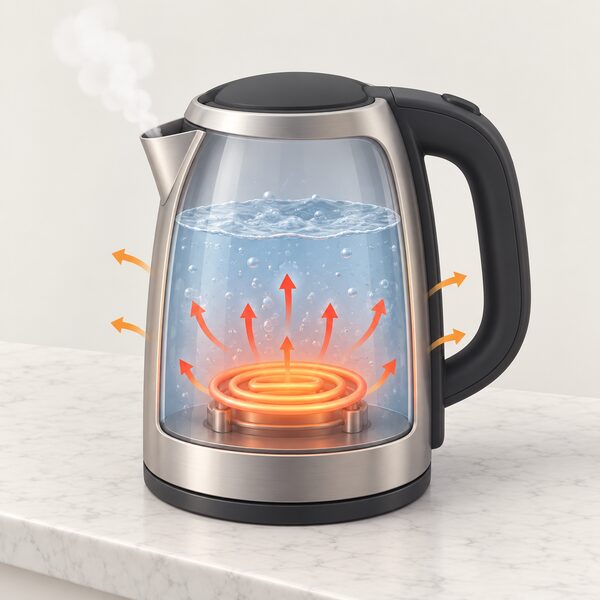
The efficiency question is about where the energy ends up. In a kettle, the element is submerged, so the heat has nowhere to go but into the water, and the only losses are through the kettle walls and from the steam at the end of the boil. In a hob, the heat has to cross an air gap or a contact surface before it reaches the water, and some of it never makes the crossing.
Induction is the most efficient hob type on the published figures, at around 85%1. It works by inducing a current in the base of a suitable pan, so the pan itself becomes the heating element and the hob surface stays relatively cool. That removes one layer of loss compared with a radiant electric ring, and a great deal compared with a gas flame, which is given as around 40% efficient because much of the flame's heat travels around the pan rather than into it1.
The same principle appears elsewhere in home energy: direct heating of the thing you want hot is more efficient than heating something else and passing the heat on. A system boiler is described as more efficient than a combi at producing hot water, but heat is lost from the hot water cylinder over time8, and a heat-only boiler is described as less efficient than a combi for the same reason, losing heat from the stored hot water in the cylinder9. Storage always costs something.
For a household, the useful conclusion is that the kettle's advantage is structural rather than a matter of brand or wattage. A more powerful kettle boils faster, which reduces standing losses, but it does not change the fact that the element sits in the water. A more efficient hob narrows the gap, but it still has a pan in the way.
Why the hob loses heat to the air and the pan
Three losses account for most of the hob's disadvantage. The first is the air gap between the heat source and the pan, which matters most for gas, where the flame licks around the sides. The second is the pan itself: its base, walls and handle all absorb heat that is never used on the water, and a heavy pan takes longer to reach temperature. The third is the hob surface, which stays warm after the pan is removed.
The published efficiency figures are the summary of all three. Gas hobs at around 40% mean that roughly six-tenths of the energy in the flame does not reach the food or water1. Electric hobs at around 75% lose about a quarter1. Induction at around 85% loses about a sixth1. None of these is a kettle figure, because the kettle's losses are small enough that the guidance treats the appliance differently, as a low-energy device overall7.
There is a second cost that does not appear in the efficiency percentage: time. A hob running for ten minutes on high heat is given as 25p3. That figure covers the whole cooking session, not just the boil, and it shows how quickly a hob's cost accumulates compared with a kettle's few minutes.
For a household watching its electricity use, the hob is where the larger cooking load sits, and the guidance on cooking points to appliances that use less power and less time for small jobs. Cooking in a microwave or air fryer is described as cheaper than an oven because it uses less power and takes less time10, and using a microwave for heating or reheating small amounts of food is described as quicker and cheaper than the oven11. The same logic applies to boiling water: match the appliance to the volume.
Cost per litre: how the numbers work out
There is no published figure for the cost of boiling exactly one litre, and the guidance is explicit that the exact amount depends on the electricity tariff, the kettle's wattage and how much water is filled2. What the published figures do give is a set of worked examples at a stated unit rate, which show the arithmetic without pretending to be a current price.
The unit rate used in the cooking calculation is 0.34 GBP per kWh1. At that rate, a 3,000W kettle boiling for three minutes is given as 5p on average, and for two minutes as 3p; four boils a day for a year come to around £59 and £44 respectively3. Those are the figures to work from, and they carry the date of the calculation.
| Example | Time | Cost per boil | Four boils a day, for a year |
|---|---|---|---|
| 3,000W kettle | 3 minutes | 5p on average | around £593 |
| 3,000W kettle | 2 minutes | 3p on average | around £443 |
| Hob, high heat | 10 minutes | 25p | not given3 |
The waste from overfilling is the figure most often quoted, and it is consistent across two independent sources. Boiling more water than is needed for one cup is put at around £10 a year in Great Britain and £12 in Northern Ireland4, and separately at around £10 a year in England, Scotland and Wales and £11 in Northern Ireland5. The two estimates differ slightly in how they are framed, but they agree on the order of magnitude: a few pounds a year, not tens of pounds.
An ECO kettle that only boils the amount of water required is stated to use 20% less energy than a conventional electric kettle6. That is a maker-independent figure for the category rather than a single model, and it describes the saving from boiling less, not from a more efficient element.
When the hob can match or beat the kettle
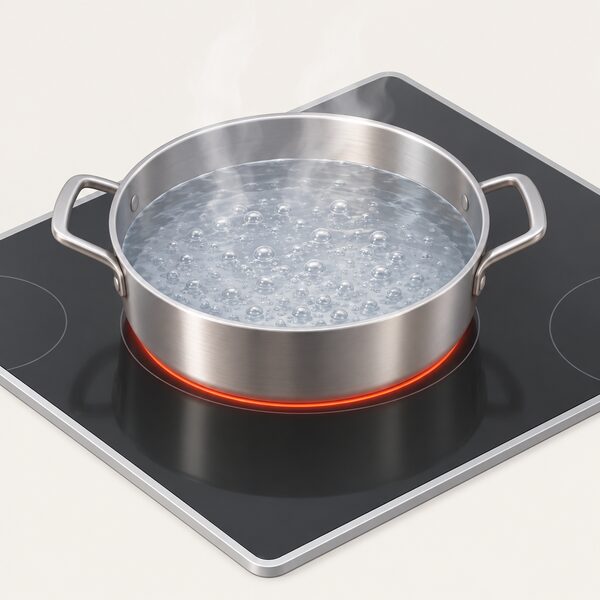
The hob wins on volume and on purpose. A kettle cannot cook, and for a large pan of water the hob is the only option. Where the hob is already running for a meal, adding water to an existing pan costs nothing extra in standing losses, because the ring is hot and the pan is already on it.
Induction narrows the gap more than any other hob type. At around 85% efficiency, with only about 15% of its energy wasted, and using 57% less energy than gas hobs1, an induction ring delivers most of its energy to the pan. For a large volume, where the pan is well matched to the ring and the water is needed as part of a meal, the difference between induction and a kettle becomes small enough that convenience decides it.
The comparison also shifts with the tariff. A household on a time-of-use tariff that makes electricity cheap overnight or in the middle of a sunny day is buying the same kilowatt-hours at a different price, and the appliance choice matters less than when the load runs. The published evidence on time-of-use tariffs is about heating rather than kettles, but it shows the size of the effect: a heat pump paired with a time-of-use tariff is given as saving £280 versus a boiler12, and one tariff is given as saving more than £500 for a SCOP 4.0 heat pump compared with running a gas boiler13.
For a household with its own solar panels, the arithmetic changes again, because the marginal cost of a midday boil is the export price forgone rather than the import price paid. That is a question about generation and storage rather than about kettles, and it belongs with the wider decisions in planning a route to household energy independence.
What this means for household energy use
Boiling water is a small load with a large behavioural component. The appliance choice is worth pence per boil; the fill level is worth around £10 a year in Great Britain and £12 in Northern Ireland4, or around £10 in England, Scotland and Wales and £11 in Northern Ireland5. The second figure is the one a household can act on today, with no purchase.
Set against the rest of a home's energy use, the kettle is minor. The published comparisons that matter are about heating, where the sums run to hundreds of pounds. A heat pump is given as around three to four times more efficient than a gas boiler14, and as using 3 to 4 times less energy to provide the same heat15. Running costs are described as typically lower than those of traditional gas boilers16, though the same guidance notes that a poorly performing system changes the picture. One analysis puts a typical home's annual saving from replacing a gas boiler with a heat pump at £28012, while another finds most families seeing bills increase slightly, by £32 a year on average17.
The independence lens is the same for a kettle as for a heat pump. Both draw from the grid unless a home generates its own, and both are exposed to the unit price of electricity, which is given as around four times the unit price of gas at the standard price-capped rate18. Reducing the waste from overfilling cuts the size of the load; it does not change where the energy comes from. For a household working through the order of measures, the kettle sits with the behaviour and habit changes rather than with the fabric or the heating system, and it is one of the few measures that costs nothing and pays back immediately.
Sources18 cited
- Energy efficient cooking, Uswitch, 27 January 2025
- Kettle running costs, Smart Energy GB, 17 August 2026
- Save money using your electrical appliances, Citizens Advice, 10 May 2023
- Energy mistakes to avoid, Energy Saving Trust, 15 October 2025
- Appliances: how much do yours cost to run, Confused.com, 18 December 2025
- Home appliances, Energy Saving Trust, 20 May 2026
- Uswitch guide to kWh, Uswitch, 26 August 2026
- Boilers, Energy Saving Trust, 20 May 2026
- What are the different types of boiler, Which?, 16 September 2025
- Preparing for winter, National Energy Action, 14 October 2025
- How to save energy in the kitchen, Home Energy Scotland, April 2025
- What it really costs to heat a home in the UK with a heat pump, Carbon Brief, 30 January 2026
- Heat pump calculator, Which?, 30 April 2025
- The seventh carbon budget, Climate Change Committee, 26 February 2025
- Domestic heating technology options, Nesta, 3 February 2025
- What impact can heat pumps have in domestic heating today, GOV.UK, 21 November 2023
- Turning up the heat, Resolution Foundation, 10 April 2025
- Air source heat pump costs and savings, Which?, 14 April 2026
 Hot Water Heat PumpsA hot water heat pump heats only the water in your cylinder, using air instead of a boiler flame.
 Electric BoilersHow electric flow boilers heat a conventional wet system, what they cost to buy and run, where they suit UK homes, and why point-of-use efficiency near 99% does not translate into cheap heating at the meter.
 Heat Pumps vs BoilersWill a heat pump actually cost less to run than my boiler, and does it heat the house as well?
 Heat Pump Running CostsWhat does a heat pump cost to run each year, and is it cheaper than a gas boiler?
 Heating Schedules and SetbackIs it cheaper to leave the heating on low all day, or set it to come on only when you need it?
 The Full Boilers and Heating GuideWhich boiler suits your home, and when is it worth swapping the old one?