
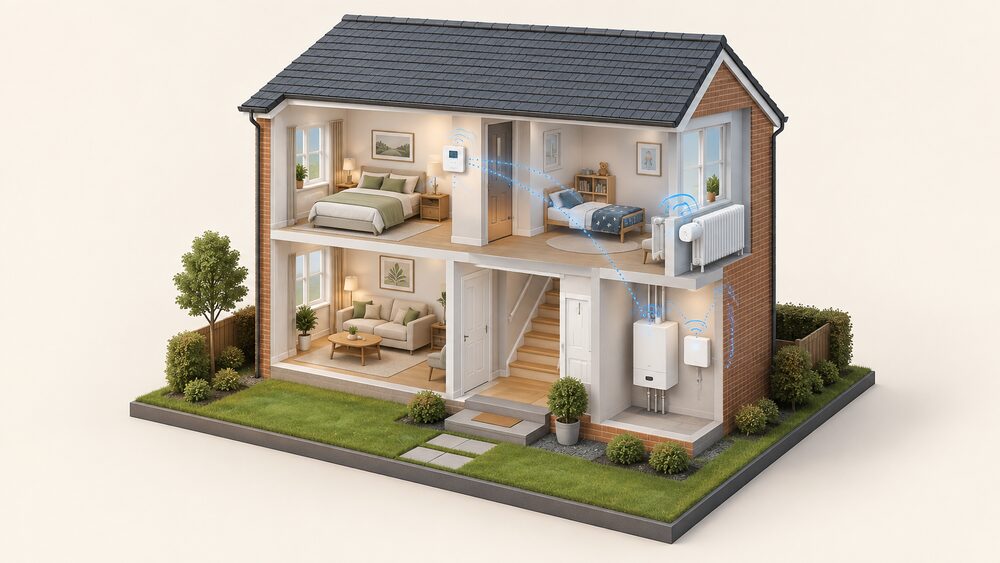
In this guide
WundaSmart is a UK smart heating control system built around room-by-room zoning rather than a single thermostat. Its HubSwitch is a configurable four channel programmer that the maker states will control up to four different heating circuits, and a single system can be expanded to 30 thermostats and 50 radiator heads covering up to 30 different rooms or zones1. The maker describes it as working with any boiler, and lists the HubSwitch as OpenTherm compatible and Boiler Plus compliant2.
The distinctive claim is independence from the cloud. WundaSmart uses a radio frequency signal rather than Wi-Fi, and the maker states the system is not reliant on cloud storage or servers and will still work if the internet goes down3. That separates it from the mainstream smart thermostat model, where scheduling and remote control run through a manufacturer's servers and app.
This page sets out what the system controls, how zoning works in practice, what comes in the kit, how it handles hot water, what happens when the broadband fails, and where the limits sit. Prices are quoted by the maker as recommended retail figures for individual components; installed costs are not published.
What WundaSmart is and what it controls
WundaSmart is a zoning system rather than a single-room thermostat. The HubSwitch sits at the boiler end as a configurable four channel programmer, and the maker states it will control up to four different heating circuits2. The system as a whole is described as unique in the way it can be configured to control up to four heating channels3. That matters for a household with more than one heating circuit, such as a house with a cylinder and separate upstairs and downstairs loops, because the same unit can address each.
At room level, the maker states that WundaSmart lets a household set the temperature in any room or zone, so heating is controlled by when and where it is wanted5. The radiator heads are wireless and offer manual control at the valve as well as app control, so a room can be adjusted without a phone6. Room thermostats pair into zones with radiator heads to give zone temperature and humidity readings7.
The system was developed over four years of specialist research and development, according to the maker6. It is sold as a range of components rather than a single box: the HubSwitch, radiator heads, room thermostats in screened and screenless forms, and a Starter Bundle that combines them.
For a household, the practical effect is that the boiler runs for the rooms that call for heat rather than for the whole house at once. That is the same principle behind heating zoning generally, and it is the mechanism by which zoning is meant to reduce gas use. The dependence it leaves in place is unchanged: the home still runs on a gas boiler and a gas supplier, and the controls only decide when that boiler fires.
Zoning: heat only the rooms you choose, up to 30
The headline capacity is 30. The maker states that a household can control and schedule up to 30 rooms with the Wunda Home app, and that a system can take up to 30 thermostats and 50 radiators to control 30 different rooms or zones1. The radiator head page puts the same ceiling in terms of zones: up to 50 radiator heads per system to control up to 30 different zones6.
That is a far larger ceiling than most homes need. For comparison, Honeywell evohome is described as splitting a home into up to 12 individual heating zones8. The WundaSmart figure is a system limit rather than a recommendation, and the maker's own advice is to use a thermostat and radiator head in each room for accuracy5.
Zoning has a regulatory dimension in new systems. Guidance for England set out in the Part L 2022 heating controls document states that for dwellings over 150m2, separate heat zones could also be achieved through the use of individual networked thermostatic radiator controls and a central smart control that offers zoning9. Scottish guidance states that dwellings with a total floor area over 150m2 should have at least two space heating zones with independent temperature and time control, while dwellings under 150m2 may have a single space heating zone10. A system of networked radiator heads and a central control is one way of meeting that pattern, though the rules apply to new systems rather than to every existing home.
In practice, most households zone a handful of rooms: bedrooms that are not used during the day, a spare room, a home office. The 30-room ceiling means the system will not run out of capacity in a domestic setting.
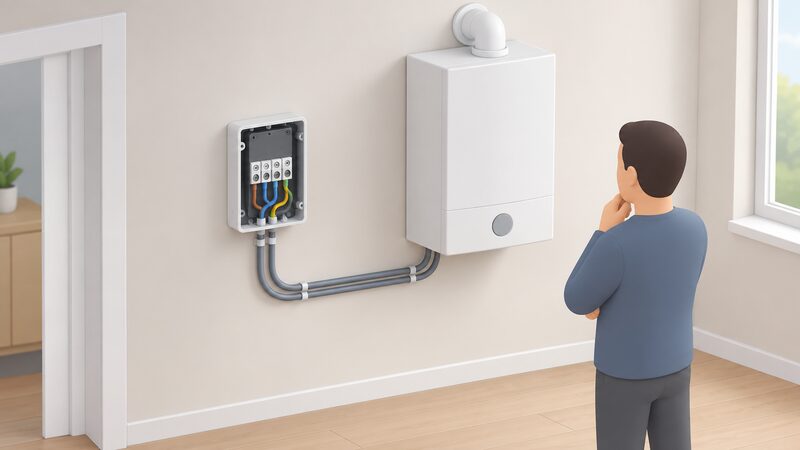
The kit: HubSwitch, Radiator Heads and the Starter Bundle
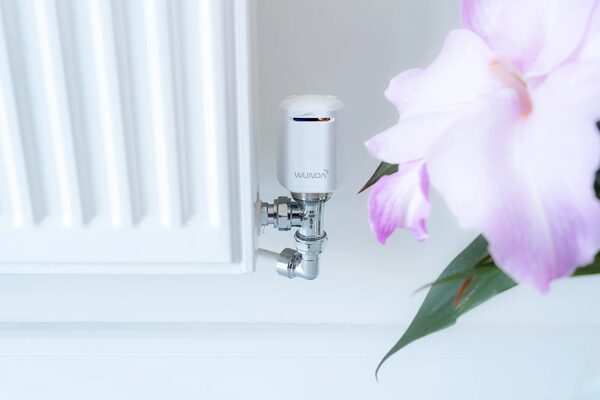
The range is modular. The HubSwitch is the controller that connects to the boiler; the box contents are listed as one HubSwitch, one British Standard backplate and one quick installation manual2. The radiator heads are wireless and fit to the valve in place of a manual head6. Room thermostats come in a screened version and a screenless version, both measuring temperature and humidity11.
The Starter Bundle is the entry point. The maker states it allows a household to control the whole home as a zone and one individual room as a zone, and lists the contents as including one WundaSmart HubSwitch at a recommended retail price of £1504. That two-zone starting point is the minimum configuration that demonstrates what zoning does: one schedule for the house, one exception for a single room.
| Component | Role | Key published detail |
|---|---|---|
| HubSwitch | Boiler-side controller | Configurable 4 channel programmer, OpenTherm compatible, Boiler Plus compliant2 |
| Radiator Head | Room-level valve control | Wireless, manual control available, up to 50 per system6 |
| Room Thermostat | Zone temperature and humidity | Pairs with radiator heads, 7 day scheduling7 |
| Screenless Room Thermostat | Zone sensing without a display | Measures temperature and humidity, up to 30 per system11 |
| Starter Bundle | Entry configuration | Whole home as one zone plus one room, HubSwitch RRP £1504 |
Expansion is by adding components to the same system rather than replacing the controller. The maker states that a household can add up to 30 thermostats and 50 radiators per system4. Scheduling runs to 7 days with copy and paste between rooms and days, and up to 48 events on any day2.
Compatibility: any boiler, radiators, underfloor or both
The maker states plainly that WundaSmart works with any boiler, and the HubSwitch is listed as OpenTherm compatible and Boiler Plus compliant2. OpenTherm is a modulating control protocol, so where a boiler supports it the HubSwitch can vary flow temperature rather than simply switching the boiler on and off; the OpenTherm page explains what that changes.
On the heat emitter side, the maker states that whether a household has radiators, underfloor heating, or both, it can be controlled in one place with the Wunda Home app5. Underfloor heating controls are a different wiring problem from radiator valves, and the underfloor heating controls page covers manifolds and wiring centres. Independent guidance notes that underfloor heating can be controlled using simple dial thermostats or more advanced smart controls via smartphone, tablet or home automation systems12.
One compatibility limit is internal to the range. The maker states that WundaSmart radiator heads only work with other WundaSmart heating controls, and that WundaSmart thermostats only work with other WundaSmart heating controls6. The system is not a set of components that can be mixed with another maker's thermostats or hub.
Hot water is covered separately below, but the HubSwitch is listed with hot water control as a function, so a cylinder can be managed from the same unit2.
Control methods: app, voice and panels, with four temperature modes
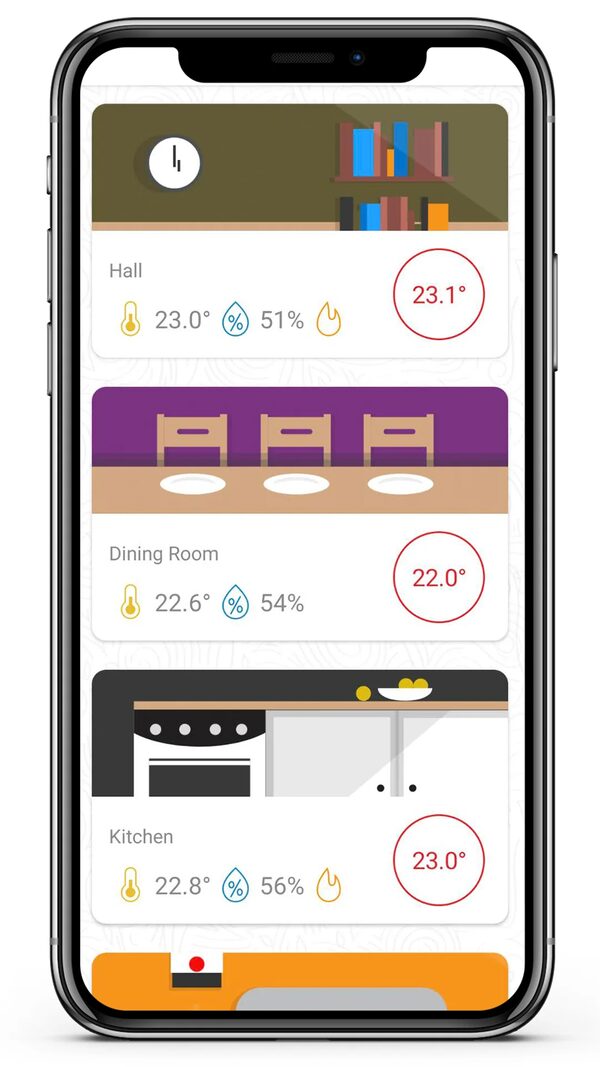
Control is offered through the Wunda Home app, a voice assistant, or control panels1. The HubSwitch is listed as compatible with Alexa and Google Home2. Independent guidance on smart controls notes that many allow heating schedules and temperatures to be adjusted remotely through a mobile app, and that some products include occupancy detection13; the Energy Saving Trust notes that smart meter and app access lets a household see temperature settings from a phone14.
The four predefined temperature modes are Off, Reduced, Eco and Comfort, changed with a single touch1. Alongside those, the maker describes an Adaptive Learning Mode in which the system learns how long it takes to heat a room, so that a target temperature is reached at the scheduled time rather than after it2. Room thermostats also carry geo-location, open window mode and adaptive mode7.
Scheduling is granular: 7 day scheduling with copy and paste abilities, up to 48 events on any day, with schedules copied from room to room or from one day to another2. Geo-fencing is described as setting a perimeter and triggering rooms to cool or turn off whenever the household leaves that perimeter4.
The dependence here is the familiar one. Local control at the valve and at the HubSwitch continues without a connection, but app scheduling, voice control and remote adjustment need a working home network and the maker's app.
Works without the internet: RF signal, offline operation and data privacy
This is the part of the system that most distinguishes it. The maker states that WundaSmart is not reliant on cloud storage or servers and will still work even if the internet goes down, and that the system works perfectly even when the internet goes down2. The same claim appears across the product pages: works even when your internet goes down, no internet, no problem6.
The mechanism is the radio link. The maker states that WundaSmart uses a unique RF signal and will work far beyond any WiFi or Zigbee signal, making it suitable for any property, and that no repeaters or boosters are needed even with Wi-Fi blind spots2. Room thermostats use the same RF signal and require no repeaters11. Independent guidance on Zigbee notes that local connectivity of that kind still works if the internet is down and does not require connection with or communication to the cloud15.
On data, the maker states that data privacy and autonomy sit at the heart of the system, and that all usage and data is securely stored in the system1.
The remaining dependence is narrower than for a cloud-based thermostat: the household depends on the maker for the app, for firmware and for replacement components, but not on a server being available for the heating to run.
Monitoring and smart triggers: temperature, humidity and open-window detection
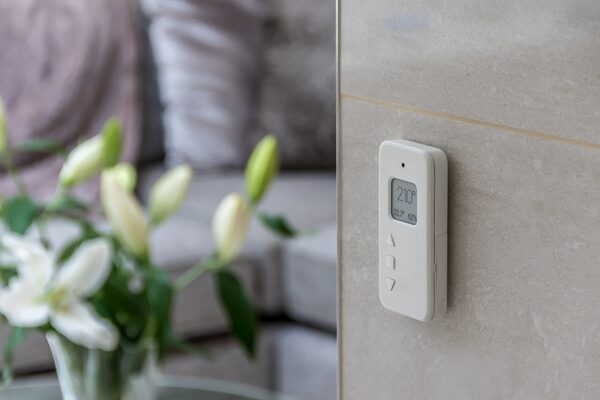
The system senses more than temperature. The maker states that WundaSmart includes temperature and humidity monitoring, and the HubSwitch and Starter Bundle repeat that1. Room thermostats measure temperature and humidity, and the screenless thermostat does the same11.
Open-window detection is the trigger most households will notice. The maker states the system will turn off the heating if it senses the temperature has dropped by more than 0.6 degrees Celsius3. That is the signature of a window or door being opened in a heated room. The radiator head feature list includes open window detection alongside GPS tracking, frost protection, a child lock and on-valve controls8. A comparable approach appears in other products: the Dimplex AluRad Wi-Fi is described as using open window detection technology that adjusts the heating when sudden temperature drops are detected17.
Humidity monitoring is a passive reading rather than a control function in the published material, but it gives a household a room-by-room view of moisture alongside temperature. Independent advice on keeping warmth in covers the low-technology side of the same problem, such as draught excluders on windows and doors18.
The value of these triggers is that they act without the household having to remember. The limit is that they are the maker's own described behaviour, and the accuracy of a 0.6 degree threshold in a room with a radiator cycling on and off is not independently tested in the published material.
Installation: what a householder can do and when to use a professional
The maker states that WundaSmart is as quick and easy to install as any standard external thermostat or boiler programmer, and that no specialist knowledge is needed3. It also states that it does not install systems and recommends a professional to help install the HubSwitch to the boiler3. Those two statements sit together: the wireless components are a householder task, the boiler connection is not.
The radiator heads and room thermostats are wireless and need no wiring, which is where most of the physical work in a zoned system sits. The HubSwitch replaces or joins the existing programmer at the boiler and uses a British Standard backplate2.
General guidance on electrical work points the same way. It is recommended to hire an installer registered with a competent person scheme who can self-certify that the work meets the required standards19. Independent safety guidance states that for more complicated devices or smart systems, a professional installer should be used and their qualifications checked20. Where a household is considering grant-funded efficiency work, a competent person register such as TrustMark is suggested for finding an installer who will assess the property and identify suitable measures21.
For households weighing the whole job, the heating controls installation page covers what replacement involves, and DIY thermostat installation and warranty covers the warranty question that arises when a householder does the work.
Hot water, and where the system's limits sit
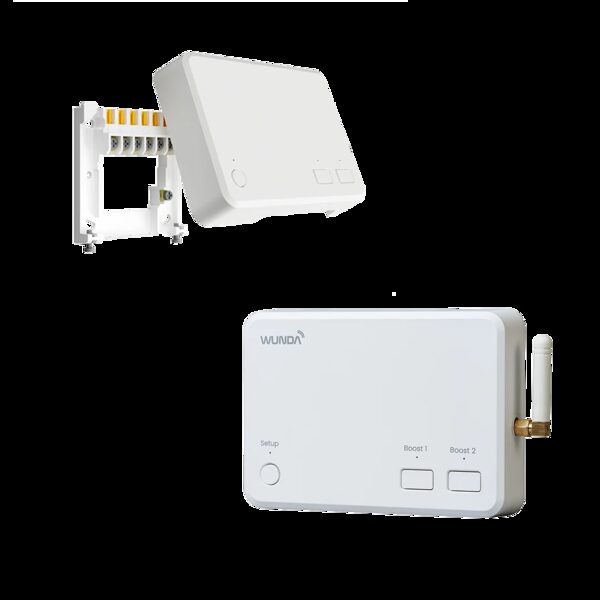
Hot water is supported. The HubSwitch is listed with hot water control, and the maker states that hot water can be scheduled or manually controlled from anywhere in the world with the Wunda Home app2. That makes the unit a programmer for the cylinder as well as for the heating circuits, which is unusual among smart thermostats that address heating only. The hot water controls page covers cylinder thermostats and timers in more detail.
The limits are worth stating as plainly as the capabilities. The system is closed: radiator heads and thermostats only work with other WundaSmart controls, so components cannot be mixed with another maker's hub6. Remote control and app scheduling depend on a working home network and the maker's app, even though the heating itself does not. The published prices are recommended retail figures for components, with the HubSwitch listed at £150 in the Starter Bundle, and no installed price is published, so a fitted cost is installer-quoted4.
For a household's energy independence, the position is mixed but clearer than for most smart controls. The heating runs on a local radio link with no cloud dependency, and the data stays in the system, so a broadband outage or a withdrawn service does not stop the house being heated1. What remains is the gas supply itself, the boiler, mains power, and a continuing relationship with the maker for the app and for replacement parts. The heating controls and energy independence page sets that trade-off out across the category.
Sources21 cited
- WundaSmart home page, WundaSmart, 2026-09-20
- WundaSmart HubSwitch, WundaSmart, 2026-09-20
- How WundaSmart works, WundaSmart, 2026-09-20
- WundaSmart Starter Bundle, WundaSmart, 2026-09-20
- WundaSmart shop, WundaSmart, 2026-09-20
- WundaSmart Radiator Head, WundaSmart, 2026-09-20
- WundaSmart Room Thermostat, WundaSmart, 2026-09-20
- Best smart radiator valves, Which?, 2026-09
- Part L 2022 Heating Controls Guidance, BEAMA, 2022
- Domestic Building Services Compliance Guide 2022, Scottish Government, 2022-06
- WundaSmart Screenless Room Thermostat, WundaSmart, 2026-09-20
- Underfloor heating FAQs, BEAMA, 2025-09-01
- Guide to smart meters, Energy Saving Trust, 2026-07-15
- What are smart thermostats?, Uswitch, 2021-01-04
- Zigbee FAQ, Connectivity Standards Alliance, 2026
- Storms and bad weather, Energy Networks Association, 2026-09-17
- AluRad Wi-Fi electric radiator, Dimplex, 2026-09-17
- Smart meters for renters, Smart Energy GB, 2026-03-16
- Do I need building regulations approval for electrical work?, Planning Portal, 2026
- Smart homes safety advice, Electrical Safety First, 2026-09-19
- Energy Company Obligation scheme, Leeds City Council, 2026-09-20