In this guide
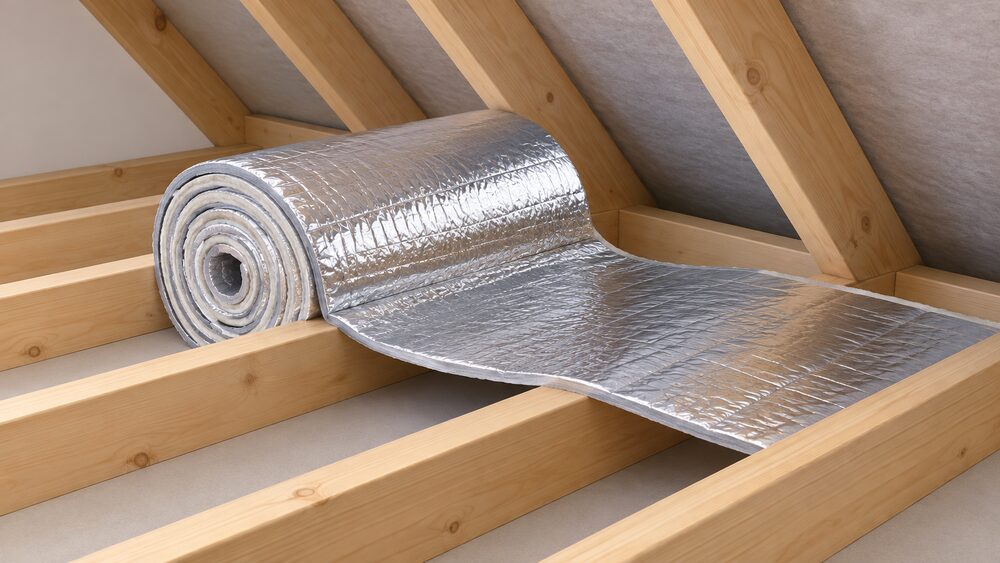
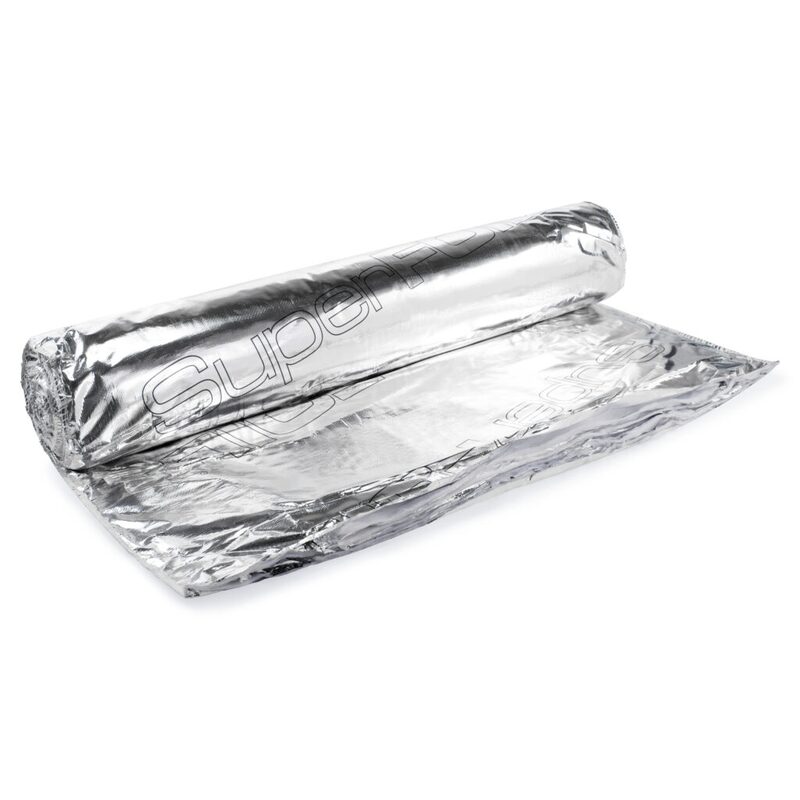
SuperFOIL insulation is a reflective multifoil sold in the UK as a single roll that does three jobs at once: it insulates, it acts as a radiant barrier, and it works as a vapour control layer1. The maker describes it as a 3-in-1 product, and the same description is repeated across the individual product pages for SF6, SF19+, SF40, SF60 and the flat roof range2. It is made by a family business based in Lincoln, established in 1997, which sells through stockists, retail and online outlets rather than installing anything itself7.
The performance claim that carries the range is radiant heat reflection of over 90%, with some products listed at up to 95%1. That is a different measurement from a U-value or an R-value, and the distinction matters when comparing multifoil with mineral wool or PIR board. SuperFOIL's own figures put SF19+ at a 2.60 R-value for roof performance, measured to EN 16012 with the core value plus two air spaces4. The company states that SF19+, SF40 and SF60 can each achieve or exceed a 0.30 U-value on a wall with no other insulation, when installed with the recommended air gaps11.
For a household, the appeal is thinness and speed. The range is sold in various sizes and thicknesses to suit budget, thermal requirements and space, and the maker claims installation at least twice as fast as traditional insulation types12. The limits are equally clear: the performance figures depend on air gaps being built in exactly as specified, the material is a manufacturer's product with a manufacturer's warranty rather than an installation guarantee, and the company does not fit it8.
What SuperFOIL multifoil actually is
Multifoil is a layered build-up rather than a single material. SuperFOIL's own description is that a single roll provides high-performance insulation, a radiant barrier and a vapour control layer, and the company calls the construction a 3-in-1 design1. The vapour control layer is the part that most often surprises householders, because it means the product is doing a moisture job as well as a thermal one. SuperFOIL states plainly that its product has outstanding thermal properties combined with a vapour control layer and a radiant barrier16.
The radiant barrier works by reflecting heat rather than absorbing and slowing it. That is why the reflection percentages are quoted separately from R-values: a foil surface reflects radiant heat across an air space, while the wadding and foil layers together provide the conductive and convective resistance that an R-value describes. SuperFOIL's multifoil can be used on its own or in combination with traditional non-reflective insulation materials, in new builds and renovations alike17.
The practical consequence is that multifoil is usually specified as part of a build-up with defined air spaces, not as a straight swap for a mineral wool quilt of the same thickness. The maker's own guidance is that the range comes in various sizes and thicknesses to suit budget, thermal requirements and space availability, which is a way of saying the choice depends on the construction it is going into12.
How it performs: over 90% radiant heat reflection
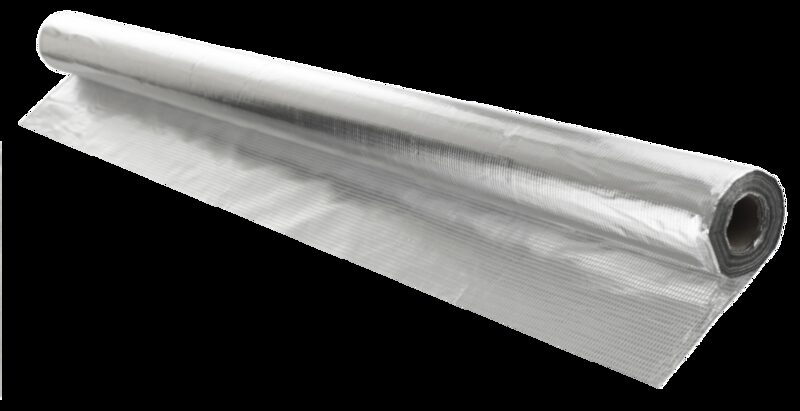
The headline figure is that multifoil works to reflect over 90% of radiant heat1. Two products go further: SFNC+ and SFTV 1L are each listed as reflecting up to 95% of radiant heat, and the Multipurpose Wrap is described as reflecting up to 95% of heat9. These are the maker's figures for its own products, and they describe radiant reflection specifically, not overall thermal efficiency.
The seasonal argument follows from that. SuperFOIL states that in summer the material reflects excess heat away, keeping the inside comfortably cool, and that in winter the same reflection works the other way around, keeping heat inside19. The same principle is behind the Window Reflector Kit, which reflects heat away from a window as a radiant barrier, keeping heat out in summer and warmth in during winter20.
Where the range is measured in the units building control uses, the figures are more modest and more specific. SF19+ carries a roof performance of 2.60 R-value, described as the core value plus two air spaces to EN 160124. SF19+, SF40 and SF60 can each achieve or exceed the typically required retrofit rating of 0.30 U-value on a wall with no other insulation, when installed with the recommended air gaps11. That condition is doing real work in the sentence: the air gaps are part of the specification, not an optional extra.
For a household, the honest reading is that multifoil performs well in thin build-ups where a conventional quilt would not fit, and that its published numbers are tied to a described installation rather than to the roll alone. The wider comparison with mineral wool is set out in multifoil vs mineral wool for loft insulation, and the underlying units are explained in U-values and R-values explained.
The range: SF19+, SF40, SF60, SF6 and the flat roof options
SuperFOIL's multifoil family covers pitched roofs, flat roofs, walls and floors, with different products aimed at different build-ups. SF19+ is described as multifoil insulation for use in roofs, walls and floors, and carries the 2.60 roof R-value4. SF40 and SF60 share the 3-in-1 construction and the 0.30 U-value wall claim when installed with the recommended air gaps5. SF6 is sold for roofs, walls and floors and also for garden rooms, garages, sheds and conservatories, in domestic and commercial projects21.
| Product | Stated function | Key published figure | Typical applications |
|---|---|---|---|
| SF19+ | 3-in-1: insulation, VCL, radiant barrier4 | 2.60 roof R-value, core plus two air spaces to EN 160124 | Roofs, walls, floors4 |
| SF40 | 3-in-1: insulation, VCL, radiant barrier5 | 0.30 U-value on a wall with recommended air gaps11 | Roofs, walls, floors5 |
| SF60 | 3-in-1: insulation, VCL, radiant barrier6 | 0.30 U-value on a wall with recommended air gaps11 | Roofs, walls, floors; new build, retrofit, timber frame, DIY6 |
| SF6 | 3-in-1: insulation, VCL, radiant barrier21 | Not stated on the product page | Roofs, walls, floors; garden rooms, garages, sheds, conservatories21 |
| SFUF | 3-in-1: insulation, VCL, radiant barrier22 | Not stated on the product page | Flat roof applications |
| SFNC+ | Fire rated multifoil9 | Reflects up to 95% of radiant heat9 | New build, retrofit, residential, commercial, high rise (18m+)9 |
| SFTV 1L | Radiant barrier10 | Reflects up to 95% of radiant heat10 | Roofs, walls, floors in new build, retrofit and extension projects10 |
| Multipurpose Wrap | Insulation, VCL, radiant barrier18 | Reflects up to 95% of heat18 | Multi-purpose wrap applications |
The flat roof side of the range is built around over-joist and under-joist applications, and the maker states that its products suit new builds, retrofits and extensions either on their own or in combination with other insulation types14. The flat roof range is described as certified for high-performance vapour control and breathable properties23. For pitched roofs, SuperFOIL offers both under-rafter and over-rafter options, serving retrofit, extension and new build projects13.
There is also a breathable range, SF19BB and SF40BB, which the maker describes as ideal for external applications25. Thickness varies by product: SF60 appears in a case study at 100mm thick, chosen so that space was not compromised while still offering thermal performance26. The maker's general statement is that the range comes in various sizes and thicknesses to suit budget, thermal requirements and space availability12.
Where it fits: lofts, walls, floors and outbuildings
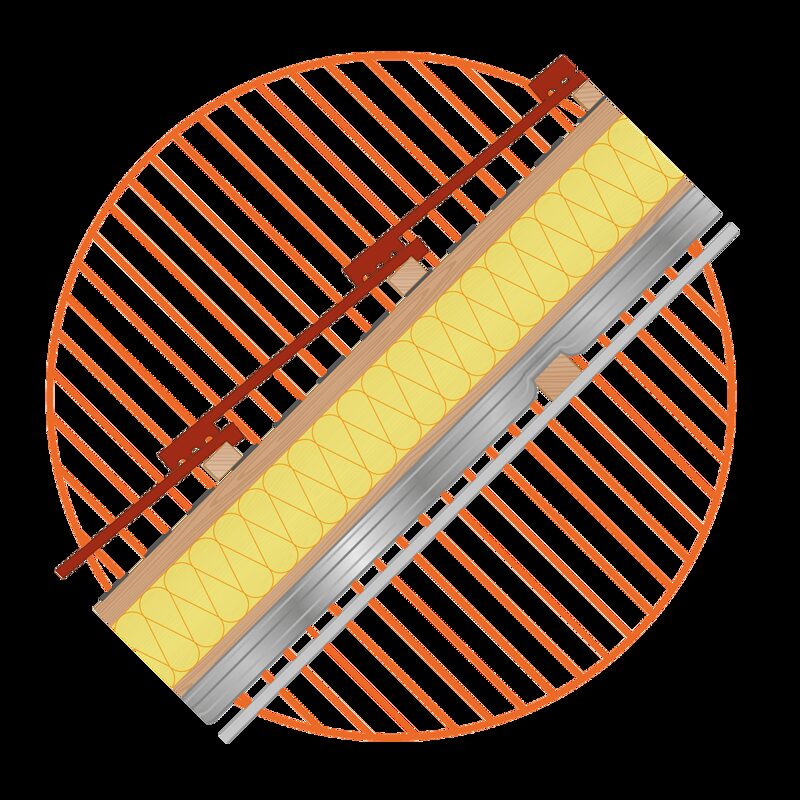
The applications divide into four groups. In roofs, SuperFOIL offers under-rafter and over-rafter options for pitched roofs, and over-joist and under-joist options for flat roofs13. The flat roof range is designed for warm roofs and cold roofs, with insulation fitted under, between or over the rafter or in combination, or between the joists underneath the roof surface23. The maker states that its multifoil is designed to suit both applications, simplifying the process by eliminating the need for separate materials23.
In walls, SuperFOIL offers thin and easy-to-install vapour control and breathable multifoil products for solid wall and timber frame applications15. The company has published guidance on external wall insulation problems and on using multifoil to overcome them, and its wall products are described as undergoing independent testing by notified bodies and third-party certified laboratories to comply with relevant UK building regulations and European regulations such as CE and UKCA15.
In floors, the products are listed alongside roofs and walls in the standard application set, and the maker states that SuperFOIL can be used in flat roofs, pitched roofs and a range of other applications4. For outbuildings, the maker has published separate guides for summer houses, sheds and conservatory roofs, and SF6 is explicitly sold for garden rooms, garages, sheds and conservatories19.
The pattern across all four is the same: multifoil suits situations where depth is tight, where a continuous reflective layer is wanted, or where the build-up is being assembled from scratch. It is less obviously a like-for-like replacement for a deep quilt in an open loft, where conventional insulation has more room to work. The loft case is covered in loft insulation: types, thickness and installation, and the wider material comparison in insulation materials compared.
Certification, testing and building regulations

SuperFOIL states that its insulation is tested and certified by KIWA BDA, among other certification bodies, which it says makes the products viable for insurance backed guarantees8. The company is explicit that its certifications are issued by KIWA BDA rather than the British Board of Agrément, and that its partnership with KIWA BDA guarantees its credentials remain fully accredited and compliant29.
The most recent certification milestone is the Room-in-Roof insulation system, which secured KIWA BDA Agrément certification in August 2026. SuperFOIL describes this as the second insulation system it has secured Agrément accreditation for with KIWA BDA29. The certificate and install guide for room-in-roof applications were published in July 20261.
On testing, the company states that all SuperFOIL products undergo independent testing by notified bodies and third-party certified laboratories to comply with relevant UK building regulations and European regulations such as CE and UKCA23. One guidance page goes further and states that thermal performance is confirmed through testing to BS EN ISO 12667 and ISO 8301 by the BBA, a UKAS-certified body and internationally accredited laboratory17. That sits alongside the statement that certifications are issued by KIWA BDA rather than the BBA, and the two are not reconciled in the published material.
For a household, certification matters because building control and warranty providers ask for it. The general framework is set out in insulation product standards, certification and guarantees and in building regulations Part L.
Warranty and lifespan: 25 years, with performance guaranteed beyond 50
All SuperFOIL products carry a 25-year manufacturer's warranty, and the company states that its durable insulation is guaranteed to maintain its thermal performance for over 50 years15. The warranty terms are specific: any appropriately installed SuperFOIL product which fails to provide its rated performance for at least 25 years is considered defective, and SuperFOIL will either fully refund the original price of the product or provide a suitable replacement8.
That is a product warranty, not an installation guarantee, and the distinction is one the company makes itself. SuperFOIL states that it is a manufacturer, not an installer, and does not directly install its insulation products8. Its published guidance explains that insurance backed guarantees cover installation quality while its 25-year manufacturer's warranty covers defective products, and that it does not offer IBGs as a manufacturer8.
"Any appropriately installed SuperFOIL product, under the terms of the warranty, which fails to provide it's rated performance for at least 25 years is considered defective."
The 25-year term is in line with what is treated as standard elsewhere in the sector: government-published statistics on home insulation note that a 25-year guarantee is considered standard for solid wall insulation products and installations30. The lifespan claim of over 50 years appears repeatedly across SuperFOIL's pages, including in guidance dating from 2022 and 2023, so it is a long-standing published position rather than a recent addition31.
For a household, the practical point is that the warranty protects the material, and that the quality of the installation sits with whoever fitted it. Where a project is grant-funded or installer-led, that split is worth understanding before work starts. The wider picture is in insulation product standards, certification and guarantees.
Installation: stapled to battens, and claimed twice as fast
SuperFOIL describes its multifoil as lightweight and easy to install, requiring no specialist tools, and states that it does not require any specialist equipment or PPE33. The same claim appears on individual product pages for SF40 and the Multipurpose Wrap, both described as requiring no specialist tools5. The maker's summary is that multifoil is quick and easy to install with no need for specialist tools32.
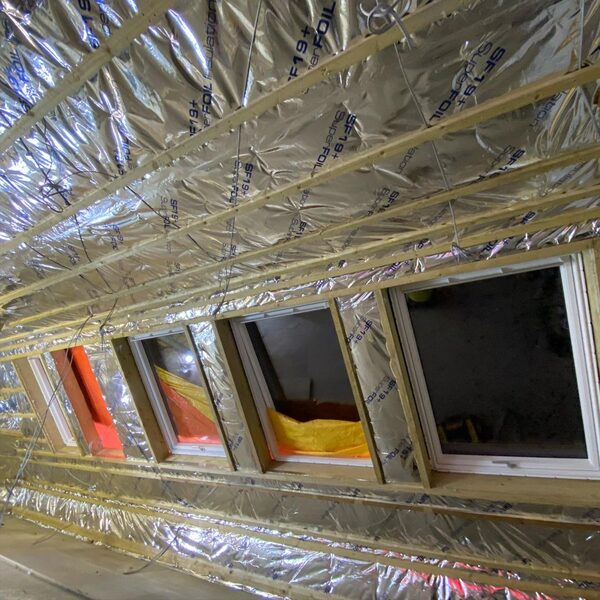
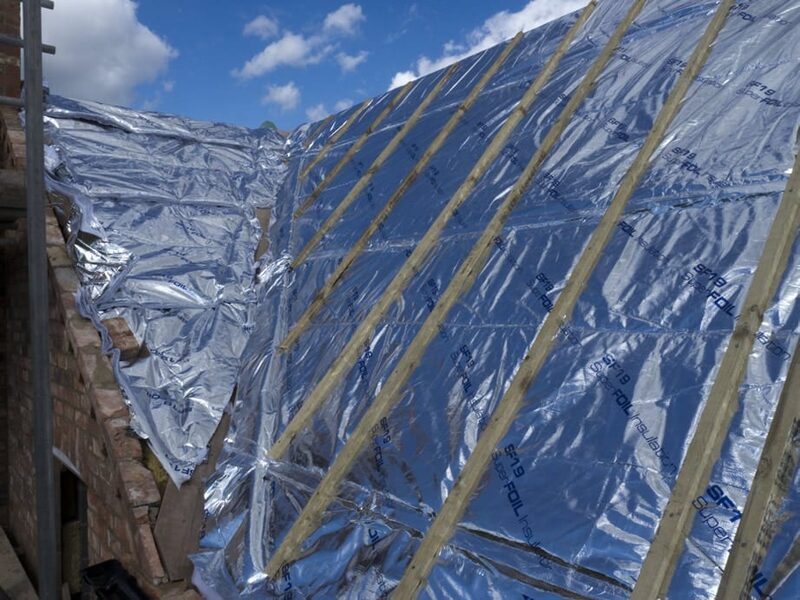
The published method for a wall or roof is a batten build-up. The material is applied to the battens, generally horizontally, by stapling it into place. It is then trimmed and secured with perimeter fixing battens, counter battens are fixed vertically to create an air gap, and the external finish is fixed to those battens16. For a summer house wall or roof, the maker's three-step method is to fix timber battens to internal surfaces, attach the multifoil to the batten frame, seal the joints with foil tape, and install a second batten set for the secondary air gap19.
Speed is claimed repeatedly. SuperFOIL states that its multifoil can be installed at least twice as fast as traditional insulation types, using fewer materials, and that for flat roofs it makes under-joist insulation airtight and twice as fast to install compared with traditional insulation types17. One support article puts it more broadly, describing the process as twice as fast and half as complicated as traditional insulation types29.
There is one technique worth knowing. Where the material is being screwed through, the maker advises compressing the product fully under the batten and applying pressure directly to the batten to prevent the screw snagging the wadding material29. The question of whether multifoil tears when screwed in place is addressed directly in that guidance.
Condensation, damp and wireless signals
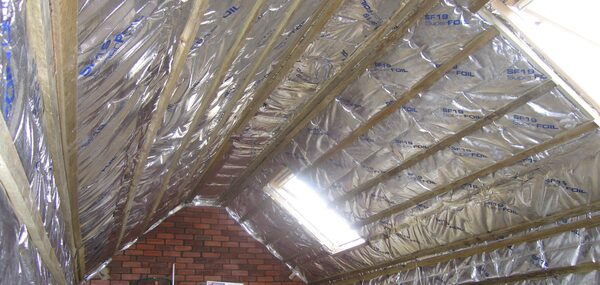
SuperFOIL states that properly installed products will reduce the risk of condensation issues in a home, and that all its multifoil products act as high-quality vapour control layers11. The company describes its insulation as uniquely well-designed to help prevent the condensation issues that can lead to damp and mould, and its bubble foil as water and corrosion resistant with a built-in vapour control layer that minimises the risks of moisture penetration, condensation and mould growth19.
For over-rafter applications, the maker cites a W1 watertight property alongside higher thermal performance and a continuous layer that minimises thermal bridging and condensation24. For under-rafter applications it cites high vapour resistance and a continuous layer design24. The mechanism is straightforward: a continuous foil layer resists the passage of moisture vapour, so the risk moves to wherever the vapour ends up instead.
That is why the vapour control layer is a design responsibility as much as a product feature. A vapour control layer on the wrong side of the insulation, or one interrupted by gaps and unsealed joints, changes how the build-up behaves. The general principles are covered in condensation, damp and mould after insulation and in home ventilation.
On wireless signals, SuperFOIL states that it is highly unlikely its products will noticeably impact the quality of wireless signals in a home11. The concern is reasonable, since the product contains metallic foil, but the company's position is that the effect is not noticeable in practice. Signal strength will still depend on how many foil surfaces sit between a router and a device.
The company: a family manufacturer in Lincoln since 1997
SuperFOIL Insulation is a family business based in Lincoln, established in 1997, with a team of over 40 people7. The company describes itself as an award-winning family business and cites over 26 years of industry experience13. A separate page gives over 27 years, and the two figures are not reconciled in the published material7.
The company's role is manufacturing and supply, not installation. SuperFOIL states that it does not directly install its insulation products, and that it sells to trade contractors, professionals and DIY projects through stockists, retail and online outlets8. It works with distributors across the UK, Ireland and Europe to keep the range available, and its Window Reflector Kit is sold through Amazon UK11.
The technical support offer is a phone line on 01636 639900, with a team that assists with technical queries, product recommendations, installation advice, U-value calculations and guidance on building regulations25. SuperFOIL also offers a free insulation guide and a free sample pack containing samples of its most popular products with an information booklet, sent free of charge with postage covered by the company14.
On sustainability, the company states that its insulation is made from 500 recycled bottles per roll, and that the wadding in its breathable and multifoil products uses up to 40% recycled materials1. One support article gives a different figure for a single product, stating that each roll of SF19+ contains an average of 450 plastic bottles worth of recycled plastic11.
What multifoil does for a household's energy independence
Multifoil insulation changes what a household can do with the space it has. Because the material is thin and combines three functions in one roll, it can be added to a roof, wall or floor build-up where a conventional quilt or board would cost headroom or require deeper framing1. That is a genuine gain in fabric performance, and fabric performance is the part of a home's energy use that does not depend on a supplier, a tariff or a fuel market.
The dependence that remains is on the manufacturer. The 25-year warranty is a product warranty held by SuperFOIL, and the company states it does not install its products, so installation quality sits with whoever fitted the material8. The performance figures are the maker's own, tied to specified air gaps, and the certification route runs through KIWA BDA rather than the BBA29. A household relying on the published R-value and U-value claims is relying on the maker's testing and on the installer following the described build-up.
There is also a materials dependence. Multifoil is a manufactured plastic and foil product, made from recycled bottles but still produced in a factory and bought through a distributor network1. It does not remove a home from the grid, and it does not generate anything. What it does is reduce the heat a home loses through the parts of the envelope that are hardest to insulate conventionally, which in turn reduces how much energy has to be bought in the first place.
The wider context for that argument is set out in insulation, glazing and energy independence and in multifoil insulation: what it is and how it performs. For households weighing the material against conventional alternatives, the comparison pages on multifoil vs mineral wool for loft insulation and low-cost and DIY insulation measures cover the trade-offs.
Sources33 cited
- SuperFOIL Insulation, SuperFOIL, 2026
- What is multifoil insulation, SuperFOIL, 2024
- Cutting the cost to insulate a house with multifoil, SuperFOIL, 2024
- SuperFOIL SF19+, SuperFOIL, 2026
- SuperFOIL SF40, SuperFOIL, 2026
- SuperFOIL SF60, SuperFOIL, 2026
- The best multifoil companies on the market, SuperFOIL, 2023
- Insurance backed guarantee vs manufacturer's warranty, SuperFOIL, 2025
- SuperFOIL SFNC+ fire rated multifoil, SuperFOIL, 2026
- SuperFOIL SFTV 1L radiant barrier, SuperFOIL, 2026
- SuperFOIL frequently asked questions, SuperFOIL, 2026
- Pitched roof insulation, SuperFOIL, 2026
- Roof insulation guide, SuperFOIL, 2026
- Flat roof insulation, SuperFOIL, 2026
- Wall insulation applications, SuperFOIL, 2026
- Overcoming external wall insulation problems with multifoil, SuperFOIL, 2023
- Ten reasons multifoil insulation is the future, SuperFOIL, 2024
- SuperFOIL Multipurpose Wrap, SuperFOIL, 2026
- How to insulate a summer house, SuperFOIL, 2025
- Three ways to use window reflectors, SuperFOIL, 2025
- SuperFOIL SF6, SuperFOIL, 2026
- SuperFOIL SFUF, SuperFOIL, 2026
- SuperFOIL room-in-roof Agrément, SuperFOIL, 2026
- SuperFOIL support FAQs, SuperFOIL, 2026
- Roof insulation guide, SuperFOIL, 2024
- The Woodsman's Treehouse case study, SuperFOIL, 2026
- Expert insulation without the work, SuperFOIL, 2026
- Introducing multifoil, SuperFOIL, 2023
- Does multifoil insulation tear when screwing it in place, SuperFOIL, 2024
- Energy Innovation Needs Assessment: heat and buildings, Department for Energy Security and Net Zero, 2025
- What is multifoil insulation, SuperFOIL, 2022
- Multifoil: the eco-friendly future for house insulation, SuperFOIL, 2023
- SuperFOIL SFBB, SuperFOIL, 2026