

In this comparison
Scotland and Northern Ireland both run a national energy advice service for householders, and both are free. Home Energy Scotland gives free, independent and impartial advice to householders, community groups and businesses throughout Scotland, and it is funded by the Scottish Government1. In Northern Ireland, NI Energy Advice offers free, independent and impartial energy advice to domestic householders, plus referrals to energy grants and other sources of help2. The Consumer Council NI provides the same free, independent and impartial advice to all domestic householders in Northern Ireland3.
The two models are not the same shape. Scotland has one body that carries both the advice and the referral route into grant funding, including the Home Energy Scotland Grant and Loan scheme for eligible homeowners4. Northern Ireland splits the job: a dedicated advice line for householders, and a consumer body that also advises on bills and complaints. That split reflects a deeper difference, because Northern Ireland has a different regulator, the Utility Regulator, no price cap and an entirely different set of suppliers from Great Britain5.
For a household, the practical question is what each service can actually do. Both can tell you where your home is losing heat, both can point you at funding, and neither sells anything. What follows sets out what each offers, what it costs, what it cannot cover, and what it means for a home trying to become less dependent on the grid and on imported fuel.
What each service actually offers
Home Energy Scotland describes itself as a free independent advice and referral scheme10. Its scope is wider than bill help: it gives free impartial advice on energy efficiency and renewable energy in Scotland11, and free advice on improving the energy efficiency of your home12. It also acts as a referral partner for Area Based Scheme eligibility enquiries, providing free and impartial advice funded by the Scottish Government13. Local authorities route householders to it for that purpose, and the scheme rules state that Home Energy Scotland provides free, independent and impartial energy advice to householders, community groups and businesses throughout Scotland14.
NI Energy Advice is narrower in scope but broader in referral. It offers independent and impartial energy advice to domestic householders in Northern Ireland, plus referrals to energy grants and other sources of help15. The same description appears across the Northern Ireland guidance pages on insulation, low carbon heating, ventilation and heating technologies, which is how a householder usually meets the service: not by searching for it, but by landing on a government page about a specific measure and finding the advice line named at the bottom2.
The Consumer Council NI sits alongside it. Together they give free, independent and impartial energy advice to all domestic householders in Northern Ireland3. The distinction matters in practice: NI Energy Advice is the route into efficiency measures and grants, while the Consumer Council is the route for problems with a supplier, a bill or a connection.
"Home Energy Scotland provides free, independent and impartial energy advice to householders, community groups and businesses throughout Scotland"
Specifications: what the advice covers and who it reaches
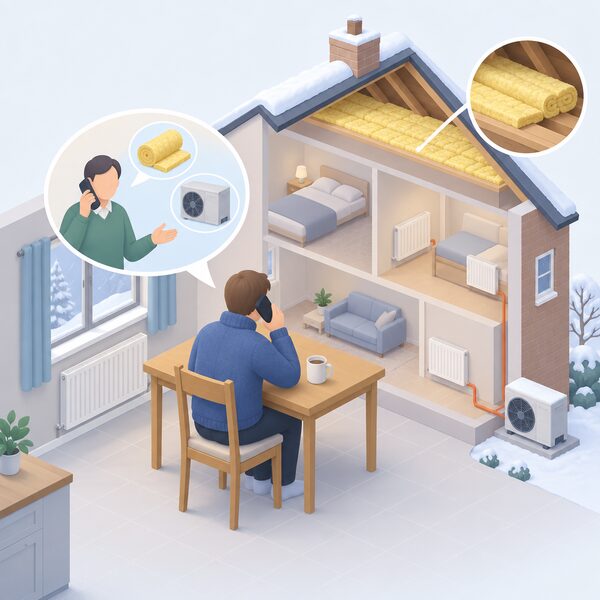
The two services cover a similar list of physical measures, because both are answering the same question about a cold, leaky home. The Northern Ireland guidance covers insulation, low carbon heating, ventilation systems, biomass and the heating technologies that suit a particular home2. Scottish advice covers the same territory plus renewable energy, and the Area Based Schemes route adds area-wide retrofit rather than single-property work11.
Where they diverge is in the housing stock they are advising on. The latest comparable data shows that homes in Northern Ireland had the highest average energy efficiency rating19. That is a striking figure given the age and oil dependence of much of the Northern Ireland stock, and it shapes what the advice service spends its time on: less on basic draught-proofing, more on heating system replacement and on the grants that pay for it.
Scotland's advice load is driven by a different set of numbers. The Scottish Government aims to reduce emissions from buildings by 68% by 2030 against a 2020 baseline, and over one million households are expected to need a low-carbon heating system by 20309. A further target, set out in consultation, is for over one million homes and around 50,000 non-domestic buildings to be converted to zero emissions heating systems by 203020. Advice at that scale is not a helpline answering individual queries; it is the delivery front end for a national retrofit programme.
Both services also sit inside a wider support map. National Energy Action offers advice and support to help people across England, Wales and Northern Ireland stay warm and manage energy costs, so a Northern Ireland householder has more than one free route in21. In Scotland, the equivalent breadth comes from Home Energy Scotland itself rather than from a patchwork of charities.
| Home Energy Scotland | NI Energy Advice | |
|---|---|---|
| Cost | Free1 | Free2 |
| Who it advises | Householders, community groups and businesses14 | Domestic householders15 |
| Scope | Energy efficiency and renewable energy11 | Energy advice plus grant referrals15 |
| Grant route | Administers the Home Energy Scotland Grant and Loan scheme4 | Refers to energy grants and other help15 |
| Funded by | Scottish Government13 | Northern Ireland guidance and departments2 |
What the funding behind the advice covers
Neither service hands out money itself, and it is worth being clear about that. Home Energy Scotland and the Energy Saving Trust are grant funded by the Scottish Government to provide advice, support, grants and loans to domestic consumers on all aspects of energy efficiency and renewable technologies22. The funding flows through the advice body, which is why the advice and the application sit in the same conversation.
In Northern Ireland the funding landscape is more fragmented. The NI Energy Advice Line Service provides free, comprehensive advice and support on how to save energy in the home and eligibility for help to improve energy efficiency23. Eligibility is the operative word: the advice service can tell a household what it qualifies for, but the schemes themselves are run by departments and by the Utility Regulator.
The scale of past intervention differs sharply. Northern Ireland and Wales spent 3x and 2x as much respectively per capita on energy efficiency as England in 201724. That is a historical figure and it reflects a period when Northern Ireland was catching up on a colder, oil-heated housing stock, but it explains why the advice infrastructure exists in the form it does.
Recent one-off support has been delivered nationally rather than through the advice services. A scheme has been announced to cut energy bills in Northern Ireland by £30 a year25, and under the Energy Bills Support Scheme households in Northern Ireland received a discount of £400 on their energy bills26. The Energy Price Guarantee applied to all households in Great Britain, with the same level of support made available to households in Northern Ireland27, and separate ministerial directions set out how it applied in Northern Ireland specifically28.
What the advice cannot do, and where it stops
Advice is the front door, not the building. Neither service is a supplier, neither can change a tariff on a householder's behalf, and neither can compel a network operator. Where a dispute escalates, the route is the Energy Ombudsman, which offers advice to consumers worried about their energy bills29 and maintains a dispute process for named suppliers30.
There are also structural gaps that no advice service can close. Northern Ireland has no Energy Company Obligation, so the supplier-funded efficiency route that operates in Great Britain is absent. Its smart meter rollout is not due to begin until 2028, which means households there are advised on a metering base that is years behind Scotland's. Scotland's own rollout has problems of its own: Consumer Scotland has warned that coverage lags Great Britain, with gaps in rural and island Scotland.
The fuel poverty definitions the two services work to are also different, and that changes who qualifies for what. Fuel poverty in Northern Ireland is measured using the 10% indicator, where a household is fuel poor if the fuel costs required to maintain a satisfactory heating regime are greater than 10% of household income31. Scotland's definition is set out in section 3 of the Fuel Poverty (Targets, Definition and Strategy) (Scotland) Act, and requires that fuel costs exceed 10% of adjusted net income after housing costs, with remaining income insufficient to maintain an acceptable standard of living, at least 90% of the UK Minimum Income Standard31. A household can therefore be fuel poor on one side of the Irish Sea and not on the other, on identical income and identical bills.
Scotland's targets are also more explicit. The Heat in Buildings strategy sets a goal that in 2040 no more than 5% of households are fuel poor, no more than 1% are in extreme fuel poverty, and the fuel poverty gap is no more than £250 in 2015 prices31. Northern Ireland has no equivalent statutory target in the same form.
What it means for a household's energy independence
The honest answer is that advice services improve a household's position at the margins, and the margins are where most of the money is. A home that insulates, draught-proofs and replaces an old heating system uses less delivered energy, and less delivered energy means less exposure to whatever the price of gas, oil or electricity does next. That is real independence, and it is the kind the advice services are built to deliver.
What they cannot deliver is independence from the network. A Scottish household advised by Home Energy Scotland still draws from the grid, still buys from a supplier, and still depends on the gas network if it has a gas boiler. A Northern Ireland household advised by NI Energy Advice is more exposed still, because much of the stock runs on heating oil, a fuel with no price cap and no equivalent of the Energy Price Guarantee. The £400 discount and the £30 a year scheme were one-off interventions in a market where the underlying exposure remains25.
The direction of travel is set by targets rather than by advice. Scotland has committed to reaching net zero by 2045, five years before the UK targets7, while England, Wales and Northern Ireland have committed to reaching net zero by 20508. Scotland's climate plan records over 6,900 public charge points, a 6,000 charge point target met in October 2024 two years ahead of schedule, and an ambition for approximately 24,000 additional public charge points by 2030, largely funded and delivered by the private sector7. Those are transport figures, but they show the pattern: devolved government sets the target, private delivery does the work, and the advice service explains it to householders.
For a household, the practical reading is this. The advice is free, it is independent, and it is the correct first call in both nations. It will tell you what your home needs and what funding exists. It will not insulate the loft, and it will not remove the standing charge.
Sources31 cited
- Energy Efficient Scotland: Area Based Schemes 2020, Scottish Government, 2015-12
- Insulation, nidirect, 2026-09-02
- Low carbon heating, nidirect, 2026-09-17
- Energy Price Guarantee for domestic energy consumers in Northern Ireland: ministerial directions, GOV.UK, 2023-01-04
- Energy Price Guarantee announcement, GOV.UK, 2022-09-08
- Green Deal Home Improvement Fund details announced, GOV.UK, 2014-12-07
- Scotland's Climate Change Plan 2026 to 2040, Scottish Government, 2025-11-06
- Net zero and housing research briefing, House of Commons Library, 2026-07-10
- High rise retrofit and upgrade programme phase 1, City of Edinburgh Council, 2026-04-20
- Heat in Buildings progress report 2025, Scottish Government, 2025-10-02
- Who to contact, Ofgem, 2026-09-17
- Financial help for energy efficiency and low carbon heating improvements, City of Edinburgh Council, 2026-09-20
- Home energy efficiency, Argyll and Bute Council, 2026-09-17
- Area Based Schemes, Glasgow City Council, 2026-06-08
- Ventilation systems, nidirect, 2026-09-17
- Energy saving grants in your area, nidirect, 2026-09-17
- Heating technologies to suit your home, nidirect, 2026-09-17
- Biomass, nidirect, 2026-09-17
- Energy efficiency of housing in England and Wales, House of Commons Library, 2026-09-17
- Heat in Buildings Strategy consultation, Scottish Government, 2030
- Home Energy Scotland Grant and Loan scheme awards, Scottish Government, 2025-05-12
- Changes to the Affordable Warmth Scheme, Department for Communities, 2023-09-08
- Green Home Loans, Scottish Government, 2017-05-02
- Written evidence on energy efficiency spending, UK Parliament, 2017
- Energy bills and fuel poverty research briefing, House of Commons Library, 2026-08-06
- Energy Bills Support Scheme (Northern Ireland) legislation, UK Parliament, 2022-10-18
- Highland Electricity Limited dispute, Energy Ombudsman, 2026-09-19
- Energy Prices (Domestic Supply) (Northern Ireland) Regulations 2022(NorthernIreland)Regulations2022), Hansard, 2022-11-16
- Worried about your energy bills, Energy Ombudsman, 2026-03-24
- Heat in Buildings Strategy summary, Scottish Government, 2021-10
- Fuel poverty modelled estimates, Welsh Government, 2025-10-16
 Energy Consumer BodiesWho do you call about an energy problem where you live?
 Housing Stock Data for NIMost homes in Northern Ireland heat with oil, so why are the grants and help different from the rest of the UK?
 The Full Scotland, Wales and Northern Ireland GuideWhy a householder in Glasgow, Cardiff or Belfast faces different schemes, standards, targets and markets from one in England.
 Tariffs in ScotlandWhy do Scottish electricity bills differ from the rest of Great Britain, and why do standing charges cost more in the north?
 Overheating StandardsScotland and Northern Ireland handle overheating in new homes differently from England and Wales.
 Community Energy in ScotlandCommunity energy in Scotland lets you join a local scheme for cheaper, greener heat and power, or get advice and funding to make your own home warmer and cheaper to run.