In this guide
FuturaSun is an Italian photovoltaic module manufacturer whose Silk range holds renewed MCS certification for the UK market, confirmed on 1 July 2026 for the Silk Plus, Silk Premium and Silk Pro panels1. MCS is the UK's quality mark for renewable energy technologies like solar panels and heat pumps, and product certification ensures compliance with UK regulations2. For a household, that certification is the practical gate: it is what an installer needs in order to sign a system off and what an export tariff normally requires.
The range spans a wide band of outputs. The Silk Colour series, described by the maker as its best selling series of monocrystalline PV modules, is rated at up to 400 Wp4. The Silk Nova series runs higher, with the Glass-Backsheet version at 460 Wp, the glass-glass Silk Nova Duetto at 450 Wp, and the Silk Nova Premium Max Duetto at 720 Wp5. Coloured variants sit between 370 Wp and 410 Wp5.
What follows is the UK-facing picture: what the modules are, how they are certified, what the maker says about build and cell sourcing, and where the technology is heading. It also sets out the dependence that remains, because a panel brand is only one part of a system that still leans on the grid, an installer and a certification body.
An Italian maker with a UK office and a certified Silk range
FuturaSun designs and manufactures in Italy and sells into the UK through a domestic office and a distributor network rather than direct to households. The company's UK presence matters less for the badge than for the paperwork: warranty claims, technical queries and replacement modules all route through a manufacturer that has a British entity, rather than through an importer who may change hands.
The Silk range is the part of the catalogue aimed at residential roofs. MCS certification was renewed for the Silk Plus, Silk Premium and Silk Pro panels on 1 July 20261. That renewal is the single most important fact for a UK buyer, because MCS certification is what allows an installer to certify a system and what most export tariff arrangements expect. Independent guidance for households is to check that a system is properly registered with MCS and any export tariffs, and to have the panels checked by an MCS-certified specialist to confirm safe installation in line with safety standards8.
Certification is not a one-off. MCS product certification ensures compliance with UK regulations, and it is held by the product rather than by the company3. A panel that loses certification, or a model that is superseded by an uncertified variant, cannot be used on a certified installation. That is why the renewal date matters more than the original grant.
FuturaSun also sells beyond the UK, and its module range is used in architectural and infrastructure projects across Europe, including the Vienna State Opera and a site in Leuven, Belgium9. Those are commercial and cultural installations rather than domestic ones, but they indicate a maker willing to take on non-standard mounting and appearance requirements, which is the same capability that coloured residential modules draw on.

The range: Silk Colour, Silk Premium and Silk Nova
FuturaSun's residential catalogue splits into the Silk Colour series, which trades some output for appearance, and the Silk Nova series, which pushes output higher. The Silk Colour series is rated at up to 400 Wp4. Within the Silk Nova family, the maker's 2025 announcements give model-level figures that range from 370 Wp to 720 Wp5.
| Model | Output | Construction | Notes |
|---|---|---|---|
| Silk Colour | up to 400 Wp | Monocrystalline | Coloured modules4 |
| Silk Nova Red | 370 Wp | Silk Nova Colour | Refined red finish5 |
| Silk Nova Silver | 390 Wp | Silk Nova Colour | Metallic grey finish5 |
| Silk Nova Orange | 400 Wp | Silk Nova Colour | Terracotta tone5 |
| Silk Nova Green Duetto | up to 410 Wp | Silk Nova Colour | Green finish5 |
| Silk Nova Duetto | 450 Wp | Glass-glass | Flagship model5 |
| Silk Nova Duetto | 460 Wp | Glass-backsheet | Flagship model5 |
| Silk Nova Premium Max Duetto | 720 Wp | Silk Nova | Highest output in range5 |
The spread is wide enough that "a FuturaSun panel" is not a single specification. A 370 Wp coloured module and a 720 Wp Premium Max Duetto differ by roughly a factor of two in rated output, and they suit different roofs. Coloured modules exist for visible elevations, conservation areas and any roof where appearance is a planning or aesthetic constraint; the higher-output models suit a household trying to maximise generation from a limited area. Roof orientation, pitch and shading affect real output more than the headline rating does, and the site's guide to roof orientation, pitch and shading sets out how those interact.
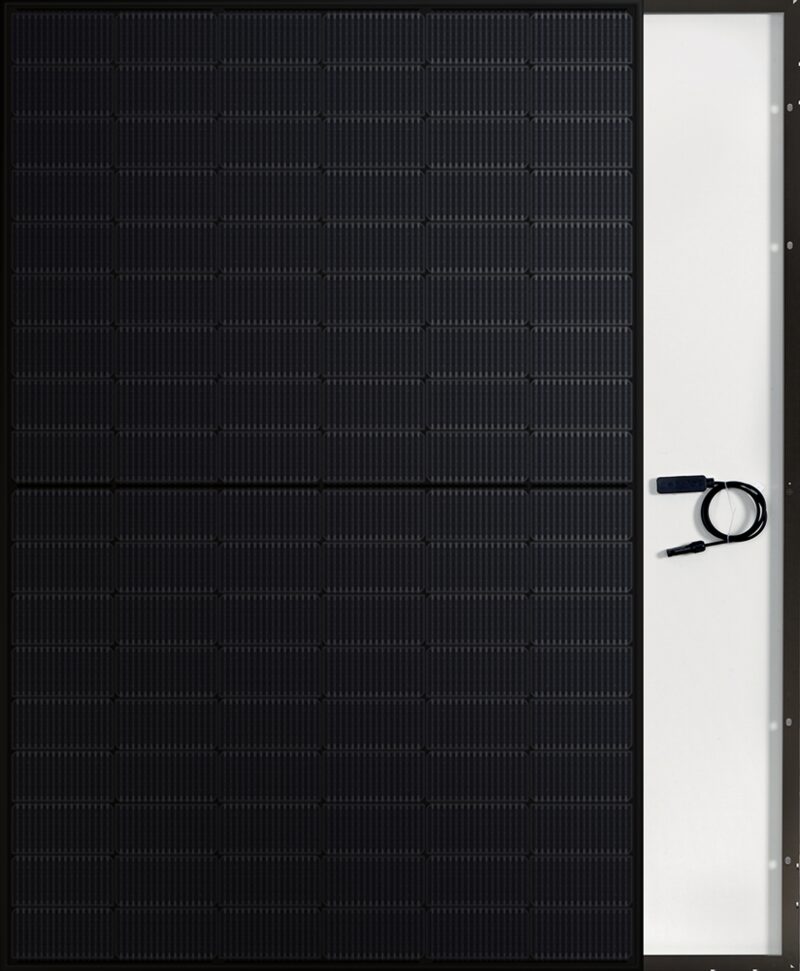
The 450 Wp and 460 Wp Silk Nova Duetto models are the ones the maker treats as flagships, and both obtained EPD certification in October 2025, with a Carbon Neutral version offered alongside7. EPD is an environmental product declaration: a verified summary of a product's environmental impact across its life, rather than a performance rating. It is a documentation credential, useful where a specifier or a buyer wants lifecycle data, and it does not change how much electricity a panel makes.
Certifications: over 20, from TÜV Rheinland and DEKRA to EPD and fire safety

FuturaSun states that its modules carry more than 20 certifications, drawn from bodies including TÜV Rheinland and DEKRA, alongside environmental declarations and fire classifications. The two that a UK household is most likely to encounter in practice are the MCS certification that governs the installation and the fire classification that governs where a module may be mounted.
On fire, FuturaSun announced on 27 October 2025 that all its photovoltaic modules had obtained Class E and Broof classifications6. Broof is the classification relevant to roof coverings and their resistance to external fire spread, and it is the one that matters when a module is mounted on or integrated into a roof rather than held above it. A module without an appropriate fire classification can restrict what an installer is willing to specify, particularly on a roof-integrated or in-roof arrangement. The site's guide to solar PV fire and electrical safety covers the wider picture.
The EPD certification obtained in October 2025 by the 460 Wp and 450 Wp All Black Silk Nova Duetto models is a separate strand7. Environmental product declarations are verified documents summarising lifecycle impact, and they are increasingly requested in commercial and public sector procurement. For a domestic buyer they are background assurance rather than a decision driver.
Independent testing of solar modules in the UK market is carried out by programmes such as Which?, which uses tests based on the international standards for photovoltaic modules, EN50380:2003 and IEC61215:200511. Those tests cover power stabilisation with solar radiation exposure of 25 kWh/m2, determination of maximum overall production performance, nominal efficiency, performance decline after sun exposure, power output, exposure at 60 kWh/m2, electroluminescence and current leakage due to humidity11. FuturaSun's own figures come from the maker's laboratory and datasheets rather than from that programme, so the two are not directly comparable. The site's guide to solar panel standards and testing explains what each standard covers.
Build quality: PFAS-free components and audited cell suppliers
FuturaSun states that its modules are built with PFAS-free components and that it audits its cell suppliers. PFAS, or per- and polyfluoroalkyl substances, are used in some backsheets and coatings, and their presence in a module is a manufacturing and end-of-life question rather than a performance one. The claim is the maker's own about its own production, and it is not backed in the available material by an independent test result, so it should be read as a sourcing commitment rather than a certified property of every unit.
The practical consequence for a household is limited but not zero. A module free of PFAS is easier to handle at end of life, and the site's guide to solar panel recycling and disposal sets out what happens to panels when they come off a roof. Cell supplier auditing matters more directly: it is the maker's route to controlling the quality of the cells that determine output and degradation, and it is the part of the supply chain where variation between batches is most likely to appear.
Glass-glass construction, used on the Silk Nova Duetto, is the other build choice worth noting. A glass-glass module sandwiches the cells between two sheets of glass rather than glass and a polymer backsheet, which affects durability and how the panel behaves under mechanical load. The site's guide to bifacial and glass-glass solar panels explains the trade-offs, and glass-glass vs standard solar panels compares the two directly.
N-type IBC cells and the TNO partnership
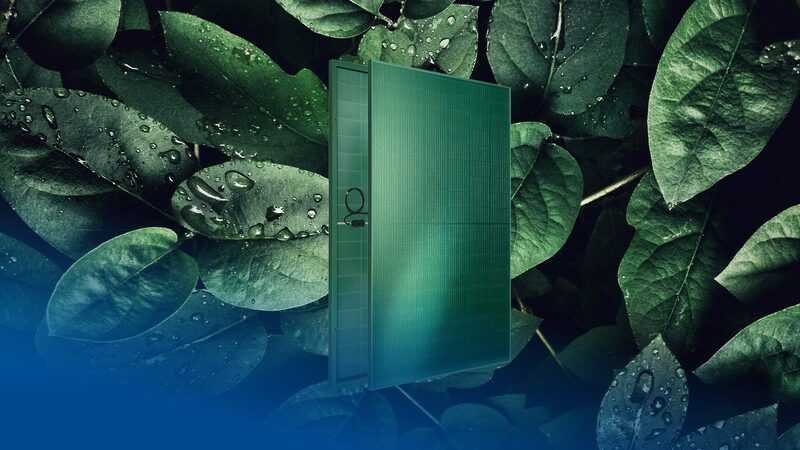
FuturaSun's technology direction is set out in a partnership announced on 14 May 2025 with TNO, the Netherlands Organisation for Applied Scientific Research, to develop bifacial n-type silicon solar cells for integration into the Silk Nova modules12. The same announcement stated that FuturaSun is planning to establish a European manufacturing base to reduce dependencies on scarce materials and overseas production12.
That second point is the one with the clearest bearing on a UK household. Around 80% of panels available in the UK are made in China, including those from Trina Solar13. A European manufacturing base would not change the physics of a panel, but it would shorten the supply chain for a brand whose modules are already designed in Italy. It is a stated plan rather than a completed facility, so no module on a UK roof today can be attributed to it.
N-type cells are the wider shift. N-type silicon wafers are doped differently from the older p-type, and they typically degrade more slowly and hold efficiency better at higher temperatures. The site's guide to n-type vs p-type solar cells explains the difference, and solar cell technology covers where TOPCon, heterojunction and IBC sit relative to one another. FuturaSun's stated work with TNO is on bifacial n-type cells, which collect light on both faces and suit elevated or reflective mounting.
The most forward-looking item is SunXT, announced on 19 December 2025 as a joint venture between FuturaSun and Eniverse to develop perovskite-silicon tandem photovoltaic panels15. Tandem cells stack a perovskite layer over silicon to capture more of the solar spectrum than silicon alone can. It is a research and development venture, and no SunXT product is available for a UK roof. A household buying today is buying silicon, and the tandem work is a statement about where the maker intends to be in the following decade rather than a specification to compare.
Support, installers and what owning FuturaSun panels means
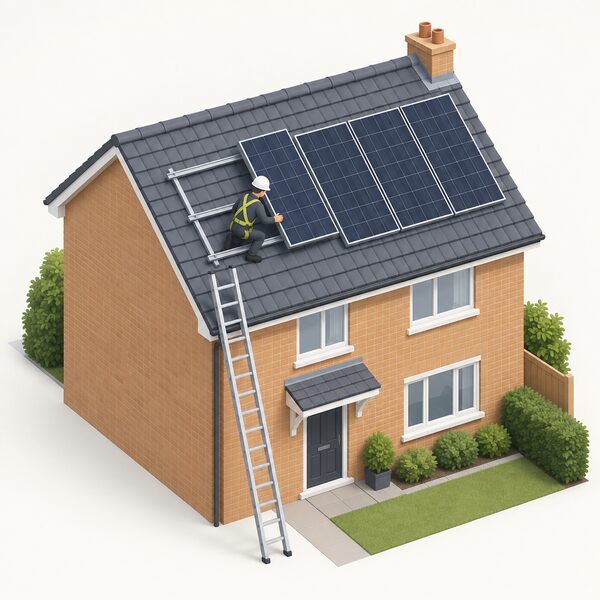
FuturaSun sells through MCS-certified installers and distributors rather than direct to households, so the buying experience is the standard UK one: a survey, a quote, an installation date and a handover pack. Independent guidance is to get quotes from at least three different MCS-certified solar panel installers, and to check that the system is properly registered with MCS and any export tariffs17. A qualified installer should confirm safe installation in line with safety standards8.
The permission side depends on where the property is and who owns it. Leaseholders need the permission of the freeholder to install solar panels, and may also need permission from a landlord or management company18. In Wales, building regulations apply to solar panel installations, and the Welsh Government advises contacting an installer who can provide the necessary advice20. In Scotland, Home Energy Scotland covers the practical steps for households considering generation21. Planning rules differ across England, Scotland, Wales and Northern Ireland, and the site's guides to planning permission in England, Scotland, Wales and Northern Ireland set out each regime.
On independence, the position is straightforward and worth stating plainly. A FuturaSun array generates electricity on the roof and reduces the amount drawn from the grid during daylight, but the home remains connected to the distribution network, to a supplier for the import and export arrangements, and to an installer and a manufacturer for warranty work. The panels themselves are a long-lived asset with no fuel input and no moving parts, which is the strongest form of independence a household can buy. What they do not remove is the grid connection, the certification chain that keeps the system compliant, or the dependence on a manufacturer that must still exist when a claim is made. The site's guide to solar panels and household energy independence sets out where the boundary sits, and solar panel warranties and degradation covers what a warranty actually promises over the life of the array.
Sources21 cited
- FuturaSun renews MCS certification for its Silk range solar panels, FuturaSun, 2026-07-01
- Why MCS certification matters, MCS Certified, 2026-08-17
- Certifying your product, MCS Certified, 2026-05-18
- Silk Colour photovoltaic monocrystalline coloured panels, FuturaSun, 2026-09-02
- FuturaSun at Intersolar 2025, FuturaSun, 2025-04-16
- Fire safety certifications for the entire FuturaSun range, FuturaSun, 2025-10-27
- EPD: new Silk Nova Duetto models now also certified, FuturaSun, 2025-10-08
- Solar panel installation, Energy Saving Trust, 2026-09-07
- Case study: architectural integration at the Paul Van Ostaijen site, Leuven, FuturaSun, 2025-07-22
- The Vienna State Opera turns green with integrated PV modules, FuturaSun, 2025-12-10
- How we test solar panels, Which?, 2026-08-12
- FuturaSun and TNO join forces on next-generation bifacial n-type solar cells, FuturaSun, 2025-05-14
- SolarEdge solar panels review, Which?, 2026-08-12
- Buying a house with solar panels, Energy Saving Trust, 2026-08-13
- Eniverse and FuturaSun: SunXT is born, FuturaSun, 2025-12-19
- Eniverse and FuturaSun: the new SunXT venture, FuturaSun, 2025-12-19
- UK solar panel hotspots, Energy Saving Trust, 2026-08-13
- Solar panels and permitted development, London Borough of Richmond upon Thames, 2026-07-06
- Solar panels planning permission checklist, London Borough of Islington, 2026-09-17
- Building regulations: solar panels, Welsh Government, 2026-09-17
- Simple tips for a greener Easter, Home Energy Scotland, 2026-09-17