
In this guide
Renault is a carmaker a UK household can buy from, and its electric range sits inside the bidirectional charging story without yet delivering it. Independent guidance states plainly that bidirectional charging, which lets an electric vehicle either draw or supply power to a home or the grid, is currently being trialled in some places but is not widely available1. The same guidance confirms that bidirectional charging is allowed in the UK and that the government is keen to encourage the technology1.
What that means in practice is that a Renault electric car is a purchase you can make now, while vehicle-to-grid and vehicle-to-home operation remains a trial-stage capability. Three conditions have to be met before any car can do it: an electric car, suitable charging infrastructure including wallboxes that support bidirectional charging, and a uniform software language across the car and the charger1. Renault supplies the first of those three. The other two are the constraint.
What Renault offers UK households today
Renault's UK position is a conventional one: it sells electric cars, and the bidirectional capability that would turn those cars into home storage is not part of the offer. Independent guidance from May 2025 sets out the three conditions that must be met for bidirectional charging, and names the Nissan Leaf as the pioneer of the technology, able to charge bidirectionally for several years1. Renault does not appear in that account as a bidirectional pioneer.
The company's UK activity is nonetheless substantial and current. Renault announced UK pricing and specification for the Trafic E-Tech electric in February 2024, with official orders opening in June and first deliveries expected in September4. The Scenic E-Tech electric press kit followed in May 2024 with full UK specifications and pricing across techno, esprit Alpine and iconic trims3. In November 2024 Renault UK announced pricing, three trim levels and two powertrains for the Renault 5 E-Tech 100% electric, with orders opening in January 2025 and first deliveries in Spring 20252. The first shipment of over 200 Renault 5 E-Tech electric vehicles arrived at Portbury Docks near Bristol in February 20256.
The pipeline continues. Renault unveiled a new Megane E-Tech electric in June 2026 with a new 67kWh LFP battery, a 220hp motor, 165kW DC charging and a simplified techno and esprit Alpine trim line-up7. The Twingo E-Tech electric is confirmed for a 2027 launch, built at Novo Mesto in Slovenia, at under £20,0008. For a household, the significance is that Renault is a live, active supplier of electric vehicles in the UK with a visible forward range, not a company whose products might be orphaned.
Specifications: what the range actually delivers
The specifications that matter for a household considering bidirectional operation are battery capacity, DC charging rate and powertrain. Renault's most recent published figures come from the June 2026 Megane E-Tech electric announcement: a 67kWh LFP battery, a 220hp motor and 165kW DC charging7. LFP chemistry is worth noting because it is the cheaper, longer-cycling lithium iron phosphate type, though the announcement does not state a cycle life or a warranty term for it.
| Model | Announced | Key published specification | UK price |
|---|---|---|---|
| Renault 5 E-Tech 100% electric | November 2024 | Three trims, two powertrains | from £22,995 OTR2 |
| Scenic E-Tech electric | May 2024 | techno, esprit Alpine, iconic trims | from £37,4953 |
| Trafic E-Tech electric | February 2024 | Panel van, LCV | from £34,500 plus VAT after £5,000 PiVG4 |
| Megane E-Tech electric (new) | June 2026 | 67kWh LFP battery, 220hp, 165kW DC | not stated7 |
| Twingo E-Tech electric | confirmed for 2027 | City car, built Novo Mesto, Slovenia | under £20,0008 |
The Trafic Van E-Tech electric was presented at the 2026 IAA Transportation show in Hanover in September 2026 as the first of five new light commercial vehicles planned under the futuREady plan, with the panel van available by the end of 2026 and chassis-cab and crew cab versions joining the range in 20279. Renault also confirmed a connected-data programme called uptimize, launching in 2027, which aims to halve vehicle downtime in the event of an incident9.
None of these announcements states a bidirectional charging capability, a vehicle-to-grid power output, or a compatible home charger. The specification table above is therefore a range summary, not a bidirectional specification. For the equipment side, bidirectional chargers sets out what the hardware has to do, and bidirectional charging standards covers the software language condition that independent guidance identifies as one of the three requirements1.
Warranty: what is and is not stated
The available material does not give Renault's current UK vehicle or battery warranty terms. The only warranty figure present is historical and comes from a government scheme rather than a manufacturer: the Plug-In Car Grant announcement of September 2010 described a three year or 60,000 mile vehicle warranty, plus a three year battery and electric drive train warranty, with a consumer option for a two year battery warranty extension10. That was a grant criterion in 2010. It is not a Renault term today and should not be read as one.
There is a second warranty point that bears on bidirectional charging specifically, and it comes from an official scheme rule rather than a carmaker. The electric vehicle chargepoint grant for renters or flat owners requires that the chargepoint warranty meets the grant requirements11. That is a condition on the charger, not the car, but it illustrates the structure of the problem: bidirectional operation involves a car, a charger and software, and each carries its own warranty. Where a car's battery is cycled by discharging to a home or the grid, the question of whether the vehicle warranty still covers degradation is a live one. V2G, battery degradation and vehicle warranties deals with that question directly.
What a Renault electric car costs
Renault publishes on-the-road prices for its UK electric models, which is more than many makers do. The Renault 5 E-Tech 100% electric was priced from £22,995 OTR when UK pricing was announced in November 20242. The Scenic E-Tech electric was published from £37,495 in May 20243. The Trafic E-Tech electric was announced from £34,500 plus VAT after the £5,000 Plug-In Van Grant, with pre-orders open at that point4. The Twingo E-Tech electric is confirmed for 2027 at under £20,0008.
These are manufacturer announcements, not quotes, and they are the prices at the date of each announcement. The Megane E-Tech electric unveiled in June 2026 has no published UK price in the available material7.
Running costs are a separate matter and the figures available are national rather than Renault-specific. Battery electric vehicles charged at home cost as little as 8p per mile for drivers able to charge at home, according to an official news statement of May 202412. Public rapid and ultra-rapid chargepoints typically cost upwards of £25,000 just to install, excluding additional commissioning and electricity network connection costs, which is why public charging is priced as it is13. For a household, the home charging figure is the one that matters, and it depends on being able to charge at home rather than on the badge.
Company status and the UK market
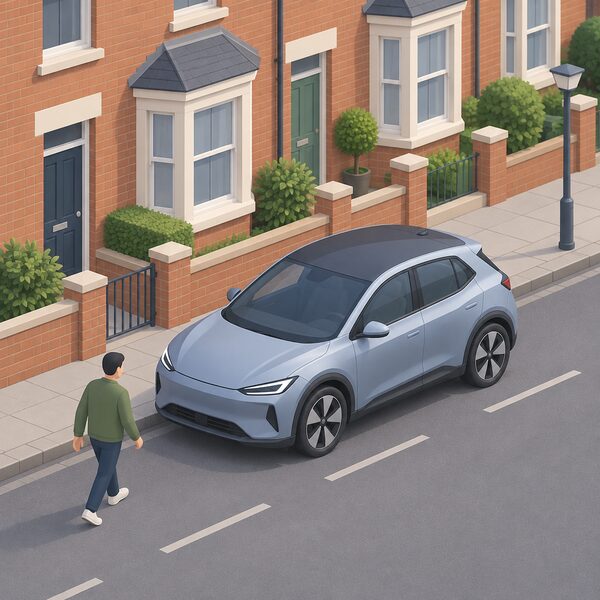
Renault is active. It has announced UK pricing and specifications for the Trafic E-Tech electric, the Scenic E-Tech electric and the Renault 5 E-Tech 100% electric, and it has confirmed future models including the Twingo E-Tech electric for 20272. It unveiled the new Megane E-Tech electric in June 2026 and presented the New Trafic Van E-Tech electric at the IAA Transportation show in Hanover in September 20267. Nothing in the available material indicates insolvency, administration or withdrawal from the UK.
The wider UK market context is favourable to buyers. More than a hundred EV models are now available to British buyers, described by the Society of Motor Manufacturers and Traders as the best ever choice12. That matters for the bidirectional question because it means a household is not choosing between a bidirectional car and nothing: it is choosing between a car that may gain the capability and one that already has it.
On the regulatory direction, an official consultation outcome of March 2023 states that bidirectional charging may be required as part of the definition of a qualifying zero emission vehicle in future years if there is a market failure identified in this area5. That is a possible future requirement, not a current one, and it signals that government sees bidirectional capability as something worth mandating if the market does not deliver it. Which cars support bidirectional charging in the UK tracks the models that already do.
What it means for household energy independence
Bidirectional charging is the mechanism by which a car becomes household storage. Independent guidance defines it as letting an electric vehicle either draw or supply power to a home or the grid1. Official guidance goes further, defining V2X as allowing electric vehicles to operate bidirectionally, charging from the electricity grid but also discharging to the grid, building or home as needed14. That is the prize: a car that can shift cheap or self-generated electricity into the home and export the surplus.
The dependence that remains is substantial and worth stating firmly. A Renault electric car keeps a household on the electricity grid and on an electricity supplier. Bidirectional operation, where it exists, does not remove that: it changes the timing of import and export, not the fact of connection. The car also depends on a charger that supports bidirectional charging and on a uniform software language, neither of which is guaranteed by buying the car1. And because bidirectional charging is currently being trialled rather than widely available, a household buying a Renault today is buying a car, not a home battery1.
There is a further dependence specific to the grid itself. Official consultation material defines rota disconnection as the deliberate disconnection of customers' electricity supplies by the relevant electricity distributor for a set duration on a rota basis so as to reduce demand to the level of capacity available. A car that can discharge to a home is useful in that scenario only if the home can operate islanded from the grid, which is a charger and wiring question rather than a car question. Vehicle-to-home and vehicle-to-load covers what using a car as power actually requires, and Emerging technology and household energy independence places it in the wider picture.
The honest summary for a Renault buyer is this: the car is available, priced and supported in the UK, and the bidirectional capability that would make it a storage asset is at trial stage, gated by charger support and software standardisation rather than by the vehicle alone.
Sources14 cited
- What is bidirectional charging?, Carwow, 2025
- Renault 5 E-Tech 100% electric UK pricing, Renault UK, 2024
- Renault Scenic E-Tech electric press kit, Renault UK, 2024
- Renault Trafic E-Tech electric UK pricing, Renault UK, 2024
- Zero emission vehicle mandate: government response, Department for Transport, 2023
- First production Renault 5 E-Tech electric vehicles land in the UK, Renault UK, 2025
- Renault unveils new Megane E-Tech electric, Renault UK, 2026
- Renault Twingo E-Tech electric, Renault UK, 2027
- Renault unveils New Trafic Van E-Tech electric, Renault UK, 2026
- Government confirms Plug-In Car Grant criteria, SMMT, 2010
- Electric vehicle chargepoint grant for renters or flat owners: eligibility, GOV.UK, 2026
- Brits enjoy best ever EV choice, SMMT, 2024
- Electric vehicle charging market study: final report, Competition and Markets Authority, 2021
- Well-adapted energy system, Climate Change Committee, 2026