
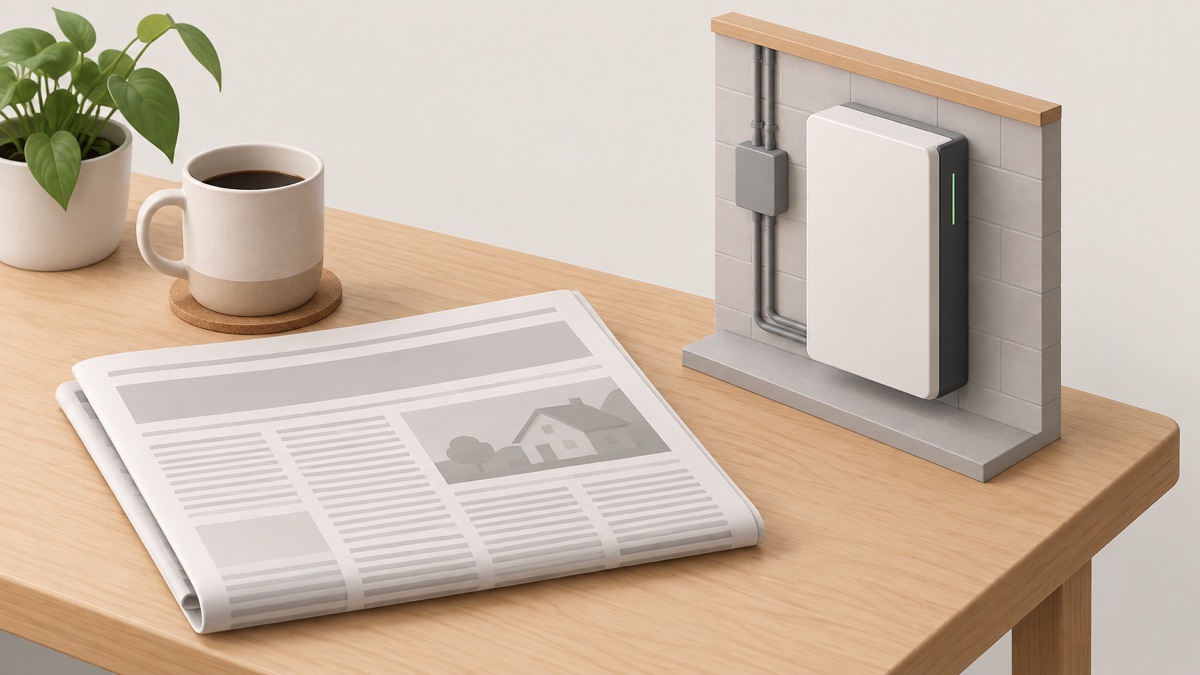
Windfall Energy is preparing to open pre-orders for the first limited run of its Windfall Battery, the company's chief executive said in an interview published on 13 April 2026 by Energy Systems Catapult, which lists the firm among its GridFlex innovators1.
Ashley Grealish, CEO and co-founder of Windfall Energy, said the company is targeting households in flats and rented homes, a group he put at about 9 million UK households1. The battery plugs into a standard wall socket rather than needing professional installation, and the company says it is already integrated with energy suppliers1.
"We are just about to launch pre-orders for our first limited run of Windfall Batteries."
Grealish said the company has tested its software and optimisation algorithms on off-the-shelf batteries to demonstrate the proposition before its own hardware finished a first production run1. He described a catch-22 for hardware startups, in which manufacturing needs investment but investors want to see the product in homes first1. The company is also seeking investment partners1.
The interview did not give a price, a pre-order opening date, a delivery date, a battery capacity, a warranty or a number of units in the limited run. None of those details has been reported1. The company's own website is named as the place to reserve a unit, but no address or terms are given in the interview1.
Why it matters for households
Most home battery installations assume a homeowner with a roof, a wall, a consumer unit and the ability to commission an electrician. For the roughly 9 million UK households in flats and rentals that Windfall cites, that route is often closed: landlords may not consent, and there is no suitable external space1. A battery that plugs into a socket changes who can take part in storing and shifting electricity, and it is the reason the company frames its market as the "ignored" half of the energy system1.
The practical questions for a household are the ones the interview leaves open. A plug-in battery still has to be connected to the network in a way the local operator accepts, and the rules differ between a small plug-in unit and a fixed installation. Buyers of any pre-production energy product also carry the risk that the design, the software or the company changes before delivery. Both subjects are covered in our guides to telling the network operator about a home battery and to buying pre-production and crowdfunded energy products.
For a renter, the appeal is that the hardware can move house with them, which is not true of a fixed battery or solar array. That also means the value depends on the software and supplier integrations continuing to work, since the company says the savings and grid balancing come from that side rather than the cells alone1. The wider context for home batteries and household energy independence is that a battery shifts when a home draws from the grid; it does not remove the need for a supply.
What happens next
Pre-orders are described as about to launch, with no date given1. The company says reservations will be taken through its website and that it is looking for investment partners1. Energy Systems Catapult is separately inviting innovators, industry partners and researchers to register interest in the GridFlex programme1.
Sources1 cited
- The GridFlex innovators powering flexibility: Windfall Energy, es.catapult.org.uk