
In this guide
Hitachi sells air source heat pumps in the UK under its Cooling & Heating division, and the domestic product is the Yutaki air-to-water range. The maker lists A+++ energy class on all models, a noise output of 37dB(A) on the Yutaki S 4.3kW, 6kW and 8kW units, and a COP of up to 5.25 on the Yutaki S Combi 4.3kW model, tested at 7°C external and 35°C water under EN145111. Homeowners can connect a Yutaki to a separate hot water cylinder of any brand, or choose a Combi model with an integrated tank1.
The wider case for the technology is settled. Heat pumps are technically suitable for most UK homes if installed appropriately, according to parliamentary research2, and air source is the most common domestic type in Great Britain3. Independent guidance puts a well-maintained heat pump's life at 20 years or longer4, and the same body notes heat pumps can cut household heating bills by up to 60%5.
What follows is what the Hitachi name specifically brings: a long air conditioning engineering history, a small UK domestic range, and a set of dependencies on electricity, controls and servicing that no heat pump removes.
Hitachi at a glance: eight decades of cooling and heating
Hitachi's claim to a household's attention is not newness in heat pumps but depth in air conditioning. The company states it was the world's first air conditioning manufacturer to use a brushless DC motor compressor, in 1983, and it introduced the world's first Centrifugal VRF technology in 2011. Its design history runs from the H-Series wall-mounted units of 1996 through the PAM Shirokumakun of 2002 to the SHIROKUMA-KUN S series with camera sensors in 2012, and it took a Red Dot Design Award for remote iconography in 2022.
That background matters because the two product categories share a physics. Air conditioning units are considered a form of heat pump, and the same process applies8. Many heat pumps function as heating and cooling systems and can even provide summer air conditioning9. A maker that has built compressors and refrigerant circuits for decades is applying the same engineering to a wet heating system rather than to room air.
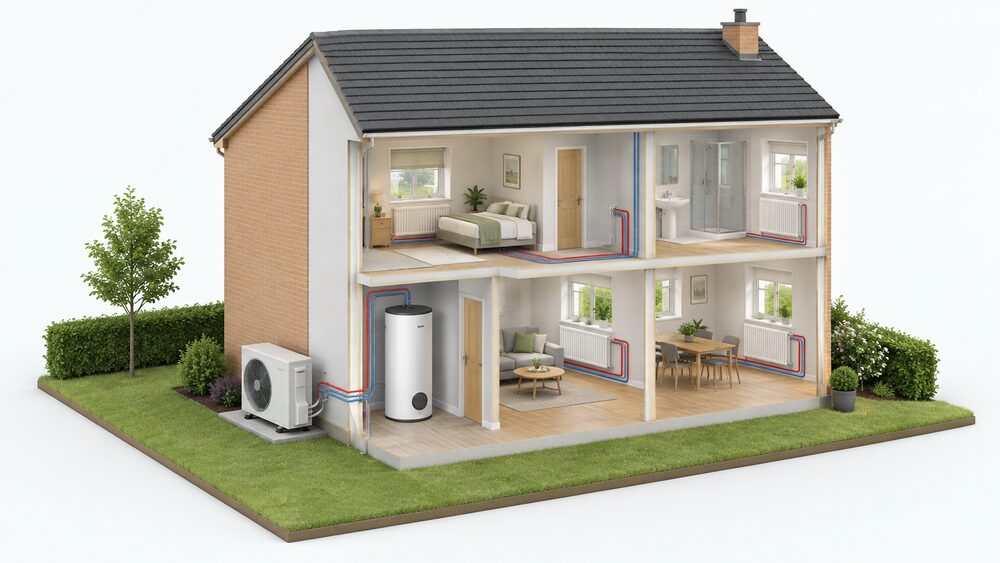
The distinction a household needs to hold on to is between air-to-air and air-to-water. An air-to-air unit conditions the air in a room; an air-to-water unit such as the Yutaki feeds radiators, underfloor loops or a cylinder. The air-to-air route is a different proposition from the air-to-water systems that replace a boiler, and the two are not interchangeable in a home with an existing wet circuit.
The Yutaki range: Hitachi's air source heat pump for UK homes
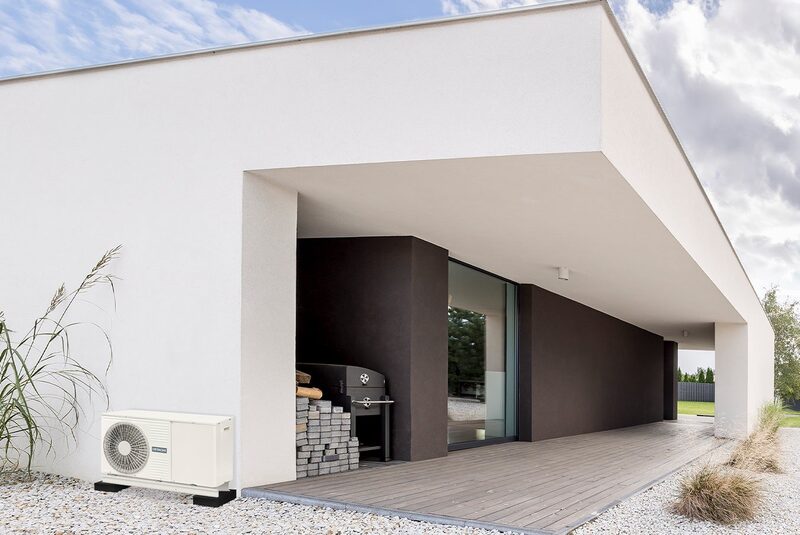
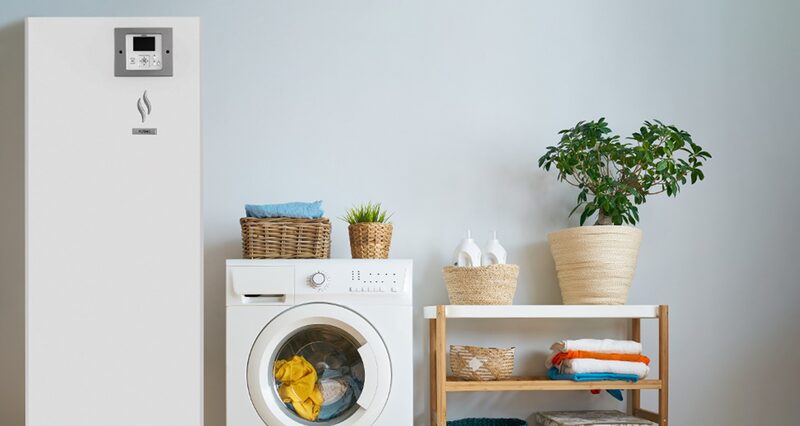
The Yutaki is Hitachi's domestic air-to-water line, and the maker's own product page sets out its shape. Every model carries A+++ energy class1. On hot water, homeowners can connect the unit to a separate cylinder of any brand or choose a Combi model with an integrated tank, which gives a household a genuine choice between matching an existing cylinder or taking a packaged unit1.
Cooling is available on some models with an additional cooling kit accessory, so a Yutaki can be specified as a heating-only or a heating-and-cooling machine1. That is a meaningful difference from a gas boiler, which cannot cool at all, and it links the Yutaki to the wider heat pump cooling picture.
| Specification | Figure | Applies to |
|---|---|---|
| Energy class | A+++ | All Yutaki models1 |
| COP | up to 5.25 | Yutaki S Combi 4.3kW, 7°C ext/35°C water, EN145111 |
| Noise | 37dB(A) | Yutaki S 4.3kW, 6kW, 8kW1 |
| Hot water | Separate cylinder of any brand, or integrated Combi tank | Range-wide1 |
| Cooling | Optional cooling kit | Some models1 |
The COP figure deserves care. It is quoted at 7°C external air and 35°C water, which is a mild-condition test point rather than a UK winter average, and it applies to one specific model. A seasonal figure across a real heating year will be lower. The efficiency measures explained page sets out how COP, SCOP and SPF differ, and why a single quoted number is not a running-cost forecast.
What Hitachi's compressor heritage means for efficiency

A heat pump's efficiency is not set by the badge on the casing. It depends on system design, operating temperatures, building fabric performance, emitter sizing, controls strategy and commissioning quality10. That list is the honest answer to what compressor heritage buys a household: better hardware inside a system whose performance is still decided by the installation around it.
The physics is favourable. Heat pumps transfer heat rather than generate it through combustion, making them considerably more efficient when installed correctly11, and independent analysis puts achievable efficiencies at 250 to 400%12. A government consultation used 300% efficiency as an illustrative running-cost example13. Those figures describe the technology, not a specific Hitachi model.
Where efficiency is lost is at temperature. Heat pumps operate efficiently at lower temperatures, and the higher the flow temperature, the harder they have to work14. They also run best when the house is kept warm continuously rather than reheated from cold15, and a system that cycles on and off when demand is low wears the pump and compressor more than one that runs steadily16. Independent guidance for heat pump homes is that leaving the heating on all day can save money, because the units function differently to boilers and rely on good insulation17.
The practical implication is that a Yutaki's quoted COP tells a household what the machine can do at a test point, while the installed result depends on radiator sizing, flow temperature and commissioning. The sizing and heat loss work and the emitter choices are where the number is made or lost.
Servicing and support through HomeServe
Annual servicing is the standard recommendation for heat pumps, and it is commonly tied to the warranty. Independent guidance recommends an annual service6, and a subscription study notes that routine maintenance relates to annual routine service of the heat pump, required to maintain product warranty7. Government guidance adds that an annual heat pump service will help it remain clean and ensure it runs efficiently and sounds as quiet as possible18.
A service is not a visual check. The tasks listed in independent guidance are cleaning coils, cleaning fan blades, inspecting filters, checking refrigerant level and pressure, and checking that all electrical connections are safe6. Refrigerant work is the part that requires a competent engineer rather than a general maintenance visit.
That last point is worth checking for a Hitachi unit specifically, because remote diagnostics change how quickly a fault is identified. Where a maker offers monitoring, a fault can be seen before it becomes a breakdown; where it does not, the household depends on the installer and the manufacturer's service route.
Faults themselves are usually diagnosable. A common fault is a heating blocked message, which might mean the heat pump is running at temperatures that are too high19. The recommended action is to check the fault log for recurring fault messages and speak to the installer and manufacturer19. A government-commissioned study recorded that some participants reported major system faults leading to significant discomfort with no effective pathway to resolve the issue13, which is a reminder that the support route matters as much as the hardware. The faults and troubleshooting page covers the general diagnostic sequence.
What owning a Hitachi heat pump means for household energy independence

A heat pump changes what a home depends on. It eliminates the need for fuel deliveries required by other types of domestic heating20, which is the direct benefit for a household off the gas grid, and it provides energy efficient, low carbon heating19. Households with a heat pump and an electric vehicle are far less dependent on foreign oil and gas imports and make more use of British electricity21. Independent analysis is blunt that insulating homes and running electric heat pumps and cars on an ev on wind and solar would boost energy independence21.
What remains is electricity. The compressor, pump, controls and any cooling function all run on mains power from a supplier, and the household stays connected to the grid. That is a smaller and more domestically sourced dependence than imported gas, but it is not independence. Heat pumps also support climate mitigation, adaptation and energy system flexibility, which is the system-level version of the same argument22.
Two practical levers exist. A smart meter lets a household see how the heat pump uses electricity and shift when it runs23, and heat pumps can keep homes comfortable on smart tariffs by heating steadily at times when electricity is cheaper, without noticeable change for most households24. Planning is rarely a barrier: domestic heat pumps benefit from permitted development rights, so in most cases planning permission is not required, subject to certain limitations and conditions23. In Wales the position is set out separately in the Welsh planning guidance.
"Domestic heat pumps benefit from permitted development rights. This means that in most cases you do not require planning permission to install them, subject to certain limitations and conditions"
The honest summary for a household weighing a Hitachi unit is this. The fuel dependence shifts from gas to electricity, the delivery dependence disappears, and the remaining ties are to the grid, a supplier, and a servicing and support chain that keeps the warranty valid. The energy independence page sets out how those trade-offs compare across technologies.
Sources24 cited
- Heating and DHW range, Hitachi Cooling & Heating, 2026-09-17
- Heat pumps, Parliamentary Office of Science and Technology, 2026-09-19
- How do heat pumps work, Smart Energy GB, 2026-03-16
- Heat pumps, Home Energy Scotland, 2026-09-20
- Tackling upfront costs: how the electrification action plan can make heat pumps more affordable, EHPA, 2026-07-27
- Is now a good time to get a heat pump, Energy Saving Trust, 2025-12-12
- Heat pumps on subscription, ClimateXChange, 2024-02-21
- Connecting electric vehicles and heat pumps to the networks, Energy Networks Association
- Heat pumps vs boilers, CPA, 2025-02-18
- Heat pumps campaign, CIBSE, 2026-09-17
- Energy efficient home improvements, CPA, 2026-05-07
- Balancing investment in clean heat and energy efficiency in Scottish housing retrofit, ClimateXChange, 2026-06-03
- Heat pump transition report, Department for Energy Security and Net Zero, 2026-05
- Avoiding costly mistakes: why heat pump installations must be done right, Flexi-Orb, 2025-02-11
- Does turning off the heat pump affect heating, Nesta, 2025-01-21
- Thermal energy stores, Energy Saving Trust, 2025-05-15
- The best way to run your central heating to save money, ivie, 2026-09-20
- Heat pumps explained: experts answer your questions, GOV.UK, 2024-03-28
- How to ensure a heat pump runs efficiently, Energy Saving Trust, 2026-05-19
- Heat pumps, REA
- Household energy buying British, ECIU, 2024-04-15
- Cooling matters: the other side of heat pumps, EHPA, 2026-07-31
- Planning permission: heat pumps, Welsh Government, 2026-09-17
- How smart meters work with heat pumps, Smart Energy GB, 2026-04-24