In this guide
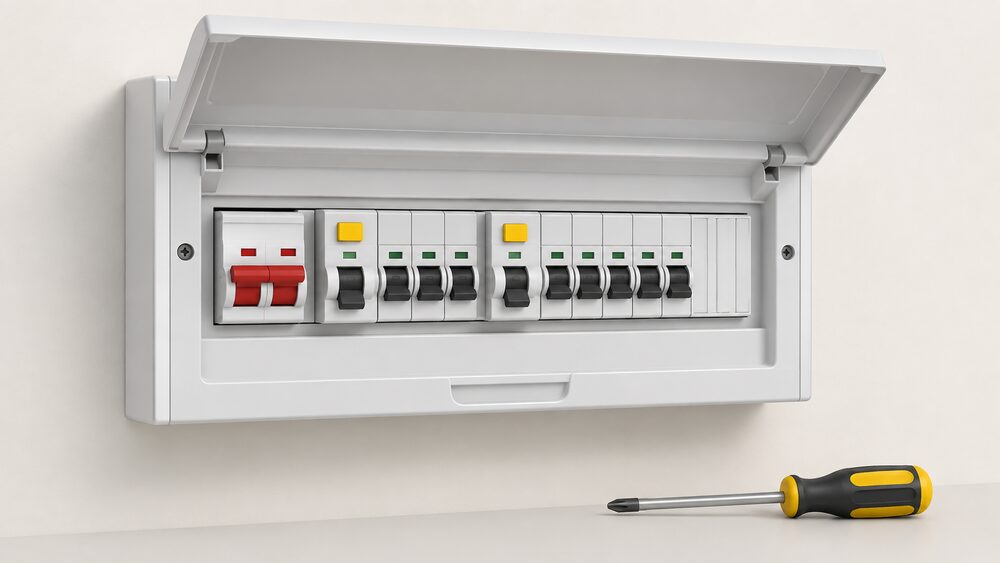
A consumer unit is the box on the wall that holds the main switch, the fuses or circuit breakers, and the residual current devices for a home1. It is the property of the home owner, not the electricity supplier, and it is the point at which the fixed wiring of a house is divided into circuits and protected2. Wylex is one of the names householders most often find printed inside that lid, and the range covers main switch boards, split load boards, dual RCD boards and high integrity boards, with miniature circuit breakers, residual current devices and combined RCBOs as the devices inside them1.
There are five common types of consumer unit sold in the UK, and the differences between them are about how circuits are grouped under residual current protection rather than about the enclosure itself1. A high integrity unit gives each connected circuit either a circuit breaker or the combined RCD and circuit breaker protection of an RCBO, without combining circuits under a single RCD1. That distinction matters more than the brand on the lid, because it determines what happens to the rest of the house when one circuit develops a fault.
Installation, replacement and repair of a consumer unit is notifiable work. It must either be carried out by a qualified and competent person registered on a competent person scheme, or inspected and approved by Local Authority Building Control in England and Wales1. The unit is also the component most often caught up in wider upgrades, because replacing the fuse box or consumer unit is part of a full house rewire3.
Wylex consumer units: what the range covers
The consumer unit sits inside the fixed electrical installation of a home, alongside the wiring, the socket-outlets and the light fittings6. Official guidance describes it in exactly those terms, as one of the fixed electrical parts of a dwelling, which is why work on it falls under the electrical safety standards that apply to rented housing as well as to owner-occupied homes6.
The range a householder will meet splits along two axes. The first is the enclosure: single row boards for a typical flat or small house, and duplex units arranged in two rows for the required protective devices, which offer a larger capacity for managing multiple electrical circuits1. The second is the protective device configuration, and duplex units can be provided in any of the four protective device configurations that the single row boards use1.
That means the physical size of the board and the way circuits are protected are chosen separately. A large house with many circuits may need a duplex enclosure, but it can still be configured as a main switch board, a split load board, a dual RCD board or a high integrity board. The enclosure does not determine the protection strategy.
Types of Wylex consumer unit: main switch, split load and dual RCD
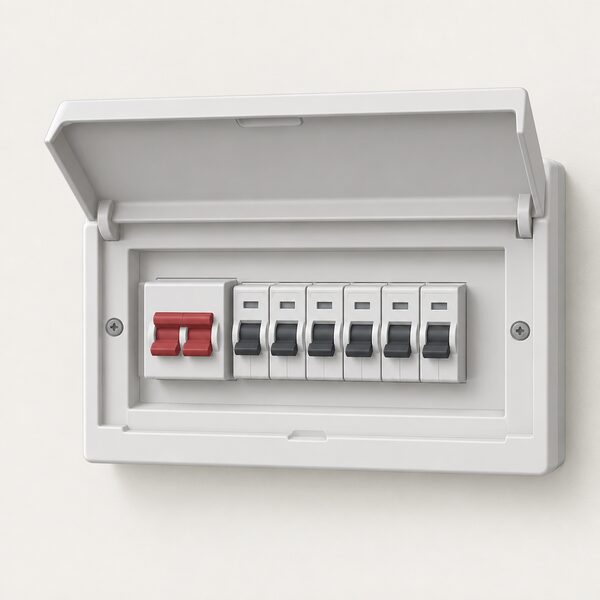
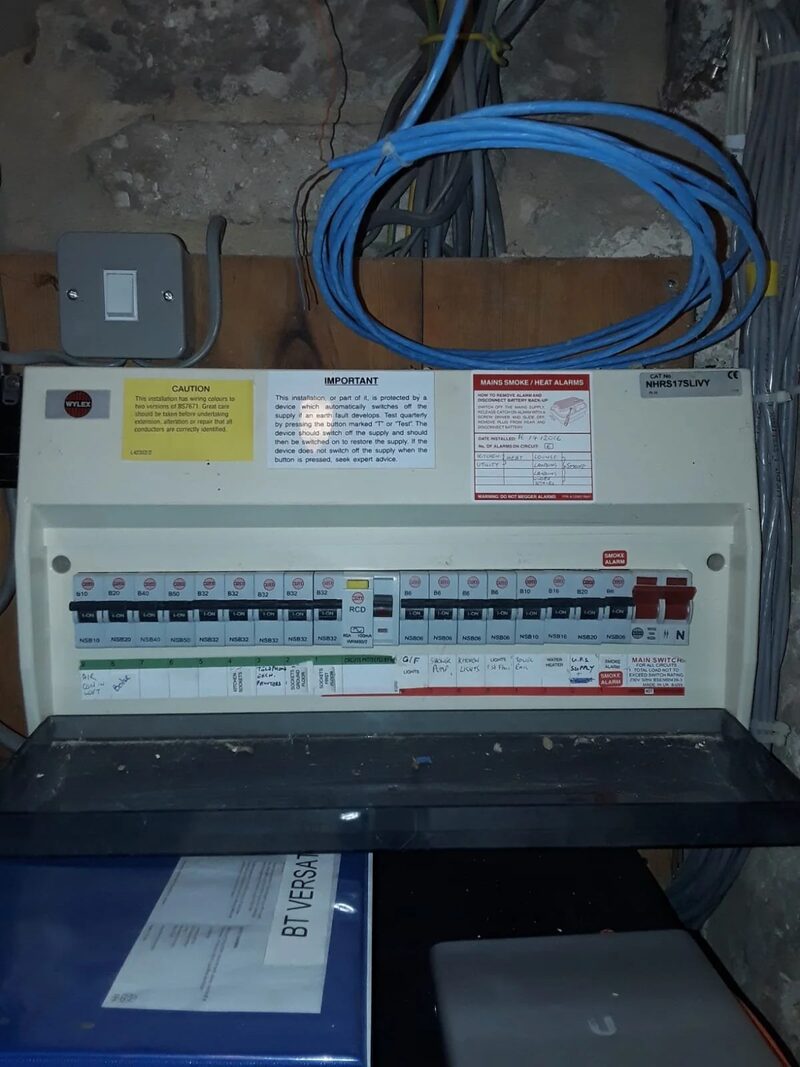
The five common types of consumer unit differ in how residual current protection is applied1. A main switch board has no RCD at all and relies on circuit breakers alone, which is the arrangement found in older installations and in boards that predate the current wiring regulations. A split load board divides the circuits between an RCD protected section and an unprotected section, so that lighting and other circuits that nuisance trip can be kept off the RCD side.
A dual RCD board splits the circuits across two residual current devices, so that a fault on one side does not take out the whole house. The trade-off is that a fault on either side still removes every circuit grouped under that device. A high integrity board avoids the grouping altogether: it provides either circuit breakers or the combined RCD and circuit breaker protection of an RCBO for each connected circuit, without combining circuits under a single RCD1.
For a household, the practical difference is what happens at the moment of a fault. On a dual RCD board, one faulty appliance can darken half the house. On a high integrity board, the fault is confined to the circuit it occurred on. That is the reason high integrity boards have become the common specification for new and replacement installations, and it is a configuration choice rather than a brand choice.
RCBOs, MCBs and RCDs: the protective devices inside the board
Every consumer unit contains three things: the main switch, fuses and/or circuit breakers, and RCDs1. The main switch isolates the whole installation. The circuit breakers, whether miniature circuit breakers or RCBOs, protect individual circuits against overcurrent. The residual current devices protect against earth leakage, which is the fault mode that causes electric shock.
An RCBO combines both functions in a single module, which is what allows a high integrity board to protect each circuit separately1. A miniature circuit breaker does the overcurrent job alone and relies on a separate RCD for earth leakage protection. The choice between them is a choice about how much of the installation goes dark when something goes wrong.
Surge protective devices are a separate addition. They are usually installed within the consumer unit to protect the electrical installation, and combined Type 1 and Type 2 devices are available and are usually installed in consumer units4. Surge protection could be installed in an existing consumer unit if appropriate physical space was available, which is the constraint that most often decides whether it can be added to an older board or requires a new one4.
There is also a newer consideration. Type A residual current devices and RCBOs are designed and tested to tolerate moderate levels of DC residual current, up to 6mA, and are described as suitable for the addition of plug-in solar panels on the circuits they protect5. A household considering a plug-in solar kit therefore has a reason to check the type of RCD already fitted, because an older device may not be suited to it.
| Device | What it protects against | Where it sits |
|---|---|---|
| Main switch | Nothing; it isolates the installation | Consumer unit1 |
| MCB | Overcurrent on one circuit | Consumer unit1 |
| RCD | Earth leakage across grouped circuits | Consumer unit1 |
| RCBO | Overcurrent and earth leakage on one circuit | Consumer unit1 |
| SPD | Voltage surges | Usually within the consumer unit4 |
Amperage, ways and ratings: choosing the right size
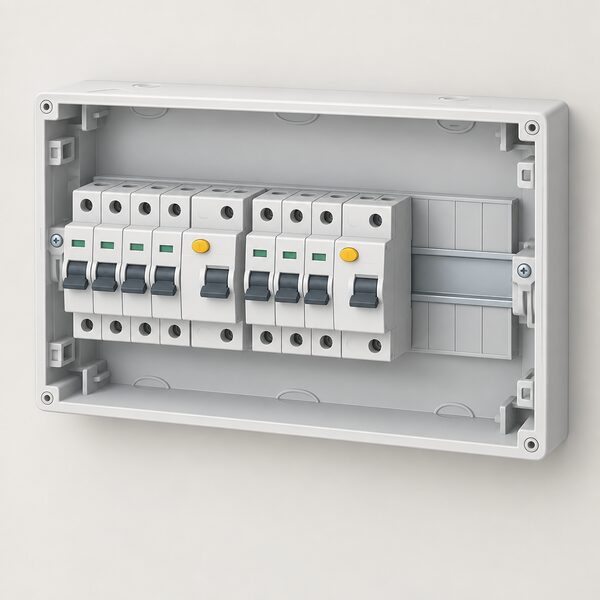
Sizing a consumer unit is a question of ways and ratings rather than of brand. The number of ways is the number of circuits the board can hold, and the rating of each device is set by the cable and the load on that circuit. A board with spare ways leaves room for later additions, which matters because adding a circuit to a full board means replacing the enclosure.
The capacity question is real in practice. One official scheme specification for consumer unit replacement under a particular grant paragraph describes a 10-way capacity with 2 residual current device units and 10 miniature circuit breakers7. That is a worked example of how a specification is written: a way count, a number of RCDs, and a device count to match.
The general principle that applies to any appliance choice also applies here: consider the size of the appliance you need, and going for the right sized appliance means you do not use more energy than you need8. For a consumer unit the equivalent is not to over-specify ways that will never be used, but to leave enough capacity that a future circuit does not force a second board change.
Ratings on the devices themselves are set by the circuit they protect, not by the household's preference. A 0.1A miniature circuit breaker and a 40A residual current device appear on one maker's plug-in solar consumer unit specification, which shows the range of ratings that can sit side by side in a single enclosure10. The device rating must match the cable it protects, and that is an electrician's calculation.
Where Wylex consumer units are used in the home
The consumer unit is the fixed electrical hub of a dwelling. Official guidance on electrical safety standards lists it alongside the wiring, the socket-outlets and the light fittings as one of the fixed electrical parts of a home6. Every circuit in the house starts at that box, which is why it appears in so many different kinds of work.
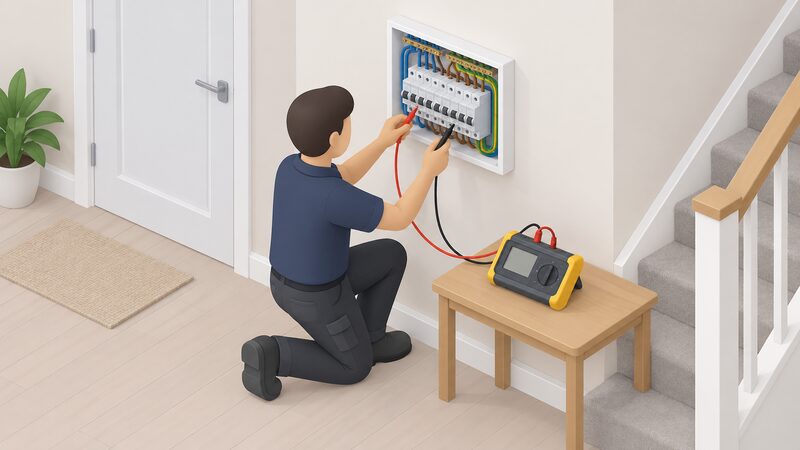
It is part of a rewire. Replacing the fuse box or consumer unit is one of the items included in a full house rewire, so a household having the wiring replaced will have the board replaced at the same time3. It is also a common standalone upgrade, because a board that no longer complies with the latest wiring regulations is a replacement trigger found during an electrical installation condition report1.
Consumer units also sit at the centre of newer household energy work. Surge protective devices are usually installed within the consumer unit, and combined Type 1 and Type 2 devices are available for that position4. Plug-in solar is the other case: a Type A RCD or RCBO on the protected circuit is what makes the circuit suitable for the addition of a plug-in solar panel5.
Where a household has an installation with fuses, or a consumer unit that does not use modern protective devices and is not clearly labelled, the advice is to seek an inspection and assessment by a competent electrician registered with a competent person scheme before installing the product5. That is a safety condition attached to plug-in solar specifically, but it applies to any addition to an older board.
Installation and who can fit one
Consumer unit work is notifiable. The installation must either be carried out by a qualified and competent person who is registered on a competent person scheme, or inspected and approved by Local Authority Building Control in England and Wales1. It is described as absolutely essential to hire a registered electrician to carry out any work relating to the installation, replacement or repair of a consumer unit1.
The same requirement appears in maker documentation. One plug-in solar consumer unit specification states that the product must be installed by a qualified electrician10. That is a maker's condition on its own product, and it aligns with the general rule rather than adding to it.
Cost is genuinely hard to pin down. It is difficult to give any kind of accurate estimate of the cost of installing a consumer unit, because the type of consumer unit, the property size, the electrical system complexity and the electrician's charge all affect the price1. There is no published list price for a Wylex consumer unit installation, and quotes are installer-led after a visit.
Replacement, upgrades and older Wylex units
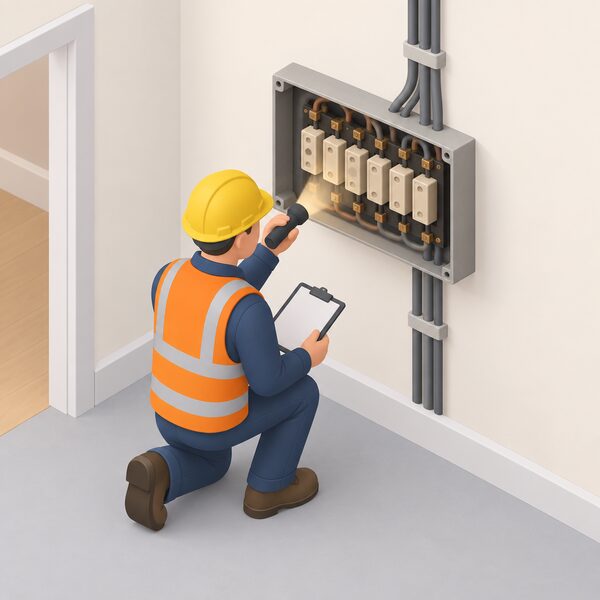
The trigger for replacement is usually compliance rather than failure. A consumer unit that no longer complies with the latest wiring regulations is a replacement trigger found during an inspection1. Older boards with rewirable or cartridge fuses are the clearest case, and where a household has an installation with fuses, or a consumer unit that does not use modern protective devices and is not clearly labelled, the advice is to seek an inspection and assessment by a competent electrician registered with a competent person scheme before installing new equipment5.
Upgrading in place is sometimes possible and sometimes not. Surge protection could be installed in an existing consumer unit if appropriate physical space was available4. That conditional is the whole answer: a board with spare ways and room beside the devices can take an SPD, and a full board cannot. The same logic applies to adding a circuit for a new appliance or a plug-in solar kit.
For a household, the practical sequence is an inspection first. An electrician assesses the existing installation, identifies what no longer complies, and sets out whether the board can be extended or needs replacing. Replacement of the fuse box or consumer unit is part of a full rewire, so where the wiring itself is being replaced the board change comes with it3.
The independence question is straightforward here. A consumer unit is a fixed component of the home's own electrical installation, owned by the householder rather than the supplier2. Replacing it does not change the household's relationship with the grid or with an energy supplier, and it does not generate or store anything. What it does is make the installation safe, labelled and capable of accepting the circuits that later equipment needs, which is the precondition for adding generation or storage rather than a step towards independence in itself.
Spare parts and accessories
Spare parts for a consumer unit are the protective devices and the accessories that sit alongside them. The devices themselves are the main item: miniature circuit breakers, residual current devices and RCBOs, sized to the circuit and matched to the enclosure1. Surge protective devices are the other common addition, and combined Type 1 and Type 2 units are made for installation within a consumer unit4.
The constraint on older boards is the enclosure rather than the device. A board with no spare ways cannot take an additional circuit without a new enclosure, and a board with no physical space beside the devices cannot take an SPD even if one is available4. Where a unit no longer complies with the latest wiring regulations, replacement of the whole board is the usual route rather than a part-by-part repair1.
Accessories in the wider sense, the ancillaries and vessels that sit around heating and electrical plant, are catalogued separately by manufacturers and are not consumer unit parts11. For a consumer unit, the parts that matter are the devices, the busbar and the enclosure, and they need to be matched as a tested assembly rather than assembled from mixed sources.
Registration and record keeping are worth attention. Registering electrical appliances means the manufacturer can contact you if a problem is found with the product12, and for a fixed component the installation certificate and the invoice are the documents that carry the warranty and the compliance record. Consumer protection law gives remedies where goods are faulty, and the guidance on those rights covers England, Scotland and Wales, with separate arrangements in Northern Ireland13.
Sources13 cited
- Consumer units and fuse boxes, NICEIC, 2025
- Meter services FAQs, NIE Networks, 2026
- Rewiring your house: an essential guide for homeowners, NICEIC, 2026
- Surge protective devices, IET, 2026
- Plug-in solar consumer guide, Electrical Safety First, 2026
- Electrical safety standards in the private and social rented sectors: guidance, GOV.UK, 2025
- Information released: consumer unit specification, Scottish Government, 2024
- Top five tips to save energy in the kitchen, Energy Saving Trust, 2026
- Buying energy efficient products, Energy Saving Trust, 2024
- easyConsumerUnit plug specification sheet, Plug In Solar, 2026
- Product ranges: accessories, Lochinvar, 2026
- Recycling electricals and batteries, Electrical Safety First, 2026
- Consumer protection rights, GOV.UK, 2025