

In this guide
SSE tariffs are no longer sold to households in Great Britain under the SSE name. The domestic supply business now sits inside OVO Energy, and Ofgem's supplier-level satisfaction research counts the two together, sampling 314 respondents for OVO Energy including SSE in July to August 20251. The SSE name still trades in Northern Ireland as SSE Airtricity, where electricity tariffs rose 6.2% from 1 August 2026, adding around £76 a year, and gas tariffs rose 19.2% from 1 October 2026, affecting around 204,000 domestic customers in Greater Belfast and West2.
For a household with solar panels, the export side is the part that matters most. The Smart Export Guarantee is a market-led scheme: licensees set their own tariff price and decide how their tariffs work3. Rates across the market run from 1p to 25p per kWh, and official guidance states that as of June 2026 SEG payments can reach up to 25 pence per kWh, comparable to the unit rate of electricity4. A 3.5p per kWh export rate sits near the bottom of that spread, not the top.
What follows sets out what the SSE name covers today, what a household can actually sign up to, how the export tariff works, how standing charges and price rises are built, and where to go for help. The wider picture of how tariffs are structured is at UK energy tariffs.
SSE today: owned by OVO, and what that means for householders
The practical answer to "what happened to SSE" is that the household supply brand in Great Britain changed hands and now appears in official statistics as part of OVO Energy. Ofgem's supplier-level findings for July to August 2025 list OVO Energy (including SSE) with 314 respondents, and the January 2025 edition of the same research lists 365 respondents under the same combined heading1. That combined presentation is the clearest official signal that the two are treated as one supply operation for measurement purposes.
For a householder, the consequences are about who holds the account rather than about the fuel. The supply licence obligations, the price cap protection on a standard variable tariff, and the complaints route all attach to the supplier named on the bill. Ofgem's guidance is explicit that people on a standard variable tariff are protected by the energy price cap5. That protection does not depend on the brand name above the logo.
The SSE name has not disappeared entirely. In Northern Ireland, SSE Airtricity operates as a separate business with its own tariff changes, announced through the Consumer Council: a 6.2% electricity increase from 1 August 2026 worth around £76 a year, and a 19.2% gas increase from 1 October 2026 affecting around 204,000 domestic customers in Greater Belfast and West2. A tariff change in the Gas to the West area and a Greater Belfast gas tariff change were both scheduled for 1 October 20262. Households in Northern Ireland are on a different regulatory footing from those in England, Scotland and Wales, which is covered at energy tariffs in Northern Ireland.
The independence point is straightforward. A household on an SSE-branded account in Great Britain is dependent on OVO Energy as its supplier, on the wholesale market for the price of what it buys, and on the network to deliver it. Nothing about the brand change alters that. What a household controls is the tariff type it chooses and, where it generates, who pays for the export.
SSE tariffs: what domestic customers can actually sign up to

The tariff landscape a household faces is dominated by one product. Around 34 million domestic customer accounts sit on standard variable tariffs, according to Ofgem's August 2025 figures6. An earlier Ofgem figure put the number at around 22 million domestic customers on SVTs as of January 20258. The two figures are not directly comparable, and the scale is disputed, but both point the same way: the default tariff is where most households are.
The licence rules that shape what a supplier must offer apply to suppliers of domestic consumers, and some microbusinesses9. That is the framework within which any SSE-branded or OVO-branded domestic tariff sits. The price cap protects those on the default tariff, and the cap itself moves with the costs underneath it.
For households with generation, the tariff question splits in two. Import supply and export payment need not come from the same company: a household can choose to use separate companies for its SEG payments, its electricity supply and its gas supply10. That separation is the single most useful piece of independence a solar household has, because it means the export rate does not have to be accepted from whoever supplies the electricity.
| What a household chooses | Who can provide it | Constraint |
|---|---|---|
| Import electricity | Any licensed supplier | Price cap applies on the default tariff5 |
| Import gas | Any licensed supplier | Separate contract from electricity10 |
| Export payments | Any SEG licensee | Licensee sets its own rate3 |
The practical position is that a household looking for "SSE tariffs" in Great Britain is looking at OVO Energy products, and a household in Northern Ireland is looking at SSE Airtricity products. The two are governed differently and priced differently. Comparison mechanics are set out at comparing energy tariffs.
Smart Export Tariff: 3.5p per kWh for exported solar electricity
The Smart Export Guarantee obliges licensees to offer at least one SEG tariff to eligible installations, to assess eligibility, to make payments based on export meter readings, to handle complaints from SEG generators, and to provide Ofgem with data on tariff offerings, uptake and payments11. Those are the duties. The price is not among them.
The scheme is deliberately market-led. Ofgem's own annual report states that licensees are free to set their own SEG tariff price and decide how their tariffs work3. That is why a rate of 3.5p per kWh can exist alongside rates many times higher. Independent guidance puts the market range at 1p to 25p per kWh5, and official guidance states that as of June 2026 SEG payments can reach up to 25 pence per kWh, which is comparable to the unit rate of electricity4.
"The amount you can get paid for exporting energy from your solar panels varies from a paltry 1p to 25p per kWh."
A 3.5p per kWh rate is therefore in the lower part of the range. Whether that matters depends on volume: a household exporting a small surplus gains little either way, while one with a large array and a battery has more to lose. The rate is also only half the picture, because some SEG tariffs carry conditions, and one example in Ofgem's reporting is a bundled tariff condition tied to the purchase of import electricity12. A household weighing an export rate against a supply contract is weighing two things at once.
Applications go direct to the licensee. Ofgem's guidance is that generators should contact SEG licensees directly for information about the scheme and to apply for a SEG tariff10. The mechanics of readings, statements and payments are covered at applying for an export tariff, and the rate comparison across suppliers is at Smart Export Guarantee rates.
Standing charges: how SSE charges and where reform is coming
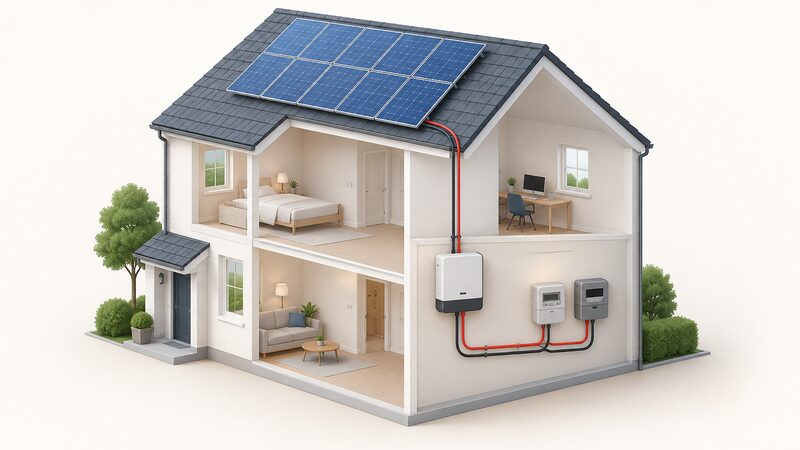
Every electricity and gas bill is built from the same components: wholesale costs, network costs, operating, debt and industry costs, EBIT, policy costs, VAT at 5%, the type of energy used, the type of meter installed and how the bill is paid13. Ofgem's own explanation of wholesale costs is simply the cost a supplier pays to buy energy5. Standing charges sit within the network and operating elements, and they are charged whether or not any energy is used.
That structure is under active reform. Ofgem consulted on a requirement to offer lower standing charge tariffs, with a proposal to amend the standard licence conditions to require suppliers to offer a tariff with a standing charge priced £150 below the price cap nil consumption level per annum14. The consultation closed on 24 September 2025 and its status is recorded as closed, awaiting decision15.
The significance for a household is about who benefits from the current shape. A high standing charge is recovered regardless of consumption, which suits low-usage homes poorly and high-usage homes relatively well. A £150 reduction in the standing charge shifts the balance the other way, and it is the reason the proposal exists. For a household with solar panels and a battery, which imports less than a comparable home without them, the standing charge is a larger share of the bill than the unit rate.
Standing charges also differ by region and by nation, because network costs differ. Ofgem's October 2025 cap announcement attributed part of the increase to rises in the costs of transporting energy in Great Britain, that is England, Scotland and Wales, and to costs towards government schemes and essential support16. Northern Ireland sits outside that cap arrangement entirely, which is why SSE Airtricity tariff changes there are announced separately2. The rules suppliers must follow are set out at tariff rules and consumer protections.
What drives SSE price rises: wholesale costs, network charges and policy costs
Price rises on a domestic bill come from a small number of places, and the proportions are documented. Analysis of the rise in energy bills since pre-crisis levels attributes 54% to higher wholesale prices, with network charges and green levies accounting for 20% and 6% of the rise respectively17. Wholesale cost is the largest single driver by a wide margin.
The remaining components are the ones a household cannot influence at all. Ofgem lists wholesale costs, network costs, operating, debt and industry costs, EBIT, policy costs, VAT at 5%, the type of energy used, the type of meter installed and the payment method as the inputs to a bill13. Ofgem's separate explanation of bill calculation repeats the same set, describing wholesale costs as the cost a supplier pays to buy energy3. None of these are set by the household.
What the household can influence is exposure. A standard variable tariff moves with the cap, and the cap moves with the costs above. Ofgem's April 2025 announcement recorded a rise in the cap, and its later announcement recorded a further rise for October7. The direction of travel in the underlying costs is what determines whether a fixed tariff or a variable one costs more over a given period, and that is a judgement about future wholesale prices rather than a fact.
For energy independence, the picture is uncomfortable but clear. A household buying electricity and gas from a supplier is exposed to wholesale prices it cannot control, network charges set by regulation, and policy costs set by government. The only levers are how much is consumed, when it is consumed, and whether some of it is generated at home. Tariff structures that reward shifting consumption are covered at time-of-use electricity tariffs and shifting electricity use to cheap rates.
Smart meters: the requirement behind many SSE tariffs
A smart meter is not a condition of buying electricity or gas, but it is a condition of many of the tariffs worth having. Ofgem's guidance is that a smart meter gives access to more flexible tariffs, including dual-rate tariffs19. For electric vehicle owners the position is sharper: charging an EV does not itself require a smart meter, but without one some EV-specific tariffs are unavailable, and for many EV-specific tariffs, particularly smart or time-of-use tariffs, a working smart meter is required20.
That distinction matters because it separates two different things. A household can charge a car on an ordinary tariff with an ordinary meter. What it cannot do without a smart meter is sign up to the tariffs that price electricity differently by time of day, which are the tariffs that make off-peak charging worthwhile. The same logic applies to heat pumps and to homes with a battery.
The rollout has a deadline attached. Energy suppliers are required to offer smart meters to all households and small businesses by the end of 203021. Until then, availability depends on the supplier and the area, and a household that wants a time-of-use tariff may need to request a meter installation before it can switch.
There is a second, quieter dependence here. Smart tariffs depend on a working meter, a communications link and the supplier's systems. Where any of those fail, the household falls back to a standard arrangement. The meter is the point at which a household's ability to respond to price signals is either enabled or blocked, and it is worth understanding before choosing a tariff. Which tariffs a given meter allows is set out at which tariffs your meter allows.
Customer service and complaints: how SSE performs

The official measure of supplier performance in this material is Ofgem's supplier-level satisfaction research, which reports OVO Energy including SSE with 314 respondents in the July to August 2025 wave and 365 respondents in the January 2025 wave1. Those sample sizes are the basis on which the combined operation is assessed, and they are modest relative to the customer base, which is worth bearing in mind when reading any satisfaction figure.
When something goes wrong, the route is defined. Where a household has its own contract with an energy supplier, it can follow that supplier's complaints procedure, with details on the bill or on the website22. If the dispute is not resolved, the Energy Ombudsman accepts disputes free of charge via its website, post, email or telephone23. That is the escalation path, and it is free to the household.
There is a separate route for a specific kind of complaint. Where the complaint concerns an Energy Company Obligation installation, Ofgem publishes a dedicated complaints process24. That matters because ECO work is often carried out by a contractor rather than the supplier, and the complaint may be about the installation rather than the account.
For SEG generators there is a further layer. Handling complaints from SEG generators is one of the licensee's formal obligations under the scheme11, which means an export customer with a payment dispute has a route that runs through the supplier first. The general framework for disputes and protections is at tariff rules and consumer protections.
Getting help with bills: support schemes and how to contact SSE
Support for households in difficulty comes from several directions, and the routes differ by nation and by customer type. Ofgem publishes guidance on getting help with energy bills25, and separately on help for a home or business26. Suppliers refer customers who are struggling to pay bills to organisations such as Advice NI, which offers free, independent debt advice27.
For prepayment customers there is a specific obligation. A supplier must offer help where a customer cannot afford to top up, for example by giving extra credit in a vulnerable situation28. That is a duty on the supplier, not a discretionary gesture, and it applies where the household raises the problem.
Local advice services fill a different gap. A Local Energy Advice Programme offers a free telephone advice service to help with benefits, money and bill problems, and can help a household check whether it is on the cheapest tariff29. The contact number published for that service is 0800 082 223429. That is an advice line, not a supplier customer service number.
| Route | What it covers | Where it applies |
|---|---|---|
| Supplier obligation | Extra credit where a prepayment customer cannot top up28 | Great Britain |
| Advice NI | Free, independent debt advice via supplier referral27 | Northern Ireland |
| Local Energy Advice Programme | Benefits, money and bill problems, tariff check29 | Local schemes |
| Ofgem guidance | Getting help with energy bills25 | Great Britain |
There is also a policy direction worth noting. The Scottish Government's Social Tariff working group recommended targeted bill support in the form of a unit rate discount, with the level of discount proportionate to need, applied automatically, and available to all fuel users30. That is a recommendation, not a scheme in force, and it indicates the shape support may take rather than what exists now.
For a household thinking about independence, the honest summary is that bill support is a safety net rather than a route to self-sufficiency. It reduces the cost of dependence on a supplier and a network; it does not remove it. Reducing consumption, shifting it to cheaper hours and generating some of it at home are the levers that change the underlying position, and the tariff choices that support them are set out across UK energy tariffs.
Sources30 cited
- Customers' satisfaction with their supplier: supplier level findings, July to August 2025, Ofgem, 2025
- Electricity, oil and gas help for consumers, Consumer Council for Northern Ireland, 2026
- How your electricity or gas bill is calculated, Ofgem, 2026
- Smart Export Guarantee: generators, Ofgem, 2026
- Smart Export Guarantee rates: the best and worst SEG tariffs, Which?, April 2026
- Energy price cap will rise 2 percent in October, Ofgem, 2025
- Customers' satisfaction with their supplier: supplier level findings, January 2025, Ofgem, 2025
- Energy price cap will rise 6.4 percent in April, Ofgem, 2025
- Licence guide: tariffs and contracts, Ofgem, 2019
- Smart Export Guarantee: contacts, guidance and resources, Ofgem, 2026
- Smart Export Guarantee annual report, year 5, Ofgem, 2025
- Smart Export Guarantee annual report 2022-23, Ofgem, 2023
- Understand your electricity and gas bills, Ofgem, 2026
- Requirement to offer lower standing charge tariffs: supporting document, Ofgem, 2025
- Requirement to offer lower standing charge tariffs, Ofgem, 2025
- Changes to the energy price cap between 1 October and 31 December 2025, Ofgem, 2025
- Electricity prices in Great Britain, House of Lords Library, 2026
- Check if you are owed money on your energy bill, Ofgem, 2026
- Getting a smart meter, Ofgem, 2026
- EV tariffs and home charging: what consumers need to know, Energy Ombudsman, 2026
- A guide to smart meters, Age UK, 2026
- Alternative homes energy guidance, Ofgem, 2026
- Raise a dispute with SWS Utility, Energy Ombudsman, 2026
- Energy Company Obligation: contacts, guidance and resources, Ofgem, 2026
- Get help with your energy bills, Ofgem, 2026
- Get help for your home or business energy bills, Ofgem, 2026
- Advice if you're struggling to pay your energy bills, nidirect, 2026
- Get help with your prepayment meter, Ofgem, 2026
- Grants and funding for energy saving, Tameside Council, 2026
- Tackling fuel poverty in Scotland: periodic report 2021-2024, Scottish Government, 2025
 SSE Energy ServicesSSE no longer supplies households in Great Britain: its retail arm was sold to OVO, and the SSE name now covers networks, Airtricity in Northern Ireland and other businesses.