
In this guide
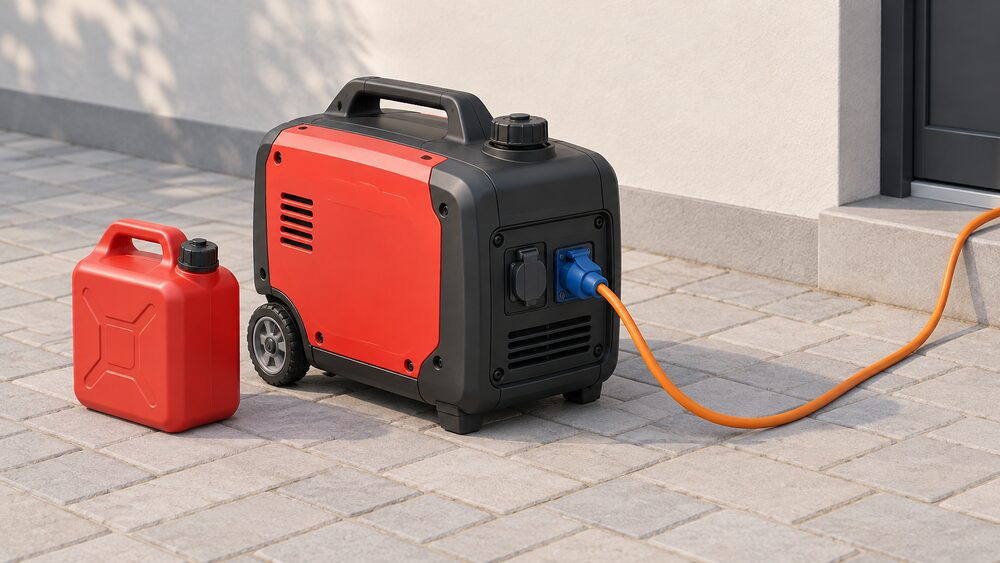
Honda is the generator brand UK householders name most often, and the range sold here is petrol-powered portable equipment rather than a whole-house standby system. That distinction sets the whole picture. A portable Honda generator is a source of electricity you wheel out, fuel, start and plug appliances into. It is not wired into the house, it does not start itself when the mains fails, and it does not remove a household's dependence on the electricity network for everything it does not happen to be powering at that moment.
The UK market for portable generators runs from around £160 to £2,000 or more, and petrol models start at about £2001. Diesel equivalents start at £1,000 and can reach £10,000 and beyond1. Those are market-wide figures rather than Honda-specific prices, because Honda does not publish a UK list price for its generator range in the material available here. What a household can work from is the shape of the market, the sizing logic, and the running and servicing realities that apply to any petrol set.
This page sets out what the range covers, how inverter models differ from conventional sets, how to size one against a fridge, boiler and lights, what a tank of petrol buys, why decibel ratings matter in a garden, what buying and running costs look like, and how connection and safety rules apply. For the wider picture of how generators sit alongside batteries and power stations, the backup power pillar is the place to start.
What the Honda generator range covers for home backup
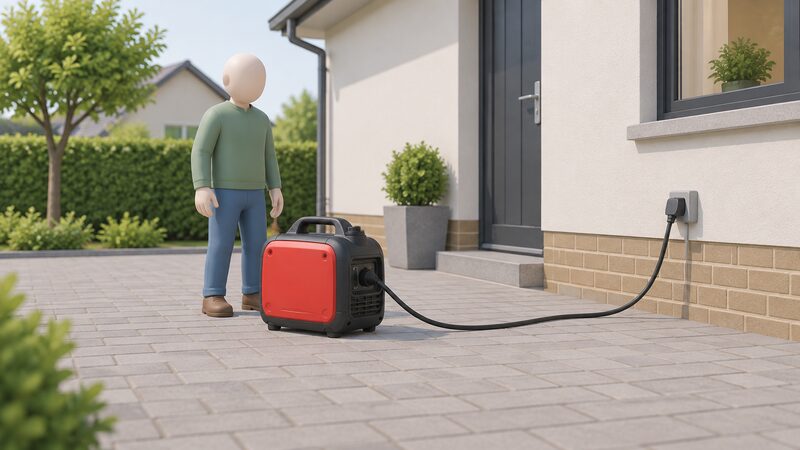
Honda's UK presence in this category is portable petrol generators, and the models most often discussed for household backup are the inverter sets, of which the EU22i is the best known. The range splits broadly into conventional generators, which produce a raw alternating current, and inverter generators, which convert the engine's output to direct current and then rebuild a clean alternating waveform at 230 volts. That second category is the one that matters for a home with electronics in it.
The practical question for a household is not which model but what job the machine is being bought for. A portable generator can run a few circuits' worth of appliances through extension leads, or it can be connected to a property's fixed wiring through a transfer arrangement installed by a qualified professional2. The first is a temporary measure during an outage. The second is a permanent installation decision with notification and safety consequences, covered in more detail under connecting a generator to a house.
It is worth being clear about what a portable set does not do. It does not cover the whole house, it does not start automatically, and it does not store energy. It converts petrol into electricity for as long as the tank lasts and the engine runs. Everything downstream of that, including which circuits stay live, is a decision about essential loads, which is a separate exercise set out in essential loads and backup circuits.
Inverter models like the EU22i: clean power for electronics
The reason inverter generators dominate household recommendations is the quality of the electricity they produce. An inverter is a device that converts direct current to alternating current, and inverter rating is expressed in terms of the output it can sustain3. In a generator, the inverter stage sits between the alternator and the socket, and its job is to hold voltage and frequency steady as the engine speed varies with load.
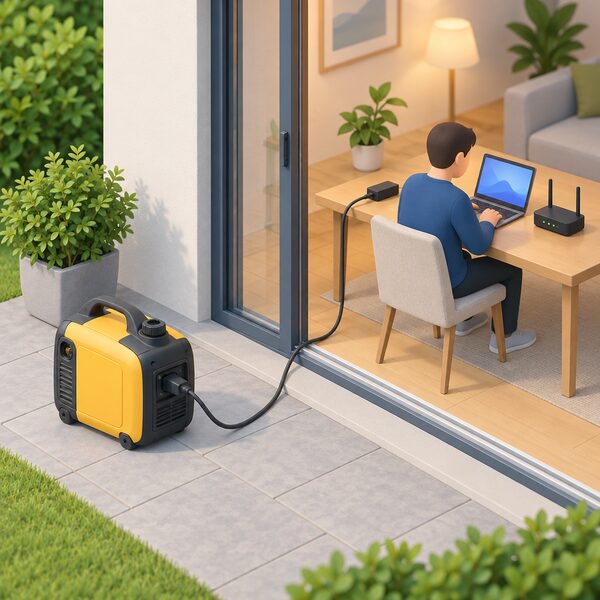
That stability is what makes an inverter set suitable for a modern home's sensitive equipment: a boiler's control board, a broadband router, a television, a laptop charger. A conventional generator's output fluctuates with engine speed, which is tolerable for power tools and resistive loads but less so for electronics. The distinction is set out more fully in inverter generator vs conventional generator.
Inverter sets also tend to be quieter and more fuel-efficient at part load, because the engine can idle down when demand is low rather than running at a fixed speed. For a household running a fridge, a boiler and a few lights through an evening, that part-load behaviour is where most of the operating hours are spent.
The limit is capacity. An inverter generator of the size a household would wheel out is a few kilowatts at most, which is a fraction of what a house with electric heating, an electric shower or an electric oven draws. It will run the essentials and nothing more. Households weighing an inverter set against a battery alternative can compare the two in portable power station vs generator.
Running output vs peak output: sizing a generator for your home
Generator ratings come in two numbers, and confusing them is the most common sizing error. Running output, sometimes called continuous or rated output, is what the machine can supply indefinitely. Peak output is a short-term surge the set can deliver for a few seconds, which is what a motor needs at the moment it starts. A fridge compressor, a boiler pump and a freezer all draw several times their running current for an instant on start-up.
Sizing therefore starts with a list of what must stay on, in running watts, and then adds headroom for the largest starting surge. A generator whose running output covers the combined load, with the peak output covering the biggest motor start on top, is the minimum. Anything tighter risks the set tripping out whenever the fridge kicks in.
| Rating | What it means | What it covers |
|---|---|---|
| Running (continuous, rated) output | Output the set can supply indefinitely | The combined running watts of everything plugged in |
| Peak (surge) output | Short-term output for a few seconds | The largest motor start, such as a fridge compressor or boiler pump |
For context on scale, domestic generation connections in the UK are typically permitted up to between 5kW and 15kW for domestic customers under an export limitation scheme4. That is the network's view of what a domestic premises might export, not a generator rating, but it gives a sense of the order of magnitude involved in whole-property generation. A portable petrol set is well below that band.
Where a household is deciding between a portable set and a permanently installed standby machine, the trade-offs are set out in whole-home generator vs portable and in standby generators for homes. Sizing guidance specific to generators is at what size generator do I need for home backup.
Runtime and fuel: what a tank of petrol buys you

Runtime is a function of tank size, load and engine speed, and published figures are usually quoted at part load because that is where the numbers look best. One 3 litre petrol generator in the UK market claims 8.5 hours from a full tank1. Another claims 11.6 hours, and a third claims 8.3 hours at a 25% load, equivalent to a 750 watt draw1. Those are claimed figures from the manufacturers concerned, not measured results, and they assume a light load.
| Claimed run time | Tank or load condition |
|---|---|
| 8.5 hours | 3 litre tank1 |
| 11.6 hours | Not stated1 |
| 8.3 hours | 25% load, equivalent to a 750 watt draw1 |
The fuel itself is the running cost that matters. Petrol is bought at the pump in small quantities, and one published example puts the cost of filling a small generator and running the tank empty at around £4.351. That figure is dated January 2026 and reflects pump prices at the time. Over a multi-day outage, refuelling becomes the limiting factor rather than the machine.
Storage is the other half of the fuel question. Petrol has a shelf life, and stale fuel is a common cause of a generator failing to start after a long idle period. The rules and practicalities of keeping fuel at home are covered in storing petrol, diesel and LPG for a generator, and the wider comparison of fuels and their running costs is in generator fuel types and running costs.
Noise levels: why decibel ratings matter in a garden or driveway
A generator's noise output decides where it can realistically be run and for how long before it becomes a problem with neighbours. Decibel figures are hard to judge without reference points, and the standard scale runs from the threshold of hearing at 0 dB, through a quiet forest at 15 dB and a library at 35 dB, to a business office at 65 dB, heavy traffic at 90 dB, a pneumatic drill at 105 dB and a plane at 125 dB6. A portable generator sits somewhere in the range between a business office and heavy traffic, depending on model and load.
| Reference point | Level |
|---|---|
| Threshold of hearing | 0 dB6 |
| Quiet forest | 15 dB6 |
| Library | 35 dB6 |
| Business office | 65 dB6 |
| Heavy traffic | 90 dB6 |
| Pneumatic drill | 105 dB6 |
| Plane | 125 dB6 |
For comparison with other domestic equipment, an air source heat pump installed under permitted development in England must have a noise level equal to or lower than 42 dB7. That is a fixed installation running through the night, and it is the benchmark against which a generator's noise becomes obvious. A generator running in a garden is a temporary, louder and more noticeable source.
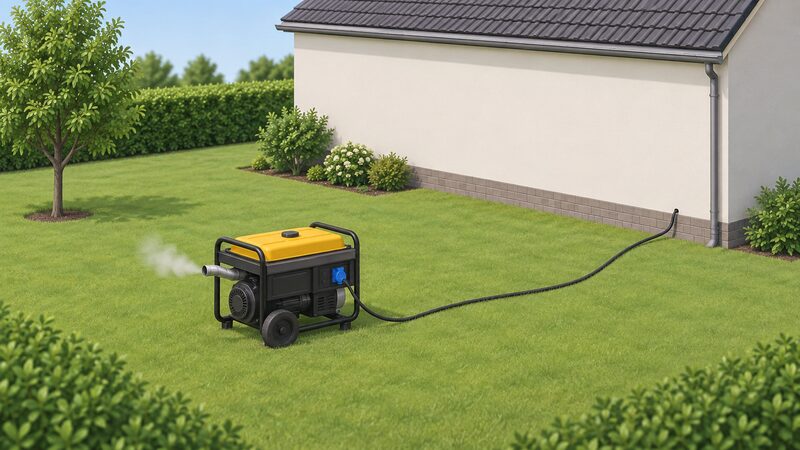
Placement matters as much as the rating. Guidance on domestic outdoor power equipment in the UK notes that current devices available here are generally more suitable for garden locations than balconies8. The same logic applies to a generator: an open garden position, away from neighbouring windows and away from the property's own air intakes, is the practical option. Running one in a driveway between two houses concentrates the noise and puts exhaust closer to habitable rooms.
Cost of buying and running a Honda generator in the UK
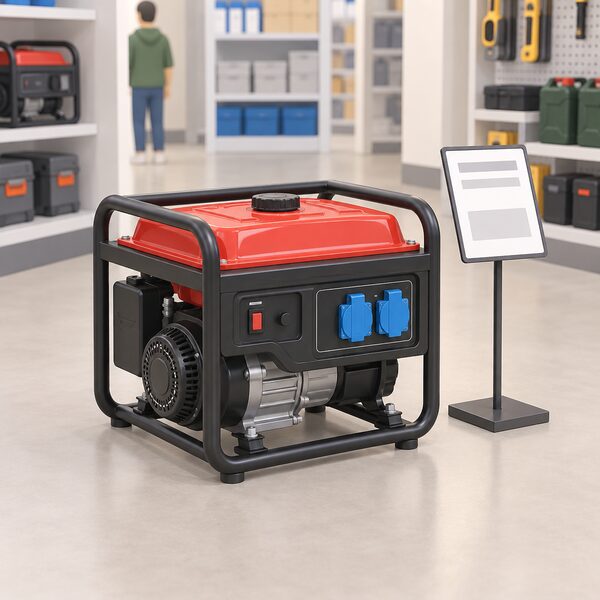
There is no published Honda list price for a supplied generator in the material available here, so any figure a household sees will be a dealer or retailer price. What the market data shows is the band the category occupies. Portable generators start at around £160 and run up to £2,000 or more1. Petrol generators specifically start at about £2001. Diesel generators start at £1,000 and can reach £10,000 and beyond1.
| Option | Published figure |
|---|---|
| Portable generators, market range | Around £160 to £2,000 or more1 |
| Petrol generators, entry point | At least £2001 |
| Diesel generators, entry point | At least £1,000, up to £10,000 and beyond1 |
| 1.6kVA portable generator, hire | Around £76 for a day, £110 for a week1 |
| Small generator, fill and run tank empty | Around £4.351 |
Hiring is an alternative for a short outage. One published example puts a 1.6kVA portable generator at around £76 for a day, or £110 for a week1. For a household facing a single predicted event, that is a different cost structure from buying, and it avoids storage, servicing and fuel staleness.
Running costs are dominated by petrol and by servicing. The fill cost example of around £4.35 for a small generator's tank1 is a snapshot from January 2026. Servicing adds an annual cost, and the pattern recommended for other domestic engine-driven equipment is an annual service9. For a wider comparison of what different backup technologies cost over their life, backup power costs compared sets the categories side by side.
Where to buy in the UK, warranty and servicing
Honda generators are sold through outdoor power equipment dealers, garden machinery retailers and specialist generator suppliers, and the warranty and service relationship runs through that dealer network rather than directly with the manufacturer. That matters for a household because the practical questions, parts availability, service booking and warranty claims, are all handled at dealer level.
Servicing follows the owner's handbook intervals, and for engine-driven equipment the working assumption is an annual service plus attention after long storage. Annual servicing is the pattern recommended for other domestic equipment with a mechanical core, including heat pumps, where the advice is to service according to the manufacturer's advice, usually once a year9. Hybrid heating units carry the same recommendation, with the added note that they require both gas and electrical skill10. A petrol generator is simpler than either, but the principle of a yearly check holds.
The serial number is the key to parts and warranty. It is stamped on the machine, normally on the engine or frame plate, and recorded in the supplied paperwork. A dealer will ask for it before ordering anything.
Safety and connection: running appliances without backfeeding the mains
The single most important rule is that a generator must never be connected to a property's wiring in a way that can energise the mains. Backfeeding puts network engineers and neighbours at risk, and it is the reason connection arrangements exist. Guidance from a UK network operator is explicit:
"if you do choose to connect your own generation, this must be done by a qualified professional"
The same guidance makes the scale of a widespread outage clear. In a major event there will not be enough generators to keep everyone powered, as more than one million homes, at least 5% of households in Great Britain, will be without power at once2. A household generator is a personal measure, not a substitute for the network, and it is worth understanding what the network itself does during an outage, which is covered in who fixes a power cut.
The safe pattern for a portable set is to run appliances directly from the generator's sockets using leads, keeping the machine outdoors and the exhaust clear. Where a household wants fixed circuits supplied, the correct route is a transfer switch or changeover arrangement installed by a qualified professional, so that the property is physically isolated from the mains before generator power is applied. The options are compared in manual changeover switch vs automatic transfer switch, and the notification question is answered in do you need to tell the network operator about a generator.
Some generators include protective features such as automatic low-oil shutdown to help prevent engine damage1. That protects the machine, not the household, and it is no substitute for correct siting and connection. The full safety picture, including earthing and fire risk, is at generator safety.
What a Honda generator does for energy independence
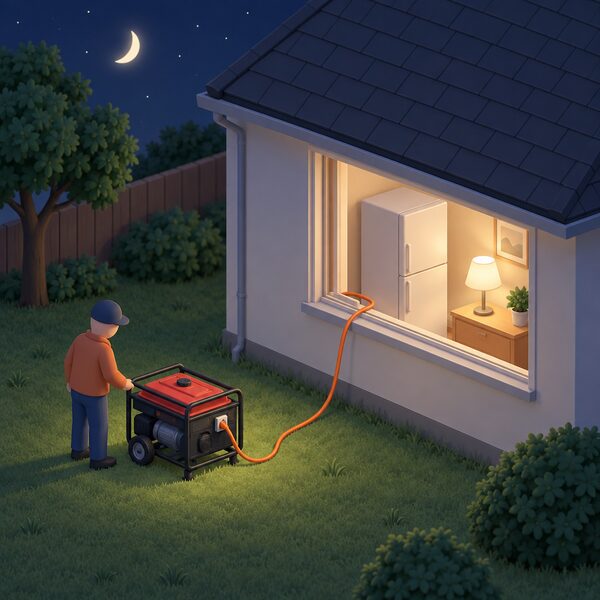
A portable petrol generator buys a household time, not independence. It keeps a fridge cold, a boiler running and a few lights on during an outage, and it does so without any dependence on the electricity network, a supplier or an app. That is a genuine and immediate benefit, and it is the reason the category persists.
The dependence it leaves in place is substantial. The household remains on the gas grid for heating and on a petrol supply chain for fuel. The generator needs petrol bought at a pump, stored safely and kept fresh. It needs an annual service and a dealer relationship for parts. It needs a qualified professional for any fixed connection. And it covers only the loads a household chooses to plug into it, which in practice is a small fraction of a modern home's demand.
For households weighing that against alternatives, the comparison pages set out the trade-offs: diesel vs petrol generator, solar generator vs fuel generator, and standby generator vs home battery. The broader question of what independence actually means for a household is addressed in backup power and energy independence.
Sources10 cited
- How to buy the best generator, Which?, 2026-01-20
- Emergency power cuts, Electricity North West, 2026-09-19
- Jargon buster, MIMA, 2026-09-20
- Installations above 3.68kW per phase but 50kW or less, SSEN, 2026-09-17
- Generation connections, SSEN, 2026-09-19
- Installations up to 3.68kW per phase at a single premises, SSEN, 2026-09-17
- Air source heat pump guide, Eastleigh Borough Council, 2024-04
- What to know about plug solar panels, Home Energy Scotland, 2026-09
- Hybrid heat pumps guidance, HHIC, 2026-09-17
- Off gas grid heating options, OFTEC, 2026-09-17