
In this guide
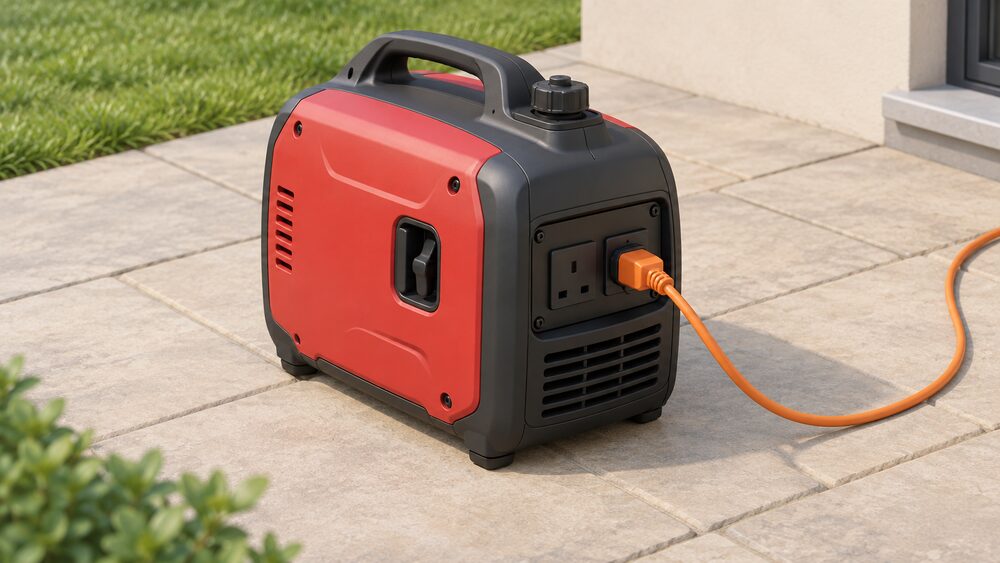
A Clarke generator is a portable petrol or diesel set bought by name, usually as a budget answer to a power cut or to run tools away from a socket. What the name does not tell a householder is how the machine fits the rules that govern any generator connected to a home, and those rules are the same whatever badge is on the casing. A generator with a capacity greater than 3.68kW per phase falls under EREC G99; below that threshold, EREC G98 applies1. That single dividing line decides how much paperwork stands between a machine and a house.
The other figure that matters is usable output. Generator ratings are often quoted in kVA, and the usable power in kW is less than that, at roughly 80% of the kVA figure2. A set sold on its kVA headline therefore delivers less than the number on the box, and motor-driven appliances such as fridges and freezers draw a start-up surge above their running load.
For a household, a Clarke generator is a fuel-dependent, manual backup. It keeps selected loads running while the grid is down, but it does not reduce dependence on a fuel supplier, on stored fuel, or on a qualified electrician to connect it safely. Network operators are explicit that in a wide outage there will not be enough generators to keep everyone powered, with more than one million homes, at least 5% of households in Great Britain, without power at once3.
Clarke generators: what the range covers
The Clarke name sits in the same market as the portable petrol sets that dominate UK household backup: inverter and conventional generators sold on output, tank size and portability. The range a householder meets is defined less by the badge than by the categories the market uses, and those categories carry their own rules.
Output is the first division. Generating units of 50kW or less, which covers every domestic portable set, generally face no network capacity constraints or reinforcement costs in most areas5. Above that, the picture changes: installations of 50kW or greater need a G99 A1-1 application in advance of installation so the network operator can run a full network study and quote to connect, and it is worth checking the thermal Centralised Network View map for constraints in the area5. No domestic Clarke set approaches that threshold, but the boundary explains why small generators are treated so differently from larger plant.
The second division is certification. MCS product certification covers electricity generating products with outputs of up to 50kW6, which is the route by which generating equipment becomes eligible for certain schemes. A portable petrol generator is not a certified microgenerator in that sense, and it is not a low-carbon installation, so it sits outside the support structures built for solar, wind and heat pumps.
The third is the connection standard itself. EREC G98 is formally titled "Requirements for the connection of Fully Type Tested Micro-generators (up to and including 16 A per phase) in parallel with public Low Voltage Distribution Networks"7. That phrase, in parallel, is the crux: a generator running alongside the grid is a different legal object from one running a few appliances on an extension lead.
Petrol, inverter or diesel: which type suits which use
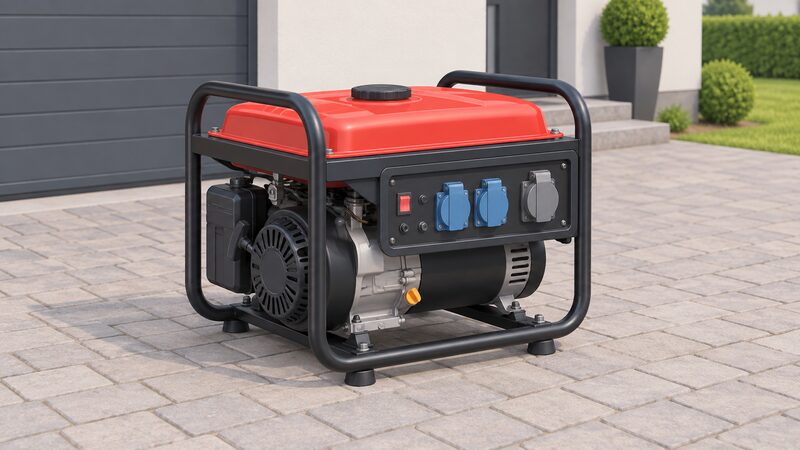
Fuel and technology decide what a generator is good for. Petrol sets are the common domestic choice: one portable inverter generator in the UK market is petrol-powered and carries two 230V 13A sockets, a 12V DC outlet and two USB ports2. That outlet mix tells you what it is designed to run: small mains appliances, a charger, a light, a laptop, rather than a whole house.
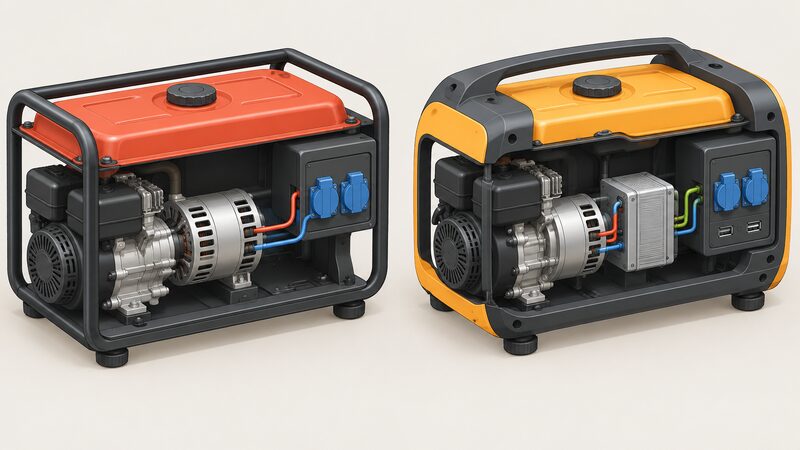
Inverter generators differ from conventional sets in how they produce power. The distinction matters for electronics, because an inverter stage produces a cleaner supply, and it matters for fuel use, because inverter sets typically throttle the engine to the load rather than running flat out. The trade-off is output ceiling and price. A conventional set of the same engine size usually costs less and delivers more raw power, at the cost of noise and fuel consumption at part load.
Diesel sets sit at the heavier end. They are built for longer runs and higher duty cycles, and they are correspondingly less suited to being carried to a shed or started for a two-hour outage. For a household, the practical question is not which fuel is better in the abstract but how long the set may need to run and how often it will be started.
The connection rules do not vary by fuel. Any generating unit connected through the fast-track process must use EREC G99 or G98 type tested inverters, and units installed before 27 April 2019 may also use EREC G59 or G83 type tested inverters8. Small generation installations are held to the same requirement: all generating units must be connected via either EREC G99 or G98 type tested inverters9. A petrol generator with no inverter stage is not part of that framework at all, which is precisely why it cannot be paralleled with the grid.
Power output: matching a generator to what you need
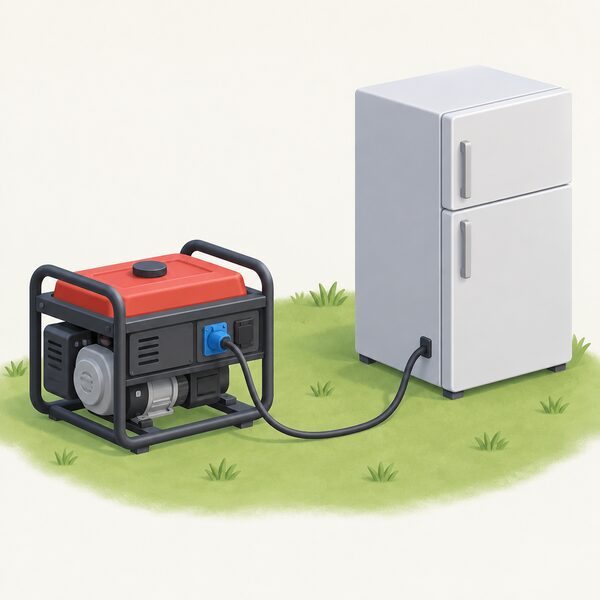
Sizing starts with the difference between kVA and kW. Where a set is rated in kVA, the usable power in kW is less, at about 80% of the kVA figure2. A machine sold as a round kVA number therefore has a smaller real ceiling, and that ceiling is what has to cover everything plugged in at once.
The second factor is surge. Motor-driven appliances draw a starting current well above their running current, so a fridge, freezer or pump can trip a generator that looks adequate on paper. The practical approach is to add up the running loads of what must stay on, then check the generator's surge capability against the largest motor among them.
The third factor is the connection itself. A backup generator should be checked to ensure it meets the power needs and connections required in an emergency10. That is a statement about adequacy and about the physical interface: sockets, leads, and whether the set is feeding appliances directly or the house wiring.
Where a generator is connected through a formal process, the paperwork demands consistency. For a micro-generation connection of 50kW or less, the power rating in kW on the inverter type test certificate should match the power rating in kW of the inverter shown on the schematic diagram11. The schematic itself must show the generator, the name and power rating of the inverter, live phases, neutral and earth, lockable isolators, and clear demarcation between the network operator's equipment and the customer's11. For an inverter-connected generator, a harmonics report up to the 50th harmonic must also be included12, and a site location plan at 1:2500 and 1:500 scale is required12.
| Check | What it decides | Source |
|---|---|---|
| kVA to kW | Usable output, about 80% of kVA | 2 |
| Surge capability | Whether motors start without tripping | 2 |
| Emergency adequacy | Whether the set meets the loads and connections needed | 10 |
| Certificate match | Inverter rating must match the schematic | 11 |
| Harmonics report | Required for inverter-connected generators | 12 |
Specifications to check before buying
Beyond output, the specification sheet carries the details that decide whether a generator is usable in practice. Tank size and claimed runtime are the first pair: a petrol set with a 3 litre tank is quoted at 8.5 hours, while another portable inverter unit claims 8.3 hours at 25% load, a 750W draw2. A third claims 11.6 hours2. Those figures are quoted at part load, and running nearer full output shortens them.
Noise is the second. A generator running through an evening outage is a machine in a garden, and the sound level determines whether neighbours are affected. Inverter sets are generally quieter at part load because the engine speed falls with demand.
Outlets are the third. The mix of 230V 13A sockets, a 12V DC outlet and USB ports on a petrol inverter set2 shows what the machine expects to feed. A household wanting to run a boiler or a fridge needs to know whether the set can carry the surge and whether the connection is safe, and that is a question for a qualified professional rather than a socket count.
Fuel storage is the fourth, and it is where the practical limits bite. Petrol cannot be stored indefinitely, and the volume needed for a multi-day outage is substantial. LPG behaves differently: LPG tanks can be left on site for up to 30 years, against oil tanks that need replacing every 15 to 20 years13. For a household weighing a generator against other backup, that storage difference is as important as the machine's output.
Running a generator at home: fuel, noise and placement
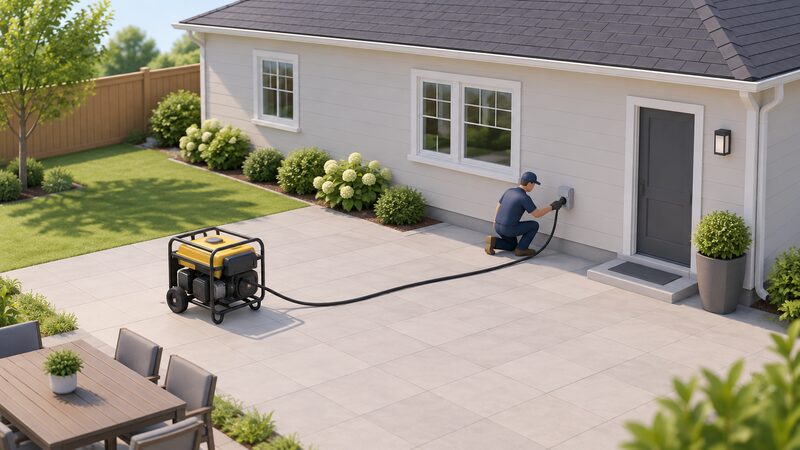
Placement is a safety rule, not a preference. A petrol, diesel or gas generator must never be run inside or near a tent, awning, caravan, motorhome or cabin, and it must be kept away from open doors and windows3. Carbon monoxide from a generator is the risk that rule exists to remove, and it applies to every fuel type.
Connection is the second rule. If a household chooses to connect its own generation, that must be done by a qualified professional4. Owners are also required to make sure that generation equipment they purchase and install on their premises complies with the law1. Those two statements together rule out the improvised approaches, a lead through a window or a plug into a socket, that cause both danger and illegality.
Fuel storage brings its own constraints. Where natural gas is used for home refuelling, a separate meter situated in the garage indicates the quantity of fuel used for that purpose14. For liquid fuels, the storage question is about quantity, ventilation and containment, and for oil tanks specifically, underground tanks should be leak tested at the recommended intervals, three to five years15.
What owning a generator means for household energy independence
A generator changes what a household can do during an outage, and it changes very little about where energy comes from. The machine burns stored fuel bought from a supplier, so the household swaps dependence on the grid for dependence on a fuel chain, a can or cylinder, and the ability to start and maintain an engine.
The benefits are real but bounded. Small-scale heat or power generation units have the potential to reduce energy bills, reduce environmental impact, and possibly allow electricity to be sold back to the grid, and they help reduce dependence on large generating plants located far from where people live16. More homegrown energy means greater energy independence17. Those statements describe generating equipment generally, and a petrol generator used only during outages delivers the resilience half of that without the bill reduction, because it runs too rarely to displace grid import.
The limits are equally clear. In a wide outage there will not be enough generators to keep everyone powered, with more than one million homes, at least 5% of households in Great Britain, without power at once3. A generator is therefore a personal measure, not a system one, and it works only for the household that has one and can run it.
Support structures do not attach to a portable generator. There is no financial support available for homeowners who wish to generate their own electricity through domestic renewable technologies in Northern Ireland18, and the Feed-in Tariff framework defines a FIT generator as the owner of an eligible installation used or intended to be used for small-scale low-carbon electricity generation19, a description a petrol set does not meet. Where a FIT installation changes hands, a solar PV installation requires the new generator to make a new multi-installation declaration20. None of that touches a Clarke generator, and that is the point: it sits outside the subsidy and export framework entirely.
For a household, the honest summary is that a generator buys time, not independence. It covers selected loads for as long as fuel lasts, and it leaves the household dependent on a fuel supplier, on storage, and on a qualified electrician for any connection to the fixed wiring. Alternatives that change the fuel rather than supplement it are covered in portable power stations and standby generators for homes.
Care, storage and servicing
Servicing a generator is engine maintenance plus electrical checks, and the split matters because some of the work is reserved. Work on stationary refrigeration, air conditioning and heat pump equipment is a reserved activity, covering service and maintain systems21, which is a reminder that not every task around a home's energy equipment is open to the householder. Engine oil, filters, spark plugs and fuel system checks on a small petrol set are within the scope of ordinary maintenance, on the schedule the maker sets.
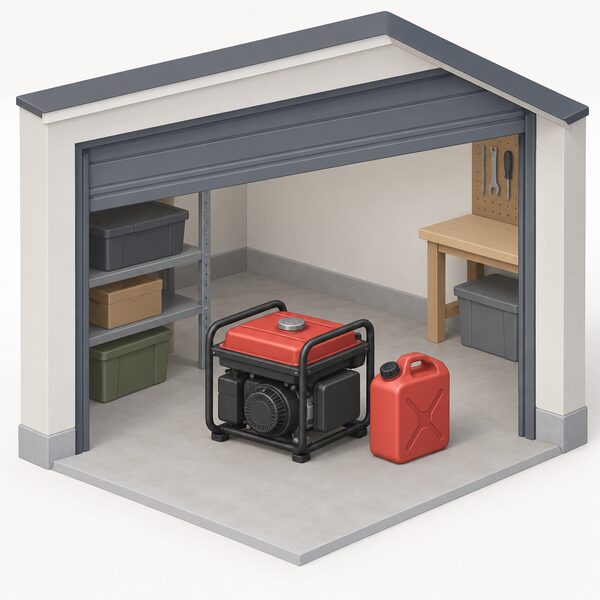
Storage is where generators most often fail. Fuel left in a carburettor over a season degrades, and a machine that will not start in an outage is worse than no machine, because the household has planned around it. The practical routine is to run the set under load at intervals, keep fuel fresh, and store the unit dry.
Registration and records are part of care. All electrical appliances should be registered so the manufacturer can contact you about a problem21, and where a scheme applies, inverter product registrations to activate guarantees and warranties are to be completed within 48 hours of commissioning22. Keeping the serial number, receipt and service record together is what makes a warranty or parts enquiry possible later.
Routine servicing covers engine oil, fuel condition, the air filter, the spark plug, the battery where one is fitted, fuel lines and connections, and the general condition of the generator1. Oil, fuel and air filters are replaced annually, or at the interval the manufacturer sets2. Oil changes and filter replacements are the routine items, and they add to the overall running cost of a generator3.
For a household, the maintenance burden is the ongoing cost of generator ownership. A battery-based alternative has no oil, no fuel and no engine, and its limits are different ones. The comparison is set out in portable power station vs generator, and the wider context for keeping a home supplied is in backup power for UK homes.
Sources22 cited
- Connecting generation to the electricity networks, Energy Networks Association, 2026-09-17
- How to buy the best generator, Which?, 2026-01-20
- Emergency power cuts, Electricity North West, 2026-09-19
- Should I buy my own generator?, NIE Networks, 2026-09-19
- Generation connections, SSEN Distribution, 2026-09-19
- MCS Product Certification, Kiwa, 2026-09-17
- G98 Single Premises, Energy Networks Association, 2026-09-17
- G99 Fast Track process, Electricity North West, 2026-09-19
- G99 Fast Track process and SGIs, UK Power Networks, 2026-09-17
- Care and assisted living providers, Energy Networks Association, 2026-09-17
- Installations above 3.68kW per phase but 50kW or less, SSEN Distribution, 2026-09-17
- Documentation to send with small scale generation, NIE Networks, 2026-09-19
- What is LPG?, Liquid Gas UK, 2026-09-20
- VAT Fuel and Power VFUP2100, HM Revenue and Customs, 2026-09-17
- Check your oil tank, nidirect, 2026-09-17
- The RECC scheme, Renewable Energy Consumer Code, 2026-09-17
- Solar Energy Scotland manifesto, Solar Energy UK, 2026-09-17
- Support to generate your own electricity, nidirect, 2025-09-22
- Key terms explained: Feed-in Tariffs, Ofgem, 2026-09-17
- Guidance for FIT Generators V18, Ofgem, 2026-04-01
- Recycling electricals and batteries, Electrical Safety First, 2026-09-17
- Barcud Solar Panel Installation Scheme Specification, Sell2Wales, 2026-06-15