
In this guide
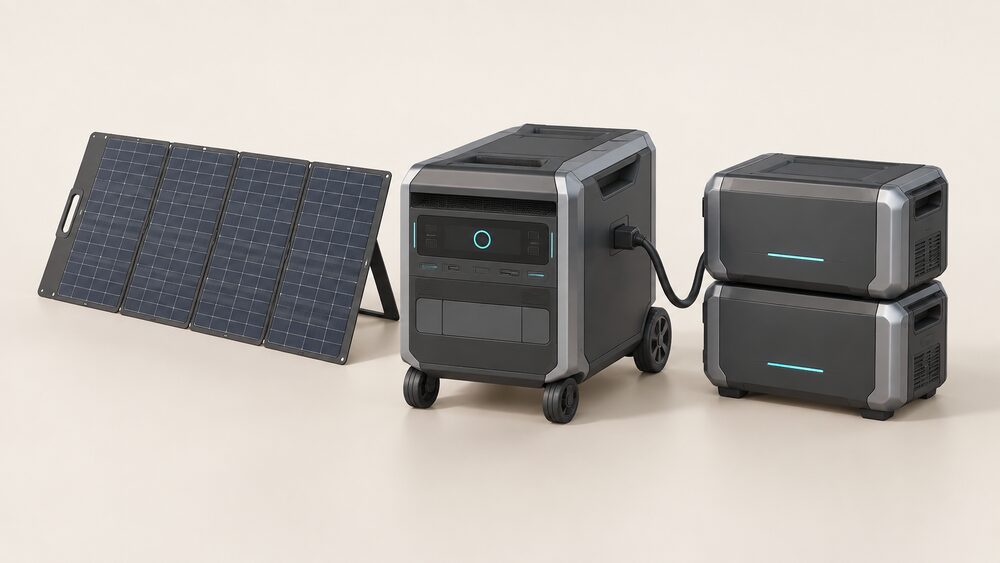
Zendure is a consumer energy technology maker selling portable power stations, plug-in home batteries and a whole-house backup panel, mostly direct to households through its own online store. Its flagship is the SuperBase V, which Zendure describes as the first plug-and-play home energy storage system1, and which the company says is the first home storage system to use semi-solid state batteries2. The range also covers the SuperBase Pro 2000, the Satellite Battery expansion modules, the SolarFlow series of balcony and plug-in batteries, the Home Panel with EV Outlets, and a Mobile EV Charger3.
For a UK household, the appeal is a battery that can be bought and installed without a full solar array, charged from the grid, from solar panels or from a car charger, and used either as a portable supply or, with the Home Panel, as a partial whole-house backup. The dependence that remains is real: the Home Panel needs a licensed electrician, the smart features run through the Zendure app and a home network, and the longest warranty terms sit with the maker's own conditions.
Zendure: an energy tech maker selling direct
Zendure positions itself around an AI-powered Home Energy Management System, or HEMS, that it says monitors solar PV generation from both plug-in and rooftop panels, Zendure storage systems, household loads and grid import and export data10. The optimisation layer, which the company calls Zenki AI, is stated to work from real-time electricity prices, weather forecasts and consumption habits10. The app offers customisable energy plans that adapt to time, sensors and cost, and three control modes named Zenki, Auto and Expert10.
The scale claims are the maker's own. Zendure reports that its HEMS integrates with more than 840 suppliers across 32 European markets for dynamic tariff optimisation10, and that the app draws on Nord Pool day-ahead wholesale pricing and Rabot Energy real-time retail pricing11. It also states that Zendure users save a €4.99 monthly service fee at Rabot Energy for six months11. Those are European market arrangements rather than UK tariff integrations, and no equivalent UK supplier list is given.
The company's own account of its growth is striking: the number of users was 32,239 last year and increased to 67,182 this year, and annual power generation across users rose from 13.17 million kWh to 38.9 million kWh, a 295% growth9. Zendure also states it has been recognised by UNESCO as one of the 80 global sustainability leaders, and that it supports the 2026 World Engineering Day under the theme "Your Energy, Our Future"9.
"Last year, the number of users was 32,239, which has increased to 67,182 this year"
The range: SuperBase V, SuperBase Pro, Satellite Battery and accessories
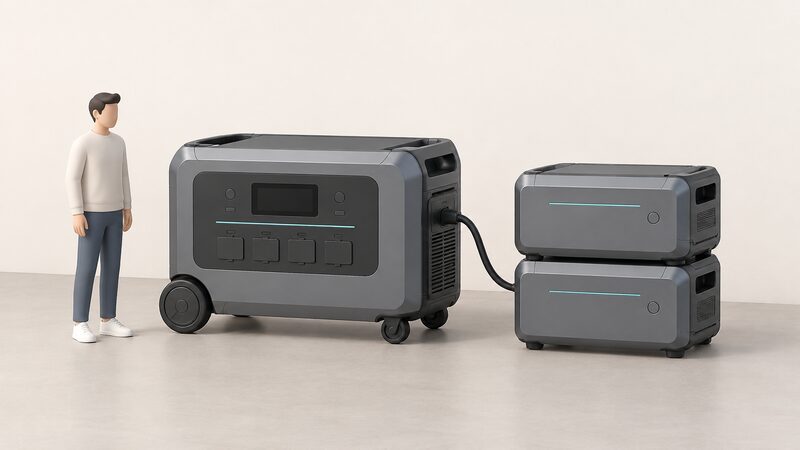
The SuperBase V is the centre of the system. It is sold in two chemistries: the V4600 uses LFP (LiFePO4) batteries with a charge capacity of 4,608Wh, and the V6400 uses semi-solid state batteries with a total charge capacity of 6,438Wh3. The LFP version is rated at 6,000+ cycles4. Capacity expands by adding up to four B6400 satellite batteries of 6.4kWh each, and a system can include two SuperBase V units working in tandem with a maximum of eight satellite batteries in total6. Two units of the same battery type can be linked with a ZenY cable or the Home Panel to reach up to 7,600W of total output4.
The Satellite Batteries are not purely slaves to the main unit. Zendure states they have their own independent DC input and output capabilities that allow them to function as standalone units, and that they stack directly on each other without cable, connecting to the SuperBase V with the included battery cable4. An optional Battery Mounting Bracket secures satellite expansion batteries inside a moving vehicle4.
The SuperBase Pro 2000 sits in the portable camp rather than the home backup camp. It has 12 output ports and can power up to 12 devices at once, with a dual MPPT input supporting rooftop solar panels of up to 1,800W AC and an additional 600W DC input5. It accepts third-party solar panels from 12V to 60V up to 600W through the XT60 port, and 60V to 160V up to 1,800W through the AC input5. Zendure's 200W Portable Solar Panel is designed to produce maximum power at any time of day when paired with a SuperBase Pro power station12.
| Product | Type | Key figure |
|---|---|---|
| SuperBase V4600 | Portable/home battery, LFP | 4,608Wh, 6,000+ cycles3 |
| SuperBase V6400 | Portable/home battery, semi-solid state | 6,438Wh3 |
| Satellite Battery B6400 | Expansion module | 6.4kWh each, up to 4 per SuperBase V6 |
| SuperBase Pro 2000 | Portable power station | 12 output ports, 1,800W solar input5 |
| Home Panel with EV Outlets | Transfer switch and dock | 7,600W max backup6 |
| Mobile EV Charger | Portable EV charger | 3,800 to 7,600W AC output3 |
Semi-solid state batteries: what being first means
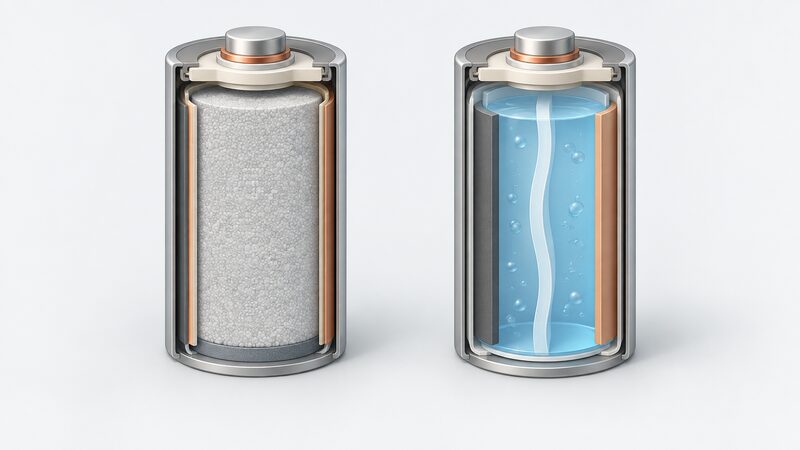
Zendure states it is the first company to offer semi-solid state batteries in a home energy storage system, and that it chose that chemistry for the SuperBase V2. The maker's case for it rests on two claims: energy density and safety. On density, Zendure says semi-solid state NMC batteries hold more energy, pound for pound, than other batteries2. On safety, it states they have a more resilient solid electrolyte interphase and are far less likely to suffer the chain reaction that causes fires and burns, and that they perform better even when punctured by a metal spike in performance tests2.
Those are the manufacturer's own descriptions of its chosen chemistry, not an independent test result, and they should be read as such. The wider context is that domestic battery storage is principally lithium based, with cobalt and nickel also used, according to the Centre for Sustainable Energy13. Independent guidance from Solar Energy UK describes home batteries simply as a way for homeowners to store excess electricity produced from their solar system14, and Which? frames the benefit as storing your electricity to use later, making your energy system more independent from the National Grid15.
The legal definition matters for anyone fitting one. An electrical storage battery qualifies under the relevant legislation if it is intended for use solely for storing energy converted from electricity supplied to the residential accommodation or building in question, or generated by a microgeneration system16. That is the framing that determines how a home battery is treated, and it applies to the function of the battery rather than to its chemistry.
Zendure Home Panel with EV Outlets: whole-house backup
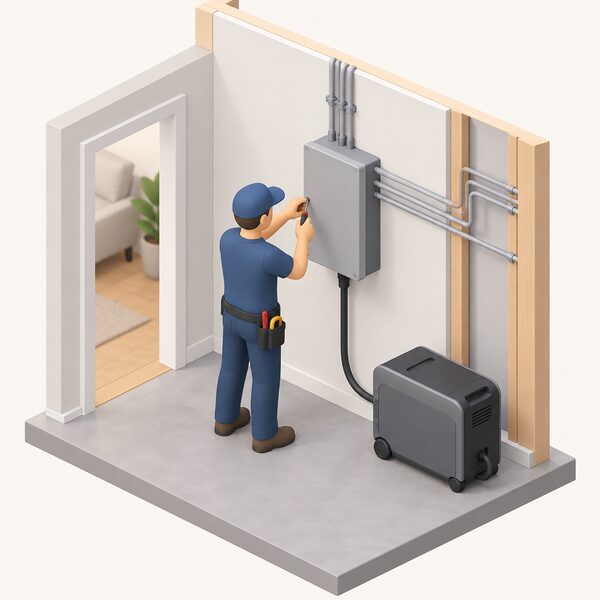
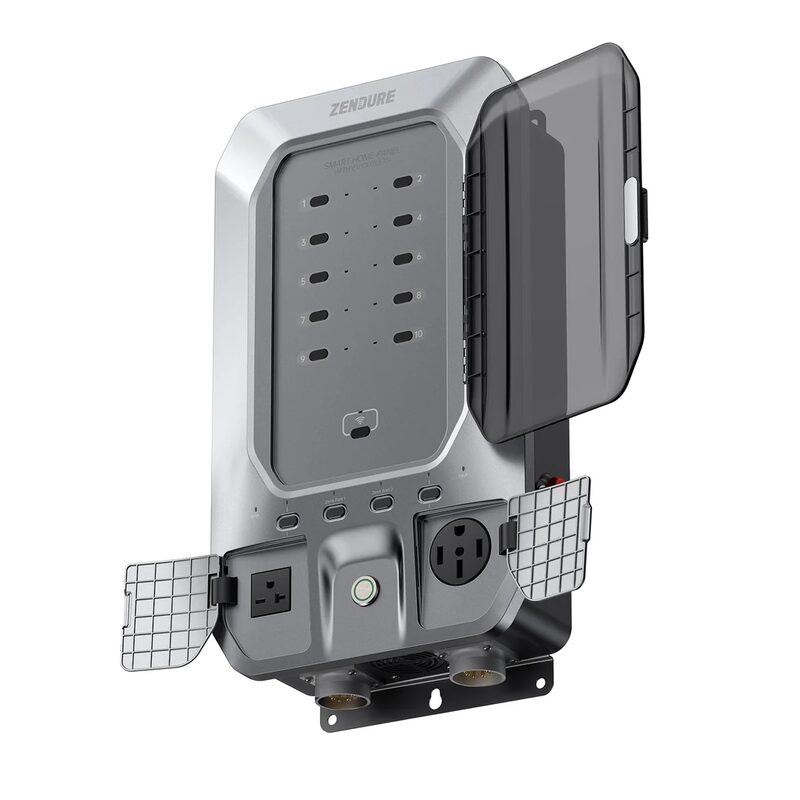
The Home Panel with EV Outlets is the piece that turns a portable battery into a house supply. Zendure describes it as a transfer switch and a fast-charging dock for the SuperBase V, with two EV charging outlets4. It monitors and controls connected home circuits and provides fast EV charging for one or two electric vehicles, rather than acting as a simple changeover switch18. The panel takes 7,600W (3,800W x2) from the SuperBase V, and its relay modules are rated at 20A x6 and 30A x46. The EV outlets are NEMA 14-50 at 40A maximum and NEMA 6-20 at 16A maximum, total 50A, and Zendure notes these are for grid mode only6.
Installation is not a DIY job. Zendure states the Home Panel should be installed by a licensed electrician with the proper qualifications, and elsewhere that it should be installed by an authorised electrician with the necessary qualifications4. That is the point at which a household takes on a fixed electrical installation, with the wiring rules and notification that go with it, rather than a plug-in appliance.
The panel also anchors the wider system. Zendure's Satellite Plugs remotely turn devices on or off and, together with the Home Panel system, provide insight and tools to manage a home's power4. The PowerHub is described as the central hub connecting solar, storage, EV charging, heat pumps, smart devices and home circuits8. The company states that its HEMS will soon support intelligent control of EV charging and heat pumps, which is a statement about a future capability rather than a present one8.
Local control: the app, the API and what stays independent
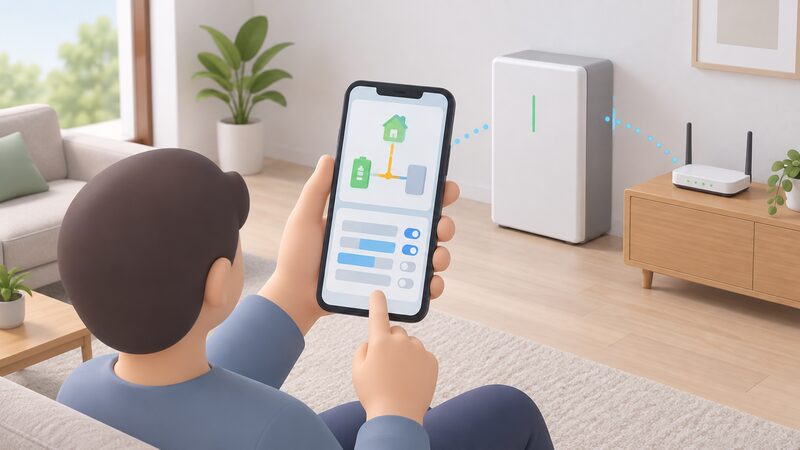
Zendure's app is the control surface for the whole system. It allows devices to be controlled from anywhere with energy diagrams and advanced settings, and it provides detailed energy data and trends over time through charts19. Pairing requires location, local network and Bluetooth permissions, a Bluetooth pairing followed by a Wi-Fi connection, and then binding the device in the app19. The app is offered for iOS through the Apple App Store and for Android19.
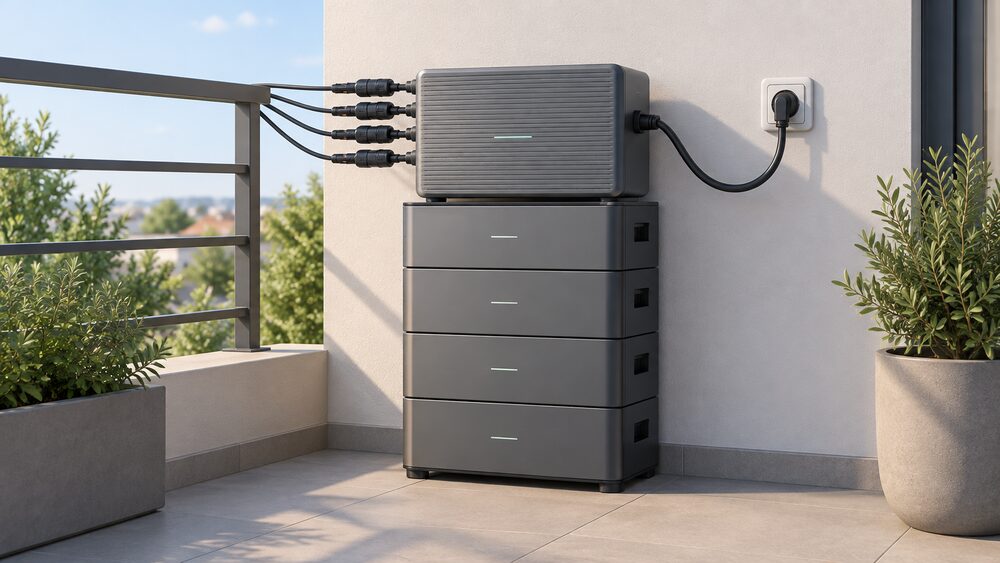
That chain is the clearest dependence the system creates. Scheduling, remote control, energy monitoring and the tariff optimisation all run through a home broadband connection, Zendure's servers and the maker's app. The Satellite Batteries are the exception in principle, since Zendure states they have independent DC input and output capabilities that allow them to function as standalone units4. The SolarFlow Hyper 2000 supports bidirectional charging, so it can be charged both from solar panels and from the electricity grid20, and the Hyper 2000 and SolarFlow Ace 1500 have bi-directional charging and discharging capabilities11.
There is also an anti-discharge behaviour worth understanding. Zendure states that the Hyper 2000 is equipped with intelligent anti-discharge technology that automatically draws power from the grid during prolonged insufficient sunlight to prevent the battery getting too low21. The Ace 1500 behaves similarly: when battery capacity is close to 0%, the battery stops discharging and automatically draws power from the grid through the Ace to charge the battery21. Both are protective behaviours, and both mean the system can reach for the grid rather than run flat.
Cost, shipping and the 30-day money-back guarantee
Zendure sells direct, and its store advertises lifetime support, an official warranty, free shipping, exclusive offers, secure payment, buy now pay later, and a 30-day money-back guarantee8. The promotional terms state that they apply only to end consumers who place orders on the official Zendure website, and not to orders from wholesalers, resellers or distributors7.
The returns policy has conditions that matter more than the headline. Zendure accepts non-quality issue returns and exchanges only for orders within 30 days from the date of purchase, and states that a product may be returned within 30 days from the date the item was received22. Where a return or exchange is for non-quality reasons within that window, the relevant logistics costs, including freight, taxes and customs clearance fees, are undertaken by the customer22. Returns and refunds are accepted only for products purchased directly from Zendure, and refunds are credited back to the original payment method, with five to seven business days to process a refund after the returned items are received22. Orders cancelled before shipping, normally within two working days, get a full refund22.
On price, Zendure's own store lists bundle configurations rather than a single unit price, and the VAT position is not stated in the listings. Prices for the SolarFlow 2400 Pro and its battery and panel bundles are shown on the maker's product page, and they move with promotions, so the figure to work from is the one on the page at the time of ordering rather than any figure quoted second-hand15.
Sustainability record: UNESCO recognition and the numbers

Zendure states it has been recognised by UNESCO as one of the 80 global sustainability leaders9. The same page carries the company's environmental accounting for 2025: annual power generation across its users rising from 13.17 million kWh to 38.9 million kWh, a 295% growth, an equivalent reduction in coal consumption of 12,953.7 tons, and planting forests covering an area of 1,362 football fields9. It also states support for the 2026 World Engineering Day under the theme "Your Energy, Our Future"9.
These are the maker's own figures for its installed base, and they are not independently audited household generation data. For context on the wider UK picture, official statistics record that two record-breaking renewables auctions secured enough power for the equivalent of 23 million homes23, and the Climate Change Committee's 2026 assessment states that faster electrification would cut UK household bills24. Independent research into consumer attitudes puts environmental awareness at 8 out of 10 for eco high-earning Gen X-ers, 7 out of 10 for techie young families, 6 out of 10 for rural retirees on stable income, and 5 out of 10 for budget-conscious millennial parents25. Those segments describe the audiences most likely to weigh a home battery, and they are independent of any maker's claims.
What owning Zendure kit means for household energy independence
The honest position is that Zendure kit buys a household a measure of independence, not autonomy. A SuperBase V with satellite batteries can run core appliances from stored energy, and Zendure states that expanding a SolarFlow 2400 Pro from 2.4kWh to 16.8kWh allows a household to sustain its core appliances for one to two days with proper load management16. That is the maker's runtime claim, and it is conditional on how the load is managed.
What remains is a set of dependencies. The system stays connected to the grid for charging, for the anti-discharge behaviour that tops the battery up during poor sunlight, and for the Home Panel's grid-mode EV outlets21. The smart layer depends on a home broadband connection, the Zendure app and the maker's servers19. The Home Panel depends on a licensed electrician to install it4. The tariff optimisation features are built around European markets and suppliers rather than UK ones10. And the warranty and returns terms are the maker's own, with the customer carrying logistics costs on non-quality returns22.
For a household already thinking about backup power, the useful comparison is with the alternatives covered elsewhere on this site: portable power stations for the plug-in route, home battery vs portable power station for the fixed option, and backup power and energy independence for the wider picture. The portable power station sizing guide is the place to work out what capacity a given set of appliances needs, and lithium battery safety covers the chemistry questions that apply to any of these systems.
Sources28 cited
- Zendure SuperBase V product page, Zendure, 2026-09-19
- Zendure technology page, Zendure, 2026-09-19
- Zendure Mobile EV Charger, Zendure, 2026-09-19
- Zendure SuperBase V Solar Generators, Zendure, 2026-09-19
- Zendure SuperBase Pro 2000, Zendure, 2026-09-19
- Zendure Smart Home Panel with EV Outlets, Zendure, 2026-09-19
- Zendure promotions, Zendure, 2026-09-19
- Zendure official store, Zendure, 2026-09-19
- Zendure SolarFlow new gen evolved, Zendure, 2025
- Zendure HEMS, Zendure, 2026-09-19
- Zendure TOU, Zendure, 2026-09-19
- Zendure 200W Solar Panel, Zendure, 2026-09-19
- Energy glossary, Low Carbon Hub, 2026-08-05
- Batteries in the home, Solar Energy UK, 2026-09-17
- Solar panel battery storage, Which?, 2026-05-14
- Electrical storage battery definition, legislation.gov.uk, 2026-09-17
- Zendure SuperBase V Battery Balcony Power Plant Kit, Zendure, 2026-09-19
- Zendure PowerHub, Zendure, 2026-09-19
- Zendure intelligent app, Zendure, 2026-09-19
- Solar battery storage: the complete guide, Zendure, 2025-11-05
- Zendure winter electricity fest, Zendure, 2026-09-19
- Zendure warranty policy, Zendure, 2023-12-12
- Performance report, Department for Energy Security and Net Zero, 2026-09-17
- Faster electrification would cut UK household bills, Climate Change Committee, 2026-06-24
- Segment A: eco high-earning Gen X-ers, Nesta, 2025-07
- Segment B: techie young families, Nesta, 2025-07
- Segment D: rural retirees on stable income, Nesta, 2025-07
- Segment C: budget-conscious millennial parents, Nesta, 2025-07-24
 Zendure SolarFlowThe Zendure SolarFlow range of plug-in balcony batteries: models, specifications, warranty terms, prices and what the systems mean for a household's energy independence.
 Zendure SolarFlow Hyper 2000The Zendure SolarFlow Hyper 2000 stores cheap overnight power or spare solar and sends it back through a normal plug.