
In this guide
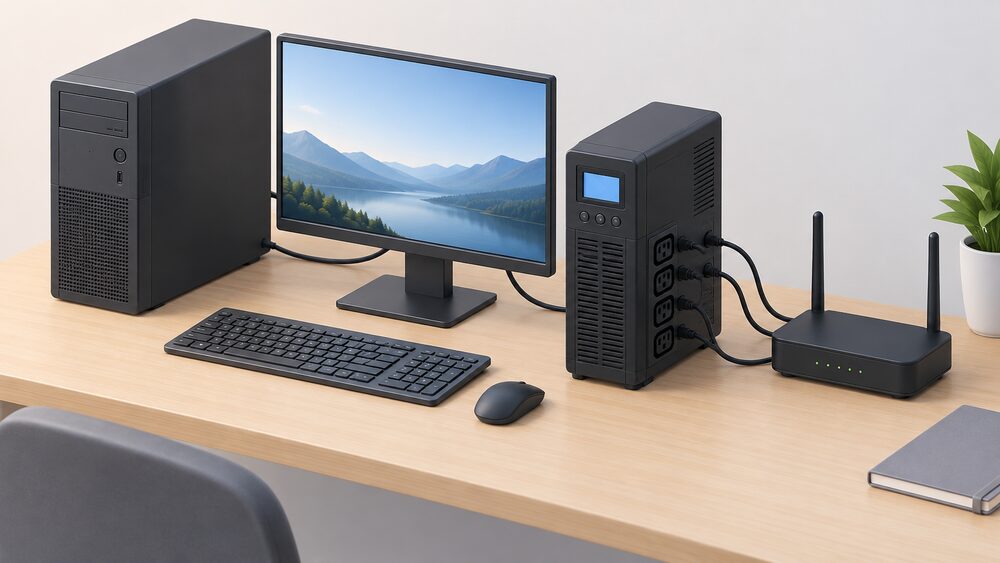
An APC UPS is a battery box that sits between the wall socket and the equipment, and its job is to ride through the short interruptions and voltage wobbles that a home or home office notices. UK Power Networks, which runs the electricity network across London and the South East, puts the case plainly: if you work from home or a small business and use your computer, a UPS is worth considering, and UPS systems will provide backup power to your computer until your electricity supply is restored1.
That is a narrower promise than a generator or a home battery makes. A UPS is sized in minutes, not hours, and it is built to hold up a small set of loads: a router, a desktop, a monitor, a network attached storage box, a home office phone. It is not a whole-house supply and it does not change where the electricity comes from. What it changes is what happens in the seconds and minutes after the supply drops.
APC is the best-known domestic brand in this category in the UK, sold under Schneider Electric. The current household-facing families are Back-UPS, Easy UPS and SurgeArrest, and the range is in flux: several references have already been discontinued and two more carry published withdrawal dates. This page sets out what the units do, which models remain, how sizing works, what battery replacement involves, and what owning one does and does not do for a household's energy independence.
What an APC UPS does for a home or home office
The function is narrower and more specific than most backup equipment. A UPS holds up the equipment plugged into it while the mains supply is interrupted, and UK Power Networks frames the use case around exactly the household that notices a cut most: someone working from home or running a small business on a computer1. For that household the cost of a two second interruption is a lost session, a corrupted file or a dropped call, and the UPS exists to absorb it.
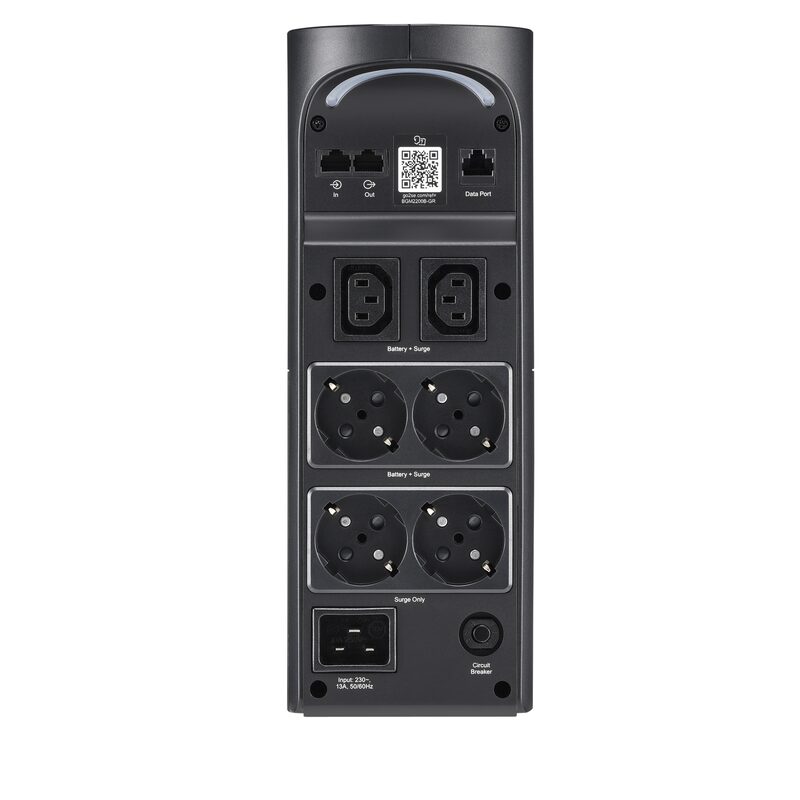
The Back-UPS Pro BR1500GI shows what the hardware actually contains. It is a tower unit rated 1500VA and 865W, with ten IEC C13 outlets, an LCD display and automatic voltage regulation, which the maker describes as correcting voltage variations to provide reliable power2. That last feature matters more in the UK than the battery does for most households. Voltage variation is a routine event on a distribution network, and UK Power Networks runs a voltage investigation service that can involve fitting a recording device to monitor and measure the supply over a two week period3. A UPS with AVR conditions that supply rather than passing it straight through.
The distinction between a UPS and a surge protector is worth holding on to. A SurgeArrest strip deals with a transient spike and nothing else; it has no battery and no runtime. A UPS deals with the interruption itself. Households that want both usually end up with a UPS on the critical equipment and surge protection elsewhere, and the two roles are covered separately in surge protection devices and lightning protection.
What a UPS does not do is keep the heating on, run the fridge or cover a lighting circuit. Those are the jobs of a standby generator, a home battery or a portable power station, and the differences are set out in UPS vs portable power station and in the wider guide to uninterruptible power supplies for the home.
The APC range for household use: Back-UPS, Easy UPS and SurgeArrest
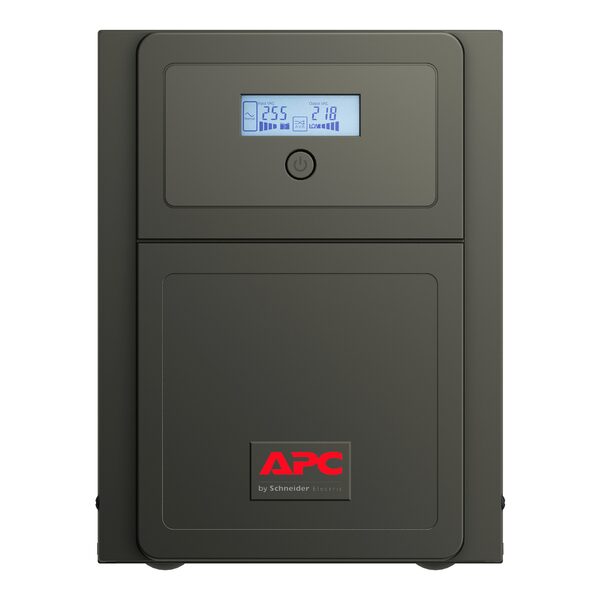
Three families cover the domestic market, and they sit at different points on the same job.
Back-UPS is the long-standing home and home office line, and the Pro tier within it is the most capable. The BR1500GI is the reference the maker publishes full detail for: 1500VA and 865W, tower format, ten IEC C13 outlets, AVR and an LCD, with a user replaceable battery2. The IEC C13 outlets are the kettle-style connectors used on computers and network gear rather than the square-pin domestic sockets, so a household running ordinary UK plugs needs the right leads.
Easy UPS is the simpler, lower-cost line. The BV1000I is a 1000VA floor or wall mount unit at 230V with six IEC C13 outlets and AVR, and it carries a published discontinuation date of 31 December 2026, with end of service on 31 December 2028. The Back-UPS BX1200MI-GR is a 1200VA 230V unit with AVR and four Schuko outlets, and it is to be withdrawn from production on 13 August 2027, with after-sales service continuing to the end of the product's service life.
SurgeArrest is the surge protection line rather than a UPS family. The Essential PME6U2B-UK was a six-outlet BS1363 surge protector rated 760 joules with two USB type A ports on a BS1363 plug, and Schneider Electric stopped accepting offers for that reference on 8 April 2025.
| Family | Role | Example reference | Key figures |
|---|---|---|---|
| Back-UPS Pro | Home office UPS with AVR and LCD | BR1500GI | 1500VA / 865W, 10x IEC C13, tower2 |
| Back-UPS | Domestic UPS line | BX1200MI-GR | 1200VA, 230V, AVR, 4x Schuko; production ends 13 August 2027 |
| Easy UPS | Simpler, lower-cost UPS | BV1000I | 1000VA, 230V, 6x IEC C13, AVR; discontinued 31 December 2026 |
| SurgeArrest | Surge protection only, no battery | PME6U2B-UK | 6x BS1363, 760 joules, 2x USB type A; discontinued 8 April 2025 |
The pattern across the table is that the household range is being pruned rather than expanded, and the references a buyer sees on a shelf today may not be the ones on sale in a year. For a wider view of how these units compare with other makers, Eaton vs APC home UPS sets the two side by side.
Which models have been discontinued, and what remains on sale
Discontinuation in this range is a rolling process with published dates, and the dates mean something specific: they are the last date the maker accepts an offer for a reference, not the date the product stops working or stops being supported.
The record so far runs across several years. The Power-Saving Back-UPS Pro 1000VA, reference BR1000G, was discontinued on 6 December 2021. The Smart-UPS XL 3000VA RM 3U 120V, reference SU3000RMXL3U, was discontinued on 10 June 2022, with the SMX3000RMLV2U named as its replacement. The Smart-UPS RT 2000VA 230V, reference SURT2000XLI, was discontinued on 25 August 2023, with sales services continuing until end of life. The SurgeArrest Essential PME6U2B-UK was discontinued on 8 April 2025.
Two further references carry future dates. The Easy UPS BV1000I is to be discontinued on 31 December 2026, and is to be end of service on 31 December 2028, the last date for maintenance services such as repair and spare parts. The Back-UPS BX1200MI-GR will be withdrawn from production on 13 August 2027, with after-sales service continuing to the end of the product's service life.
For a household, the practical reading is that buying a reference with a published withdrawal date is not buying an orphan, but it is buying a product whose replacement battery and spare parts will eventually stop being supplied. The units that remain on sale without a published withdrawal date are the safer long-term purchase, and the Back-UPS Pro BR1500GI is the reference with the fullest published specification2.
Sizing a UPS: how long it runs and what it can hold up
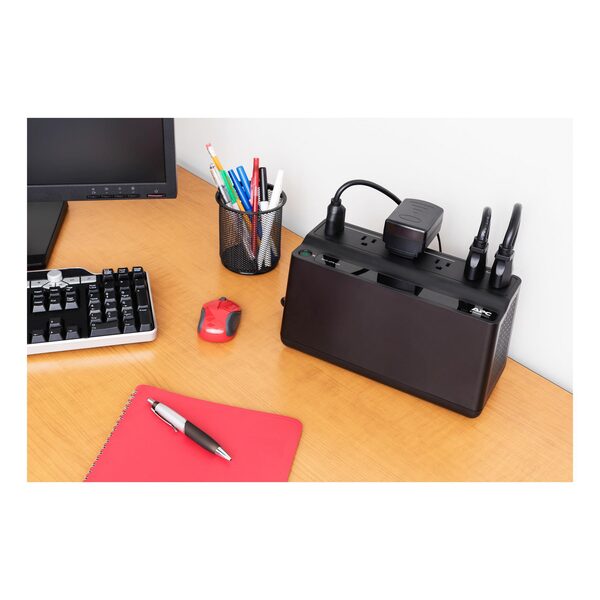
Sizing starts with the load, not the room. The question is what must stay on, and for a home office that is normally the router, the computer and the monitor, with perhaps a network storage box. Add the wattage of those items and choose a unit whose wattage rating covers the total with headroom. The BR1500GI's 865W rating is the maker's own figure for that model, and it is the number to compare against a load list rather than the 1500VA figure, which describes apparent power rather than the real power the equipment draws2.
Runtime then falls as load rises. A UPS carrying a router alone runs far longer than the same unit carrying a router, a desktop and a monitor. The role UK Power Networks describes is backup power to a computer until the electricity supply is restored, which is a ride-through function rather than an hours-long supply1. Households that need hours rather than minutes are looking at a different class of equipment, and the arithmetic of VA, watts and runtime is worked through in UPS sizing: VA, watts and runtime explained.
It helps to know what the network itself is doing during an interruption. UK Power Networks staff work 24 hours a day, 365 days a year to keep the voltage and the electricity supply to homes3, and planned interruptions for tree trimming are typically capped: the longest the operator allows for a shutdown is 8 hours4. That is the outer edge of a planned outage, and it is far beyond what any domestic UPS covers. The realistic UPS event is the unplanned, short interruption, and the equipment is built for that.
For households weighing a UPS against other options, the runtime question is the dividing line. A portable power station trades the instant switchover for hours of capacity, and the comparison is set out in UPS vs portable power station. A UPS is the right tool when the requirement is that nothing switches off at all.
Batteries: replacement, false fault warnings and units that will not hold charge
The battery is the part that ages, and it is also the part that generates most of the fault reports.
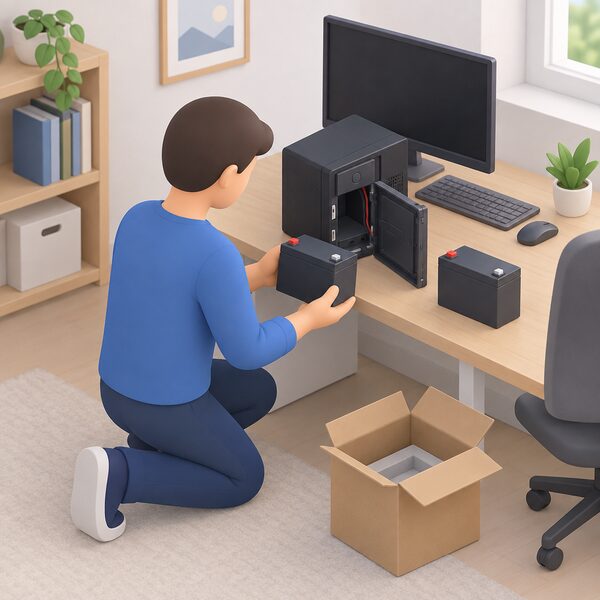
On replacement, the maker's own listing for the Back-UPS Pro BR1500GI describes it as having a user replaceable battery, and states that a replacement battery is available2. That is the intended route: the owner swaps the battery rather than returning the unit. Confirm the correct battery for the exact reference before ordering, since the range spans several capacities and outlet configurations.
The fault reports are more awkward. A forum thread opened on 28 June 2021 documents two Back-UPS LS 700 units reporting the battery as disconnected despite new, fully charged batteries being fitted, and the thread gathered similar reports alongside responses from APC staff. A separate thread opened the same day documents a Back-UPS Pro 1500 owner whose unit would not stay charged after a battery replacement, with a charge, float and drain cycle that a replacement battery set supplied through APC support failed to fix. In both cases the symptom points away from the cells: if a new battery behaves exactly as the old one did, the fault is more likely in the unit's charging circuit or its battery sensing than in the battery itself.
Battery safety is a separate matter and worth stating plainly. The causes of thermal instability in lithium cells are poor quality and substandard components, flawed design, physical abuse and improper charging or discharging, according to the charity Electrical Safety First5. Its Battery Breakdown report recommends third-party certification for all e-bike and e-scooter batteries before they enter the UK market6, and its Westminster work asks for standards for conversion kits and charging systems and consideration of a temporary ban on the sale of universal chargers5. Those findings concern e-bike and e-scooter packs rather than UPS batteries, but the underlying point about substandard components and improper charging applies to any lithium pack, and the wider picture is covered in lithium battery safety: fire risk, recalls and safe disposal.
What owning a UPS means for household energy independence
A UPS does one thing for independence and leaves everything else untouched, and it is worth being exact about which is which.
What it delivers is continuity. The equipment plugged into it keeps running through a short interruption, and the household does not lose the session, the call or the file. That is a real gain for anyone whose work depends on a live connection, and it is the reason UK Power Networks points the technology at people working from home or running a small business on a computer1.
What it does not deliver is any change in where the electricity comes from. A UPS is charged from the mains and discharges back into the equipment; it does not generate, and it does not reduce the household's reliance on the grid or on a supplier. The dependence it removes is the dependence on the supply being uninterrupted. The dependence it leaves is everything else: the grid connection, the supplier, the meter, and the fact that the unit is only as useful as the charge it holds when the supply drops.
There is a second dependence, and it is the manufacturer's. Battery replacement runs through the maker's parts chain, and the range is being pruned on published dates, so the long-term supply of the correct battery for a given reference is not something a household controls. A unit bought today will outlive some of the references in the current catalogue.
For households whose concern is broader than a home office, the alternatives change the fuel or the scale rather than the switchover speed. A home battery stores energy for the household rather than for a desk, and the guidance on what storage does and does not cover is set out by the Energy Saving Trust7. In Northern Ireland, homeowners are directed to seek independent advice on solar panels, heat pumps and other energy efficiency measures from organisations funded to give it8, and domestic sized micro combined heat and power models are now available there9. The wider question of what backup equipment can and cannot do for independence is covered in backup power and energy independence.
Cost and where to buy in the UK
APC does not publish a UK list price for these units, and prices are quoted by retailers and distributors rather than set by the maker. Where a household is buying, the practical variables are the reference, the outlet type and the battery.
The outlet type catches people out. The Back-UPS Pro BR1500GI has ten IEC C13 outlets2, which are the connectors used on computers and network equipment, not the square-pin domestic sockets. A household running ordinary UK plugs needs the right leads, and a unit with Schuko outlets such as the BX1200MI-GR is not a straight fit for a UK socket either. Buyers should check the outlet configuration against what they intend to plug in before ordering.
The second variable is the battery. A user replaceable battery with a replacement available2 means the unit can be kept going rather than replaced, but the replacement is a maker's part and its availability follows the reference's support life. A reference with a published end of service date has a known horizon for spare parts.
For context on what backup power costs across the different technologies, backup power costs compared sets UPS units against power stations, generators and home batteries. Households comparing a UPS with a battery-backed alternative should also look at lithium-ion vs lead-acid battery UPS, since the battery chemistry determines both the replacement interval and the weight of the unit.
Sources9 cited
- Compensation: a power cut damaged something in my home, UK Power Networks, 2026-09-17
- APC Back-UPS Pro BR1500GI, Schneider Electric, 2026-09-17
- Voltage changes in your home or business, UK Power Networks, 2026-09-17
- Cut trees and bushes, UK Power Networks, 2026-09-17
- Battery safety campaign, Electrical Safety First, 2026-09-17
- Is your e-bike battery safe?, Electrical Safety First, 2026-09-17
- Battery storage, Energy Saving Trust, 2026-08-19
- Support to generate your own electricity, nidirect, 2025-09-22
- Micro combined heat and power, nidirect, 2026-09-17