
In this comparison
A UPS battery is chosen on chemistry before it is chosen on brand. The two chemistries sold into UK homes are lithium-ion and lead-acid, and independent guidance describes them as "the main type for domestic use"1. The practical difference is not the box on the wall but what sits inside it: how long it lasts, what it weighs, what it costs, and what it asks of the household that owns it.
The headline numbers are wide. Maker guidance puts lithium-ion home batteries at 10 to 15 years or 5,000 to 10,000 cycles, against lead-acid at typically 3 to 7 years and fewer cycles2. Another maker source puts lead-acid lifespan anywhere between 6 months and 5 years depending on usage and maintenance3. Lead-acid is the cheaper purchase; lithium-ion is the cheaper ownership in most published comparisons, and the cost of lithium-ion cells has fallen sharply.
For a household, the choice decides how often the unit is opened, how heavy the swap is, and how much of a power cut the unit can actually ride through. It does not decide whether the household is independent of the grid. A UPS of either chemistry buffers a short interruption; it does not run a home.
Lithium-ion vs lead-acid UPS: the core difference
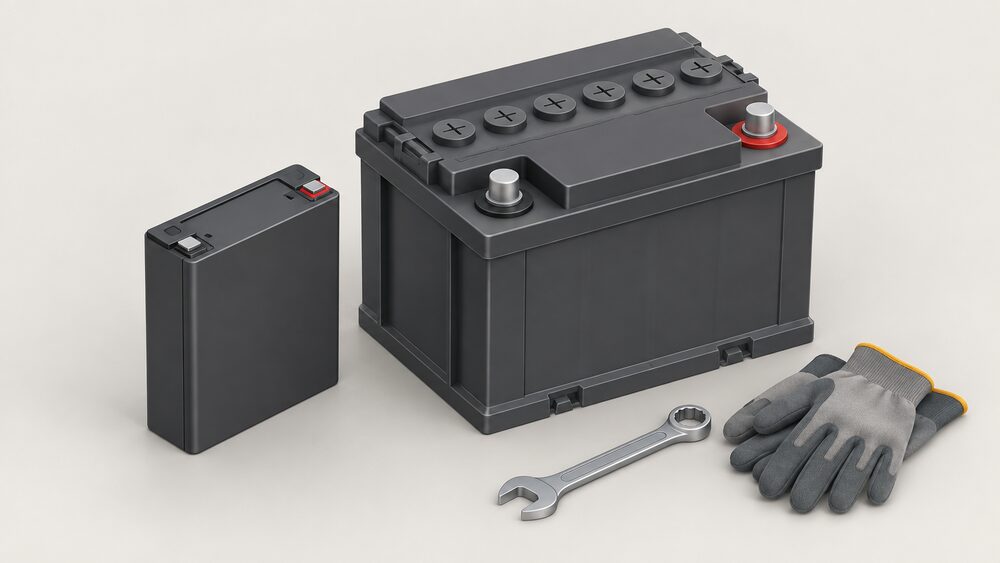
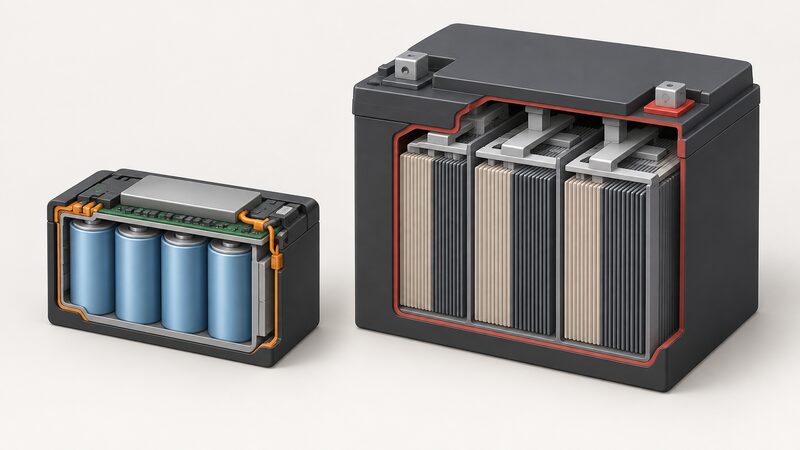
Both chemistries store the same electricity and release it the same way. The difference is in the electrode materials and the electrolyte, and everything a buyer notices follows from that. Independent guidance names lithium-ion and lead-acid as the two main types for domestic use1. Maker guidance describes lithium iron phosphate, the LFP variant used in most home storage, as around 50% smaller and lighter than lead-acid storage solutions5.
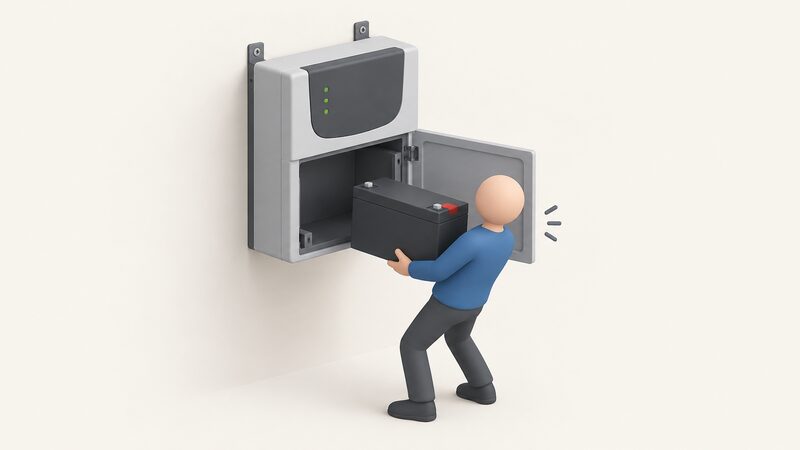
That size and weight gap is the first thing a household meets. Independent guidance states that lithium-ion batteries can weigh two thirds less than lead-acid1, and a maker support article puts lead batteries at three to four times heavier and taking up much more space7. For a UPS that sits under a desk or in a cupboard, that changes what is physically possible.
The second difference is usable capacity. Maker guidance lists the advantages of lithium-ion over lead-acid as higher depth of discharge, higher energy density, longer lifespan, faster charging and lower self-discharge3. Depth of discharge matters because a lead-acid battery that is routinely run flat wears out faster, while a lithium-ion pack is rated to give up more of its stored energy per cycle.
The third is maintenance. Maker guidance notes that a flooded lead-acid battery can be maintained to ensure optimum performance, while a sealed lead-acid battery cannot3. Most domestic UPS units use sealed lead-acid, so there is nothing to top up and nothing to inspect beyond the unit's own self-test. Both chemistries have deep cycle variants that allow greater depth of discharge3.
Cost: lead-acid is more affordable, lithium-ion is falling
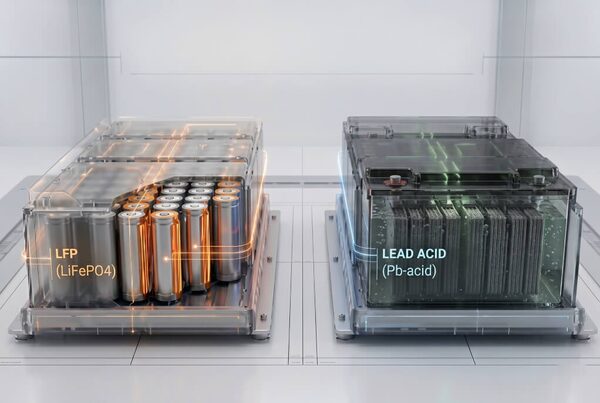
Lead-acid wins on the sticker. Maker guidance calls lead-acid the cheapest among battery types8, and another maker source describes lithium-ion as typically more expensive than lead-acid8. Independent guidance agrees that lithium-ion could have a greater upfront cost than lead-acid batteries1.
The position reverses over the life of the unit. The same independent guidance states that lithium-ion could offer greater long-term savings and is regarded as the most cost-effective option1. Maker guidance sets out why: lead-acid batteries are cheaper upfront but end up costing more over time due to shorter life, lower usable capacity and required maintenance2. The cycle ratings explain the arithmetic. LFP chemistry is rated for 5,000 to 10,000 cycles, while lead-acid is rated for around 300 to 500 cycles, which leads to frequent replacements and added costs5.
The direction of travel is one way. Independent analysis states that the dominant lithium-ion battery technology became 90% cheaper between 2010 and 2024, offering longer service lifetimes6. An earlier independent assessment put the fall at 90% over the last ten years9. Both figures describe the same trend from different vantage points, and both are about cell technology rather than finished UPS units.
For a household, the honest position is that no published UK price exists for a domestic UPS in the material behind this page. Prices are installer-quoted or retailer-quoted, and the comparison that matters is the total spent across the unit's life, not the first invoice. A lead-acid unit that needs a battery every five to ten years4 carries a cost that a lithium-ion unit rated for 10 to 15 years does not.
Lifespan, weight and maintenance: what each chemistry asks of you
Lifespan is where the two chemistries separate most sharply, and where the published figures disagree with each other. Maker guidance gives lithium-ion 10 to 15 years or 5,000 to 10,000 cycles, against lead-acid at typically 3 to 7 years and fewer cycles2. A different maker source gives lead-acid a lifespan of anywhere between 6 months and 5 years depending on usage and maintenance3. A third gives a replacement interval of every 5 to 10 years4.
| Lithium-ion (LFP) | Lead-acid | |
|---|---|---|
| Lifespan | 10 to 15 years2 | 3 to 7 years2; 6 months to 5 years depending on usage and maintenance3 |
| Cycle life | 5,000 to 10,000 cycles2 | around 300 to 500 cycles5 |
| Replacement interval | not stated | every 5 to 10 years4 |
| Weight | two thirds less than lead-acid1 | three to four times heavier than lithium7 |
| Maintenance | none stated | flooded types can be maintained; sealed types cannot3 |
| Upfront cost | typically more expensive8 | cheapest among types8 |
Maintenance is the quieter difference. A sealed lead-acid battery cannot be maintained3, so the household's only lever is the unit's own self-test routine and the temperature of the room. Lithium-ion asks for the same discipline plus the safety rules that apply to any lithium device indoors.
Safety and recalls: what lithium-ion incidents mean for owners
Lithium-ion safety is a live regulatory subject in the UK, and the incidents behind it are mostly not UPS units. Official fire service guidance lists the rechargeable items found in the average UK household as laptops, mobile phones, e-scooters, e-cigarettes and mobility vehicles10. It states plainly that the larger the battery, the larger the danger, and notes that some of the largest lithium batteries are found in mobility vehicles10.
The failure mode is understood. An official consultation states that non-compliant or incompatible battery components and the use of batteries outside of their safe design parameters can lead to thermal runaway, causing fires11. Independent guidance adds that lithium-ion batteries require protection from impact and water ingress7. Heat is a factor: independent guidance warns that high temperatures can cause batteries, especially lithium-ion, to overheat and potentially catch fire12.
Recalls in the UK have concentrated on chargers and power banks rather than UPS units. A lithium battery charger sold under the szYB-100W-42V2A reference carries recall numbers 22/43 and 23/43, with the instruction to stop using it until it has been checked by the manufacturer13. A second charger carries the instruction to stop using it immediately and contact the retailer for further advice14. Two types of E.ON power adaptors were recalled with immediate effect15. Electrical Safety First has recommended banning universal chargers to prevent dangerously compatible charging arrangements and damage, and better regulating non-proprietary charging systems16.
The pattern matters for a UPS buyer. The recalls cluster around cheap third-party chargers and unbranded cells, not around units with a fixed charger and a sealed enclosure. Official guidance for lithium-ion devices is to always buy devices and replacement batteries from a reputable seller10, and to remove the battery if the device is stored unused for any length of time10.
Which chemistry fits which home setup
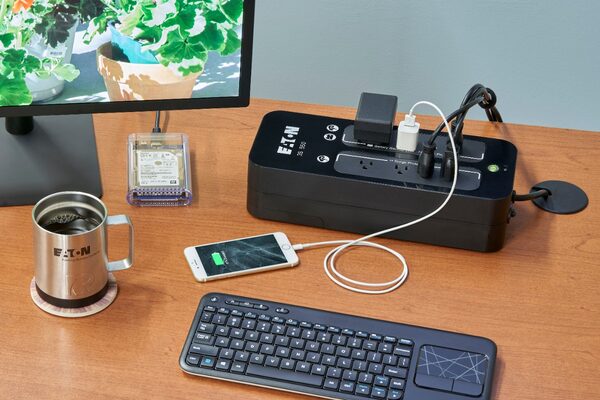
The choice follows the load and the room, not a preference. A UPS that protects a router, a NAS and a desktop for ten minutes at a time is called on rarely and deeply, which suits lithium-ion's cycle rating. A unit that sits in a cold garage or an unheated outbuilding is a harder case for any chemistry, and heat guidance applies to both12.
Maker guidance for home UPS applications recommends the Eaton 3S Gen2 for home office equipment, NAS systems, aquariums and terrariums, cryptominers, household appliances and automatic feeder systems, and the compact Eaton 3S Mini for security systems as additional protection alongside integrated batteries17. Those are load descriptions rather than chemistry prescriptions, and they show the shape of the domestic market: small, specific, always-on loads.
Where a household already has a home battery, the UPS question changes. Maker guidance states that home battery manufacturers have chosen lithium iron phosphate, LiFePO4 or LFP, chemistry for their home batteries7. Independent guidance describes lithium-ion as the most cost-effective option1. A household weighing a UPS against a larger battery should treat them as different jobs: the UPS rides through seconds and minutes, the home battery shifts energy across hours. The UPS vs portable power station comparison sets out where the boundary sits, and UPS sizing covers how VA and watts translate into runtime.
For a flat with a cupboard and a short outage history, a sealed lead-acid unit is the lower-cost entry. For a home office that runs through every brief interruption and expects to keep the unit a decade, the cycle life of lithium-ion is the argument. Neither chemistry removes the need for the grid.
UPS models and end-of-service dates to check before buying
A UPS is bought for years, so the model's own service life is part of the specification. The APC Back-UPS Pro BR1500GI is listed as a 1500VA/865W tower unit on 230V with 10x IEC C13 outlets, AVR, an LCD and a user replaceable battery4. That last point is the one that decides the chemistry question for many buyers: a user-replaceable battery means the household can choose what goes back in, within the unit's approval.
End-of-service dates are published for several references and are worth checking before purchase. Schneider Electric states that the APC Easy UPS BV1000I is to be discontinued on 31 December 2026, the last date it will accept an offer for the reference, and end-of-service on 31 December 2028, the last date for maintenance services such as repair and spare parts. The APC Back-UPS BX1200MI-GR will be withdrawn from production on 13 August 2027, with after-sales service continuing to the end of the product's service life. The SURT2000XLI has 25 August 2031 as the last date for maintenance services such as repair and spare parts.
The wider pattern in the same maker's catalogue is that references are retired on a rolling basis, and a household that buys on price alone can end up with a unit whose spares window closes sooner than expected. Checking the reference against the maker's own product page takes a minute and settles the question.
Eaton in the UK: the maker behind the storage and UPS range
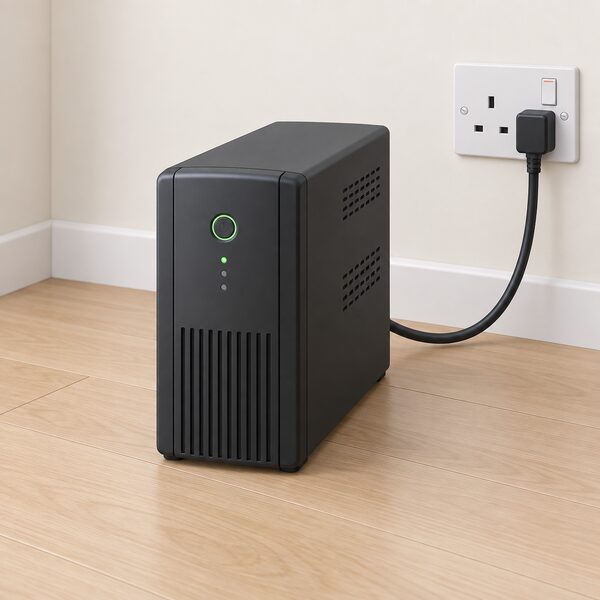
Eaton is the manufacturer whose UK pages carry the clearest domestic UPS guidance in this material. The company was founded in 1911, serves customers in more than 160 countries, and has been listed on the New York Stock Exchange for more than a century18. Its UK home UPS page recommends the 3S Gen2 for home office equipment, NAS systems, aquariums and terrariums, cryptominers, household appliances and automatic feeder systems, and the 3S Mini for security systems as additional protection alongside integrated batteries17.
The company's interests run past the desk. Eaton ran a 100 home pilot and works with smart home platform providers such as Samsung SmartThings and Alarm.com, and with distributed energy resources system providers such as LG Electronics19. It is collaborating on a project to make vehicle to grid and vehicle to home more of a reality, and has research efforts around the use of blockchain technology for use cases such as real-time energy pricing and enabling energy transactions between microgrids and nanogrids19. It also launched an xStorage hybrid energy storage system at Intersolar18.
For a household, that breadth is context rather than a reason to buy. What matters is that the maker publishes UK product pages, a UK support route and a domestic range, and that the chemistry inside a given unit is stated on the unit's own page. The Eaton UPS units for home backup power page covers the range in more detail, and Eaton vs APC home UPS compares the two makers' domestic lines.
What battery choice means for household energy independence
A UPS buys minutes. It does not buy independence. Whatever chemistry sits inside it, the unit is charged from the grid, sized for a handful of loads, and rated for a runtime measured in minutes rather than hours. The household remains dependent on the network for the energy that refills it, and on a manufacturer for the battery, the charger and the spares.
What the chemistry choice does change is how much of that dependence is recurring. A lead-acid unit that needs a battery every 5 to 10 years4 ties the household to a replacement cycle and to the maker's spares window. A lithium-ion unit rated for 10 to 15 years2 ties it to a longer one. Neither removes the supplier from the picture.
The remaining dependencies are worth naming plainly. The grid supplies the charge. The manufacturer supplies the battery and the firmware. The unit's own approval governs what can be fitted inside it, which is why a lead-acid UPS cannot simply be converted to lithium-ion. And the safety rules for lithium devices indoors apply regardless of brand: charge in a room with a working smoke alarm, away from escape routes and heat sources, and buy replacement batteries from a reputable seller10.
For a household building resilience in layers, the UPS is the bottom layer, covering the seconds and minutes that protect equipment and continuity. Above it sit portable power stations, home batteries and generators, each with its own dependence. The backup power pillar sets out how the layers fit together, and lithium battery safety covers the fire risk and recall picture in full.
Sources19 cited
- Electrical energy storage systems, Flexi-Orb, 2025-04-22
- Things you should know about LFP batteries, EcoFlow, 2026-07-22
- How do solar batteries work and store energy, So Energy, 2024-06
- APC Back-UPS Pro 1500VA 865W Tower, Schneider Electric, 2026-09-17
- Best batteries for a solar system, LuxPowerTek, 2025-09-25
- Britain benefits from the summer sun as July smashes solar generation record, Solar Energy UK, 2024
- AlphaESS residential FAQ, AlphaESS, 2026-09-17
- How many batteries does a home need, SAJ Electric, 2026-07-22
- Let's be honest about what's driving these home energy hikes, Energy and Climate Intelligence Unit, 2021-08-05
- Lithium-ion batteries, North Wales Fire and Rescue Service, 2026
- The UK's new product safety framework, GOV.UK, 2026-03-31
- Be summer ready, Electricity North West, 2026-09-19
- Product recall: lithium battery charger szYB-100W-42V2A, Electrical Safety First, 2026-09-17
- Product recall: lithium battery charger szYB-60W-29.4V2A, Electrical Safety First, 2026-09-17
- Product recall: E.ON power adaptors, Electrical Safety First, 2026-09-17
- Treat e-bike batteries like fireworks, government told, Electrical Safety First, 2026-09-17
- UPS for home applications, Eaton, 2026-09-17
- xStorage hybrid energy storage system launch at Intersolar, Eaton, 2024
- Future ready homes, Eaton, 2026-09-17
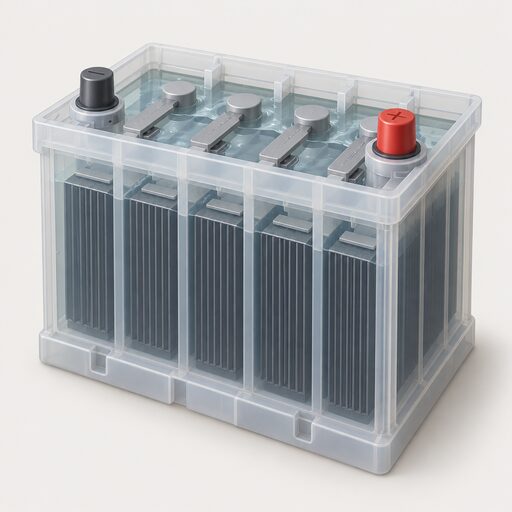 Lead-Acid, AGM and Gel BatteriesAre lead-acid batteries still worth using for solar or an off-grid home?
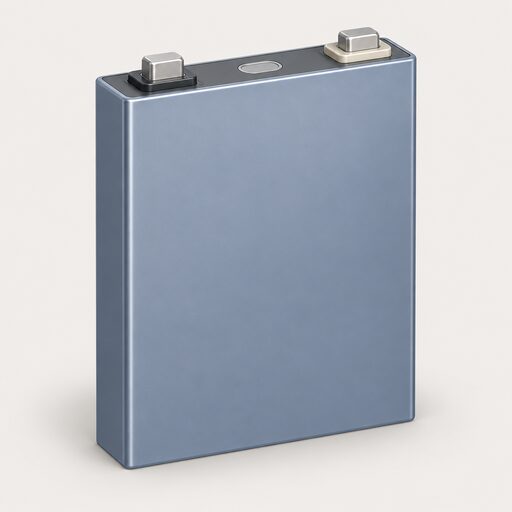 Battery ChemistriesWhich home battery lasts longest, and is it the safest?
 Power Station BatteriesWhat kind of battery is inside a portable power station, and does it matter?
 The Full Home Batteries GuideA home battery stores cheap or solar power for later, but will it really cut your bills enough to be worth it?
 Cycle Life and DegradationHow long will a home battery actually last, and what decides that?
 What Size Battery?How much electricity does your home use in a day, and how much of that falls in the hours when power is cheap or your solar panels are generating?