
In this comparison
Eaton and APC are the two names a UK householder meets first when shopping for an uninterruptible power supply. Eaton sells its home range directly through its GB catalogue, covering home office equipment, NAS systems, aquariums and terrariums, cryptominers, household appliances and automatic feeder systems, with the 3S Gen2 and the compact 3S Mini named for desktop PCs and security systems respectively1. APC is a Schneider Electric brand, and Schneider publishes withdrawal and end-of-service dates for individual APC references on its product pages2.
The practical difference for a buyer is not which brand is better but which reference is still supported. Schneider Electric states that the APC Easy UPS BV1000I is to be discontinued on 31 December 2026, with end-of-service on 31 December 2028, and that the APC Back-UPS BX1200MI-GR will be withdrawn from production on 13 August 20272. The APC SmartUPS RT SURT2000XLI carries an end of standard service of 25 August 20314. Eaton's xStorage Home 3P, its home battery storage unit, is marked on the maker's own page as to be discontinued5.
Eaton and APC at a glance: two power management heavyweights
Eaton and APC occupy different positions in the market. Eaton is an electrical power management company with a UK manufacturing and compliance presence: Eaton Electrical Products Ltd declared in April 2025 that its High-speed battery storage fuses BSF product family complies with UK statutory provisions6. That declaration matters to a householder only indirectly, but it shows a company maintaining a formal UK legal footprint rather than selling through a distributor alone.
APC is a brand within Schneider Electric, and the way Schneider publishes product lifecycle information is unusually transparent. Each reference carries its own dates: the last date offers will be accepted, the date production stops, and the date maintenance services such as repair and spare parts end. For the APC Easy UPS BV1000I, those dates are 31 December 2026 and 31 December 20282. For the Back-UPS BX1200MI-GR, production ends 13 August 2027, with after-sales service continuing to the end of the product's service life3. For the SmartUPS RT SURT2000XLI, standard service ends 25 August 20314.
The same pattern appears across the wider Schneider catalogue. The APC SurgeArrest Essential PME6U2B-UK stopped accepting offers on 8 April 20257. Schneider also set 1 December 2024 as the last date it would accept an offer for the Conext SW PDP 865-1016 and the Conext SW AC breaker panel 865-1017-61, with end of standard service for the 865-1016 following on 9 March 2026. Those are off-grid and DC distribution products rather than home UPS units, but they show the same lifecycle discipline applied across the portfolio.
For a household, the lesson is that brand reputation tells you less than the reference number does. A well-regarded brand with a discontinued reference leaves you hunting for spares; a lesser-known reference still in production does not. Checking the maker's own product page for the specific model, before purchase, is the only reliable way to know where a unit sits in its service life.
Company track record: Eaton's century in electrical power
Eaton's track record rests on longevity in electrical power management rather than on consumer retail. The company maintains a GB product catalogue covering backup power, surge protection and energy storage, and its UK entity issues formal declarations of conformity for product families sold here1. That combination, a long-established electrical manufacturer plus a UK legal entity, is what a householder is really buying into when they choose Eaton over a brand with no UK compliance presence.
The company also publishes forward-looking expectations for the storage market. Eaton states that it offers a full range of energy storage systems and advanced energy management software in the UK, from multi-residential to commercial use8. Those are the maker's own claims, not independent figures, and they concern the storage market rather than home UPS units specifically. They are useful as an indication of where the company expects its own storage economics to move.
Eaton's wider positioning is captured in the phrase Buildings as a Grid, which treats a building as an active participant in the electricity system rather than a passive load. The UK evidence that bears on this idea comes from local and regional programmes rather than from Eaton itself. The West of England Buildings Retrofit Pilot moved away from classically competitive programmes to a more allocative approach9. Bristol's Warm Homes Plan extends city-level planning to neighbourhood level through three Community Climate Investment Plans and the West of England Climate Investment Plan10.
Those programmes are about retrofit and decarbonisation, not about UPS units, and the connection to a home UPS purchase is indirect. What they show is the direction of travel: buildings are increasingly expected to interact with the grid, and equipment that sits between the grid and the load becomes part of that interaction. A UPS is a small, simple example of the same principle.
The Climate Change Committee's supplementary analysis of the Seventh Carbon Budget found that for every £1 spent on net zero, the benefits outweigh this by between 2.2 to 4.1 times11. That is a whole-economy figure and says nothing about UPS units. It is included here only because it is the official framing within which domestic electrical equipment decisions now sit.
What each maker offers a UK household
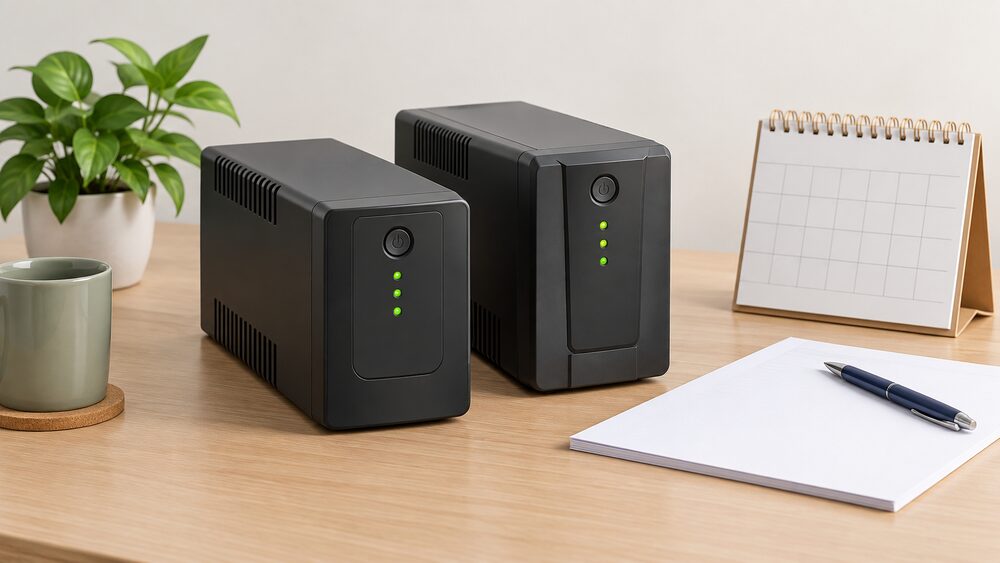
Eaton's home UPS range is narrow and clearly described. The maker recommends the 3S Gen2 for home office equipment, NAS systems, aquariums and terrariums, cryptominers, household appliances and automatic feeder systems, and for desktop PCs in home office use1. The 3S Mini is recommended for security systems, as additional protection alongside integrated batteries1. The 3S Gen2 is an alternating current model with a sleek design and multiple outlets1.
Eaton's home battery storage product is the xStorage Home 3P. It uses a wall bracket fitting system, has a built-in battery automatic switch, communicates over CAN/RS485, and carries CE certification5. The maker's page marks it as to be discontinued5. That is the single most important fact for any householder considering it: a product marked for discontinuation may still be available, but its long-term support position is uncertain.
| Feature | Eaton 3S Gen2 | Eaton 3S Mini | Eaton xStorage Home 3P |
|---|---|---|---|
| Recommended use | Home office, NAS, aquariums, cryptominers, appliances, feeder systems1 | Security systems, alongside integrated batteries1 | Home battery storage5 |
| Outlets | Multiple outlets, AC model1 | Not stated | Not applicable |
| Fitting | Not stated | Not stated | Wall bracket5 |
| Communications | Not stated | Not stated | CAN/RS4855 |
| Certification | Not stated | Not stated | CE5 |
| Status | In range1 | In range1 | To be discontinued5 |
APC's UK-facing range is broader and its lifecycle dates are published per reference. The Easy UPS BV1000I is a 1000VA floor or wall mount 230V unit with six IEC C13 outlets and AVR, discontinued 31 December 2026 and end-of-service 31 December 20282. The Back-UPS BX1200MI-GR is a 1200VA 230V unit with AVR and four Schuko sockets, withdrawn from production 13 August 20273. The SmartUPS RT SURT2000XLI is a 2000VA 230V unit with six IEC 60320 C13 outlets and two IEC jumpers, with standard service ending 25 August 20314.
The pattern across both makers is that the higher the VA rating and the more industrial the reference, the longer the support window. A householder buying a small Easy UPS is buying into a shorter service life than one buying a SmartUPS RT, and the maker states those dates openly.
Discontinued models and end-of-service dates to watch
Product lifecycle dates are the most decision-relevant facts on this page, and they are all stated by the maker. Schneider Electric's dates for APC references are set out below.
| Reference | Last date offers accepted | Production ends | End of standard service |
|---|---|---|---|
| APC Easy UPS BV1000I | 31 December 20262 | Not stated | 31 December 20282 |
| APC Back-UPS BX1200MI-GR | Not stated | 13 August 20273 | End of product service life3 |
| APC SmartUPS RT SURT2000XLI | Not stated | Not stated | 25 August 20314 |
| APC SurgeArrest Essential PME6U2B-UK | 8 April 20257 | Not stated | Not stated |
The wider Schneider catalogue shows the same discipline applied to products a householder might meet in an off-grid or backup context. The Conext SW PDP 865-1016 and the Conext SW AC breaker panel 865-1017-61 both reached their last offer date on 1 December 2024, and the 865-1016 reached end of standard service on 9 March 2026. The Acti 9 iSR remote signal auxiliary surge arrester A9L16619 reached its end of commercialisation date on 1 December 2024. Those references are not home UPS units, but they illustrate how quickly a support window can close once a maker sets a date.
For Eaton, the only discontinuation fact available concerns the xStorage Home 3P, marked on the maker's page as to be discontinued5. No end-of-service date is given for it in the material available here. A householder considering that unit should treat both availability and long-term support as open questions and confirm the position with the supplier before committing.
Availability in the UK and where to get support
Both brands are available in the UK, but the support routes differ. Eaton sells through its GB catalogue and maintains a UK legal entity, Eaton Electrical Products Ltd, which issued a UK Declaration of Conformity for its High-speed battery storage fuses BSF product family in April 20256. That entity is the formal UK point of contact for compliance matters.
For Eaton technical support, the model reference and serial number are what any support team asks for first, and the maker's GB product pages carry the range and recommended applications1. Eaton also runs webinars and publishes technical selection guides; a session titled Specifying high voltage fuses for EV applications was held in May 202512. That is aimed at specifiers rather than householders, but it shows an active UK technical function.
For APC, support runs through Schneider Electric's product pages, which carry the lifecycle dates, and through the reference-specific documentation. The dates themselves are the most useful support information a householder can hold: knowing that a SURT2000XLI has standard service to 25 August 2031 tells you whether a second-hand unit is worth considering4.
For broader household resilience, the network operator's own planning material is a separate route. SSEN publishes a Home Emergency Plan with versions for England and Scotland13. That sits alongside the Priority Services Register and the 105 power cut number, which are covered elsewhere on this site.
Sustainability commitments: carbon neutrality versus net zero
Neither Eaton nor APC publishes a household-facing carbon neutrality or net zero commitment in the material available here, so the comparison cannot be made on the makers' own claims. What can be set out is the official and independent framing within which such claims are assessed.
The Climate Change Committee's supplementary analysis of the Seventh Carbon Budget found that for every £1 spent on net zero, the benefits outweigh this by between 2.2 to 4.1 times11. That is an official assessment of net zero spending as a whole, not of any product.
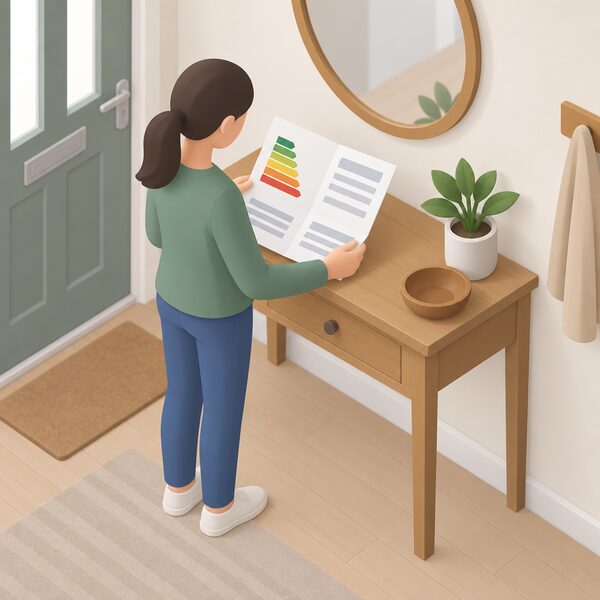
On measurement, the Energy Saving Trust's guidance on comparing homes is to look at the running costs on an existing EPC rather than current energy bills, so that numbers are calculated in the same way14. The same principle applies to any sustainability claim about electrical equipment: the basis of comparison matters as much as the number.
The Energy Systems Catapult has highlighted three key issues with the current EPC system: accuracy and consistency, alignment with Net Zero, and alignment with wider energy system needs, and argues that Net Zero policy should focus on the climate impact metric15. That is an independent critique of how domestic energy performance is measured, and it is a caution against treating any single metric as a complete picture.
The Climate Change Committee welcomed the alignment of the UK emissions trading scheme cap with Net Zero, noting that it will now decline sharply over time, but observed that its level has been set at the looser end of the range consistent with the Government's Net Zero Strategy11. That is the official position on the cap, and it illustrates the gap that can exist between a stated alignment and the level actually set.
For a householder, the practical point is that carbon neutrality and net zero are claims made at company level, and they do not transfer to a product's performance in your home. What transfers is the unit's efficiency, its support window and its warranty.
Which maker fits which home
The choice between Eaton and APC turns on three things: what you need protected, how long you need support, and whether you want battery storage as well as backup.
For a home office with a desktop PC, NAS drive and router, Eaton's 3S Gen2 is recommended by the maker for exactly that set of loads, along with aquariums, terrariums, cryptominers, household appliances and automatic feeder systems1. The 3S Mini is recommended for security systems, as additional protection alongside integrated batteries1. Both are current products in Eaton's GB range.
For a household that wants a larger unit with a long published support window, the APC SmartUPS RT SURT2000XLI carries standard service to 25 August 20314. That is the longest support date recorded for any reference on this page. The trade-off is that it is a 2000VA unit, larger than most home office loads require.
For a household considering battery storage alongside backup, Eaton's xStorage Home 3P is the relevant product, with a wall bracket, built-in battery automatic switch and CAN/RS485 communications5. It is marked to be discontinued5, so the support position is uncertain. Smart storage battery tariffs are offered by several providers, including British Gas, E.ON Next and EDF Energy16, and heat pump tariffs are offered by British Gas, E.ON Next, EDF Energy, Octopus Energy and Scottish Power16. Those tariffs are a separate decision from the UPS itself.
"To be discontinued"
The dependence that remains with any home UPS is the same in both cases. The unit protects the load for the duration of its battery, and no longer. It does not make a home independent of the grid, and it does not cover heating, cooking or high-power appliances unless it is sized for them. What it does is bridge short interruptions and protect sensitive equipment from the supply's behaviour. For longer outages, the relevant pages are home UPS systems and UPS sizing, and for the wider picture, backup power and energy independence.
Sources16 cited
- Eaton home UPS applications, Eaton, 2026-09-17
- APC Easy UPS BV1000I, Schneider Electric
- APC Back-UPS BX1200MI-GR, Schneider Electric
- APC SmartUPS RT SURT2000XLI, Schneider Electric
- Eaton xStorage Home 3P, Eaton, 2026-09-17
- UK Declaration of Conformity, High-speed battery storage fuses BSF, Eaton, 2025-04-02
- APC SurgeArrest Essential PME6U2B-UK, Schneider Electric, 2025-04-08
- Eaton energy storage FAQ, Eaton, 2025
- The Buildings Retrofit Pilot, West of England Combined Authority, 2026-09-17
- Bristol Warm Homes Plan, Bristol City Council, 2025-04
- CCC assessment of recent announcements and developments on net zero, Climate Change Committee, 2023-10-12
- Eaton EV fuse selection guide, Eaton, 2025-05
- Home Emergency Plan, SSEN, 2026-09-19
- Energy saving house viewing tips, Energy Saving Trust, 2026-05-20
- EPCs undermining decarbonisation efforts, Energy Systems Catapult, 2023-12-13
- Time of use tariffs explained, Which?, 2026-04-23
 Home UPS SystemsA home UPS keeps your broadband, computer or boiler running through short power cuts and flickers, switching over instantly rather than after a second or two.
 Maintaining Backup PowerWill your generator actually start when the power goes off?
 Backup Power Costs ComparedCompares purchase, installation and running costs across the main backup options, and what each delivers in runtime and coverage.
 Energy Independence and MakersWhich brands let you keep control of your heating, solar or car charging, and which tie you to their app and their cloud?
 Manufacturer WarrantiesHow long does a boiler, heat pump or solar panel warranty actually last, and what do you have to do to keep it valid?
 EV Charger WarrantiesCovers typical warranty lengths on UK home charge points, what parts and labour are included, registration conditions and extended warranty options.