In this guide
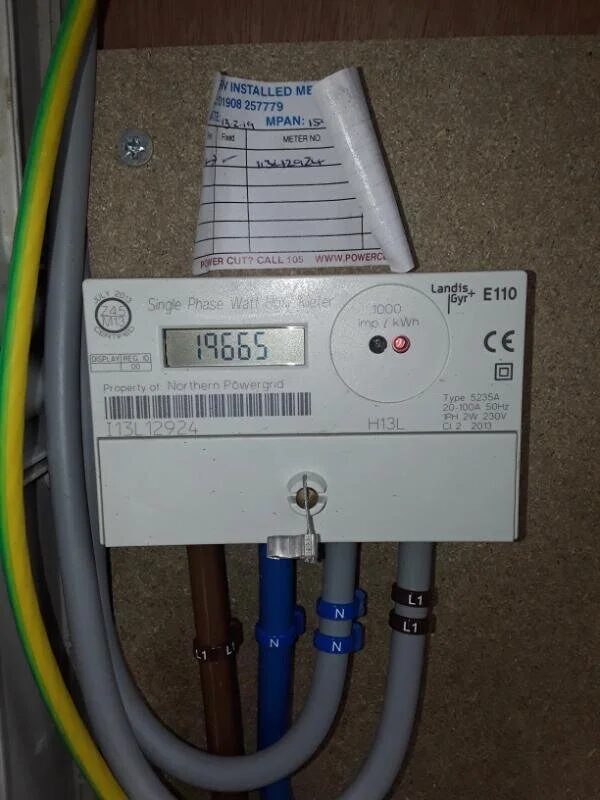
A Landis+Gyr smart meter is one of the makes of meter your energy supplier may fit in your home. It does the same job as any other smart meter: it automatically sends your electricity and gas meter readings to your supplier, replacing the analogue meter that used to sit in the same place1. The name on the casing tells you who built the hardware. It does not change who looks after it, which is your supplier.
Smart meters are replacing analogue gas and electricity meters as part of a national infrastructure upgrade to improve and modernise Great Britain's energy system2. More than two thirds of energy meters in homes and small businesses are now smart meters, nearly 40 million of them, according to government data3. Every home in England, Scotland and Wales will be offered the opportunity to upgrade before the end of the rollout4.
What matters more than the badge is the small device sitting next to the electricity meter. That is the communications hub, and it is the part of the installation most affected by the coming closure of the 2G and 3G mobile networks. An estimated seven million hubs will need replacing in the South and Central regions ahead of 20335.
What a Landis+Gyr smart meter is and the part it plays in a UK home
A smart meter is not a single box. Most homes with smart meters have an electricity smart meter, a gas smart meter, a communications hub and an in-home display9. The meter itself measures what you use. The hub moves that information off the premises. The display shows it to you in the kitchen.
The point of the whole arrangement is visibility. Smart meters help provide visibility of energy use, enabling consumers, energy suppliers and other organisations to better understand how energy is being used10. The data provided by your smart meter puts you in control of your energy usage, meaning you can take energy-saving steps to reduce your CO2 emissions10. Readings are sent automatically over the DCC's secure network to your supplier, so billing reflects energy actually used rather than an estimate11.
For a household thinking about independence, the honest position is mixed. A smart meter does not generate anything, store anything or reduce your reliance on the grid. It deepens your reliance on your supplier and on a national communications network, because the meter's smart functions run through both. What it gives back is information: a half-hourly picture of what your home actually consumes, which is the starting point for sizing solar, a battery or a heat pump, and for judging whether a time-of-use tariff would suit your pattern of use. Without that data, those decisions are guesswork.
Landis+Gyr is one of several manufacturers supplying this hardware to UK suppliers. The meter is provided and fitted by your energy supplier, not bought by you7. Gas and electricity suppliers are responsible for providing and fitting smart meters for everyone in Britain at no extra cost to you7. If the meter develops a fault, contact your supplier, who is responsible for maintenance and will fix or replace it as needed12.
The communications hub: the component of almost as great importance as the meter itself
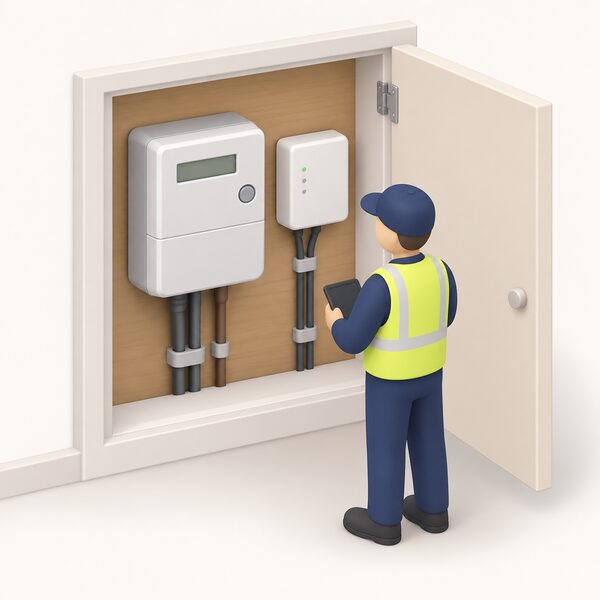
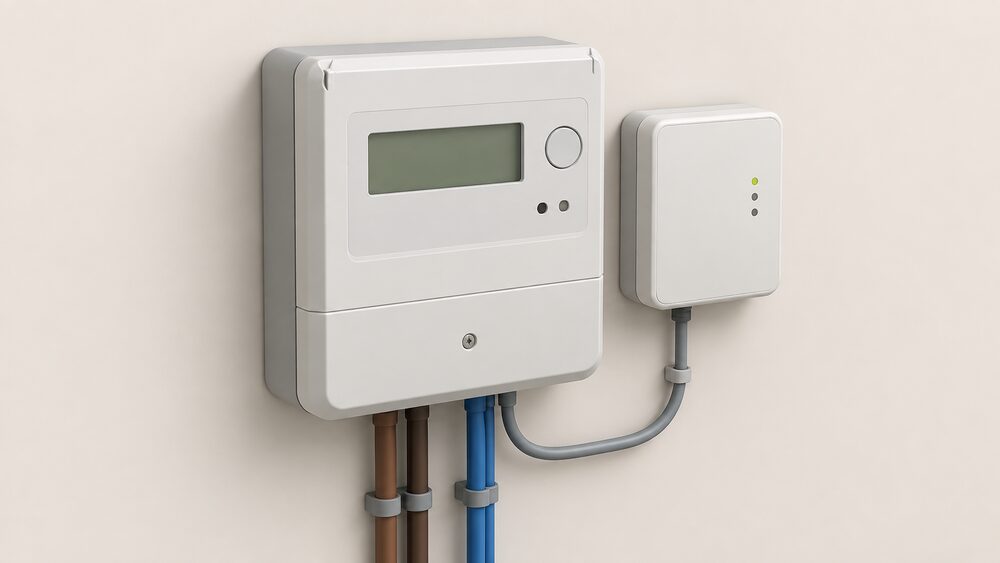
The communications hub allows your smart electricity and gas meters and your in-home display to connect to each other and to the DCC's smart meter home area network13. It is a small device that typically sits alongside the electricity smart meter, and it transmits data to the DCC network by connecting to the smart meter wide area network14.
That position beside the electricity meter is not arbitrary. The hub is typically situated within or near to the electricity meter, and if the gas meter is too far away it may not be able to communicate with it15. In a large house, or one where the gas meter sits in an outside box at the far end of a wall, that distance is the usual reason an in-home display shows electricity but no gas.
The hub is part of what a smart meter installation includes, alongside the electricity and gas meters and the in-home display16. It is not an optional extra and it is not something a householder buys separately. When it works, it is invisible. When it stops, the meter keeps measuring but stops reporting, and the household is back to sending readings by hand.
| Part of the installation | What it does | Who provides it |
|---|---|---|
| Electricity smart meter | Measures electricity used | Supplier7 |
| Gas smart meter | Measures gas used | Supplier7 |
| Communications hub | Carries readings to the wide area network | Supplier16 |
| In-home display | Shows usage in the home | Supplier16 |
Why your communications hub may need replacing ahead of the 2G and 3G network closures
The smart meter network does not use one technology everywhere. It primarily uses long range radio in the north of Great Britain, including Scotland, and 2G or 3G cellular in the central and south regions3. That split is why the replacement programme has a geography to it.
The Department estimates that 7 million communications hubs will need to be replaced in the South and Central regions ahead of 2033, when the 2G and 3G communications networks are closed5. The Public Accounts Committee put the same figure in its own terms: an estimated seven million communications hubs, part of the electricity smart meters, will need to be replaced because they will lose functionality when the 2G and 3G mobile communications networks are closed18.
Second-generation smart meters that rely on 2G or 3G will require a replacement communications hub in order to communicate with 4G networks14. The 2G network will be switched off in 2033, with SMETS1 meters needing physical replacement and SMETS2 meters needing a replacement hub14. The smart meter network will transition to the 4G communications network before the 2G and 3G networks are switched off by 203319.
In the meantime, nothing stops working. Your smart meter will continue to operate as normal following the 3G switch-off, as smart meters will switch seamlessly to the 2G network14. Since December 2024, new 4G communication hubs have been installed as part of the commitment to evolve the smart metering network14. The government has also required suppliers to replace all smart meters still connected to 2G and 3G before the services are switched off by 20338.
Replacement hubs: what changes and the cost of about £2 per household
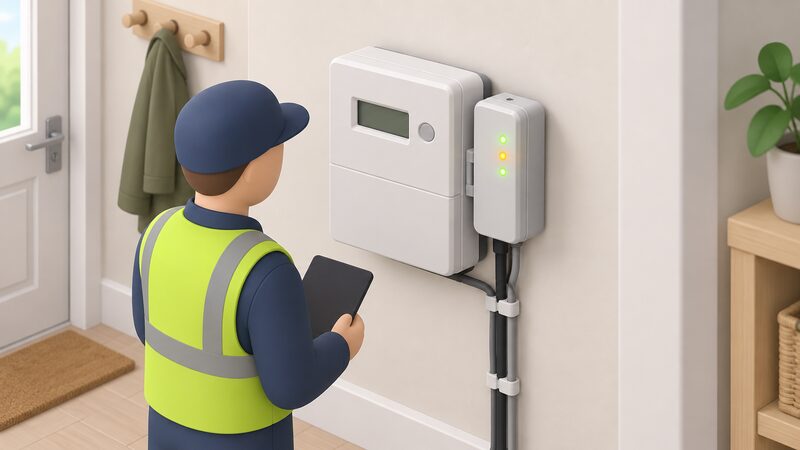
A hub replacement is a home visit, not a remote software fix. The National Audit Office has noted that additional home visits to replace communications hubs will be needed ahead of the network closures5. The Department told the Committee that it considers this replacement exercise will cost about £2 for each household5.
That figure is a programme cost, not a charge. Smart meters are free to install in both homes and businesses by the energy companies20, and the installation is funded to include the electricity and gas meters, the in-home display and the communications hub16. Suppliers are responsible for providing and fitting smart meters at no extra cost to you7.
The wider economics sit with suppliers rather than households:
- Ofgem's draft impact assessment for the Guaranteed Standards of Performance puts the set-up costs at £26m, annuitized to £5-6m annually, with £9m annual ongoing costs21.
- The same document estimates incremental supplier rollout costs at £2.4bn in today's terms, or as a constant annuity £150m per year21.
- The price cap settlement for 2025-05-23 set a Smart Meter Net Cost Change allowance of -4 £ per customer for dual fuel Standard Credit, and -6 £ per customer on a weighted average basis22.
What a household should expect in practice is a second visit at some point before 2033, arranged by the supplier, with the meter itself left in place where it is a SMETS2 unit. Where the meter is a first-generation SMETS1 device, the position is different: those need physical replacement rather than a new hub14. About 12 million first-generation smart meters have now been connected to the DCC's network via over-the-air software updates6, which has kept many of them working, but the 2G sunset still requires hardware attention.
The DCC network behind your meter: 20.5 million connections and a Virtual WAN to come
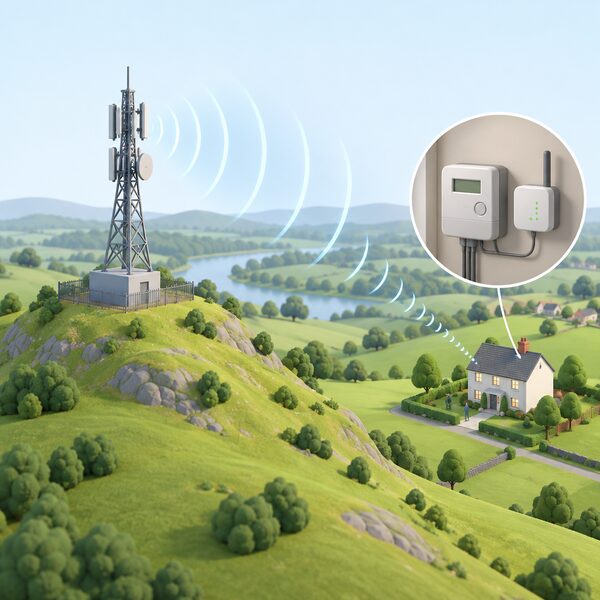
The Data Communications Company operates the secure national network that connects smart meters across Great Britain23. Readings are transmitted from the home to a wide area network made up of mobile phone or radio masts, and the data is securely wrapped using two layers of encryption, with a communications hub creating a home area network to route it24.
Scale matters here. In April 2025 the DCC recorded 20.5 million homes and small businesses connected to the smart meter network19. More than half of all homes in Britain are now connected to the DCC's secure smart meter network6. About 12 million first-generation smart meters have been connected to the network through over-the-air software updates6.
The network is separate from the public internet. Sending a meter reading does not require an internet connection, as smart meters work using the DCC's secure, standalone network6. That is a meaningful distinction for a household worried about broadband outages: your meter keeps reporting even when your router does not.
Coverage gaps remain, and the fix is scheduled for 2026. The DCC is scheduled to launch a Virtual WAN service for homes without wide area network coverage that have broadband, subject to consumer consent25. In effect, a home that cannot reach a mast would use its broadband connection to reach the national smart metering communications network instead.
Security requirements your smart meter must meet under the PSTI regime
Smart meter data is protected by law26. The DCC network wraps smart meter data within two layers of encryption before sending it over a dedicated communications system, backed by the National Cyber Security Centre and in line with governance and data protection standards6. The smart meter network was designed with security at its core, alongside the National Cyber Security Centre, part of GCHQ27.
"The smart meter network was designed with security at its core, alongside the National Cyber Security Centre, part of GCHQ"
Monitoring is continuous. At the DCC's headquarters, security experts monitor the smart meter network around the clock, carrying out around 1,500 daily checks13. Through the network, smart meter data can be shared securely between authorised users, helping to support smart energy services and innovation across the energy sector23.
On the physical side, all smart meters installed as part of the national rollout follow UK and EU product safety legislation, covering the correct use of radio equipment and emissions9. They comply with UK and EU safety standards, and all smart meters meet the same safety standards regardless of your energy supplier4. All smart meters meet safety rules for the UK and the EU26.
The Product Security and Telecommunications Infrastructure regime sits alongside this. The Security Requirements Regulations 2023 form part of the UK PSTI regime, and sections 57, 60 and 75 of the Product Security and Telecommunications Infrastructure Act 2022 were brought into force on 7 February 2023. Regulation 5 came into force on 29 April 2024, and the Amendment Regulations 2025 took effect on 25 February 2025, adding exceptions for motor vehicles, two- or three-wheel vehicles, quadricycles, and agricultural and forestry vehicles. Ofgem's final decision on the smart meter Guaranteed Standards notes that the drafting references the Electricity and Gas Acts, which could inadvertently include advanced metering, and that respondents requested the definition be updated to clarify the standards apply only to SMETS meters28.
Landis+Gyr as a company: EMEA operations as a standalone business
Landis+Gyr's Europe, Middle East and Africa operations have operated as a standalone company since 9 April 2026, with earlier press releases reflecting the prior structure. For a household, this is background rather than something that changes the meter on the wall. The hardware is already installed, the supplier relationship is unchanged, and the maintenance obligation sits with the supplier12.
What it does mean is that the manufacturer's corporate shape is not fixed. Meter makers restructure, merge and exit markets, and the household has no contract with any of them. Your supplier provides and fits the meter, and your supplier is responsible for fixing or replacing it7. If a supplier goes out of business, Ofgem's supplier of last resort arrangements move customers to a new supplier, and the meter stays where it is.
The practical independence question is therefore not about the brand. A Landis+Gyr meter, like any other, keeps a home connected to a supplier and to a national communications network for its smart functions. Local reading at the meter continues regardless. The data it produces is what a household can actually use, and that data can be accessed through the supplier, through a consumer access device, or through the DCC's authorised sharing arrangements23.
If your meter stops sending readings
Your smart meter may stop recording the energy you use, or may no longer send readings to your supplier29. Energy suppliers must take all reasonable steps to ensure that smart meters automatically send them your gas and electricity meter readings17. Where they fail, the Guaranteed Standards of Performance set timeframes for repair, and the government has brought forward rules requiring suppliers to fix faulty smart meters, covering issues such as delayed or failed installations8.
The first step is always the supplier. If your smart meter stops working, contact your supplier, who is responsible for maintenance and will fix or replace your meter as needed30. You will also still be able to take manual readings in the meantime17. Early smart meters lost functionality when you switched supplier, meaning you had to send meter readings again, though the majority have now been reconnected to the smart meter network3.
For wider context on how the network is built and how faults are handled, see how smart meters communicate and smart meter faults and troubleshooting. The DCC page covers the network operator's role, and smart meter data explains what is collected and who can see it.
Sources31 cited
- Get help with your smart meter, Ofgem, 2026
- Smart meters: your rights and expectations, GOV.UK, 2025-08-08
- What is a smart meter?, Which?, 2026-04-07
- What is a smart meter?, Smart Energy GB, 2026-08-10
- Update on the rollout of smart meters, Public Accounts Committee, 2023-10-20
- How to get a smart meter, Smart DCC, 2026
- How to get a smart meter, Smart Energy GB, 2026-08-03
- Tough new rules force suppliers to fix faulty smart meters, GOV.UK, 2026-03-10
- Smart meters and WiFi, Smart Energy GB, 2026-03-16
- Smart meters and decarbonisation, Smart DCC, 2026
- How accurate are smart meters?, Smart DCC, 2026
- Get help with your smart meter, Ofgem, 2026
- Does a smart meter need Wi-Fi?, Smart DCC, 2026
- Do smart meters use 3G?, Smart DCC, 2024
- Smart meters, Energy Ombudsman, 2026-09-20
- Do you have to have a smart meter by law?, Smart DCC, 2026
- Smart meter performance, Ofgem, 2026
- Delayed smart meter programme fails to hit targets, Public Accounts Committee, 2023-10-20
- Smart meters explained, Uswitch, 2026-07-29
- Smart metres, Energy Systems Catapult, 2025-08-19
- Smart meter Guaranteed Standards of Performance draft impact assessment, Ofgem, 2025-08
- Energy price cap operating cost and debt allowances decision, Ofgem, 2025-05-23
- How do smart meters help the environment?, Smart DCC, 2026
- How do smart meters send readings?, Smart DCC, 2026
- Smart Metering 2025 Costs and Benefits Report, Department for Energy Security and Net Zero, 2025
- What is a smart meter? Easy read, Smart Energy GB, 2026-03-16
- Protecting data on the smart meter network, Smart DCC, 2026
- Final decision on smart meter Guaranteed Standards, Ofgem, 2026-01-30
- Get help with your smart meter, Ofgem, 2026-09-17
- Smart meters, Welsh Government, 2026
- Problems with services, Isle of Anglesey County Council, 2025-10