In this guide
Secure Meters is one of the manufacturers whose equipment appears in Great Britain's smart metering system, and its in-home displays (IHDs) are among the most widely issued in the country. The display is not sold to households: everyone who gets a smart meter installed is provided with an in-home display, and getting a smart meter installed is free for UK energy customers1. The funded package covers an electricity and/or gas smart meter, an in-home display and a communications hub3.
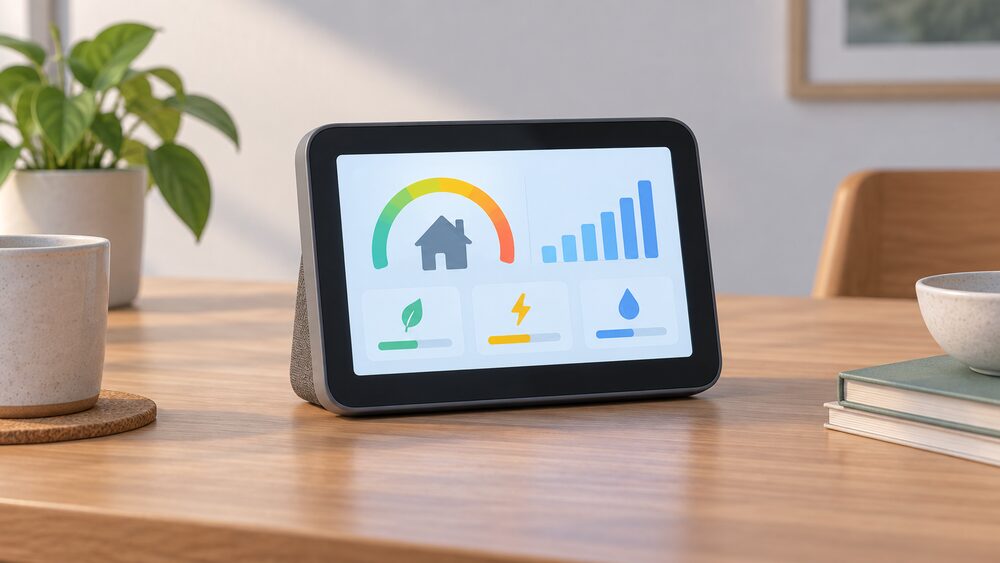
The display itself is a portable touchscreen device showing near real-time energy usage data, and it is the part of the system a household actually looks at4. The meter behind it sends readings automatically to the energy supplier through the Data Communications Company's secure network, so billing does not depend on the display being switched on5. The vast majority of smart meters in Great Britain are operating in smart mode, and 90% of installed meters were doing so as of April 20256.
What follows covers what Secure Meters equipment offers in the UK, the specifications that are published, the warranty position, the cost picture, the company's status and what the whole arrangement means for a household's energy independence. The honest summary is that the display gives a household its own view of consumption, while the metering and data route remain national infrastructure operated by others.
What Secure Meters offers in the UK
The clearest product fact in the published record is the Secure Meters C1727 Smart Thermostat, listed as Innovation Measure 016 in the Energy Company Obligation approved innovation measures guidance8. It appears in successive versions of that guidance, from the January 2022 version through the April 2023 and October 2023 editions to the January 2026 update, which indicates a product that has stayed on the approved list rather than a one-off entry8.
The thermostat connects via two modes, Wi-Fi and Bluetooth Low Energy (BLE)8. That is the whole of the published connectivity specification. There is no published figure for its temperature accuracy, its control range, its display size or its compatibility with specific boiler brands.
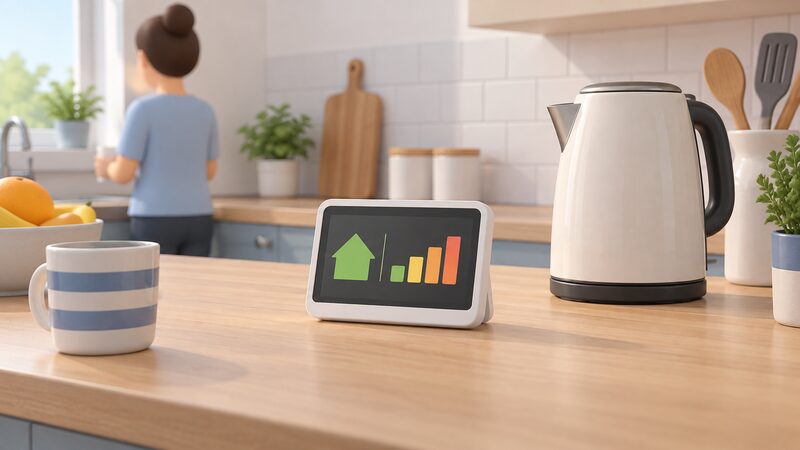
For the in-home display itself, the position is different. Secure Meters displays are issued as part of the standard installation package rather than marketed as a retail product, and the published material describes the category rather than the model. An in-home display is a portable touchscreen device that shows near real-time energy usage data, and it is what allows a household to see consumption as it happens rather than waiting for a bill4. The display is one of three funded components, alongside the meter and the communications hub3.
Smart meters themselves must be compliant with the Smart Meter Equipment Technical Specification (SMETS), which is the technical baseline every meter in the national roll-out has to meet13. The original technical specifications for smart metering equipment were published as industry recommendations in 201114. That specification work is what makes a display from one manufacturer able to pair with a meter from another, and it is why the display is best understood as a component of a national system rather than a standalone gadget.
Specifications: what is published and what is not
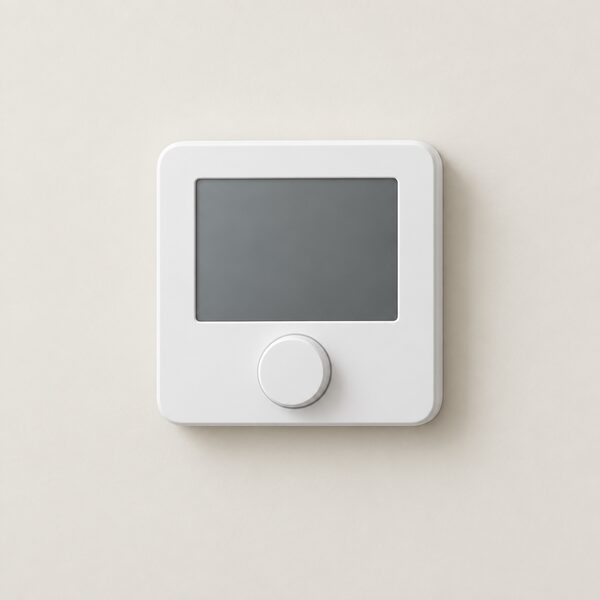
The published specification record for Secure Meters equipment in the UK is thin, and it is worth being precise about what it does and does not contain. The C1727 thermostat's connectivity is stated as Wi-Fi and Bluetooth Low Energy8. Its battery is described as unreplaceable and covered by a twelve-year manufacturer's warranty8. Beyond that, the approved innovation measures guidance lists the product by name and measure number rather than by technical detail10.
For electricity meters generally, the accuracy requirements are set out in the Measuring Instruments Directive. Meters must comply with Annex I and Annex V of the 2014 EU Measuring Instruments Directive, and must be of accuracy Class A or better as defined in Annex V; meters marked Class 1 or 2 are not compliant15. On-board electricity meters are exempt from these requirements15. That is the standard a Secure meter installed in a UK home has to meet, whatever the model.
| Item | Published specification | Source basis |
|---|---|---|
| C1727 Smart Thermostat connectivity | Wi-Fi and Bluetooth Low Energy (BLE) | Official guidance, February 20268 |
| C1727 battery | Unreplaceable, twelve-year manufacturer's warranty | Official guidance, February 20268 |
| C1727 approval route | Innovation Measure 016, ECO4 approved measures | Official guidance, 2022 to 202610 |
| Electricity meter accuracy | Class A or better, MID Annex V | Official guidance, 202615 |
| Meter technical baseline | SMETS compliance | Official statistics, March 202313 |
| In-home display type | Portable touchscreen, near real-time usage | Official guidance, 20264 |
What is not published matters as much. There is no stated display screen size, no stated wireless protocol for the display itself, no stated operating temperature range and no stated model number for the Secure in-home display in the material available. A household trying to identify which Secure display it has will find the model on the unit itself rather than in any published comparison.
Warranty: twelve years on one product, nothing published on the rest
The only warranty term in the published record for Secure Meters equipment is the twelve-year manufacturer's warranty on the C1727 Smart Thermostat's unreplaceable battery8. That figure appears consistently across the 2023 and 2026 editions of the approved innovation measures guidance, so it is a stable published term rather than a one-off8.
"an unreplaceable battery with a twelve-year manufacturer's warranty"
No equivalent published warranty term exists for Secure Meters in-home displays or for the meters themselves. That is not the same as saying there is no warranty; it means no term is stated in the material available, and a household should not assume one. The practical protection for an in-home display comes from a different direction: consumers with issues with their in-home display are in scope of the smart meter Guaranteed Standards of Performance covering issue resolution16.
Those standards are the regulatory route. The first three smart meter Guaranteed Standards of Performance, covering installation timeliness, installation quality and issue resolution, opened in February 202617. Ofgem consulted on introducing a set of new Guaranteed Standards for a range of smart metering-related issues, with the consultation naming Graeme Kelly as contact18. Separately, suppliers face compensation requirements for delayed or failed installations following reforms brought forward by Ofgem19.
What it costs
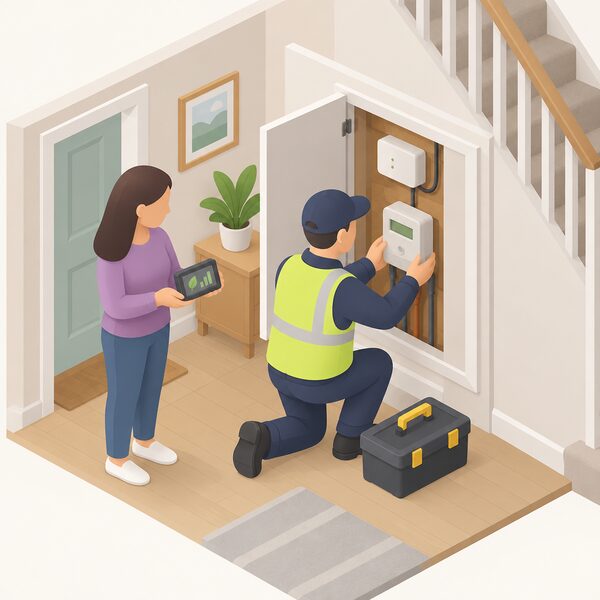
There is no published price for Secure Meters equipment sold to UK households, and no manufacturer list price for an in-home display. The reason is structural: the display is not sold, it is issued. Getting a smart meter installed is free for UK energy customers, and the in-home display comes with the smart meter2. The funded package is an electricity and/or gas smart meter, an in-home display and a communications hub3.
The costs that do exist in the record are system costs borne by suppliers rather than by households. The Guaranteed Standards of Performance carry £26m in set-up costs, annuitised to £5-6m annually, plus £9m annual ongoing costs, borne by suppliers21. Those figures describe the regulatory framework around smart metering, not a charge to a customer.
Historic cost figures exist but should be read as history. A 2001 report put a smart display meter at £75 to £120, with cost estimates supplied by BEAMA, and assumed an average cost of around £150 per installation, rising to around £200 per installation once added costs were included, which applied to a sample of 500,000 meters implied a cost of £100 million22. A 2010 consultation put the cost of smart electric meters for 77% of SME electricity customers at the same as for domestic customers, £5823. These are not current prices and should not be used to estimate what anything costs today.
Where a household wants a display or monitoring device beyond the issued one, prices are quoted by the seller rather than published as a standard figure. The wider cost picture for monitoring equipment is covered in what home energy monitoring and management costs.
The company's status
The published record does not give a company status for Secure Meters. That absence matters, because the rule for any equipment maker is that a warranty is only as good as the company standing behind it, and where a status is not stated it should not be assumed.
What the record does contain is a status for a similarly named but different company. Smart Energy & Powwer Limited is listed as Active in Energy Ombudsman support material24. That is a separate entity and says nothing about Secure Meters.
The organisations that are clearly identified in the smart metering landscape are different again. Smart Energy GB is the not-for-profit campaign helping everyone in Britain understand the importance of smart meters and their benefits to people and the environment3. The Data Communications Company has held the Smart Meter Communications Licence to build and maintain the secure national infrastructure underpinning the smart meter roll-out since 201325. The DCC network operates to security levels endorsed by the National Cyber Security Centre, part of GCHQ5.
The Government has published its decision on the future framework for smart meter installations and the supplier obligation, and the 2022 to 2025 rollout framework has now concluded26. That is the policy backdrop against which any equipment maker's UK position sits.
What it means for energy independence
An in-home display is the cheapest and most immediate piece of energy independence a household can have, and it is worth being clear about how far that independence extends. The display puts the household in control of its energy usage, meaning it can take energy-saving steps to reduce CO2 emissions, and it shows consumption in near real time rather than through a monthly estimate7. Smart meters put consumers in control of their energy use, allowing energy efficiency measures that help save money on bills, offset price increases and reduce carbon emissions28.
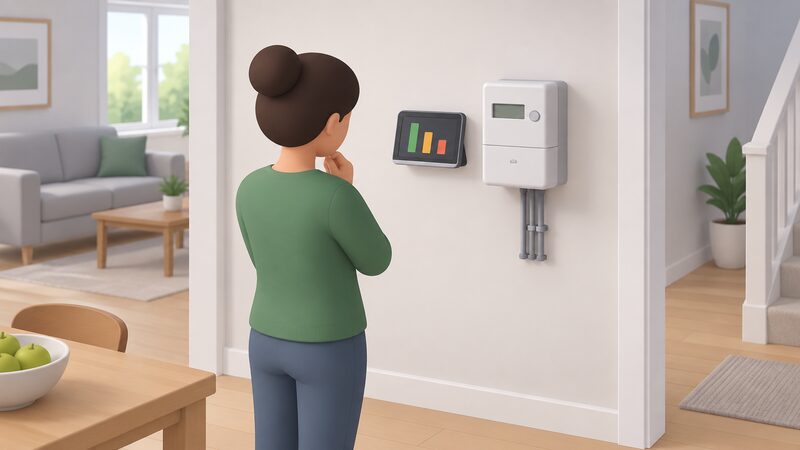
The dependence that remains is substantial and worth naming plainly. Readings are sent automatically via the DCC's secure network to the energy supplier, so the data route runs through national infrastructure rather than staying in the home5. The display is issued with the meter and tied to it. The meter itself must be SMETS compliant, a national specification13. The household does not own the data pathway and cannot reroute it.
There is a second layer of dependence that matters for anyone thinking about self-sufficiency: the display is a monitoring device, not a control device. It shows what is being used. It does not switch anything, store anything or generate anything. A household wanting to act on what the display shows needs either behaviour change or separate control equipment.
For households generating their own electricity, the smart meter has become the practical route to payment. Under the Smart Export Guarantee, the typical meter for export payments is a smart meter29. That is a case where the smart metering system extends a household's independence rather than limiting it, because it is the mechanism through which exported generation is measured and paid for.
Satisfaction data suggests the arrangement works for most people. Satisfaction for smart meter owners reached 86% in July to August 2025, compared with 83% in January of that year9. Smart meters have been installed in 65% of homes and 61% of businesses6. The roll-out has been tracked in quarterly official statistics since at least 201530, and the consumer benefit case was set out in government progress reporting as far back as 201328.
Where the arrangement has limits
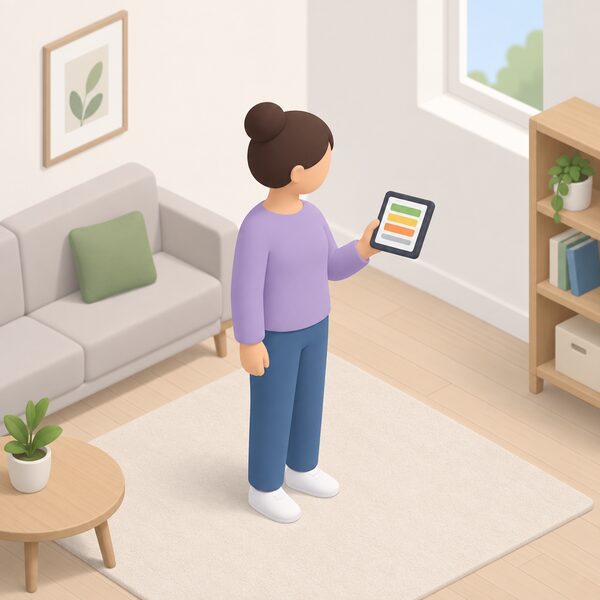
The limits fall into three groups: what the display cannot do, what happens when it fails, and what the household cannot see.
On capability, the display shows near real-time usage data and nothing more4. It does not provide appliance-level breakdown, it does not control loads, and it does not store a long history for analysis. Households wanting that level of detail need separate equipment, which is covered in home energy monitors and consumer access devices.
On failure, the protection is regulatory rather than product-based. Consumers with issues with their in-home display are in scope of the Guaranteed Standards of Performance covering issue resolution16. The first three standards opened in February 202617. Compensation requirements apply to delayed or failed installations following Ofgem reforms19. Ofgem has also consulted on reforming suppliers' meter inspection obligations, noting that other regulations and policies, including safety obligations and enhanced theft detection and billing accuracy obligations, protect consumers with traditional and smart meters more effectively than the existing inspection obligation32.
On visibility, the household sees its own consumption but not the system behind it. The DCC network operates to security levels endorsed by the National Cyber Security Centre5, and the data protection arrangements around smart meter data are set out separately in smart meter data.
Sources32 cited
- How do smart meters save energy?, Smart DCC, 2026
- Does a smart meter save money?, Smart DCC, 2024
- Do you have to have a smart meter by law?, Smart DCC, 2026
- Smart meters and decarbonisation, Smart DCC, 2026
- How do smart meters send readings?, Smart DCC, 2026
- State of the energy market report: retail, Ofgem, 2025-04-15
- Smart meter performance, Ofgem, 2026
- ECO4 Innovation Approved Innovation Measures v1.17, Ofgem, 2026-01
- Energy Consumer Satisfaction Survey Findings Report July to August 2025, Ofgem, 2025-12
- ECO4 Innovation Approved Innovation Measures v1.1, Ofgem, 2023-04
- ECO4 Innovation Approved Innovation Measures v1.5, Ofgem, 2023-10
- ECO4 Innovation Approved Innovation Measures v1.6, Ofgem, 2024-01
- HEE Stats Detailed Release, March 2023, Department for Energy Security and Net Zero, 2023-03-30
- Smart metering implementation programme: draft technical specifications, GOV.UK, 2011-08-04
- Domestic RHI: Guide to metering, Ofgem, 2022-03
- Smart Meter Guaranteed Standards of Performance: Draft Impact Assessment, Ofgem, 2025-08
- How we're working to support customers to address non-communicating smart meters, Smart DCC, 2026
- Smart meter guaranteed standards: supplier guaranteed standards performance, Ofgem, 2025-03-28
- Tough new rules force suppliers to fix faulty smart meters, GOV.UK, 2026-03-10
- How do smart meters reduce my bills?, Smart DCC, 2025
- Smart Meter Guaranteed Standard: Statutory Consultation, Ofgem, 2025-08
- Smart meter report, Ofgem, 2001-09
- Domestic smart metering consultation, Ofgem, 2010-07
- Raise a dispute: Smart Energy & Powwer Limited, Energy Ombudsman, 2026-09-19
- Data protection and smart meter data, Open Energy, 2013
- Supplier smart metering installation targets, Ofgem, 2026-09-17
- Supplier smart metering installation targets (Welsh), Ofgem, 2026-09-17
- Second annual progress report on the roll-out of smart meters, GOV.UK, 2013-12-18
- Smart Export Guarantee, GOV.UK, 2020-01-01
- Statistical release and data: smart meters, Great Britain, quarter 4 2014, GOV.UK, 2015-03-19
- Statistical release and data: smart meters, Great Britain, quarter 2 2019, GOV.UK, 2019-08-29
- Reforming suppliers' meter inspection obligations, Ofgem, 2015-07-23