In this guide
Rolls is a deep-cycle battery brand made by the Surrette Battery Company, established in 1935, and sold in the UK through the renewable energy supplier Wind & Sun, which has supplied the range since 20051. The range covers flooded lead-acid, AGM, gel and lithium iron phosphate chemistries, from small sealed batteries for modest renewable energy projects to gel cells built for stringed use in large solar installations1.
For a household, Rolls batteries are an off-grid product first. Independent guidance is blunt that batteries are essential for off-grid systems and will need replacing every six to 10 years3. Home battery storage generally is put at a 10 to 15 year typical lifespan4. A Scottish retrofit study reported that batteries were never economically viable over 15 years, in part because of a reported 10-year replacement cycle5.
The independence a Rolls bank buys is real but partial. It stores energy the household generates itself, so less electricity is drawn from the grid, but the bank still needs charging from a source, still ages, and still has to be replaced on a schedule the household does not control.
Rolls: a battery maker with UK island minigrids in service
Rolls batteries are made by the Surrette Battery Company, a business established in 1935, and the brand has been supplied into the UK market by Wind & Sun since 20052. That is a long supply relationship by the standards of the storage sector, and it matters for an off-grid household because a battery bank is not a one-off purchase: it is a component that will be replaced, and the availability of compatible cells years later is part of the value.
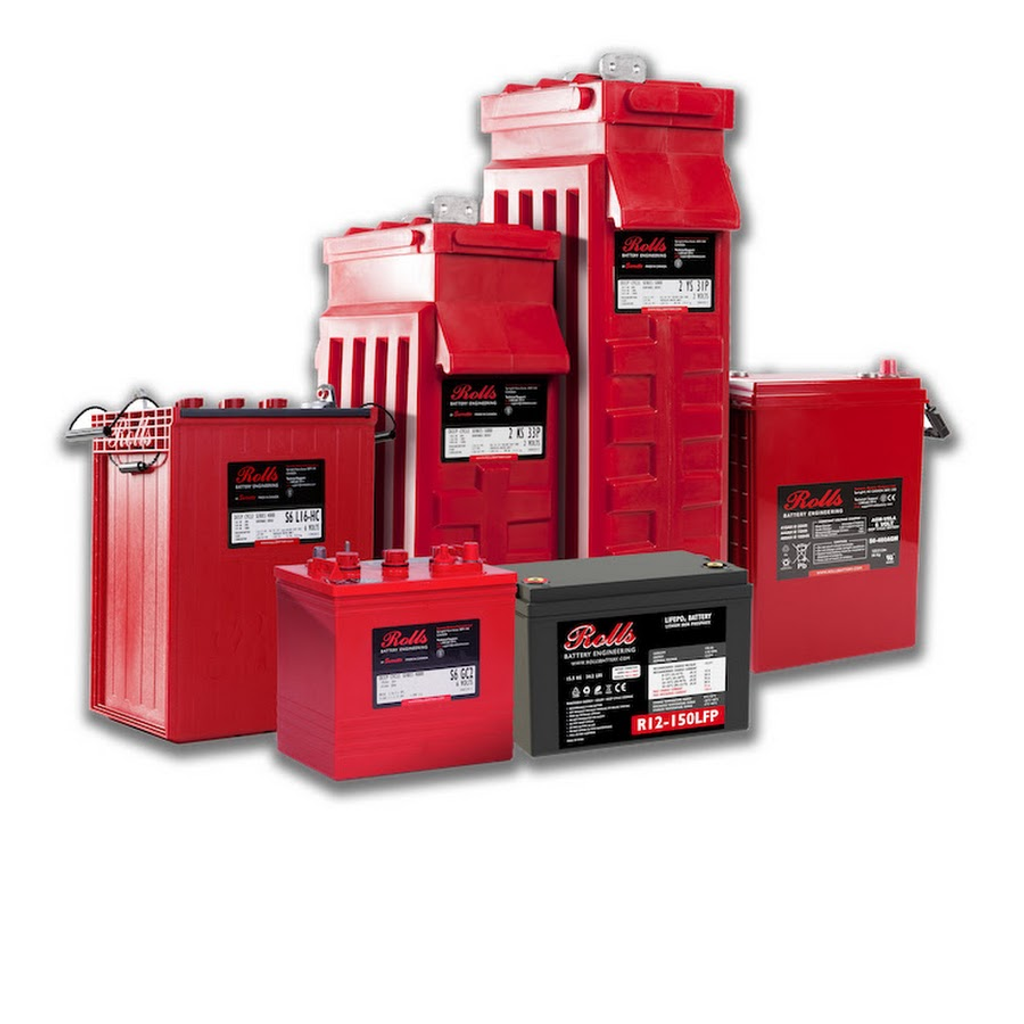
The range is built around deep cycling rather than around the shallow, high-power duty of a grid-tied home battery. The 4000 series is described as durable batteries designed for deep cycling service in renewable energy applications, with a thick plate design, high density active material, increased liquid reserve and a polypropylene rigid container, supplied fully charged1. The 5000 series uses a dual container construction, with removable cells fitted into a durable case giving double protection against breakage or leakage1. The 4500 series sits between the two, combining the convenience and portability of the 4000 series with the extended capacity and cycle life of the heavy duty 5000 series1.
The AGM range is sealed, non hazardous, non spillable and completely maintenance free, able to be operated upright or on its sides, leak proof and resistant to shock and vibration1. The AGM R Series is described as deep cycle, sealed and maintenance free, suited to smaller renewable energy projects, and comes in five models1. The OPzV Gel range is optimised for stringed use in large sized solar installations, designed to maximise efficiency and cycle life for off-grid solar applications1.
This is a maker's own description of its own products, and it should be read as such. What it establishes is the shape of the range: a household choosing Rolls is choosing between maintenance-free sealed cells for a small system and heavier flooded or gel cells for a larger, longer-duty bank.
Operating life in service: up to 15 years on Scottish island minigrids
There is no Rolls-specific service life figure in the material available, so the honest position is to give the general figures and say what drives them. Home battery storage is put at a typical lifespan of 10 to 15 years4. Off-grid system batteries are given a shorter replacement interval of every six to 10 years3. Those two figures are not in conflict so much as describing different duties: an off-grid bank is cycled harder and deeper than a grid-tied battery that mostly shaves peaks and stores cheap overnight power.
The Scottish evidence is the most cautionary. A study on balancing investment in clean heat and energy efficiency in Scottish housing retrofit reported that batteries were never economically viable over 15 years, in part because of a reported 10-year replacement cycle5. That is a finding about economics rather than about whether the cells work, and it is the kind of figure a household should weigh before treating a battery bank as a permanent asset.
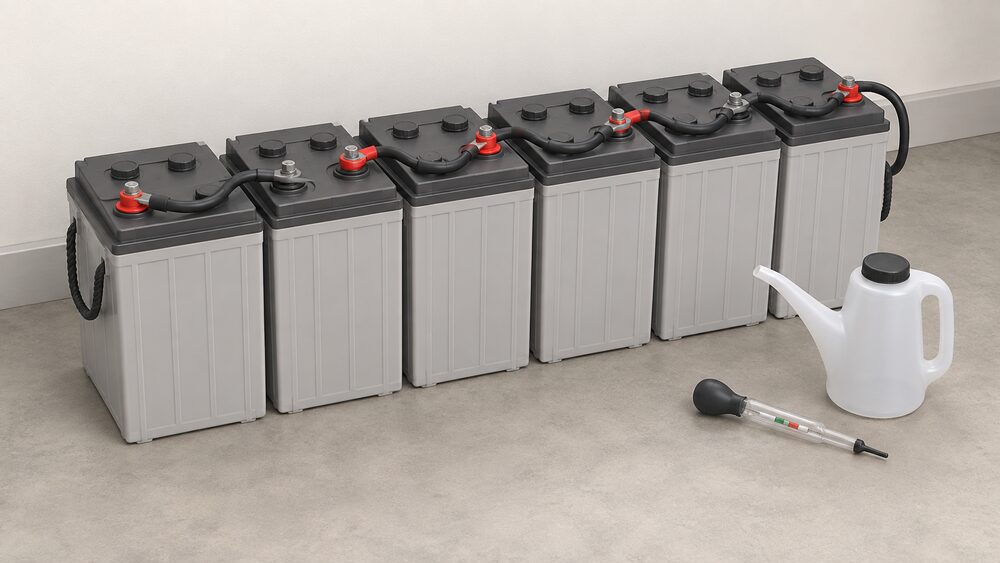
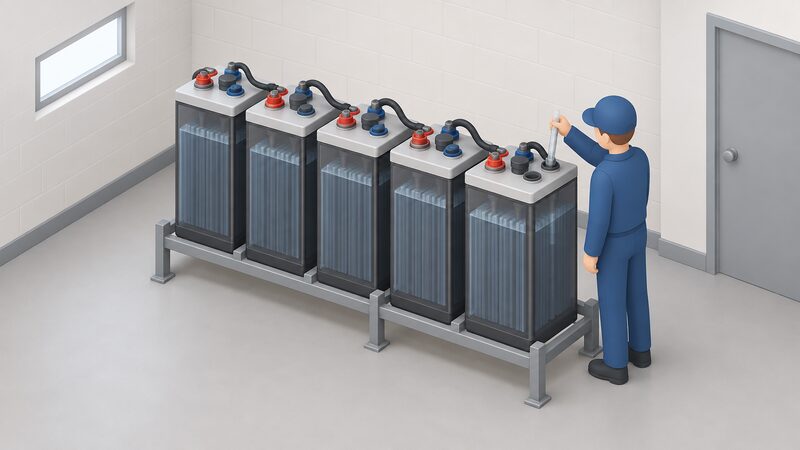
What actually sets life in service is depth of discharge, operating temperature, charging regime and maintenance. Flooded lead-acid cells need water checking and equalisation; sealed AGM and gel cells do not, which is why the AGM range is described as completely maintenance free1. A household that discharges a bank deeply every night will replace it sooner than one that keeps discharge shallow. For a fuller treatment of how chemistry and cycling interact, see lead-acid, AGM and gel batteries and home battery cycle life and degradation.
Where Rolls batteries are used: from home off-grid to diesel generator replacement
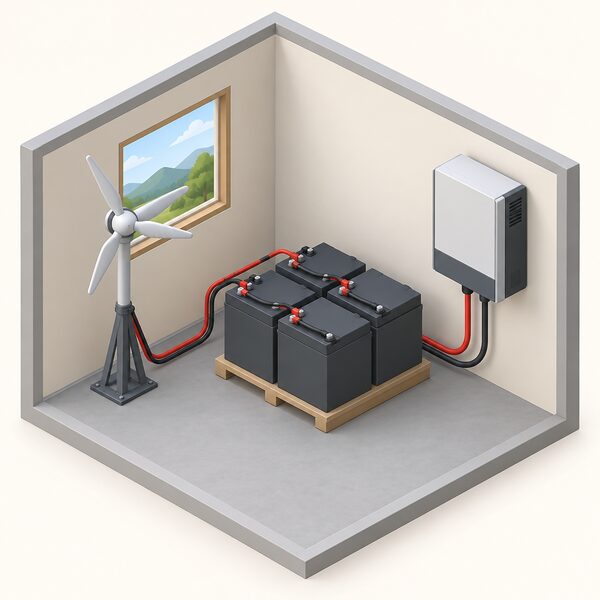
The core application is off-grid storage. Independent guidance states plainly that for off-grid systems, batteries are essential, and that they will need replacing every six to 10 years3. The same guidance notes that if a small wind system is off-grid, the batteries will also need replacing6. That is the context in which a Rolls bank sits: not a discretionary add-on to a grid connection, but the thing that makes an off-grid supply possible at all.
The second application is replacement within an existing system. Rolls states that its VB Series lithium batteries allow direct replacement for deep-cycle lead-acid, AGM and gel batteries with no system redesign required, and that the S-Series LFP provides a compatible drop-in sealed lead-acid replacement, with fast charging and discharging, a compact case design and up to 50% less weight than equivalent lead-acid models1. The VB Series has eight models1. The S-Series uses lithium iron phosphate chemistry1.
That drop-in claim is the closest the range comes to diesel generator replacement, and it is worth being precise about what it covers. It describes swapping one battery type for another inside a system that already has an inverter, a charging source and a battery bank. It does not describe removing a generator and expecting the batteries to do the generator's job unaided: something has to charge them. Off-grid systems pair storage with a generation source, and the battery's role is to carry the load through the hours when that source is not producing.
Rolls batteries in the Scottish Isles: Eigg, Muck, Rum, Fair Isle and Foula
The island minigrids of Eigg, Muck, Rum, Fair Isle and Foula are the kind of installation a large stringed battery bank is built for, and the OPzV Gel range is explicitly optimised for stringed use in large sized solar installations1. Those are the conditions the range is designed around: a defined, isolated load, a generation source that varies, and no fallback to a national grid when the wind drops or the sun goes in.
What the material available does not do is name Rolls as the supplier to any specific island scheme. The brand is not identified in the UK community battery projects covered here. Those projects involve other organisations: a network operator developing what it describes as the UK's first scalable blueprint for community-led flexibility7, and community battery schemes that Citizens Advice notes raise problems arising from multiple responsibilities, such as community energy groups, battery companies and electricity suppliers8.
That distinction matters for a household reading a supplier page. A battery range being suited to island minigrid duty, and a battery brand being the installed choice on a named island, are different claims, and only the first is supported here. What can be said is that the technical profile of the larger Rolls ranges, stringed gel cells and heavy duty flooded cells with high cycle life, is the profile such schemes require, and that the smaller AGM R Series is aimed at smaller renewable energy projects rather than at community-scale plants1.
For the wider picture of how isolated and grid-connected storage differ, see off-grid battery systems and batteries and grid services.
What owning Rolls batteries means for household energy independence
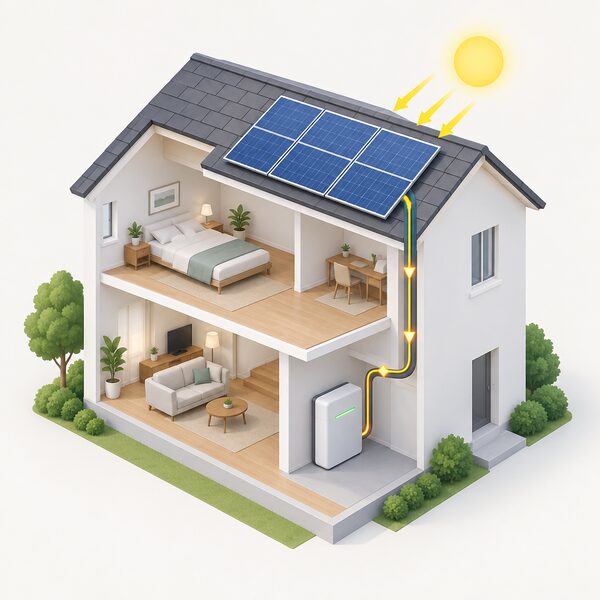
A battery bank of any make changes the relationship between a household and its electricity supply, and the effect is measurable. Adding a battery to a solar installation increases self-consumption from 30 to 40% to 70 to 80%, according to Great British Energy figures cited in official guidance9. Home storage batteries store electricity for later use, making the energy system more independent from the National Grid10. Rooftop solar with home batteries means less electricity is drawn from the grid, reducing the amount paid in bills11. A home battery captures surplus solar energy for later use, including overnight electric vehicle charging, where without it the surplus is wasted or exported at a relatively low rate12. Combining solar with a home battery lets a household store renewable electricity to power a heat pump, making it less reliant on grid electricity13.
Those are the benefits, and they are general to storage rather than specific to Rolls. The dependence that remains is what a household should weigh alongside them. An off-grid Rolls bank depends on a generation source to charge it, on an inverter and charge controller to manage it, and on the household maintaining or replacing it on a six to 10 year cycle3. A grid-tied installation depends on the grid for the periods the battery cannot cover, and on a supplier for whatever it draws. The Scottish retrofit finding that batteries were never economically viable over 15 years, partly because of a 10-year replacement cycle, is the clearest statement of the limit5.
There is also a safety and compliance dimension. Not all home battery systems are suitable for power cuts, and a household looking to protect against outages should ask its installer whether a battery will work in an outage and for how long10. Plug-in battery storage systems are not permitted to be connected to a grid-tied electrical installation14. For the wider context, see home batteries and household energy independence and battery backup in a power cut.
Availability in the UK: Wind & Sun as the supplying route
Wind & Sun is the UK route to Rolls batteries covered here, and has supplied the brand since 20052. The catalogue spans the full chemistry range plus the accessories an installation needs: ready-made cables for connecting batteries in series or parallel, supplied with two crimped terminal lugs, AGM terminal covers, and a battery level indicator1.
| Item | Detail | Price |
|---|---|---|
| Rolls battery cables | For series or parallel connection, two crimped lugs | From £6.491 |
| Rolls Batteries Level Indicator | Accessory | From £7.041 |
| Rolls Batteries AGM Terminal Covers | Accessory | From £3.391 |
| Rolls VB Series Lithium Batteries | 8 models | From £213.491 |
Those are accessory and small-item prices from the supplier's own listings, and they are the only published Rolls prices in the material available. There is no published installed price for a Rolls battery bank, and no published price for the larger flooded and gel cells. A household should expect a bank to be quoted by an installer or supplier against the specific capacity, voltage and chemistry required, and should treat the accessory figures above as an indication of the range's entry point rather than of system cost.
Availability is also worth separating from the wider UK storage market. Plug-in solar batteries are already being developed for the UK market15, plug-in solar panels are now available to buy and use across Great Britain16, and one plug-in solar range has reached UK compliance ahead of a consumer launch17. None of that is Rolls: the brand sits in the off-grid and renewable energy supply channel rather than the retail plug-in market. For the general cost picture, see how much does a home battery cost in the UK and lithium-ion vs lead-acid solar batteries.
Sources17 cited
- Rolls Battery collection, Wind & Sun, 2026
- Rolls Battery, Wind & Sun
- Small wind turbines, MCS Certified, 2026
- Battery storage, Home Energy Scotland, 2026
- Balancing investment in clean heat and energy efficiency in Scottish housing retrofit, ClimateXChange, 2026
- Wind turbines, Uswitch, 2026
- Neighbours could hold the key to cheaper greener energy, UK Power Networks, 2026
- Citizens Advice responds to DESNZ consultation on community batteries, Citizens Advice, 2026
- POSTnote 771, Parliamentary Office of Science and Technology, 2026
- Solar panel battery storage, Which?, 2026
- Batteries in the home, Solar Energy UK, 2026
- Can solar panels charge electric cars?, CPA, 2026
- How to ensure a heat pump runs efficiently, Energy Saving Trust, 2026
- Plug-in solar consumer guide, Electrical Safety First, 2026
- What to know about plug-in solar panels, Home Energy Scotland, 2026
- Save money home energy check, Home Energy Scotland
- UKSOL Plug-In Solar Pro first to reach key UK compliance, Solar Energy UK, 2026