In this guide
GB-Sol is a British solar manufacturer that has been making panels in South Wales since 1994, and it is one of the very small number of firms producing solar modules on UK soil. Its range covers conventional framed panels and PV Slate, a roof-integrated product that replaces the roof covering rather than sitting above it. For a household, the appeal is a shorter supply chain, a British maker to pursue a warranty against, and a roof-integrated option that avoids panels bolted over the tiles.
The context matters. Around 80% of the panels available in the UK are made in China, including those from Trina Solar, and the industry's own assessment is that manufacturing within the UK is minimal1. A British-made module is therefore the exception. Solar PV is also a growing share of British electricity: solar made up 10% of renewable generation in 2024, up from 0.2% in 2010, with 18 GW of solar installed in the UK3.
What GB-Sol does not change is the underlying dependence. A grid-connected array still relies on the grid for import and export, on a supplier for any export payment, and on an inverter and monitoring equipment that the household does not make. Roof integration changes how the array sits on the building, not where the electricity goes.
GB-Sol: a British solar maker since 1994
GB-Sol has been manufacturing solar panels in Britain since 1994. That date places it well before the feed-in tariff era that created the modern domestic solar market, and before the current run of record installations. Longevity is not a technical specification, but it bears directly on one thing a household cares about: whether there is still a company standing behind a 25-year performance promise when a claim is made in year fifteen.
The wider British solar picture has changed enormously over that period. Solar made up 10% of renewable generation in the UK in 2024, up from 0.2% in 2010, and there was 18 GW of solar installed in the UK by 20243. The solar share of total generation increased by 2.4 TWh between the first half of 2024 and the first half of 20256. Embedded solar set a record of 16.3 gigawatts at 12.30pm on 23 April 20267.
Against that, UK panel manufacturing has not grown with installation. The industry position is that manufacturing within the UK is minimal2, and the great majority of modules fitted to British roofs are imported, with around 80% of panels available in the UK made in China1. A British maker therefore sits in a small niche, and the practical value of buying from one is a shorter physical supply chain for replacements and a domestic point of contact, not a different class of cell.
For energy independence, the distinction is real but limited. A British-made panel does not make a home independent of the grid, and it does not remove the need for an inverter, cabling and a connection agreement. What it does is keep more of the equipment supply chain inside the UK, which matters when a module needs replacing years later and shipping and lead times are the constraint. The wider picture is set out in solar panels and household energy independence.
The range: Infinity edge-to-edge roof and PV Slate
GB-Sol's product line divides into two ideas. The first is a conventional framed panel, sold for on-roof mounting on rails above the existing covering. The second is PV Slate, a roof-integrated product in which the generating units form the roof surface itself. The Infinity range is described as edge-to-edge, meaning the active area runs close to the frame edge rather than leaving a wide border, which raises the proportion of the module that generates.
Roof-integrated products of this kind are a recognised category. Solar PV can be installed in the form of PV tiles and slates, which work in the same way as traditional solar PV panels but resemble traditional tiles or slates8. The Energy Saving Trust notes that solar roof tiles can be a good solution for getting the most out of the available space on angled roofs, roofs with eaves and other complicated roofs9. That is the case for the format: awkward geometry, dormers, valleys and small planes where a framed panel will not sit neatly.
There is a definitional wrinkle worth knowing. For the purposes of one local listed building consent order, solar PV includes only solar panels but not solar tiles or solar slates10. That is a planning-law distinction rather than a technical one, and it means a roof-integrated product can fall under different consent rules from an on-roof panel in the same location. Households in sensitive areas should check the position for their own property, and the general rules are covered in roof-integrated solar and solar panels vs solar roof tiles.
| Product idea | How it sits on the building | Where it suits |
|---|---|---|
| Framed panel, on-roof | Mounted on rails above the existing covering | Straight, unshaded roof planes with space below |
| PV Slate, roof-integrated | Forms the roof covering itself | Angled roofs, roofs with eaves, complicated roofs9 |
The integrated solar roof: panels as the waterproofing
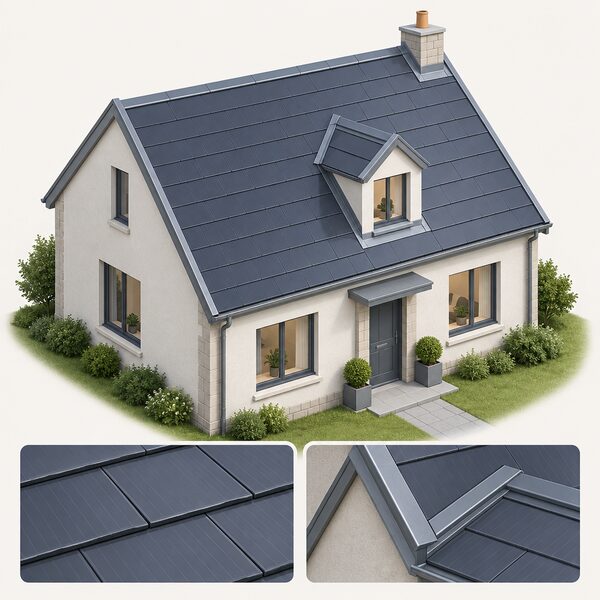
The central difference between an on-roof array and a roof-integrated one is which component keeps the rain out. With an on-roof system, the tiles or slates remain the weatherproof layer and the panels sit above them on a rail and bracket system, with the roof covering made good around each fixing. With PV Slate, the generating units are the covering, and the weatherproofing is achieved by the way the units interlock and are flashed.
That changes several things at once. It removes the visual signature of a solar array, which is the main reason households choose the format on a period property or in a sensitive location. It also means the roof and the array have a single lifespan and a single maintenance route: there is no separate layer of tiles underneath that can fail independently, and no gap between panel and roof for debris or wildlife. The trade-off is that the roof covering and the array are replaced together, so a decision about the solar is also a decision about the roof.
The planning position differs by nation and by designation. In England, Wales and Scotland the permitted development rules for domestic solar are broadly permissive for roof-mounted equipment, but roof-integrated products can be treated differently from panels, and listed buildings and conservation areas bring their own consent requirements. The relevant pages are solar panel planning permission in England, in Scotland, in Wales and in Northern Ireland.
For independence, an integrated roof behaves exactly like any other grid-connected array. It generates when the sun is out, exports surplus under a Smart Export Guarantee arrangement if one is in place, and imports from the grid at night and in winter. The difference is architectural and structural, not electrical. Structural questions about roof loading are covered in building regulations and roof loading.
Specifications and build: glass, seals and flashings
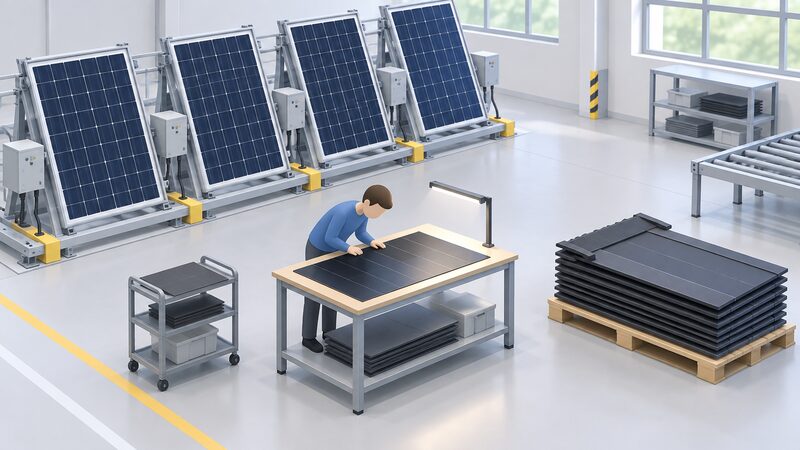
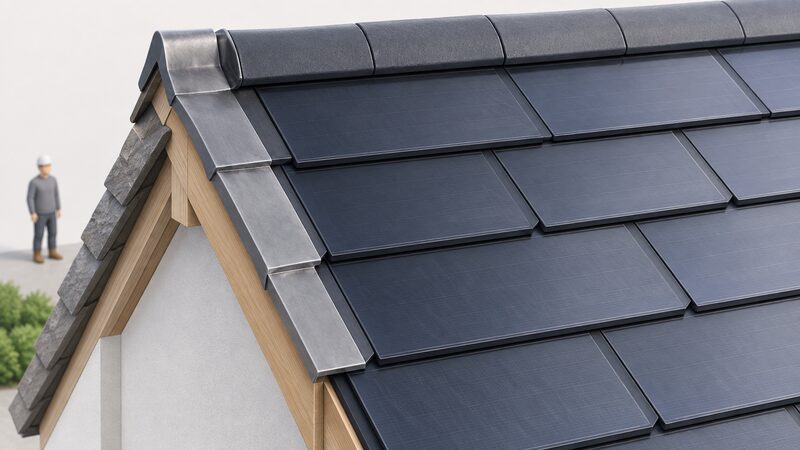
The build of a roof-integrated product is where the engineering sits, and it is the part a household cannot easily inspect after the fact. Three elements carry the performance and the weatherproofing: the glass laminate that forms the generating surface, the seals and interlocking edges that keep water out at the joints between units, and the flashings that tie the array into the surrounding roof at the ridge, eaves, verges and any penetration.
Glass quality determines how much light reaches the cells and how the module behaves over decades of thermal cycling, hail and wind loading. Seals and interlocks determine whether the roof leaks, which is the failure mode that matters most to a homeowner and the one that is hardest to remedy once the array is in place. Flashings determine whether water is directed away from the array edges rather than behind them. None of these is visible from the ground, which is why the survey and the detailing matter more on an integrated roof than on an on-roof system.
The standards framework that governs this equipment is set out in solar panel standards and testing, covering the IEC 61215 and 61730 series that modules are tested against. Mounting hardware and the interface between array and roof are covered in solar panel mounting systems, and the in-roof category more generally in roof-integrated solar.
Manufacturing in South Wales and what local production means
GB-Sol manufactures in South Wales. The regional context is unusual: Wales has a small but actively supported renewable sector, and the Welsh Government's Green Homes Wales scheme is intended to support the market to develop and strengthen local supply chains11. That is a policy statement of intent rather than a subsidy for any particular manufacturer, but it explains why a Welsh solar maker has a supportive backdrop.
The scale of locally owned generation in Wales puts the sector in perspective. Locally owned renewable energy in Wales represented an estimated 1.9 GWh of generation in 2021, while approximately 100 MW of gas, diesel and coal electricity generation capacity was locally owned in the same year, in small-scale projects such as farm diesel generators12. A separate count puts small-scale fossil fuel generation capacity in Wales at 269 MW, with the largest single generator having 22.4 MW of installed capacity12. Local ownership of generation is therefore still weighted towards fossil plant, and locally owned renewables are small in absolute terms.
The South Wales Industrial Cluster plan outlines a vision for net zero industries in South Wales by 2040, equating to a 40% reduction of Wales' national carbon emissions13. A solar manufacturer in the region sits inside that wider industrial transition rather than apart from it.
What local production means for a household is narrower than the marketing suggests. It shortens the supply chain for replacement modules and spares, it keeps the point of contact for a warranty claim inside the UK, and it avoids the shipping and lead-time exposure that comes with an imported module. It does not change the physics of the panel, the need for an inverter, or the household's relationship with the grid. The general case for British and European modules is set out in types of solar panel sold in the UK.
Installation, surveyors and planning support across Great Britain
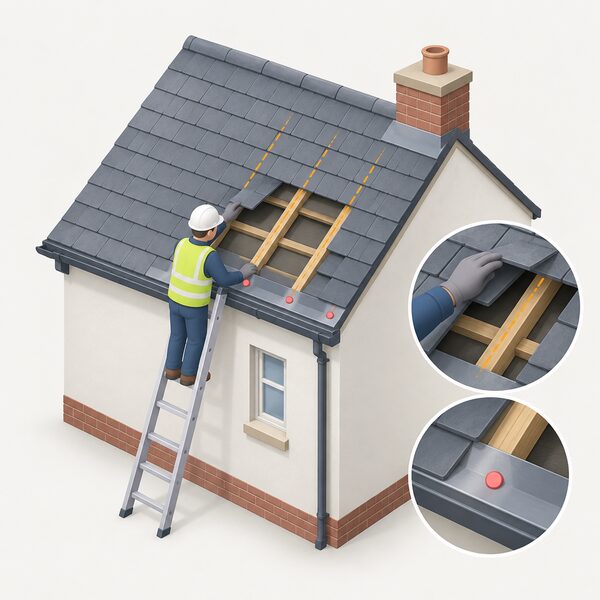
GB-Sol offers surveyors and planning support across Great Britain, which is the practical service layer around the product. For a roof-integrated system this matters more than for an on-roof array, because the survey has to establish not just orientation, pitch and shading but the condition and construction of the existing roof, the position of rafters, and how the array will be flashed at every edge.
The wider installation market gives a sense of what is normal. Good Energy installs solar panels and batteries in multiple places across the south of England, while Scottish Power installs solar panels and batteries throughout Great Britain14. Coverage is uneven, and a household outside the main urban corridors should expect to establish early whether a given installer will travel.
Grant-funded work follows its own assessment route. Under the Great British Insulation Scheme, if an applicant is eligible for support, their energy supplier will arrange an assessment of their property15. Eligibility and pre-installation paperwork for ECO4 and the Great British Insulation Scheme is handled through a declaration form whose purpose is to confirm the eligibility of properties receiving measures under either scheme and to collect project and retrofit-level information before installation16. Where a Welsh scheme loan is involved, the borrower must apply for and have received an installation grant offer letter before any work starts on installing the eligible measure covered by it17.
The process from first contact to handover, including the survey and the electrical checks, is described in solar panel installation. For a household weighing an integrated roof against an on-roof array, the comparison is set out in roof-integrated vs on-roof solar.
Certification, ethics rating and MCS status
MCS is the UK's quality mark for small-scale renewables like solar panels4, and MCS product certification is described as a mark of quality that ensures compliance with UK regulations18. For modules specifically, MCS 005 provides certification for solar photovoltaic modules19. Certification is granted per product, not per brand, so the question for a household is whether the exact module being quoted appears in the MCS product directory.
Certification carries practical weight beyond reassurance. Under the Boiler Upgrade Scheme, audits require copies of MCS certificates as evidence20, which shows how deeply certification is embedded in grant administration. A household seeking any grant-funded or scheme-backed work should expect certification to be a condition of payment rather than a nice-to-have.
The standards behind certification are specific. MCS draws on BS EN 12975-1 for thermal solar systems and components19, and the scheme operates as a certification route where innovation meets sustainability in the assessment of microgeneration products18. For a household, the useful discipline is to ask for the certificate reference for the exact model, check it against the MCS directory, and keep a copy with the handover pack.
On ethics and company conduct, no rating for GB-Sol is available, and none should be inferred. What can be said is that a manufacturer trading since 1994 has a public record that can be checked, and that a household relying on a long performance warranty is effectively taking a view on the maker's survival. That is a general point about the solar market rather than a criticism of any firm. MCS is the UK's quality mark for small-scale renewables like solar panels, and product certification under it is a mark of quality1. The scheme covers solar photovoltaic modules under MCS 0053, and MCS has been streamlining its Scheme since novation in April 2018 to improve compliance and enhance consumer protection4. The certification framework in full is covered in MCS certification for solar PV installations and solar panel warranties and degradation.
Batteries: availability and placement guidance
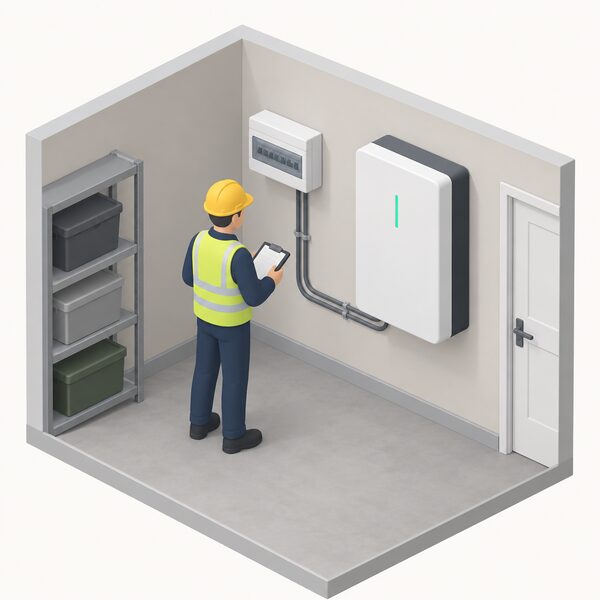
Battery storage is where the guidance has moved most recently. ECO4 delivery guidance was updated with a paragraph added in regard to battery storage installations5, and the summary of updates confirms that battery storage installations are covered by the added guidance21. That is a change to official scheme documentation rather than a product announcement, but it signals that battery placement is now treated as a defined question rather than an afterthought.
The technical guidance has kept pace. The NAPIT Practical Guide to Solar Photovoltaic Systems and Battery Storage A4:2026 covers the design, selection, installation and commissioning of solar photovoltaic systems, plus maintenance and fault finding22. Its content coverage includes expected performance, PV self consumption and grid independence, array mounting and roof interactions, cable type, location, connections, inspection and testing, health and safety, Wiring Regulations, British and Harmonised standards and industry guidance22. For a household whose battery was installed under older assumptions, that is the document an electrician will work to.
Where storage is co-located with generation, the regulatory position is set out in official guidance on the co-location of electricity storage and hydrogen production under the Renewables Obligation, Feed-in Tariff, REGO and SEG23. That guidance is a publication type of guidance rather than a rule change, but it defines how co-located storage is treated for the purposes of those schemes.
For independence, a battery is the component that most changes a household's relationship with the grid, because it shifts when imported electricity is used rather than how much is generated. It does not remove the connection. Adding storage to an existing array is covered in adding battery storage to a solar system, and the inverter side in hybrid inverters.
Where GB-Sol fits, and what it does not change
GB-Sol's proposition is a British-made module and a roof-integrated option, backed by a manufacturer that has been in the market since 1994 and offers surveyors and planning support across Great Britain. For a household with a complicated roof, a period property or a preference for keeping the supply chain domestic, that combination is unusual in a market where around 80% of available panels are made in China1 and UK manufacturing is described as minimal2.
The limits are equally clear. A GB-Sol array is still a grid-connected system: it depends on the grid for import and export, on a supplier for any export payment, on an inverter and monitoring equipment made by others, and on a connection agreement. Roof integration changes the building, not the electricity supply. Certification is per product, so the exact module must be checked in the MCS directory19. Battery placement guidance has been updated and should be applied to any storage installed alongside5.
For the wider picture, the pillar page is Solar PV for UK Homes, and the comparison with other British and European module makers is covered in UKSOL solar panels, BISOL solar panels and Solarwatt solar panels.
Sources24 cited
- Trina Solar solar panels review, Which?, 2026
- Solar power must be mainstay for new building regulations, MCS Certified, 2023
- Solar panels and renewable generation statistics, UK Parliament POST, 2025
- Solar photovoltaic (PV), MCS Certified, 2026
- ECO4 delivery guidance v3.2 and measures table summary of updates, Ofgem, 2025
- A record year for British solar, Ember, 2025
- Britain benefits from the summer sun as July smashes solar generation record, Solar Energy UK, 2026
- Solar equipment on residential buildings, Hart District Council, 2025
- Solar roof tiles, Energy Saving Trust, 2026
- Proposed Local Listed Building Consent Order, Southwark Council, 2026
- Written statement: Green Homes Wales scheme, Welsh Government, 2024
- Energy generation in Wales 2021, Welsh Government, 2022
- Draft heat strategy for Wales, Welsh Government, 2023
- Solar panel costs, Which?, 2026
- Apply: Great British Insulation Scheme, GOV.UK, 2026
- ECO4 and GBIS eligibility and pre-installation declaration v1.1, Ofgem, 2026
- Loan standard terms and conditions: Green Homes Wales, Development Bank of Wales, 2026
- Certifying your product, MCS Certified, 2026
- MCS microgeneration certification, BSI, 2026
- Boiler Upgrade Scheme guidance for installers v2.1, Ofgem, 2023
- Summary of updates to ECO4 delivery guidance and measures table, Ofgem, 2026
- NAPIT Practical Guide: Solar Photovoltaic Systems and Battery Storage A4:2026, NAPIT, 2026
- Guidance for generators: co-location of electricity storage and hydrogen production, Ofgem, 2024
- BOOW LiFePO4 leisure battery product recall, Electrical Safety First, 2026