In this guide
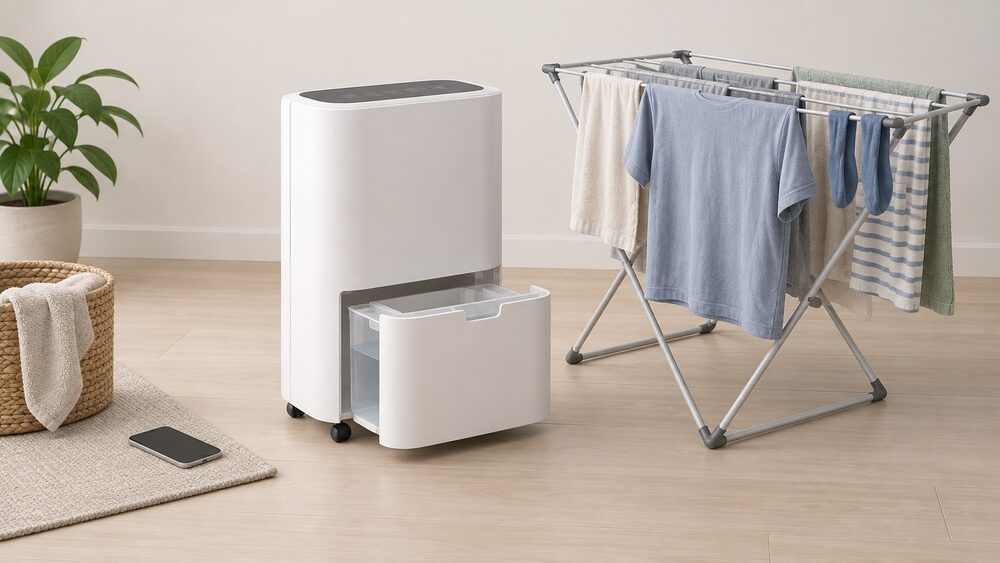
Duux does not sell a portable air conditioner in the UK. The brand's range is dehumidifiers, convector and oil-filled heaters, fan heaters and fans, and the product most often searched for under a Duux air conditioner query is the Bora Smart 30L dehumidifier, which pulls 30 litres of water a day from rooms up to 50 m²1. It is a drying appliance, not a cooling one.
That distinction matters for anyone arriving here expecting a cooling unit. A dehumidifier removes moisture; it does not chill the air in any meaningful way. The Bora's own maker states a running cost of 8p per hour on the highest setting in laundry mode1, which is a fraction of what a portable air conditioner costs to run: independent guidance puts a typical 1,000 to 1,500W portable air conditioner at around 26 to 39p per hour, roughly 14 to 20 times more than a fan2.
What Duux does offer a household is a set of low-draw appliances that address damp, condensation and local warmth rather than summer heat. The Bora 30L is the centrepiece, with a 4-litre tank, a 1 to 24 hour timer, app scheduling and a dedicated laundry drying mode added in 20241. Around it sit the Edge and Threesixty heater families, several of them Quiet Mark certified3.
A 30-litre dehumidifier for rooms up to 50 m²
The Bora Smart 30L is rated at a dehumidification capacity of 30 litres a day and an effective space of 50 m², with an airflow of 230 m³1. Those two figures describe different things and are worth separating. The 30 litres a day is the maximum water the unit can extract in a 24 hour period under test conditions, typically warm and humid. The 50 m² is the floor area the maker considers the unit suited to. A cold, well-sealed room will not yield anything like 30 litres, and a warm damp one may exceed the area rating's usefulness.
The hygrostat range runs from 30 to 80% relative humidity1. That is the control that matters most in practice: setting a target humidity rather than running the unit flat out. Independent guidance on condensation and damp puts dehumidifier running costs at approximately 4p to 15p per hour depending on size and settings7, which is the range a household should expect across the whole cycle rather than the single headline figure.
An activated carbon filter is fitted1. That addresses odours rather than moisture, and it is a consumable rather than a permanent part.
For a household thinking about independence, a dehumidifier is a grid appliance with no fuel alternative. It draws between 20 and 400W depending on load1, so it can be run from a modest solar or battery setup, but it cannot be run from gas. Its value is in protecting the fabric of a home from damp, which is a different problem from overheating.
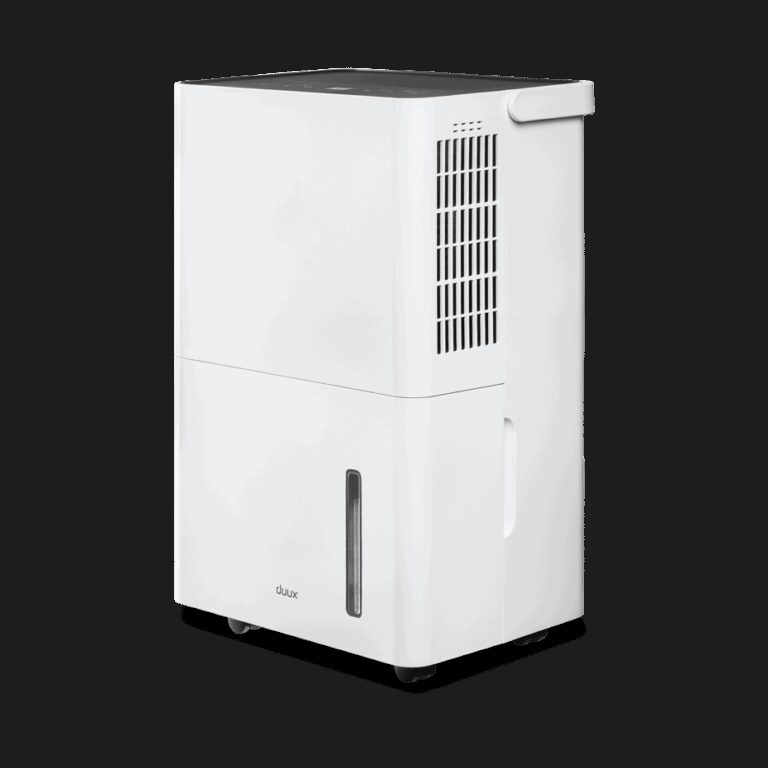
Specifications: capacity, tank, dimensions and weight
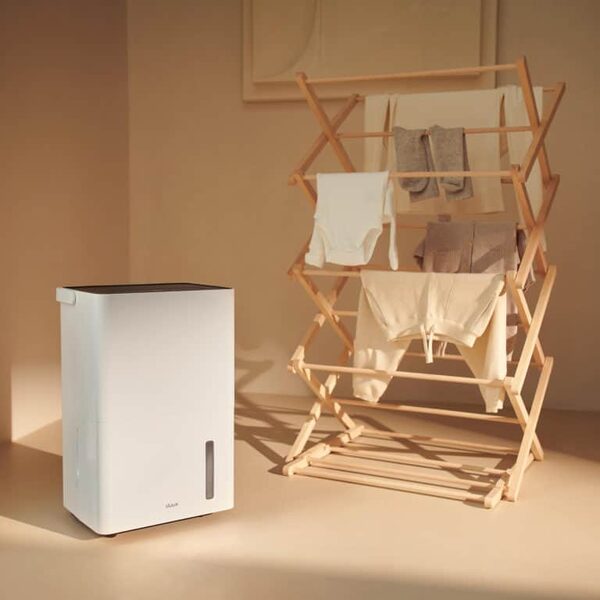
The Bora's physical figures are modest for its claimed output. It measures 32 x 23.5 x 51 cm and ships in packaging of 38.5 x 29.5 x 53.5 cm1. The maker does not publish a product weight for the Bora on the page reviewed, so no weight figure is given here.
| Specification | Bora Smart 30L |
|---|---|
| Dehumidification capacity | 30L a day1 |
| Effective space | 50 m²1 |
| Airflow | 230 m³1 |
| Water tank | 4L1 |
| Hygrostat range | 30 to 80% relative humidity1 |
| Power range | 20 to 400W1 |
| Standby power | 0.9W1 |
| Dimensions | 32 x 23.5 x 51 cm1 |
| Noise | 36 to 42 dB1 |
| Timer | 1 to 24 hours1 |
| Refrigerant | R2901 |
| Filter | Activated carbon1 |
The 0.9W standby draw is small but not zero1. Over a year of being left plugged in, that is a continuous trickle, and a smart plug is one way households manage standby loads across a home8.
The wider Duux range uses the same control conventions. The Edge convector heaters cover 15 m², 20 m² and 30 m² depending on model9, the Edge Oil covers 25 m² to 30 m²10, and the Zone heater covers 20 m²5. The Threesixty 2 heater is rated to 30 m²9. Timer ranges across the Edge family run 1 to 24 hours10.
Running costs: 8p an hour in laundry mode
The maker states a running cost of 8p per hour on the highest setting in laundry mode1. That is a maker's figure, and it depends entirely on the unit rate paid for electricity. It is not a tariff-independent number, and it should be read as indicative rather than as a bill.
Independent figures give the context. A 300W heated clothes airer costs 8p per hour at the July 2026 price cap unit rate11, which is the same figure the Bora's laundry mode claims. Dehumidifiers generally run at approximately 4p to 15p per hour depending on size and settings7. A 500W dehumidifier run for 24 hours would use 12kWh, which at 26p per unit comes to £3.1212.
Against drying alternatives, the comparison is stark. A tumble dryer costs 65p per hour of use, or 11p per ten minutes12, and a one-hour cycle runs between 46p and £1.2913. A standard ten-hour heated airer drying session costs between 51p and 77p13. A 2kW washing machine run for an hour uses 2kWh, costing 52p at 26p per kWh14.
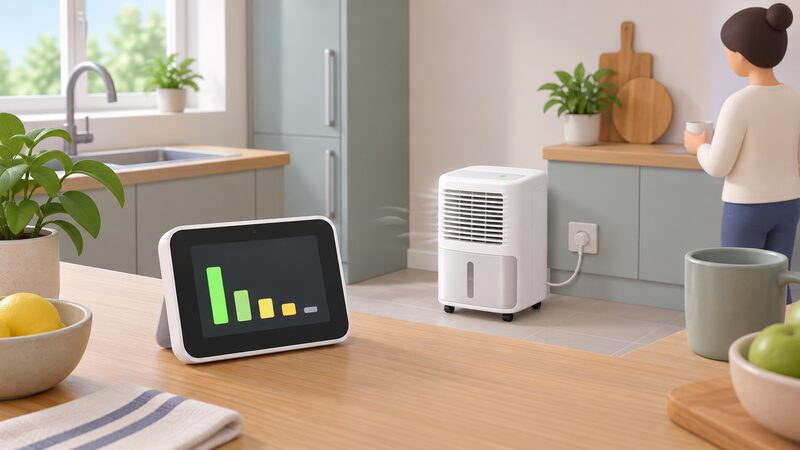
Laundry mode: a dedicated drying button
The 2024 Bora interface added a dedicated laundry drying mode button, running on a 4-hour timer1. The maker describes the mode as running on a 4-hour timer to quickly dry your laundry1. It is a preset rather than a separate appliance: the unit runs at high output for a fixed period and then stops.
That matters because drying laundry indoors is one of the largest sources of household moisture, and moisture is what drives condensation and mould. Independent guidance on condensation and damp treats ventilation and moisture reduction as the primary levers7. A dehumidifier with a drying preset addresses the moisture at source rather than moving it around the house.
The wider Duux heater range carries related modes. The Zone heater has three heat settings and a fan only mode, and is described as suitable for use in damp rooms5. The Edge 2000W fan heater is described as suitable for damp areas15. Those are heater functions, not drying functions, but they are aimed at the same problem: cold, damp rooms that are hard to ventilate.
For a household, the practical point is that laundry mode is a timed high-output cycle, not a continuous setting. Running it for the 4-hour window and then letting the unit return to a humidity target is the pattern the controls are built around.
Noise: 36 to 42 dB, Quiet Mark certified
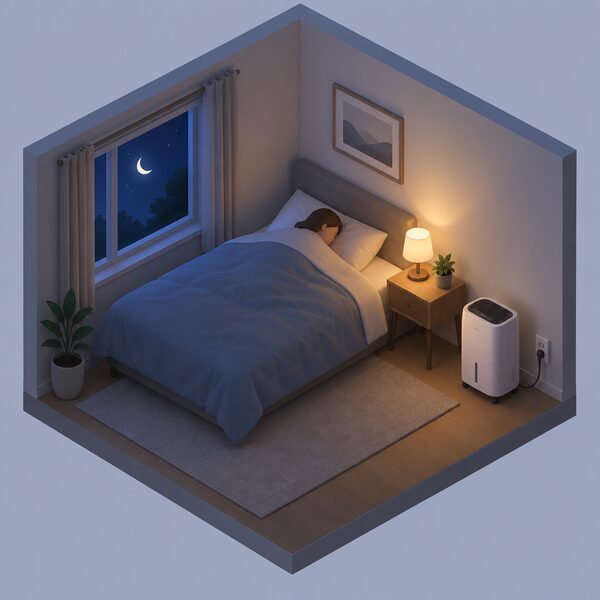
The Bora 30L is rated at 36 to 42 dB1. The maker's page also refers to a night mode figure of 36 dB, so the two figures describe the same appliance at different settings; the documents do not resolve which applies at which point in the cycle, and both are given here.
For comparison within the Duux range, the Threesixty Smart Fan Heater Grey Gen 2 is rated 38 to 46 dB3, the Zone heater 43 dB5, the Threesixty 2 heater 46 dB9, and the Edge Oil 40 dB in boost mode10. Several Duux products hold Quiet Mark certification, including the Threesixty heater4, the Zone heaters5, the Edge convector models15 and the Edge 2000W fan heater5.
Quiet Mark certification is an independent noise assessment, which makes it a stronger signal than a maker's own decibel claim. It is still a certification of the product as tested, not a guarantee of how it will sound in a particular room: hard floors, bare walls and small rooms all raise perceived noise.
A dehumidifier running overnight in a bedroom is the case where this matters most. At 36 dB the Bora sits at the quieter end of the range, comparable to a quiet fridge. At 42 dB it is closer to normal conversation. Neither is silent, and a household sensitive to night noise should treat the upper figure as the realistic one.
Smart control: app schedules and voice assistants
The Bora supports up to 7 schedules through the Duux app, which the maker describes as also giving insight into the progress of air quality1. The app runs on Android and iOS, and the platform is Tuya3. The same 7-schedule structure appears across the Edge convector range17 and the Threesixty fan heater3.
Voice control is not yet available on the Bora. The maker's page states voice control is coming soon, described as controlling the Bora with your voice via Alexa or Google Assistant1. That is a stated intention, not a shipped feature, and it should not be relied on at the point of purchase. The Threesixty fan heater does list control via the Duux app, Alexa and Google Assistant3, and the Edge 1000 convector lists the Duux app, compatible voice assistants and a remote control9.
Local control exists alongside the app. The Edge 2000 convector has a remote control, LED display, buttons, wheels and thermostat18. That matters for independence: schedules and remote operation depend on a home broadband connection, the manufacturer's servers and the app continuing to work, while the buttons on the unit do not.
Water handling: 4-litre tank or continuous drainage
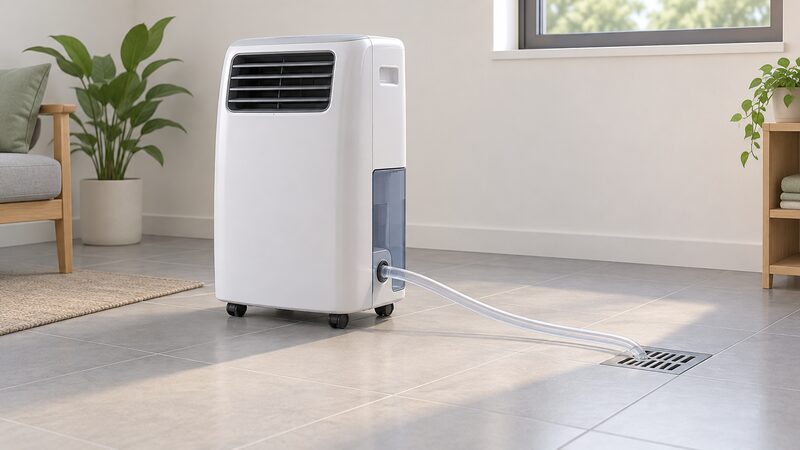
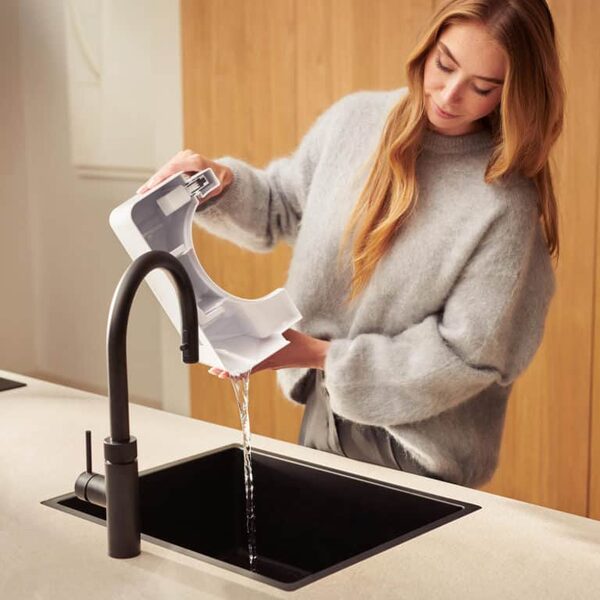
The Bora collects water in a 4-litre tank1. At a claimed 30 litres a day, that is a tank that fills quickly in a genuinely damp room, which is why continuous drainage exists as an alternative.
Independent safety guidance is to empty the water tank after each use and before moving the unit19. That is a safety rule as much as a practical one: water carried inside a unit that is then tipped or moved can reach electrical components. Where a unit runs for long periods, drainage to a drain removes the need to empty it at all.
The maker does not publish a drainage hose length for the Bora. For context on what that part of a system looks like, a comparable portable appliance lists a drainage hose length of 65 cm20. A gravity drain hose must run continuously downhill; any upward loop traps water and the tank fills anyway.
The Bora also has a self-cleaning mode, described by the maker as allowing it to be put away safe and dry1. That is a storage function rather than a cleaning one in the scrubbing sense, and it addresses the mould risk of putting a damp appliance into a cupboard.
Where the Bora 30L fits a lower-energy home
The Bora's power range of 20 to 400W and standby draw of 0.9W1 put it in the category of appliances that can be run from a modest solar or battery setup, unlike a portable air conditioner. For a household working towards energy independence, that is the relevant distinction: a dehumidifier is a low, steady load that can be shifted to daylight hours or to a cheap overnight tariff, while a cooling appliance is a high, intermittent one.
The comparison with cooling is worth stating plainly. A typical portable air conditioner at 1,000 to 1,500W costs around 26 to 39p per hour to run2. A large fan at 75W costs 1.9p per hour at a 25.7p per kWh electricity price2. The Bora sits between them at 8p per hour in laundry mode on the maker's figure1. None of these appliances produces cooling from a fuel other than electricity, so all of them keep a household on the grid or on a battery.
Where the Bora earns its place is in the shoulder seasons and winter, not in a heatwave. It addresses damp, which drives mould, which damages the building fabric. That is a different kind of resilience from summer cooling, and the two are covered separately in home cooling and in air conditioning and humidity.
For households comparing cooling options rather than drying ones, the relevant pages are portable air conditioners, electric fans for cooling and air conditioning running costs. Where a Duux heater is being considered for a cold room rather than a damp one, the Edge and Threesixty families cover 15 m² to 30 m² depending on model9.
Sources20 cited
- Bora Smart 30L Dehumidifier, Duux, 2026-09-23
- Summer energy tips, National Energy Action, 2026-08-13
- Threesixty Smart Fan Heater Grey, Duux, 2026-09-23
- Duux Threesixty Heater, Quiet Mark, 2026-09-17
- Duux DXCF43UK White Zone Heater, Quiet Mark, 2026-09-17
- Duux DXCF41UK Black Zone Heater, Quiet Mark, 2026-09-17
- Condensation, damp and mould, Plymouth Energy Community, 2026-09-20
- What are smart plugs and do energy saving plugs work, Smart Energy GB, 2026-08-19
- Duux Edge 1000 Smart Convector Heater Grey, Duux, 2026-09-23
- Duux Edge Oil Filled Radiator 2000W Grey, Duux, 2026-09-23
- Heated clothes airers energy efficiency, Uswitch, 2026-07
- How much electricity am I using?, Centre for Sustainable Energy, 2026-07
- What appliances use more electricity, Smart Energy GB, 2026-03-16
- How to estimate your energy use, Which?, 2026-08-03
- Duux Edge Convector 2000W DXCH15 White Fan Heater, Quiet Mark, 2026-09-17
- Duux Edge Convector 2000W DXCH14 Grey Fan Heater, Quiet Mark, 2026-09-17
- Duux Edge 2000 Smart Convector Heater White, Duux, 2026-09-23
- Duux Edge 2000 Smart Convector Heater Grey, Duux, 2026-09-23
- Dehumidifiers safety advice, Electrical Safety First, 2026-09-19
- Meaco Cirro+ 16000 BTU Portable Air Conditioner, Meaco, 2026-09-23