
In this guide
A Dyson fan is a fan. It moves air across your skin to create a cooling sensation, and it does not lower the temperature of a room1. That single distinction decides everything else about the product: what it can do in a heatwave, what it costs to run, and how far it can take a household towards independence from the grid.
The running cost is where the case is strongest. A small desk fan drawing 20W costs about 0.5p per hour, a pedestal fan drawing 50W about 1.3p per hour and a large fan drawing 75W about 1.9p per hour, based on an electricity price of 25.7p per kWh2. Bladeless fans are quoted at around 40 to 80W1. A typical portable air conditioner drawing 1,000 to 1,500W costs around 26 to 39p per hour, roughly 14 to 20 times more than a fan2. Fans are far cheaper to run than air conditioning, and air conditioning increases electricity use and can add significantly to summer energy bills3.
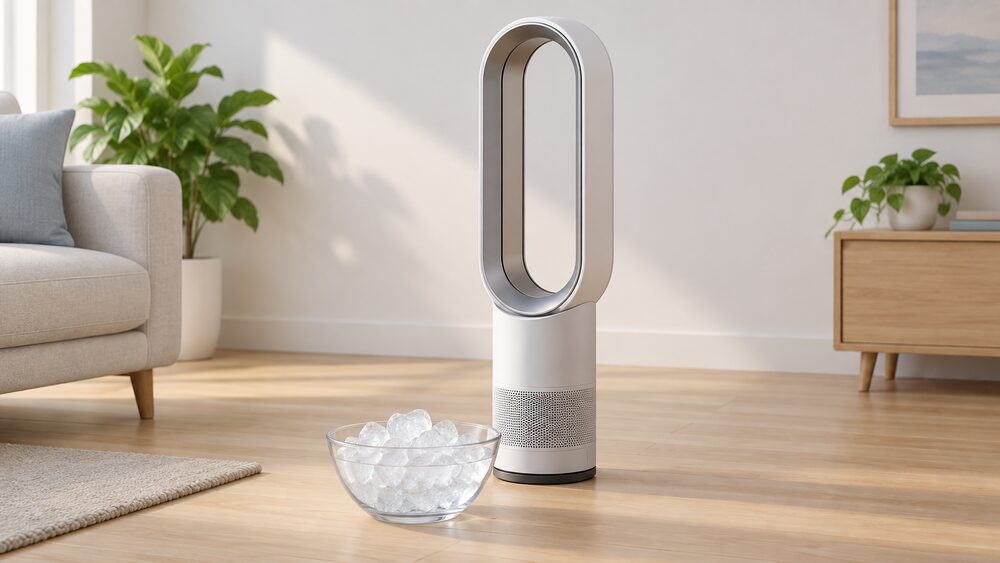
The limits are just as clear. A fan is only effective at cooling when it is blowing air directly onto you, and a bowl of ice or a damp cloth in front of it can boost the cooling effect4. Above a room temperature of about 35 degrees C, a fan will likely heat you up rather than cool you down1. A purifier-fan adds filtration to that air movement, which is a different job from cooling, and it does not change the underlying physics.
Dyson fans and purifier-fans: what the range covers
The Dyson range sold in the UK splits into two broad jobs. The first is air movement for personal cooling: floor-standing and desk fans, in bladeless form, with oscillation and variable speed settings. The second is the purifier-fan, which combines the same air movement with a filtration stage, and in some models a heating element as well. The purifier-fan is the version that carries a consumable, because the filter has to be replaced.
The wider UK market shows how the categories sit alongside each other. A portable air conditioner such as the De'Longhi Pinguino PAC EX93 Extreme is a 3-in-1 appliance covering fan, air conditioning and dehumidifying5. A fan heater such as the Devola DVSFH15BS is a 1500W portable ceramic unit with a fan function6. Air purifiers from other makers are sold on filtration coverage, with Daikin describing whisper-quiet filtration for spaces of up to 41m27. A Dyson purifier-fan sits between these: more than a plain fan, less than an air conditioner, and with a filtration claim that depends on the filter being clean and correctly fitted.
For a household, the practical question is which of those three jobs is actually needed. If the problem is a hot room, a fan of any kind addresses comfort rather than temperature. If the problem is stuffy or polluted indoor air, filtration and ventilation address it. If the problem is a room that genuinely needs its temperature brought down, none of the fan categories does that, and the alternatives are covered in air conditioning vs fans for cooling a home and in the wider guide to electric fans for cooling a home.
Bladeless design: how it works and what it does differently
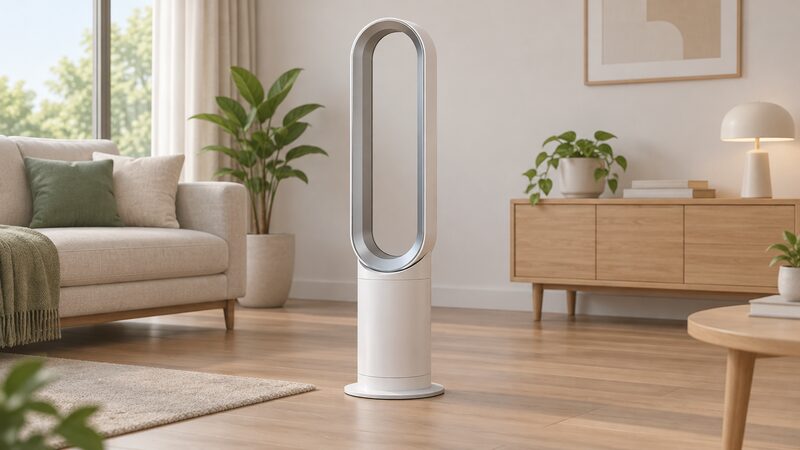
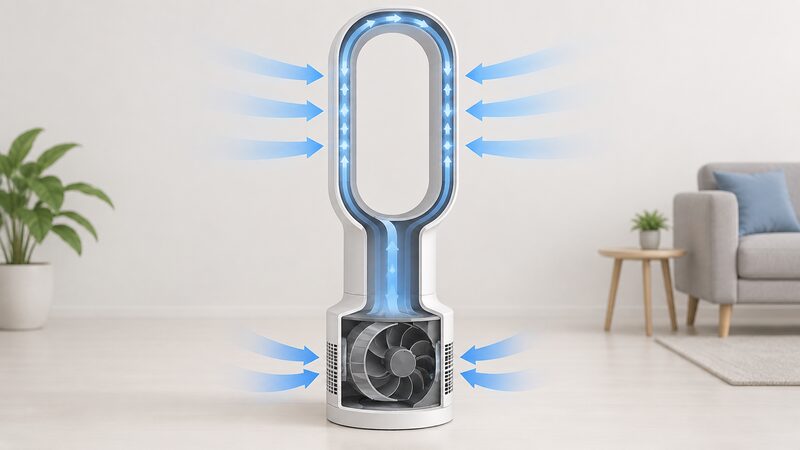
A bladeless fan draws air in through a small impeller in the base and pushes it out through a narrow slot running around the inside of the loop. The moving air drags surrounding air with it, so the visible loop produces a broader, smoother stream than the size of the base would suggest. The practical differences for a household are the absence of exposed fast-spinning blades, a narrower and more directed airflow pattern, and a form that is easier to wipe clean on the outside.
The trade-off is power. Bladeless fans are quoted at around 40 to 80W1, which sits at the upper end of the domestic fan range. For comparison, a small desk fan draws 20W, a pedestal fan 50W and a large fan 75W2. A bladeless fan is therefore not a low-energy outlier; it is a fan of roughly pedestal-to-large size in electrical terms, and its running cost follows from that. At 25.7p per kWh, a 50W fan costs about 1.3p per hour and a 75W fan about 1.9p per hour2.
Noise is the other design consideration. Fan noise scales with air speed and with the smoothness of the airflow path, which is why the loop and the internal ducting matter as much as the motor. Quiet operation is a selling point across the cooling market: the FlexBlade Multidirectional Bladeless Fan is listed as corded and quiet8, and fanless designs elsewhere in the market are marketed on silence, with one hybrid inverter described as having no internal or external fans and an almost complete silent operation9. A fan that is quiet enough to run overnight is more likely to be used, and use is what delivers the cooling sensation.
Cooling performance: what a Dyson fan can and cannot do
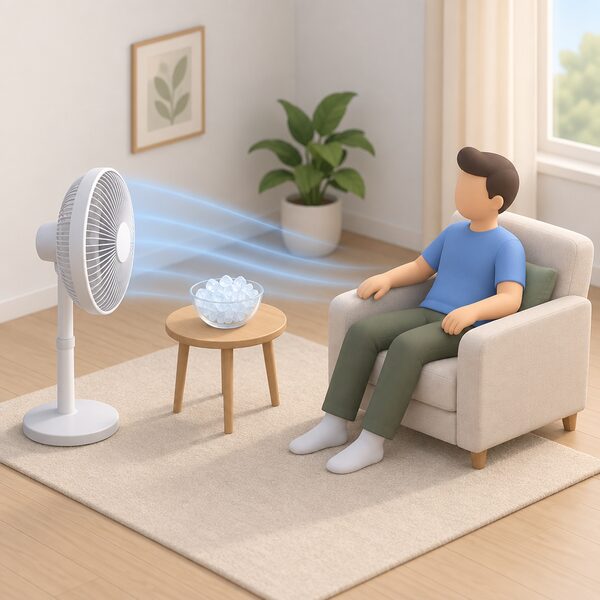
The honest answer is that a fan cools people, not rooms. Fans move air around to create a cooling sensation on your skin and do not lower the temperature of a room2. That is not a shortcoming of one brand; it is what a fan is. The mechanism is evaporative and convective heat loss from skin, which is why the effect disappears the moment the airflow stops or is directed elsewhere. Fans are only effective at cooling when blowing air directly onto you4.
There is an upper limit, and it matters in a heatwave. If the room temperature is above 35 degrees C, a fan will likely heat you up rather than cool you down1. The reason is that once air is hotter than skin, blowing it across the body adds heat rather than removing it. Below that threshold, a fan is a low-power way to make a room feel tolerable, and the addition of a bowl of ice or a damp cloth in front of it can boost the cooling effect4.
Where a fan genuinely falls short is in bringing down the temperature of a room, and that is the point at which households start looking at air conditioning. A portable unit is a different order of both capability and cost: a typical portable air conditioner drawing 1,000 to 1,500W costs around 26 to 39p per hour, roughly 14 to 20 times more than a fan2. Air conditioning also increases electricity use and can add significantly to summer energy bills3. The comparison is set out in more detail in air conditioning vs fans for cooling a home and in portable air conditioners: how they work and their limits.
Purifier-fans: filtration and air quality alongside cooling
A purifier-fan does two jobs with one appliance: it moves air for the cooling sensation, and it passes that air through a filter. The filtration side is a genuine function, but it is a different benefit from cooling, and it is worth being clear about which problem is being solved. Ventilation exists to ensure good indoor air quality and to extract indoor pollutants, removing particulates (PM10, PM2.5, PM1), CO2 and VOCs10. A purifier-fan recirculates and filters air within a room; it does not replace ventilation, which is about exchanging indoor air for outdoor air.
The maintenance point is the one that decides whether filtration keeps working. Clean air filters ensure better airflow, improved indoor air quality and lower energy bills11. A clogged filter does the opposite on all three counts: it restricts airflow, so the fan has to work against resistance, and the filtration performance falls away. That is why filter condition, not the badge on the appliance, is what determines whether a purifier-fan is doing anything useful after a year of service.
Coverage claims should be read as room-size guidance rather than a guarantee. Air purifiers from other makers are sold on filtration coverage, with Daikin describing whisper-quiet filtration for spaces of up to 41m27. A purifier-fan placed in a room larger than its rated coverage will dilute its effect, and one placed against a wall or behind furniture will short-circuit its own airflow. Position matters as much as specification.
For a household, the purifier-fan is best understood as a comfort and air-quality appliance rather than a cooling appliance. It sits alongside ventilation measures such as extractor fans, which are recommended for shower rooms, bathrooms and kitchens, with an extractor above the hob, trickle vents in double glazed windows and tumble dryers venting to the outside8. Filtration and ventilation are complements, not substitutes.
Smart controls, app and sensors
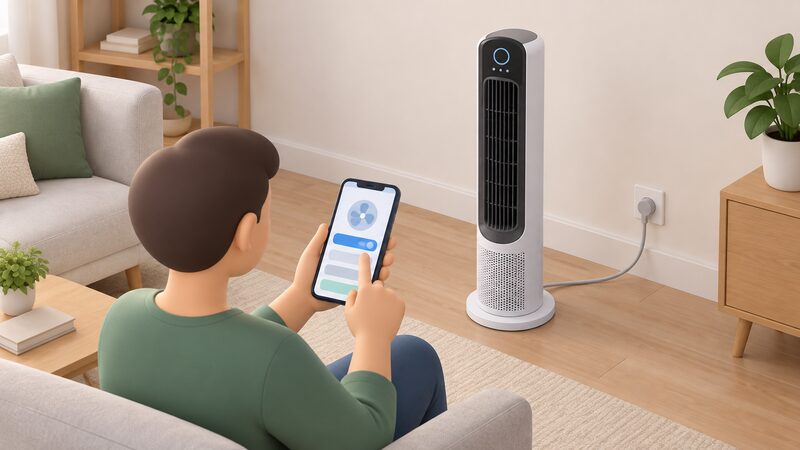
The smart layer on a purifier-fan is where the appliance stops being self-contained. Smart heating controls allow you to access your temperature settings using a mobile app12, and the same pattern applies to app-connected cooling appliances: the physical controls work locally, and the app adds remote scheduling, monitoring and diagnostics. A Dyson Purifier Hot+Cool HP1 Purifying Fan Heater is listed with 10 power settings, smart compatibility through the MyDyson app, a cold air setting, oscillation, an air purification function, a 180cm cable, a digital display, a 24 hour programmable timer and a remote control13.
The dependence this creates is worth stating plainly. Local control at the appliance continues without an internet connection. Remote control, scheduling from away, energy monitoring and remote diagnostics depend on a home broadband connection, the manufacturer's servers and the manufacturer's app. If any link in that chain changes, the remote functions change with it, even though the fan still blows air. A household that wants cooling to keep working through a broadband outage should treat the app as an extra rather than the primary control.
There is a second, subtler dependence in app-only settings. Some connected heaters restrict their temperature range to app control, with one model offering an adjustable temperature of 22 to 30 degrees C that is only controllable with the app14. Where a setting exists only in software, the appliance's capability is tied to the software continuing to be supported.
Sensors are the part of the smart layer that earns its place. A purifier-fan that reads particulate levels can adjust its own fan speed in response, which is useful in a room where air quality varies. The same sensors feed the app's reporting, which is where the household sees what the appliance is responding to. The value depends on the sensors being accurate and the readings being visible, not on the appliance being connected for its own sake.
Cost: purchase price and running costs compared with ordinary fans
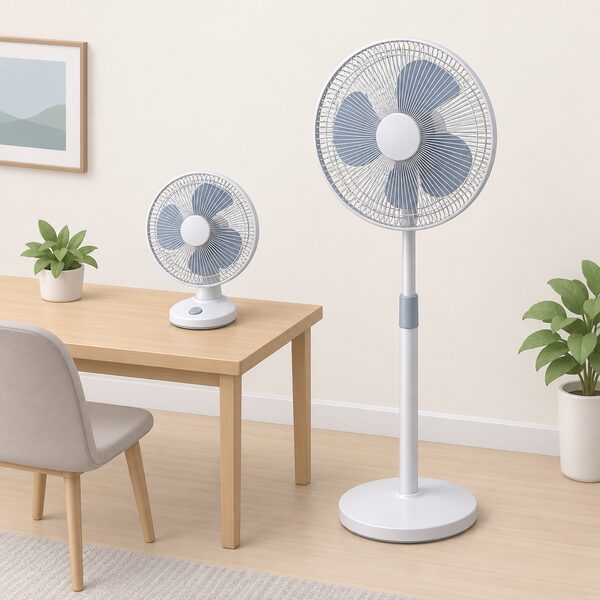
Dyson does not publish a running cost for its fans, so the honest comparison is with the fan figures that are published. A small desk fan drawing 20W costs about 0.5p per hour, a pedestal fan drawing 50W about 1.3p per hour and a large fan drawing 75W about 1.9p per hour, based on an electricity price of 25.7p per kWh2. Bladeless fans are quoted at around 40 to 80W1, which places them in the same band as a pedestal or large fan. The average fan costs around 3p per hour to run3.
| Appliance | Power draw | Running cost per hour |
|---|---|---|
| Small desk fan | 20W | 0.5p2 |
| Pedestal fan | 50W | 1.3p2 |
| Large fan | 75W | 1.9p2 |
| Bladeless fan | around 40 to 80W | not published1 |
| Portable air conditioner | 1,000 to 1,500W | around 26 to 39p2 |
The scale of the difference is what matters for a household budget. A fan run for eight hours a day costs pence; a portable air conditioner run for the same period costs pounds. Air conditioning increases electricity use and can add significantly to summer energy bills3, while fans are far cheaper to run4. For context on how cooling sits against other household loads, a condenser tumble dryer adds an average of over £125 per year to run15, and a freestanding fridge freezer averages £79 per year on constant use16. A fan is a small line item by comparison.
Purchase price is a separate question, and Dyson does not publish a list price for its fans in the material available here. Prices are retail and vary by model and by retailer, so the figure a household works from is the price at the point of sale rather than a manufacturer's list. The running cost, by contrast, is predictable from the power draw, and it is the figure that accumulates over a summer.
Where a Dyson fan fits a household energy-independence plan
A fan is one of the few cooling appliances that asks almost nothing of the wider energy system. It draws tens of watts, it needs no refrigerant, no outdoor unit, no installer and no planning consent, and it can be run from a plug socket, a battery or a small solar setup. In a household plan built around reducing dependence on the grid and on suppliers, a fan is the lowest-stakes cooling option available, and its running cost of a penny or two an hour is the reason.
The dependence that remains is the grid itself, and the tariff behind it. A fan still needs electricity, and the price per kWh set by the supplier determines what it costs to run. Smart meters and time-of-use tariffs change when that electricity is cheapest, and running appliances at cheaper times is a recognised way to shift load17. For a fan, the saving is small in absolute terms because the load is small, but the principle applies: a fan run during a cheap period costs less than one run during a peak period.
The purifier-fan adds a second dependence, on consumables. A filter is a recurring purchase from the manufacturer or its retail channel, and the appliance's air-quality function degrades without it. That is a supply-chain tie rather than an energy one, but it is a tie nonetheless, and it is the reason a purifier-fan is less self-contained than a plain fan.
The third dependence is the app, as set out above. Remote control, monitoring and diagnostics run through the manufacturer's servers and a broadband connection. A household that wants its cooling to work independently of those systems should treat the physical controls as the primary interface and the app as an addition.
For households weighing cooling options more broadly, the trade-offs between fans, evaporative coolers and air conditioning are set out in home cooling and air conditioning: the full UK guide and in home cooling and energy independence. The short version is that a fan buys comfort at a very low energy cost, and it does not buy a cooler room.
Care, cleaning and filter replacement
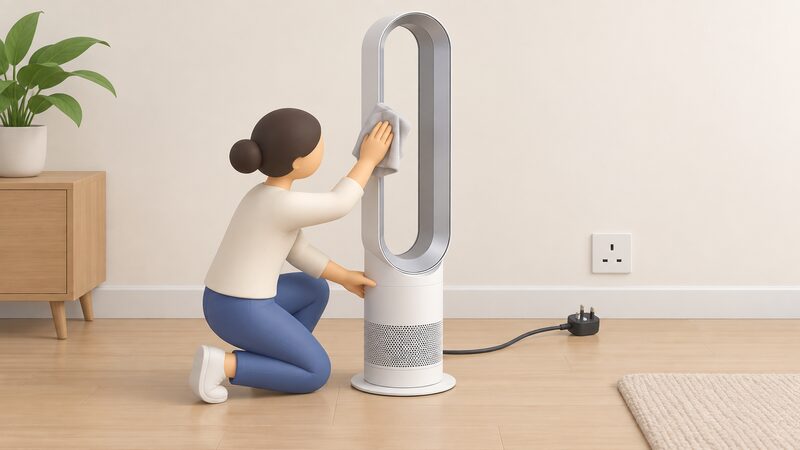
Fan maintenance is mostly about airflow. Dust build-up on vents and around the motor is the common cause of reduced performance, and the safety advice is to clear dust build-up from vents or the motor, unplugging the fan and following the manufacturer's instructions before opening the guard or cleaning9. For a bladeless fan the accessible surfaces are the loop, the base intake and the outer casing; the internal impeller is not a user-serviceable part on most models.
Filter replacement is the purifier-fan's recurring task. The interval depends on use and on local air quality, and no single figure applies across the range. The principle is that dirty or clogged air filters should be checked and replaced, because clean filters ensure better airflow, improved indoor air quality and lower energy bills11. Where a filter has visibly darkened or airflow has noticeably dropped, that is the signal to replace it rather than a calendar date.
Cleaning routines elsewhere in the home give a sense of sensible frequency. Condenser coils are commonly cleaned about twice a year18, and heat pump servicing covers cleaning coils, cleaning fan blades, inspecting filters, checking refrigerant level and pressure, and checking that all electrical connections are safe19. A fan has fewer of those tasks because it has no refrigerant circuit, but the airflow and electrical-check elements carry over.
Registration, serial numbers and fault codes
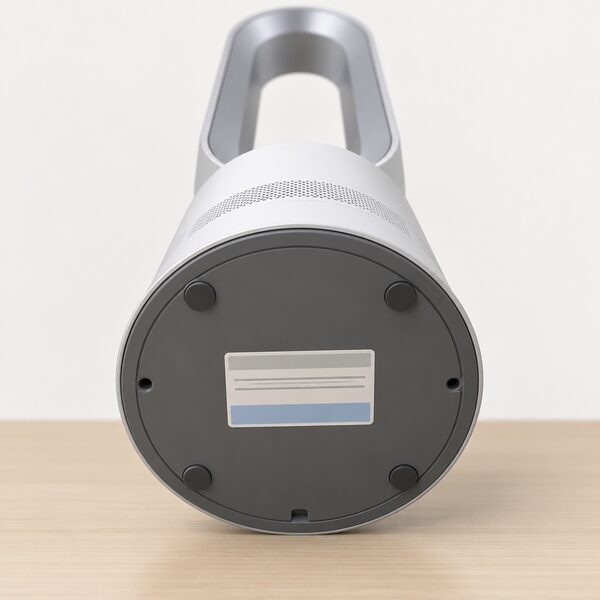
Registering an appliance with the manufacturer matters beyond the warranty term: it means you can be notified if a problem is identified with it17. Appliance warranties are usually registered on the manufacturer's website or by calling the manufacturer20. For a Dyson fan, registration runs through the manufacturer's own UK site or its customer service line, and the serial number is the key piece of information required.
Serial and batch information is normally printed on the product label on the base of the appliance and on the packaging next to the barcode. Recall notices show the pattern clearly: for one recalled radiator fan, the affected batches were 967, 968 and 970, located on the packaging next to the bar code and on the label on the base of the product21. A household checking whether its own unit falls inside a recall reads the label on the base, not the receipt.
Fault codes are specific to each manufacturer and model, and the meaning of a code is published by the maker for its own products. Codes seen on other appliances illustrate the pattern: a fan unit blocked code can point to damage or blockage to a fan blade, a faulty fan motor, a fault in the electrical connection to the fan motor, an HMU fault or an installer board fault22. An air inlet temperature sensor fault points to a fault in the electrical connection for that sensor22. The lesson is that a code is a starting point for diagnosis, not a diagnosis in itself.
Sources22 cited
- Is air conditioning worth it in the UK?, Uswitch, 2026-08-13
- How to keep your home cool in hot weather, Centre for Sustainable Energy, 2026-07
- Summer energy tips, National Energy Action, 2026-08-13
- Make your home more comfortable in warmer weather, Plymouth Energy Community, 2026-09-20
- De'Longhi Pinguino PAC EX93 Extreme Portable Air Conditioner, Quiet Mark, 2026-09-17
- Devola DVSFH15BS Black & Silver 1500W Portable Ceramic Fan Heater, Quiet Mark, 2026-09-17
- Daikin air purifiers, Quiet Mark, 2026-09-17
- Damp and mould booklet, Rent Smart Wales, 2025
- TikTok fan cooling hack warning that could risk electric shock, Electrical Safety First, 2026-09-19
- Insulate and ventilate, BESA, 2024-06-21
- Spring into home care, APHC, 2025-05-07
- Guide to smart meters, Energy Saving Trust, 2026-07-15
- Best electric heaters from our tests, Which?, 2026-08-26
- Duux Threesixty heater, Quiet Mark, 2026-09-17
- Five top tips from Which? to cut your energy bills, Climate Action Wales, 2026-03-18
- How much your appliances cost to run, Which?, 2026-10-01
- Demand flexibility: running appliances at cheaper times, Electrical Safety First, 2026-09-19
- Tips to help lower the cost of running your fridge freezer, Which?, 2026-05-05
- Is now a good time to get a heat pump, Energy Saving Trust, 2025-12-12
- Common mistakes that can invalidate your boiler warranty, Which?, 2025-10-22
- Valiant Radiator Fan product recall, Electrical Safety First, 2025-11-07
- Heat pump fault codes, Vaillant, 2026