
In this guide
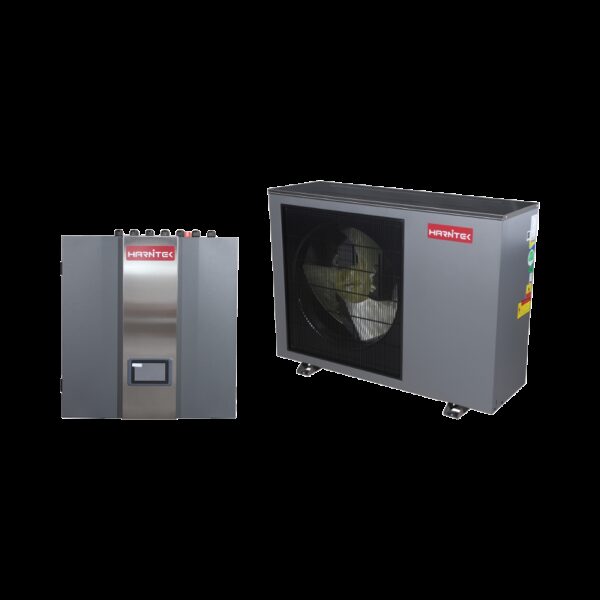
Harnitek is a heat pump brand sold into the UK market, offering R290 monobloc and high-temperature units for domestic properties. The company's own product literature is not among the material available here, so this page sets out what can be established about the range, the technology it uses and the conditions a household would meet in buying one, and it is explicit where the record is thin.
The technology is well understood even where the brand detail is not. R290 is propane, a refrigerant with a low global warming potential, and monobloc means the refrigerant circuit is sealed in the outdoor unit, with only water pipework entering the house. High-temperature units are designed to reach flow temperatures that suit existing radiators, which is the main reason a household considers one rather than a standard air source unit.
What follows covers the range, where the brand sits in a UK market of at least 33 air source manufacturers, the specification and cost evidence, installation requirements, servicing, and warranty and registration. Where a figure is not available for Harnitek specifically, the page gives the UK-wide figure and says so.
What Harnitek makes: the range at a glance
The range is described as R290 monobloc and high-temperature units sold to UK homes. Those two descriptors carry most of the technical meaning. A monobloc keeps the whole refrigerant circuit factory-sealed inside the outdoor casing, so the installer connects water pipework rather than refrigerant lines, and no F-gas handling is needed on site. R290, or propane, is the refrigerant used, and it is the reason high flow temperatures are achievable in a single-stage domestic unit.
High-temperature operation matters because it changes what a retrofit involves. A unit that can run at higher flow temperatures can often serve existing radiators without a full emitter replacement, which is the difference between a straightforward swap and a partial replumb. The trade-off is that efficiency falls as flow temperature rises, so a high-temperature unit running hot all winter will use more electricity than the same unit running at a lower temperature with larger emitters.
The wider market context is worth stating plainly. There are at least 33 manufacturers supplying air source heat pumps in the UK, and four of them, Mitsubishi Electric, Vaillant, Daikin and Samsung, account for nearly two-thirds of total annual UK sales1. Harnitek is not among that group on the evidence available, so a household considering the brand is buying outside the volume end of the market. That is not a judgement on the equipment; it is a statement about parts availability, installer familiarity and resale recognition, all of which follow volume.
Hydronic air source heat pumps, meaning those that heat water and distribute it through radiators or underfloor heating, are the most commonly installed type in the UK7. A monobloc R290 unit sits in that category. For the wider picture of how the categories divide, see air source heat pumps and monobloc and split heat pumps.
Who Harnitek is and where the products sit in the UK market
The UK heat pump market is broad and shallow at the brand level. Of the heat pumps sold in the UK, around one third are manufactured here and two thirds are imported6. That split shapes what a household can expect from any smaller brand: the unit may be assembled or badged for the UK while the core components come through an international supply chain, and the practical support network is the installer rather than a national service fleet.
The Heat Pump Association, the trade body whose members include manufacturers providing around 90% of the volume of heat pumps currently sold in the UK market, publishes supply chain readiness work covering the sector8. Membership of that body, and certification of products under the Microgeneration Certification Scheme, are the two markers that matter most when assessing whether a brand can be supported over a fifteen-year life. MCS product certification exists precisely so that a product can be listed and its performance verified independently9.
For a household, the independence question is concrete. A heat pump of any brand reduces dependence on gas supply and on a gas supplier, and shifts the household onto electricity. It does not remove dependence on the grid, and it does not remove dependence on a manufacturer for parts, firmware and, where the unit is app-controlled, for a working cloud service. A smaller brand concentrates that manufacturer dependence: the installer who fitted the unit is the route to spares, and if that installer stops trading, the household is dealing with a distributor or an importer.
Where a brand is not among the volume sellers, the sensible checks are whether the model appears on the certification listing, whether the installer has fitted that model before, and what the spares position is for the compressor, the fan motor and the control board. Those are the parts that determine whether a repair is economic at year twelve. Broader context on how brands compare is at heat pumps.
Specifications: capacity, efficiency and noise figures
No capacity, efficiency or noise figures for Harnitek units are available in the material here, so none can be quoted. What can be stated is the framework those figures sit in, and the standards a UK installation is measured against.
The Heat Pump Performance Estimate Standard, MCS 031, sets out how performance is to be estimated for a proposed installation10. It exists because a headline efficiency figure for a unit is not the same as the performance a household will see: the estimate has to account for the property, the emitters and the design flow temperature. A manufacturer's declared efficiency is measured under standard conditions, and the installed result depends on how the system is designed and commissioned.
High-temperature and hybrid heat pumps have been the subject of official evidence gathering, covering the categories of equipment that can serve a property without a full fabric upgrade11. That work is the reference point for what a high-temperature unit is expected to achieve and where its limits lie. For the underlying concepts, heat pump efficiency: COP, SCOP and SPF explains the difference between a laboratory coefficient and a seasonal figure, and high-temperature heat pumps covers the category in detail.
Noise is a planning matter as much as a comfort one. Quiet Mark certification is awarded to specific heat pump models that meet its criteria, and the listings name the exact model certified12. A household should not assume that a brand's range carries certification as a whole; it is granted model by model. The relevant UK rules on siting and separation are covered at MCS 020: the heat pump noise assessment and how noisy is a heat pump.
| Item | Position for Harnitek | UK-wide reference |
|---|---|---|
| Refrigerant | R290 (propane), stated for the range | Low GWP refrigerant, covered at heat pump refrigerants |
| Format | Monobloc, sealed refrigerant circuit | Most commonly installed UK type is hydronic air source7 |
| Capacity | Not stated in available material | Sized by room by room heat loss13 |
| Efficiency | Not stated in available material | Estimated under MCS 03110 |
| Noise | Not stated in available material | Model-specific Quiet Mark listings exist12 |
Cost: purchase price and installation budget
There is no published Harnitek price in the material available here, so no figure for the brand can be given. Prices for heat pumps generally are installer-quoted, and the UK-wide evidence gives the range a household should expect to be quoted within.
Air source heat pump installation is put at £7,000 to £13,000 depending on the size of the property2. A separate case-study figure puts buying and installing a heat pump at about £10,500, with a range from £8,000 to £15,00014. Official evidence gathering reported a wider range in the cost of installing a heat pump of between £8,000 and £15,000 depending on the work that needed to be done to the home15. Total costs have been estimated to range from £6,800 to £17,700, with an average cost of £13,0003.
Those figures vary because they measure different things. Some include the unit, materials and labour for installation and may include associated necessary upgrades to the heating system, such as hot water tanks, new radiators and pipework, including VAT, while excluding simultaneous insulation works16. Others are narrower. Median costs by property archetype illustrate the spread: approximately £9,700 for flats, £12,000 for semi-detached and terraced houses, and £14,000 for detached houses16.
Hard-to-treat and hard-to-heat properties sit at the top of the range. Once energy efficiency improvements are considered, homeowners could be expected to pay between £15,000 and £30,000 for the installation of a heat pump17. Ground and water source installations are a different order again, with an average installation cost close to £25,00018. A high-temperature monobloc is intended to avoid some of that retrofit cost by working with existing emitters, which is the commercial case for the category.
Installation: what a Harnitek system needs in your home
Every heat pump installation starts with an assessment. The installer will calculate the home's heat demand and other information to inform their recommendations13. That calculation, room by room, sets the capacity of the unit and determines whether existing radiators can deliver the required heat at the design flow temperature. It is the single most important document in the process, because everything downstream follows from it.
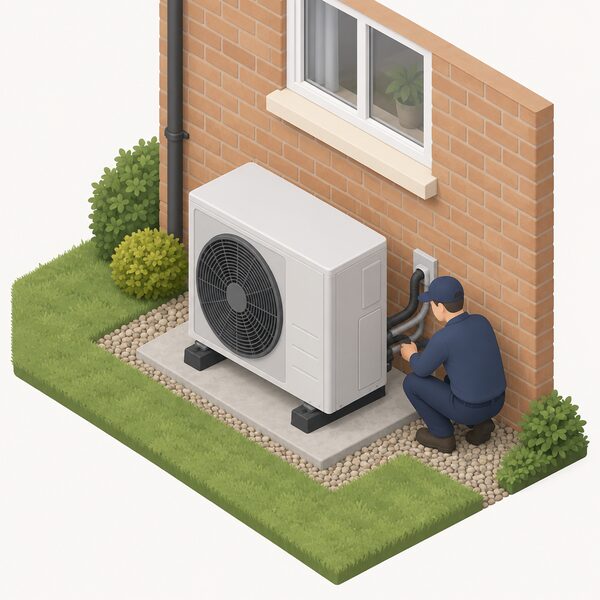
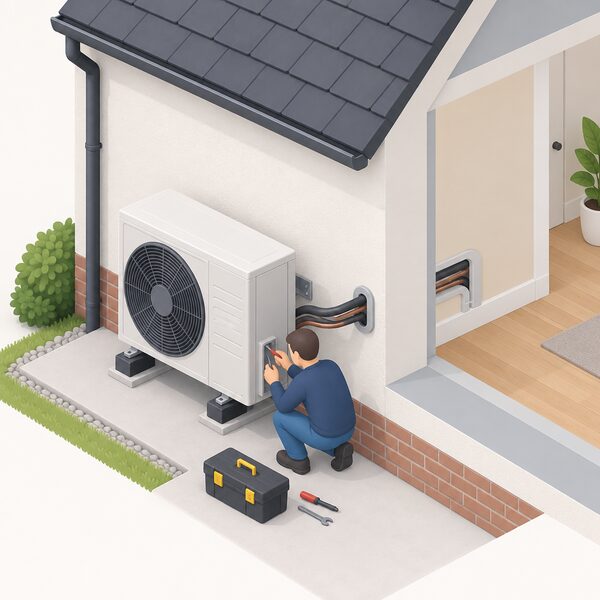
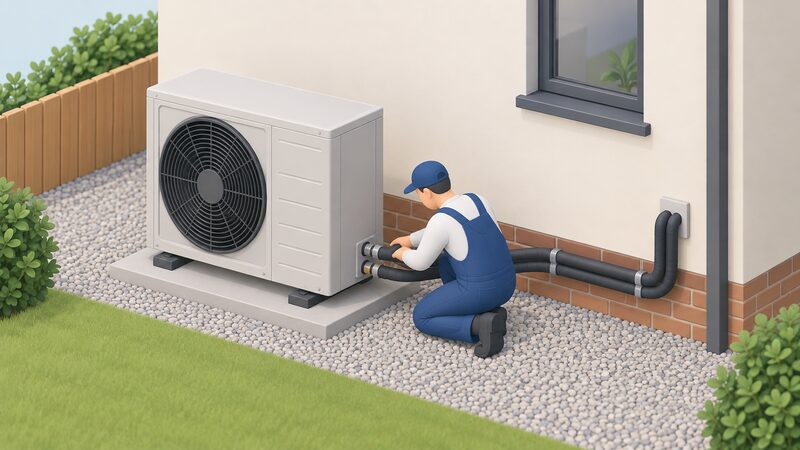
For a monobloc unit, the physical requirements are an outdoor position with adequate clearances, a route for insulated flow and return pipework into the property, and an electricity supply to the outdoor unit. Because the refrigerant circuit is sealed at the factory, no refrigerant work is needed on site, which simplifies the commissioning compared with a split system. A high-temperature unit may allow existing radiators to remain, but the heat loss calculation still decides whether that is the case in a given property.
Heat pumps can work with radiators or underfloor heating, and some types can work without either19. That flexibility is real but conditional: the emitters must be able to release the heat the property loses at the coldest design condition. Where they cannot, the options are larger radiators, additional emitters, or a higher flow temperature, and the last of those trades efficiency for convenience.
The process from survey to handover, including the electrical and siting questions, is set out at heat pump installation, with emitter detail at radiators, underfloor heating and emitters for a heat pump and sizing at heat pump sizing and heat loss calculations. Where a cylinder is needed for hot water, hot water cylinders for heat pumps covers the options.
Running a Harnitek heat pump: maintenance and servicing
An annual service is the standard recommendation for heat pumps, in the same way a fossil fuel boiler or other heating system is serviced each year4. The Energy Saving Trust recommends an annual service for heat pumps20. An annual heat pump service will help it remain clean and ensure it runs efficiently and sounds as quiet as possible21.
The tasks in a service are specific: cleaning coils, cleaning fan blades, inspecting filters, checking refrigerant level and pressure, and checking that all electrical connections are safe20. On a monobloc, the refrigerant check is a visual and pressure check rather than a top-up, because the circuit is sealed. The coil cleaning matters more than it sounds: a fouled outdoor coil raises the temperature the unit must work against, which shows up directly in running cost.
In terms of household effort, heat pumps are about as much work to maintain as a gas boiler20. That is a useful calibration. The owner's role is limited to keeping the outdoor unit clear of leaves and debris, checking that the condensate drain runs freely in winter, and leaving the controls alone rather than adjusting flow temperatures by hand.
Efficiency in service depends heavily on how the system is set up. Guidance on ensuring a heat pump runs efficiently covers flow temperature, weather compensation and the importance of not treating the controls like a boiler thermostat20. A common fault is a heating blocked message, which might mean the heat pump is running at temperatures that are too high20. Where a fault recurs, the recommended action is to check the fault log for recurring fault messages and speak to the installer and manufacturer20.
Servicing and warranty interact, and the detail is at does servicing a heat pump affect the warranty. General maintenance guidance is at heat pump servicing and maintenance, and fault diagnosis at heat pump faults and troubleshooting.
Warranty and registration
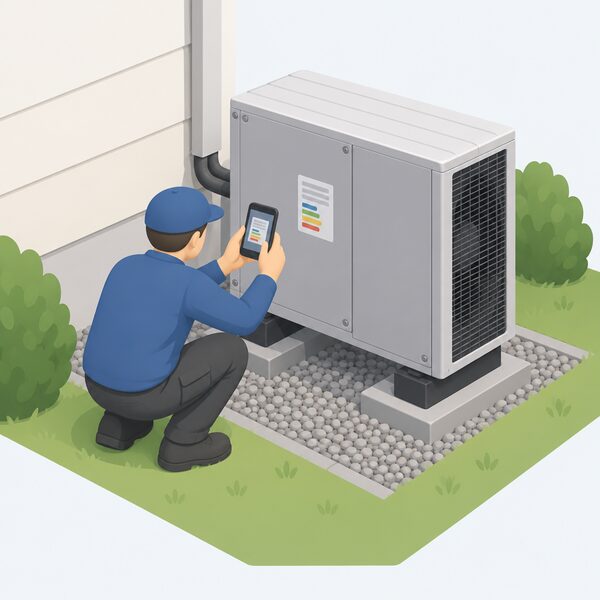
No Harnitek warranty term is stated in the material available here, so no length, condition or exclusion can be given for the brand. What can be set out is how heat pump warranties and registration work in the UK, which is the framework any Harnitek owner will be operating within.
Registration is normally completed by the installer at commissioning. It is important to ask the installer to check if the new heat pump is registered on the Energy Network Association's heat pump database2. That database is the record used for network and connection purposes, and it is separate from the manufacturer's own warranty registration. A household should hold the commissioning sheet, the benchmark logbook and the serial number together, because a claim will start with those.
The serial number location is not stated for Harnitek units. On comparable equipment the number is found on the back of the outdoor heat pump unit or on the back of the control box of the indoor unit23. Photographing the rating plate at installation is worthwhile, since the plate on an outdoor unit becomes harder to read after several winters.
Warranty terms in the UK heat pump market are commonly conditional on annual servicing by a competent person and on registration within a set period after commissioning. The conditions that void a warranty are covered at does servicing a heat pump affect the warranty. Where a brand is not among the volume sellers, the practical warranty question is not the headline term but who performs the work: whether there is a trained service network in the household's region, and how long a replacement part takes to arrive.
Grants: the Boiler Upgrade Scheme and Harnitek eligibility
Eligibility under the Boiler Upgrade Scheme is set by technology and by scheme rules, not by brand. Eligible technologies include air-to-water heat pumps, air-to-air heat pumps, ground source heat pumps including water source heat pumps and shared ground loops, and biomass boilers5. Ground source heat pumps are named separately in the installer-facing scheme rules24.
The rules that decide whether a specific installation qualifies are about the system, not the badge. Eligible heat pumps or biomass boilers must provide both space and hot water heating to the property25. The heat pump or biomass boiler must be capable of meeting the full space heating and hot water heating demands of the property26. A unit that heats radiators but leaves hot water to an immersion heater does not meet that test on its own.
There are also rules about what may be installed alongside. Heat pumps may be eligible for BUS funding on self-build properties, where all other scheme rules are met25. A consultation has proposed amending scheme eligibility criteria to allow more installations of heat pumps in combination with other electric heating appliances27. Consumer protection for home upgrade schemes has been the subject of separate consultation, covering how installations are sold and guaranteed28.
For a household, the practical sequence is to confirm the technology is eligible, confirm the system will meet both space and hot water demand, and confirm the installer is accredited under the scheme. The grant position across the four nations differs, and the detail is at heat pump grants and funding across the UK and how much does a heat pump cost with a Boiler Upgrade Scheme grant.
What a Harnitek heat pump means for household independence

A heat pump changes what a household depends on. It removes the gas boiler and the gas supply to it, and it moves space heating and hot water onto electricity. That is a real shift in sovereignty: the household is no longer exposed to gas standing charges, gas price movements or the gas network's future. What replaces it is dependence on the electricity grid and on an electricity supplier, which is a different dependence rather than no dependence.
The remaining dependencies are worth naming precisely. The grid supplies the power, and a heat pump draws more electricity than a gas boiler draws gas in cost terms at current prices. A supplier sets the tariff, and time-of-use tariffs can change the economics, as covered at heat pump running costs. The manufacturer supplies parts, firmware and, where the unit is app-controlled, a cloud service that can be withdrawn. The installer supplies the labour and holds the commissioning record.
For a brand outside the volume sellers, the manufacturer and installer dependencies are more concentrated. The mitigations are the same as for any brand: certification listing, a heat loss calculation, a commissioning record, annual servicing, and a spares conversation before purchase rather than after a failure. The wider picture of how heating choice interacts with energy sovereignty is at heat pumps and household energy independence.
Sources28 cited
- EINAS 2025: Heat and Buildings, Department for Energy Security and Net Zero, 2025
- Heat Pump Cost, Time and What's Involved, UK Power Networks, 2026
- Different Boiler Types, Uswitch, 2026
- Is Now a Good Time to Get a Heat Pump?, Energy Saving Trust, 2025
- Boiler Upgrade Scheme Guidance for Installers v5.1, Ofgem, 2026
- Raising Minimum Standards for Heat Pumps: Options Assessment, Department for Energy Security and Net Zero, 2024
- Would a heat pump work for your home?, Which?, 2024
- Heat Pump Supply Chain Readiness to Deliver Net Zero Homes, Heat Pump Association, 2026
- Certifying Your Product, MCS Certified
- An Installer Guide to the Updated Heat Pump Performance Estimate Standard and Tool (MCS 031), MCS Certified, 2025
- Evidence Gathering: High Temperature Heat Pumps, Hybrid Heat Pumps and Gas Driven Heat Pumps, Department for Business, Energy and Industrial Strategy, 2016
- NIBE S1256-13 Heat Pump, Quiet Mark, 2026
- Heat Pump Installation: A Step by Step Guide, Energy Saving Trust, 2026
- Heat Pumps as an Employee Benefit, Nesta, 2026
- Public Accounts Committee: Heat Pump Costs, House of Commons Public Accounts Committee, 2024
- How to Make Heat Pumps More Affordable: Assumptions and Methods, Nesta, 2024
- Biomass Strategy, Liquid Gas UK, 2026
- Ground and Water Source Heat Pumps, MCS Certified, 2026
- Heating Your Home, Energy Saving Trust, 2026
- How to Ensure a Heat Pump Runs Efficiently, Energy Saving Trust, 2026
- Heat Pumps Explained: Experts Answer Your Questions, GOV.UK, 2024
- Carbon Footprint Report: Heat Pump Transition, Department for Energy Security and Net Zero, 2026
- myVaillant Web, Vaillant, 2026
- Boiler Upgrade Scheme: Installers, Ofgem, 2026
- Boiler Upgrade Scheme Guidance for Property Owners v5.1, Ofgem, 2026
- Boiler Upgrade Scheme Installer Guidance, Ofgem, 2022
- Boiler Upgrade Scheme and Certification Requirements for Clean Heat Schemes, Department for Energy Security and Net Zero, 2025
- Reforming Consumer Protection for Home Upgrade Schemes, Department for Energy Security and Net Zero, 2026