
In this guide
Heliotherm is an Austrian heat pump manufacturer founded in 1987 and based in Langkampfen, in the state of Tirol, since 2007. The company makes ground source, groundwater and air source heat pumps, and its direct evaporation ground source models hold certification under the EHPA Quality Label, issued by the Austrian national commission on 10 December 2025 under Quality Regulation V 2.2/2024.
For a UK household, the practical question is not the Austrian pedigree but whether the equipment can be installed, certified and supported here. Heat pumps are technically suitable for most UK homes if installed appropriately, yet they are currently installed in only 1% of UK homes1. The Boiler Upgrade Scheme offers £7,500 towards a ground source heat pump, including water source heat pumps and those on shared ground loops, but the installer must be MCS-certified and the heat pump must be MCS-certified or certified to an equivalent scheme recognised by MCS. No certification means no grant, full stop2.
Heliotherm's range covers the three main heat sources: air, ground and water. The groundwater model includes an integrated heat meter and supports PV connection, with a stated SCOP of 6.7 at 6.7 kW heat output with 1 kW energy input3. The air source range includes split and compact designs that can be placed indoors and outdoors regardless of location4.
Heliotherm: an Austrian heat pump maker since 1987
Heliotherm was founded in 1987 by managing director Andreas Bangheri, and the company has been based in Langkampfen, in the Austrian state of Tirol, since 2007. That makes it one of the longer-established European heat pump specialists, with a history running through the period when ground source heat pumps moved from niche to mainstream in Alpine markets.
The company's public communications emphasise fossil-free operation at altitude. A press release dated 14 April 2026 describes the Congress Centrum Alpbach in Tirol operating fossil-free above 1,000 metres using Heliotherm ground source heat pump technology, with a vision of an energy-independent Tyrol by 2050. That is a commercial reference project rather than a domestic installation, but it illustrates the operating envelope the maker claims for its ground source equipment.
For UK householders, the relevant context is the state of the domestic market. Heat pumps are widely used in some European countries but are currently installed in 1% of UK homes1. Around 35,000 heat pumps a year were being installed in the UK as of 2023, mostly to early adopters6. By 2025 that had risen to a record 125,000 heat pumps sold, a 27% increase over 2024, with approximately 45,000 manufactured in the UK7. A household choosing an Austrian brand is therefore buying into a small but growing UK market, and the installer network matters as much as the badge.
The dependence that remains is straightforward: an imported heat pump depends on a UK installer for commissioning, servicing and warranty administration, and on the manufacturer for parts. There is no published UK manufacturing presence for Heliotherm in the available information, so spares and support run through the distribution chain.
The range: ground source, air source and groundwater heat pumps
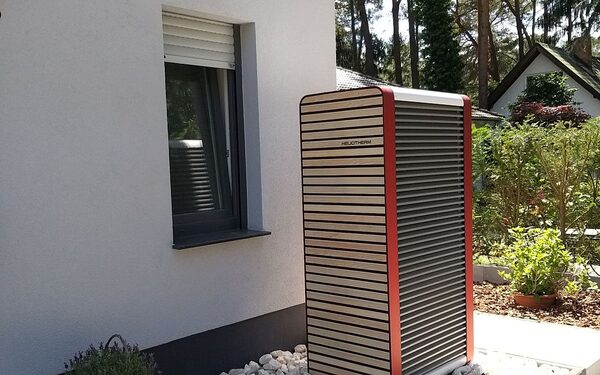
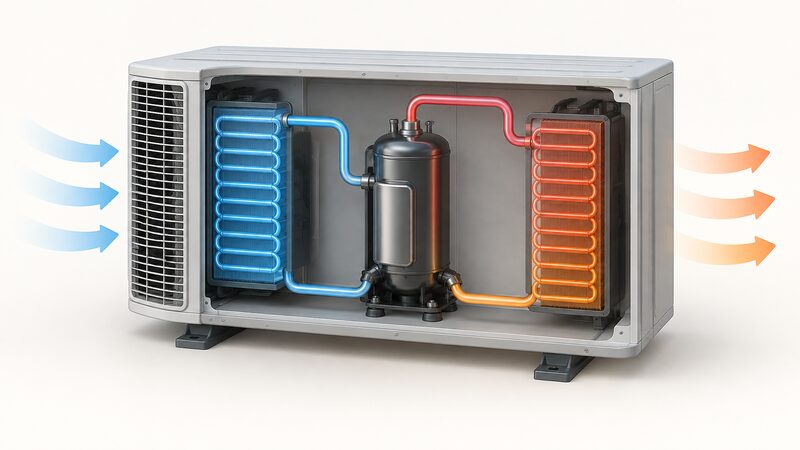
Heat pumps extract energy from the air, ground or water and convert it into heat8. Domestic heat pumps fall into three types where permitted development rights apply: air source, ground source and water source9. Heliotherm covers all three categories, with product pages for air source and groundwater models.
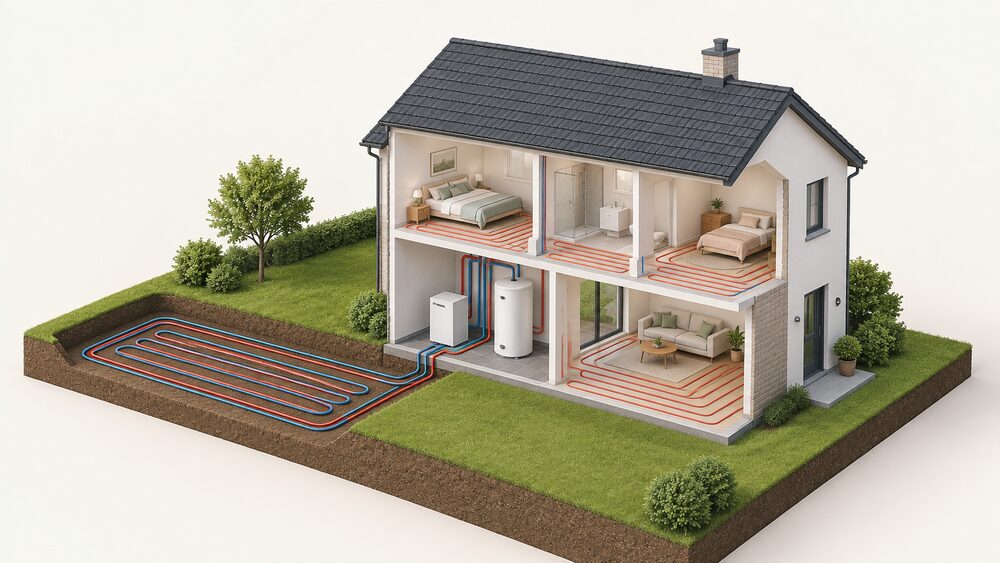
Ground source heat pumps transfer energy from the natural heat stored in the earth to heat the home and domestic hot water10. The heat pump, via an evaporator, a compressor and a condenser, transfers the heat to a hot water tank which feeds the heating distribution system11. Ground source is also called ground-to-water, and the heat produced is at a lower temperature than other forms of heating, working best with underfloor heating, which requires lower flow temperatures than radiators12.
Water source heat pumps use the energy stored in ground water, surface, or sea or sewage water14. Heliotherm's groundwater heat pump sits in this category, drawing on groundwater rather than a horizontal ground loop. The company states the unit can be set up almost anywhere in the building and is suitable for heating renovation or modernisation and single or multi-family homes3.
| Heliotherm model type | Heat source | Key stated feature |
|---|---|---|
| Air source (split) | Air | Functions distributed between indoor and outdoor unit4 |
| Air source (compact) | Air | All process in one device4 |
| Groundwater | Water | Integrated heat meter, SCOP 6.73 |
| Ground source direct evaporation | Ground | EHPA Quality Label, December 2025 |
The range therefore spans the three heat sources a UK household might consider, though availability of each model in the UK depends on the installer network rather than on the maker's catalogue alone.
Air source models: split, compact and air-split designs
Heliotherm's air source range is built around two physical arrangements. The Air-Split heat pump distributes functions between an indoor and an outdoor unit, the classic split design4. The Air Compact heat pump keeps all process in one device, which the maker describes as space-saving and suitable for installation in any building4. Both can be placed indoors and outdoors regardless of location4.
The maker claims problem-free heating operation even at the lowest outside temperatures for the compact model, and high operational reliability, long service life and low maintenance for the air-split model4. These are manufacturer statements rather than independently verified performance figures, and they should be read as such.
For UK planning, air source heat pumps benefit from permitted development rights in England, subject to conditions including the MCS 020 noise assessment. The Planning Portal directs householders to find out about planning permission and fitting air source heat pumps, solar panels and other ways to make a home more energy efficient15. In Wales, separate guidance on planning permission for heat pumps applies9. Scotland and Northern Ireland have their own regimes, and a household in a conservation area or listed building should check before ordering.
Air source units are the most common choice in the UK because they need no ground works. Air-to-water heat pumps, including exhaust air residential space heating, are within the scope of UK heat pump statistics16. The trade-off is that air source performance varies with outdoor temperature more than ground source, and the outdoor unit needs a siting position that satisfies noise rules and clearances.

Ground source and direct evaporation: which suits which home
Ground source heat pumps are generally better suited to new-build properties than retrofitting to an existing home13. That is the single most important constraint for a UK household considering a Heliotherm ground source model. A new build can plan the ground loop or borehole, the plant room and the underfloor heating together. A retrofit has to work around an existing garden, an existing radiator system and an existing floor.
Direct evaporation systems, which Heliotherm makes, use the ground as the heat source without a separate antifreeze intermediate loop. The EHPA Quality Label certificate issued on 10 December 2025 covers Heliotherm direct expansion heat pumps under Quality Regulation V 2.2/2024, certified by the Austrian national EHPA Quality Label Commission. That is an independent quality mark, though it is a European label rather than a UK certification.
The groundwater variant needs little space in the garden, requiring two drilled wells3. That is a materially different footprint from a horizontal ground loop, which needs a larger area of land. A household with a small garden but access to suitable groundwater may find the groundwater route more practical than a horizontal loop, subject to environmental permitting for the abstraction and discharge.
Ground source heat pumps can heat radiators, underfloor or warm air heating systems and hot water17. Detailed technical guidance on ground source heat pump systems, their design considerations and application is set out in CIBSE TM518. The design work, not the equipment, determines whether a ground source installation performs as intended.

Heating in winter, cooling in summer: active and passive cooling
In hot weather some heat pumps can be used in reverse to cool a home, making them very versatile17. Heliotherm offers active cooling and passive cooling as an option on its groundwater heat pump3. The distinction matters for how the system is specified and what it costs to run.
Passive cooling uses the ground loop or groundwater circuit to absorb heat from the building without running the compressor. Because the ground or groundwater is at a stable temperature year round, the circuit can act as a heat sink with minimal electrical input. Active cooling runs the heat pump in reverse: the heat extracted from the air is compressed again and returned to the heating circuit4. That is the electrical cooling principle with the opposite fundamental function, and it delivers more cooling capacity than passive operation at the cost of running the compressor.
For a UK household, cooling is a secondary benefit rather than the main purpose. The domestic market is dominated by heating demand, and the Boiler Upgrade Scheme funds heating systems, not air conditioning. A household that wants summer cooling as well as winter heating should confirm with the installer that the specific model and controls support the cooling mode, and that the emitter system, whether underfloor or fan coils, can deliver it.
The independence angle is that a heat pump with cooling capability replaces two appliances with one. That reduces the number of separate systems a household depends on, though it does not reduce the dependence on electricity supply, which remains the single fuel input for the whole system.
Stepless Modulation Technology and what it does for efficiency
Heliotherm's modulation technology aligns the heat output in real time to the heating needs that currently exist in the building3. That is the maker's description of stepless modulation: rather than switching the compressor on and off at fixed output, the unit varies its output continuously to match demand.
Modulating performance is a recognised efficiency strategy. An independent product page for a competing air source heat pump describes modulating performance as automatically adjusting power to maintain comfort and optimise efficiency18. The principle is that a heat pump running steadily at part load avoids the cycling losses and temperature swings of on/off operation, and it can run at lower flow temperatures for longer, which is what allows a condensing or heat pump system to operate efficiently.
The groundwater model's stated SCOP of 6.7 at 6.7 kW heat output with 1 kW energy input is a seasonal performance figure rather than a peak efficiency figure3. SCOP measures performance across a heating season, so it reflects part-load operation and the modulation strategy. A SCOP of 6.7 is high by the standards of the UK market, and it reflects the stable temperature of groundwater as a heat source compared with air.
The UK methodology for heat pump performance modelling is still developing. The Home Energy Model heat pump methodology lists features that may be added in future, including storage operation, solar assisted heat pumps, electricity from a PV diverter and cooling provision19. That indicates the official modelling framework is being extended to cover exactly the kind of features Heliotherm offers, including PV connection, which the groundwater model supports and describes as quick and simple3.
Certifications: MCS, Keymark and the EHPA quality label
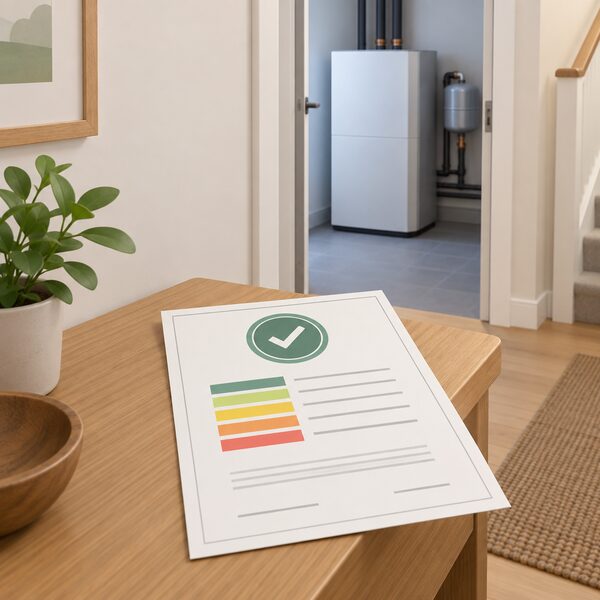
Three certification routes matter for a Heliotherm installation in the UK, and they are not interchangeable.
The Heat Pump Keymark is a voluntary certification mark that supports the quality and performance of heat pumps on the European market20. It is a voluntary, independent, third-party certification mark based on European standards EN 14825 and EN 14511, introduced in 2016, and it has become one of the most trusted quality labels in the European heating and cooling sector21. The certificate is granted by independent certification bodies and the testing is carried out by registered test centres20. The current scheme version is the Heat Pump Keymark Certification Scheme 2025, with testing based on EN 14511:202222.
The EHPA Quality Label is a separate European quality mark. Heliotherm's direct expansion ground source heat pumps were certified under EHPA Quality Regulation V 2.2/2024 by the Austrian national EHPA Quality Label Commission on 10 December 2025.
For the UK Boiler Upgrade Scheme, neither of those is sufficient on its own. The installer must be MCS-certified and the heat pump must be MCS-certified or certified to an equivalent scheme recognised by MCS. No certification means no grant, full stop23. The scheme funds ground source heat pumps, including water source heat pumps and those on shared ground loops, at £7,5005. Ofgem administers the scheme and maintains the installer route24.
What owning a Heliotherm heat pump means for UK households
A heat pump is a versatile system capable of providing heating, cooling and hot water for homes, commercial buildings and industrial applications8. For a UK household, a Heliotherm installation delivers the same core benefit as any heat pump: heat produced on site from a renewable source rather than from a delivered fossil fuel.
The independence it creates is real but partial. A ground source or groundwater heat pump draws on the ground or groundwater beneath or near the property, which is not metered or supplied by anyone. That removes the gas or oil supply from the heating system entirely. What remains is electricity, which still comes from a supplier and the grid, and the manufacturer's parts and service chain for maintenance and repairs.
The groundwater model's integrated heat meter matters for households that have claimed or intend to claim the Domestic Renewable Heat Incentive. The scheme requires meters to record and display electricity used by the plant to generate heat, electrical input into any supplementary electric heater controlled by the same control system as the heat pump, and electrical input into any immersion heater for a domestic hot water cylinder where the immersion heater is controlled by the same control system as the heat pump10. An integrated meter simplifies that metering requirement.
Support for the supply chain is a UK policy priority. Support is available for installers and manufacturers to expand supply chains1. That matters for an imported brand, because the depth of the UK installer and spares network determines how quickly a fault can be resolved.
"Heat pumps are technically suitable for most UK homes if installed appropriately."
The practical position for a household is that Heliotherm offers a technically credible range across air, ground and groundwater sources, with European quality certification and a long manufacturing history. The UK-specific conditions are the MCS certification route for grant eligibility, the availability of a trained installer, and the ground works or siting that each model requires. A household weighing independence should treat the heat source as the part that removes a delivered fuel, and the electricity supply, installer network and manufacturer support as the dependencies that remain.
Sources24 cited
- What impact can heat pumps have in domestic heating, GOV.UK, 2026-09-19
- Boiler Upgrade Scheme installers, Ofgem, 2026-09-17
- Heliotherm groundwater heat pump, Heliotherm, 2026-09-17
- Heliotherm air source heat pumps, Heliotherm, 2026-09-17
- Domestic RHI eligible heating systems, Ofgem, 2026-09-17
- Carbon Budget and Growth Delivery Plan: heat and buildings, GOV.UK, 2025
- Heat pump deployment statistics: March 2026, GOV.UK, 2026-06-11
- Heat pumps used in central heating, England and Wales, ONS, 2025-10-28
- Heat pumps, REA, 2026-09-17
- Ground source heat pumps, Energy Saving Trust, 2026-07-16
- Planning permission for heat pumps, Welsh Government, 2026-09-17
- Ground source heat pump costs and savings, Which?, 2026-05-08
- Heat pumps, Planning Portal, 2026-09-17
- Off gas grid heating options, OFTEC, 2026-09-17
- Heat pumps, CIBSE, 2026-09-17
- About heat pumps, EHPA, 2026-04-24
- Heat pumps and domestic heating, UK Parliament, 2026-09-19
- Approved Document L Volume 1 Dwellings, GOV.UK, 2026
- HEM heat pump methodology, GOV.UK, 2026-01
- Heat Pump Keymark, EHPA, 2026-08-19
- Heat Pump Keymark certification celebrates a decade, EHPA, 2026-01-05
- Heat Pump Keymark Certification Scheme 2025, Heat Pump Keymark, 2025-09-05
- Free money: the link between certification and incentives, Eurovent Certification, 2026-05-21
- What you can get from the Boiler Upgrade Scheme, GOV.UK, 2026-09-17