
In this comparison
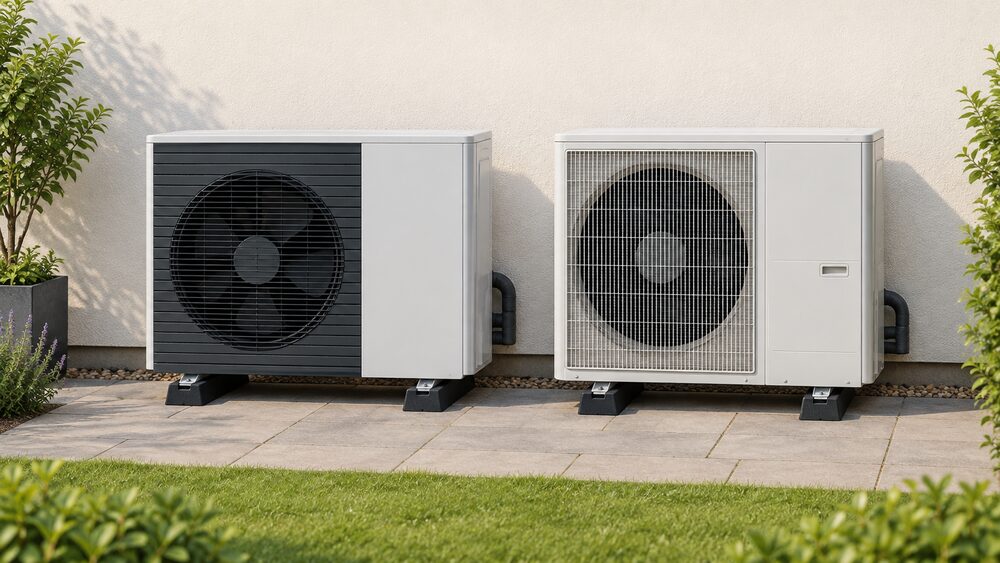
The Vaillant aroTHERM plus and the Mitsubishi Ecodan are two of the most widely quoted air source heat pumps in Britain, and both sit at the specialist end of the market: each comes from a manufacturer that sells heat pumps as a core product line rather than an add-on. The aroTHERM plus is a monobloc air source heat pump that Vaillant positions as ideal for retro-fit and new build, paired with a Vaillant hot water cylinder and indoor unit1. The Ecodan range is Mitsubishi Electric's residential heat pump system, an inverter driven air source heat pump that the maker says provides all the heating and hot water a property needs, and which it reports can offer an average lifespan of 15 to 20 years with professional maintenance2.
Neither range is a single product. Mitsubishi sells Ecodan units in both R290 and R32 refrigerant versions, in standard and compact monobloc formats, with cylinders and controls sold alongside4. Vaillant sells the aroTHERM plus as a system built around its own cylinder and indoor unit, with cooling available by adding a Vaillant cooling module5. This page compares what each maker publishes on refrigerant, noise, efficiency, cold weather performance, warranty and controls, and sets out where the published figures differ. It does not recommend one over the other: the right choice depends on the home, the heat loss survey and the installer.
Design and build: refrigerant and the outdoor unit
The clearest design difference between the ranges is refrigerant, and it runs inside each brand rather than between them. The aroTHERM plus uses R290, a natural refrigerant with a global warming potential of 3, which Vaillant describes as climate friendly1. Vaillant's guidance notes that R290 needs certain clearances, which is a siting consideration for the installer5. Mitsubishi splits its range: the Ecodan R290 uses R290, while the Ecodan R32 range uses R32 refrigerant, which Mitsubishi says delivers improved efficiencies6. A household comparing an Ecodan R290 with an aroTHERM plus is comparing like with like on refrigerant; comparing an Ecodan R32 brings a different refrigerant into play, with its own characteristics covered on our heat pump refrigerants page.
Both are monobloc designs. Mitsubishi describes the Ecodan R32 as a single fan outdoor monobloc air source heat pump unit, with a compact single fan version for tighter spots, and says its renewable heating systems are self-contained, requiring only electricity and water connections10. The Ecodan R32 Zubadan model is designed for larger domestic premises4. The aroTHERM plus is likewise an outdoor unit paired with an indoor unit and cylinder indoors1. In a monobloc, the refrigerant stays inside the outdoor box, so the household's exposure to refrigerant handling is limited to manufacture and service; the trade-off is that the outdoor unit carries the whole refrigerant circuit. Our monobloc and split heat pumps page explains the difference in full.
Vaillant states the aroTHERM plus offers both heating and cooling, enabled by adding the Vaillant cooling module, which extends what the unit does across the year5. Mitsubishi's Ecodan range is a fully electric source of heating and hot water on the R290 model6. Neither maker publishes full dimensions on the pages cited here, so physical size and siting are questions for the survey, covered on our heat pump siting and clearances page.
Noise: what each maker publishes
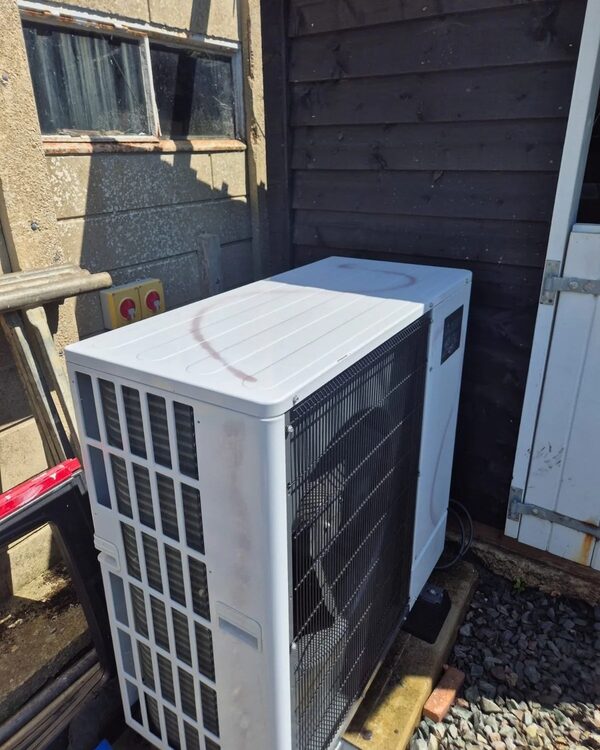
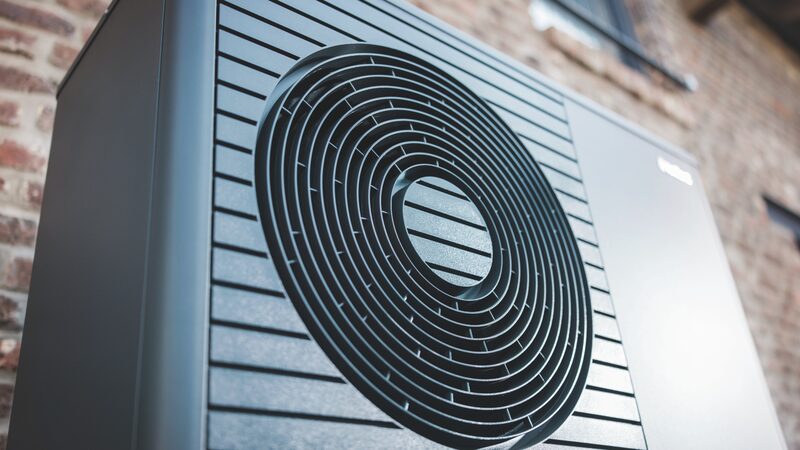
Noise is where the published figures need the most care, because Vaillant itself gives different numbers on different pages. The aroTHERM plus launch page states a noise level of 44 dB(A), based on the 3.5kW model7. Vaillant's heat pump myths guidance gives a sound power level as low as 48 dB(A) at a three-metre distance8, while the aroTHERM plus product page gives sound power as low as 54 dB(A) at a three-metre distance1. The two sound power figures differ, and both are the maker's own; neither has been reconciled here. What is consistent is that the figures are model-specific: the 44 dB(A) claim applies to the smallest unit in the range, and a larger output will be louder.
The aroTHERM plus carries independent recognition on noise: the 3.5, 5, 7 and 12kW models have been Quiet Mark certified, excluding the 10kW model8. Quiet Mark certification is awarded to products measured as among the quieter ones in their category, so it is a meaningful marker, but it covers four of the five models named.
Mitsubishi publishes no comparable decibel figure on the pages cited here. The maker describes the Ecodan as one of the quietest units available on the market3, which is a marketing claim rather than a measurement, and the R32 range includes a model marketed as ultra quiet in its product name10. For a household with a neighbour close by, the practical route is the installer's noise assessment against the permitted development rules, covered on our MCS 020 noise assessment page, using the specific model quoted.
Efficiency: SCOP, ErP ratings and what they mean for bills
Both ranges claim the top energy label class. Vaillant gives the aroTHERM plus an ErP of up to A+++, which it says ensures exceptional performance for both underfloor heating and radiators7, and an energy efficiency class of A+++1. Mitsubishi gives the Ecodan R290 an A+++ heating efficiency at 35ºC, within a label range of A+++ to D, and the Ecodan R32 compact unit carries the same rating6. The "at 35ºC" qualifier matters: the label figure is measured at a low flow temperature, which underfloor heating can reach but radiators often cannot.
SCOP, the seasonal coefficient of performance, is the more useful number because it averages performance across a heating season. It is determined using defined climate bins, load distribution profiles, measured COP values at several test points, and corrections for standby and control energy, and it includes part-load operation, standby and auxiliary electricity consumption, and defrost cycles for air source systems11. Lower heating water temperatures improve efficiency significantly, and floor heating systems typically enable higher SCOP than high-temperature radiator systems11. Our heat pump efficiency page explains the terms.
Vaillant publishes one real-world data point: a customer review reports a SCOP of 4.2 from January to July, alongside a house kept pleasantly warm at the heating setpoint during winter1. That is a single customer installation reported by the maker, not a tested average, and it covers a period that includes only part of the heating season. Mitsubishi publishes no SCOP figure on the pages cited here. Neither maker's label rating predicts a particular household's bills: flow temperature, emitter design and the heat pump sizing of the system matter more than the badge.
Cold weather performance

Both makers claim strong performance in cold conditions, and again the published figures differ within Mitsubishi's own pages. One Ecodan page states the units harvest heat energy from outside even with outside temperatures as low as -20ºC2; another states Ecodan works at temperatures as low as -25 degrees celsius, and the Ecodan R290 model has a guaranteed operation range down to -25°C ambient temperature4. The two figures differ, and both come from the maker. British winters rarely test either limit, but the gap between the claims is worth noting when comparing quotes.
The official position is more sober. Council guidance on air source heat pumps notes that an air source heat pump will be less efficient in the winter when the air temperature is colder12. That is physics rather than a brand weakness: the unit extracts energy from the outdoor air, as Mitsubishi's own support material describes13, so the colder the air, the more work each unit of heat requires. The practical questions for a household are the heat loss calculation, which sizes the unit for the coldest design day, and whether backup heating is included. Our heat pumps in cold weather page covers the detail.
Which suits which home and heating system
On paper, both ranges fit a wide spread of homes. Mitsubishi states Ecodan air source heat pumps can be used with any type of heating system, such as underfloor heating and traditional radiators2, and its support material explains that Ecodan heats radiators to a much lower temperature than gas and oil systems13. That lower temperature is why an existing radiator system may need larger radiators or better insulation to deliver the same warmth, a question settled by the heat loss calculations rather than by the brand.
Vaillant describes the aroTHERM plus as ideal for retro-fit and new building1, and says its heat pumps integrate easily with solar PV systems, whether installed before the heat pump or as part of a wider renovation7. For hot water, the aroTHERM plus is paired with a Vaillant cylinder1, while Mitsubishi sells Ecodan cylinders with plate heat exchanger technology, which it says gives faster heat up times14. Both approaches mean the cylinder is part of the system design, not an afterthought: our hot water cylinders for heat pumps page explains why.
The choice between ranges therefore turns less on the outdoor unit and more on the survey: the heat loss of the house, the emitters, the hot water demand and the siting. A larger home may point towards the Ecodan Zubadan, designed for larger domestic premises4; a retrofit with existing radiators points towards whichever quote handles the radiator upgrade honestly.
Warranty, installer network and support
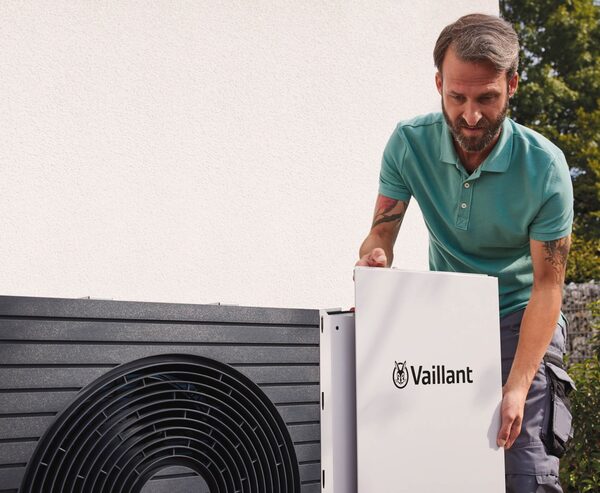
Warranty terms differ sharply, and both brands tie their best terms to their own installer networks. The aroTHERM plus comes with a 2-year standard guarantee, extendable up to 7 years when installed with a Vaillant cylinder fitted by an approved installer7. The conditions are strict: availability is limited to Platinum and Renewable Partner installers who also register the appliance with a Vaillant cylinder, and upgrades may incur charges if the installer is a lower tier or a cylinder has not been installed1.
Mitsubishi's warranty depends on installer status. A Business Solutions Partner receives up to 7 years warranty on the Ecodan system, an Accredited Ecodan Installer receives up to 5 years, and a standard account installer receives 3 years on units above 20kW, cylinders and ancillaries9. Business Solutions Partners also have access to a Fast Track Warranty process and the Ecodan Selection tool15. In practice, the warranty a household actually gets depends on which tier of installer fits the unit, so the warranty term is a question to put to the installer before signing.
| Vaillant aroTHERM plus | Mitsubishi Ecodan | |
|---|---|---|
| Standard guarantee | 2 years7 | Depends on installer tier9 |
| Maximum term | Up to 7 years7 | Up to 7 years via Business Solutions Partner9 |
| Key condition | Vaillant cylinder fitted and registered by a Platinum or Renewable Partner installer1 | Installer's status in Mitsubishi's network9 |
| Cooling | Heating and cooling with the Vaillant cooling module5 | Heating and hot water; cooling not stated on pages cited6 |
Mitsubishi lists Livingston and West Hallam among its factories for the Ecodan heat pump and cylinder ranges2, which shortens the supply chain and gives a UK base for parts and support.
Grants, smart tariffs and controls
Both ranges qualify for the main grant scheme in England and Wales. The Boiler Upgrade Scheme's eligible technologies include air-to-water heat pumps16, and its guidance also lists air-to-air heat pumps among eligible technologies17. Vaillant states the aroTHERM plus is eligible for the Boiler Upgrade Scheme grant in England and Wales1. The scheme's general conditions apply to any installation: the home must be replacing a fossil fuel heating system18, and council retrofit guidance notes a household may be eligible for a grant if the home is energy efficient enough19. Ofgem publishes the scheme statistics20. Scotland runs its own grant and loan support, covered on our heat pump grants page.
On smart operation, both ranges can take part in the flexibility services now emerging on the grid. Guidance for households describes how it works: heat pumps and smart thermostats can pre-heat or cool a home before peak hours, then ease off when the grid is under pressure21. An Energy Saving Trust analysis examined over a million heat pump, tariff and technology combinations to understand how smart tariffs integrate with low-carbon home technologies22. Mitsubishi's Ecodan wireless remote controller provides weather compensation, wireless connectivity and auto adaptive control logic23, the control features that make automated operation possible. Weather compensation is also a standing efficiency measure: our heat pump controls page explains how it works.
What ownership means for household energy independence

Either range takes a home off delivered gas, oil or LPG and onto electricity, which is the central independence gain: the fuel is the same stuff that powers the lights, and it can be bought from any supplier, generated on the roof, or shifted to cheap hours. Mitsubishi's Ecodan systems need only electricity and water connections3, and Vaillant says its heat pumps integrate easily with solar PV7, so a household with panels can offset a substantial share of its heating with its own generation, especially with a battery, as our solar and battery with heat pump page explains.
The dependencies that remain are worth stating plainly. Both ranges tie their longest warranty terms to the maker's own installer network and, in Vaillant's case, to a Vaillant cylinder1, so the household's protection depends on staying inside that network for the installation. Smart operation depends on the maker's controls and on a supplier or flexibility provider running the automation, which means ceding some timing decisions to a third party in exchange for cheaper hours21. And the heat pump itself is a manufactured appliance: Mitsubishi reports a 15 to 20 year average lifespan with professional maintenance3, after which replacement is on the horizon.
Neither dependence is unusual for a heating system, and both are manageable: an independent installer can service either unit, and smart operation can be declined. What the comparison shows is that the two ranges are closer than the marketing suggests. The refrigerant, the warranty conditions, the installer's tier and the quality of the survey will shape the outcome more than the badge on the outdoor unit.
Sources23 sources
- aroTHERM plus air source heat pump, Vaillant, 2026
- Ecodan residential heating, Mitsubishi Electric, 2026-09-17
- Our heat pumps, Mitsubishi Electric, 2026-09-17
- Ecodan outdoor units, Mitsubishi Electric, 2026-09-17
- Heat pump sizing: what size heat pump do I need?, Vaillant, 2026
- Ecodan R290 air source heat pump, Mitsubishi Electric, 2026-09-17
- The new aroTHERM plus, Vaillant, 2026
- Heat pump myths, Vaillant, 2026
- Ecodan residential warranty, Mitsubishi Electric, 2026-09-23
- Ecodan R32 ultra quiet monobloc air source heat pump, Mitsubishi Electric, 2026-09-17
- Heat pump efficiency: SCOP, iDM Energie, 2026-07-06
- Fact sheet 5: air source heat pumps, Pendle Borough Council, 2026-09-17
- Ecodan help and support, Mitsubishi Electric, 2026-09-17
- Ecodan cylinders, Mitsubishi Electric, 2026-09-17
- Ecodan residential warranty for installers, Mitsubishi Electric, 2026-09-17
- Boiler Upgrade Scheme guidance for installers V5, Ofgem, 2026-04-28
- Boiler Upgrade Scheme guidance for installers v5.1, Ofgem, 2026-07-02
- Getting help with your energy bills, Birmingham City Council, 2026-04-15
- Household retrofit guidance: air and ground source heat pumps, Croydon Council, 2026-09-17
- Boiler Upgrade Scheme statistics July 2026, Ofgem, 2026-08-27
- What is flexibility, Flex Assure, 2026-09-19
- Flexible futures: integrating smart tariffs with low-carbon home technologies, Energy Saving Trust, 2026-07-10
- Ecodan wireless remote controller, Mitsubishi Electric, 2026-09-17