

In this guide
CTC is a Swedish heat pump brand, sold in the UK as a range of air-to-water, ground source and hot water products rather than a single boiler replacement. The current families are the EcoAir air-to-water heat pumps, the EcoHeat and EcoPart ground source units, the EcoZenith hot water and control tanks, and the CombiAir range. Every CTC air-to-water heat pump comes with EnergyFlex, the maker's term for a system prepared from the start to supplement with virtually everything there is for heating1.
The headline performance figure is the same one that applies to heat pumps generally: a well-designed and installed unit typically provides 3 to 4 units of heat for every unit of electricity used2. CTC's own product pages describe the EcoAir 600M as a series of ultra-efficient, speed-controlled air-to-water heat pumps, and the EcoAir C100 as providing on-demand heating and cooling all year round1.
What CTC offers a household is a choice of heat source and a control architecture built to accept more than one. What it does not remove is the electricity supply, the hydronic heating system the heat pump needs to distribute heat into, or the sizing calculation that decides whether any of it works. This page sets out the range, the controls, the sizing rules and the efficiency evidence.
CTC: a Swedish heat pump maker since 1923
CTC is a Swedish brand, and its technical documentation is issued by Enertech AB, with manufacturer declarations signed in Ljungby, Sweden. The company's own conformity paperwork runs back through the 2000s: a manufacturer declaration for CTC EcoLogic dated 21 February 2005, a CTC EcoAir manufacturer declaration signed in Ljungby on 4 May 2005, and a declaration of conformity for CTC EcoAir issued on 20 November 2009. A conformity declaration for the CTC EcoHeat 306, 308, 310 and 312 models is dated 12 August 2011, and a declaration covering CTC EcoPart models 406, 408, 410, 412, 414, 417, 424 and 434 is dated 7 May 2012.
That paperwork trail matters for a UK buyer for two reasons. First, it establishes the product families as long-running lines with documented model numbers rather than one-off imports. Second, it shows the brand's European manufacturing base. Europe is a minority producer in global terms: 15% of all heat pumps sold globally are manufactured in Europe6. A CTC unit is therefore a European import, with the supply chain and parts lead times that implies, rather than a UK-assembled product.
For household energy independence, the position is mixed. A heat pump of any make shifts space heating and hot water off gas and onto electricity, which is the main structural change. It does not remove dependence on a supplier, on the grid, or on the manufacturer for controls, spares and support. A Swedish brand adds a further layer: the household depends on a UK distribution and service chain that sits between it and the factory.
The range at a glance: EcoAir, EcoHeat, EcoZenith and more

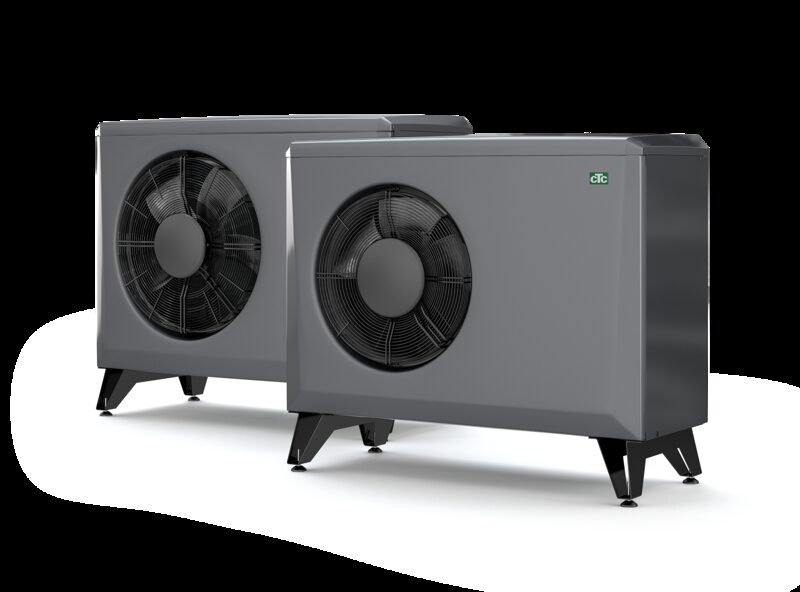
CTC's UK-facing range divides by heat source and by function. The air-to-water side is the EcoAir family, with the EcoAir C100, EcoAir 600M and EcoAir 700M all described as modulating or speed-controlled units1. The CombiAir is described as an efficient and speed-controlled heat pump1. The ground source side is the EcoHeat and EcoPart families, with EcoPart model numbers documented from 406 up to 434. The hot water and control side is the EcoZenith, with the EcoZenith i360 recommended by CTC for control and hot water alongside the EcoAir 600M3.
| Family | Type | Documented detail |
|---|---|---|
| EcoAir C100 | Air-to-water | Modulating, on-demand heating and cooling all year round1 |
| EcoAir 600M | Air-to-water | Speed-controlled, ultra-efficient series3 |
| EcoAir 700M | Air-to-water | Modulating air-to-water heat pump1 |
| CombiAir | Air-to-water | Efficient and speed-controlled1 |
| EcoHeat 300 | Ground source | Models 306 I, 308 I, 310 I and 312 [documented] |
| EcoPart | Ground source | Models 406 to 434 [documented] |
| EcoZenith i360 | Control and hot water | Recommended with EcoAir 600M3 |
The practical point of the split is that CTC sells a system, not an appliance. A household choosing CTC is choosing a heat source, a control layer and a hot water arrangement together, and the pieces are specified as a set. That is a different buying pattern from a straight boiler swap, and it is why the sizing and emitter questions below carry more weight than the badge.
EcoAir: air-to-water heat pumps for heating and cooling
The EcoAir range is air-to-water, which means it distributes heat via the wet central heating system already in most UK homes7. That is the key distinction from air-to-air units, which heat the air in a room directly. Air-to-water heat pumps tend to heat water to lower flow temperatures than boilers, which is why emitter sizing matters8.
Cooling is a documented feature of the EcoAir C100, which CTC describes as providing on-demand heating and cooling all year round1. Cooling through an air-to-water system is not automatic: it needs the right sort of emitters to make the most of it, and the independent guidance points to heat pump convectors and underfloor heating as the options9. A household expecting cooling from a standard radiator circuit may not get it.
On hot water, CTC states that pools and other heat sources such as solar heating can easily be added to its air-to-water heat pumps1. That is a maker's claim about its own products, and it describes what the system is prepared to accept rather than what a given installation will include. For comparison, air-to-air systems sometimes connect to a domestic hot water tank and sometimes do not, and where they do not, a separate hot water heat pump cylinder, heat battery, electric immersion heater or point-of-use water heater would be needed10.
The independence question here is straightforward. An air-to-water heat pump keeps the household on electricity and off gas for space heating, and it reuses the existing wet circuit. It does not remove the need for a cylinder for stored hot water, and it does not remove the grid connection.
EcoHeat and GSi: ground source heat pumps

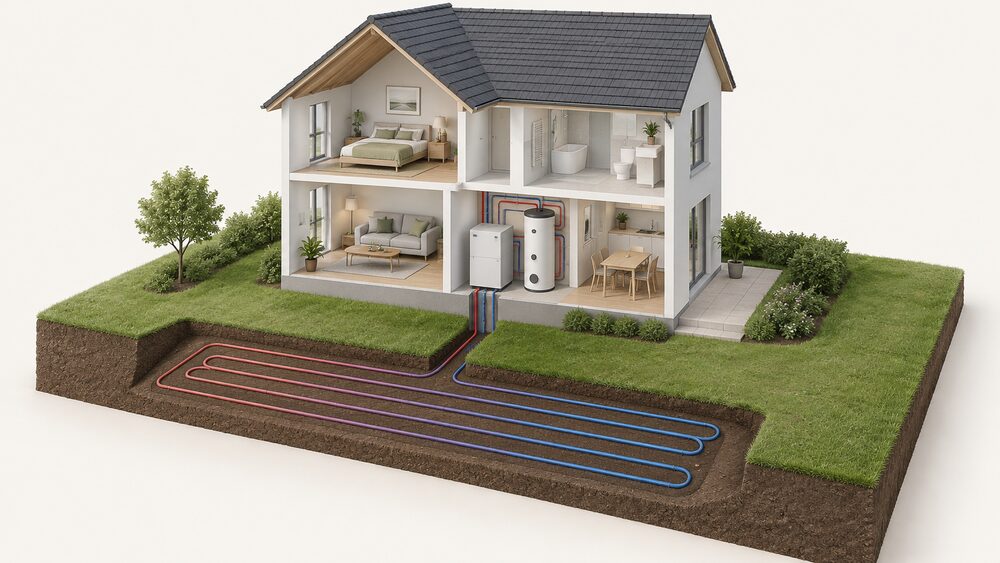
CTC's ground source side draws on the same principle as every ground source heat pump: transferring energy from the natural heat stored in the earth to heat the home and domestic hot water11. Ground source heat pumps transfer heat from the ground into a building to provide space heating and, in some cases, pre-heating domestic hot water12. The technology is well established in UK policy: ground source heat pumps are listed among energy-saving materials in the relevant legislation13, and they are an eligible technology under the Boiler Upgrade Scheme, including water source heat pumps and shared ground loops14.
That eligibility is worth stating precisely because it is a scheme condition rather than a product feature. Ground source heat pumps, including water source heat pumps and shared ground loops, are the eligible technology category14. A CTC ground source unit sits inside that category on the same terms as any other make.
Ground source installations carry design obligations that air source ones do not. Detailed technical guidance covers ground source heat pump systems, their design considerations and application15. The ground loop or borehole is a civil works item, and the performance of the system depends on it as much as on the heat pump. For a household, that means the independence gain is real, since ground source runs off electricity and a buried loop rather than a fuel delivery, but the disruption and the design risk sit in the ground rather than in the unit.
CTC's documented ground source model numbers run from EcoPart 406 to 434, and the EcoHeat 300 covers models 306 I, 308 I, 310 I and 312. A separate page covers the CTC EcoHeat 300 ground source heat pump in more detail, and the wider technology is set out in ground source heat pumps explained.
EcoZenith i360 and accumulator tanks: storing heat until it's needed
The EcoZenith i360 is CTC's control and hot water unit, and the maker recommends it for control and hot water alongside the EcoAir 600M3. Its role is to hold heat and to coordinate the heat sources feeding it, which is what makes a multi-source CTC installation possible at all.
Storage changes the shape of a heat pump installation. A heat pump works most efficiently when it runs steadily at low flow temperatures rather than in short bursts, and a tank gives it somewhere to put heat that is not needed immediately. Most heat pumps are capable of supplying 45 to 55 degrees C heat with moderate efficiency, with some exceeding 60 degrees C16. Many heat pumps can provide hot water over 60 degrees C consistently, which is the minimum temperature the hot water cylinder will need to reach1.
The cylinder is not optional equipment in a hydronic system. For domestic hot water, a solar thermal system needs a heat transfer system and a hot water cylinder17, and the same logic applies to a heat pump feeding stored hot water. The hot water cylinders for heat pumps page covers sizing and coil choice, and buffer tanks and volumisers covers the system-volume side.
For independence, a large thermal store is a modest but genuine buffer. It lets a household shift when the heat pump runs, which matters if a time-of-use tariff is in play, and it reduces short cycling. It does not store electricity, and it does not remove the grid.
EnergyFlex: combining up to ten heat and electricity sources
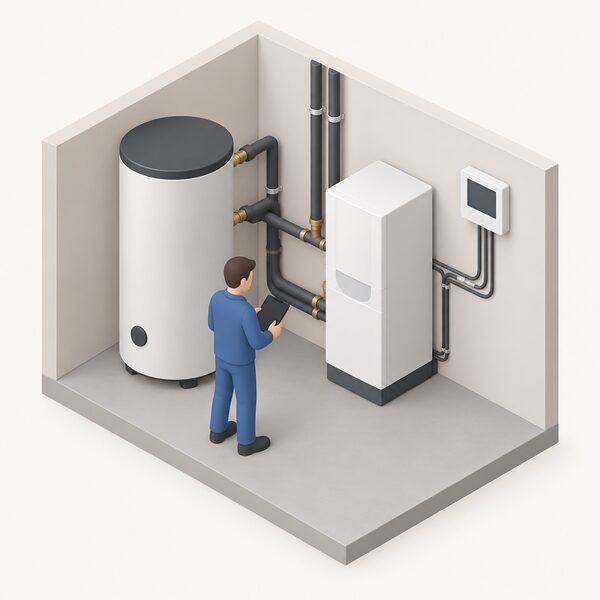
EnergyFlex is CTC's term for a heat pump prepared from the start to accept additional heat sources. CTC states that EnergyFlex means the heat pump is prepared from the start to easily supplement with virtually everything there is for heating, and that you always get EnergyFlex when you invest in a heat pump from CTC1.
The control layer that makes this work is EcoLogic, described as a unique control system that monitors and controls CTC's heat pumps, additional heating, buffer tanks, pools, cooling and more, and supports up to four different heating systems3. Compatibility is documented in two designs: one covering CTC EcoAir 400 to 700M air-to-water heat pumps, and one covering CTC EcoPart 400 to 600M geothermal heat pumps. The documents do not resolve which design applies to which installation, so a household should treat the exact compatibility of a given EcoLogic unit as something to confirm against the specific model.
Cascading is the other half of the picture. A cascaded heat pump system allows more than one heat pump unit to work together to meet a property's heating and hot water needs18. That is how a larger property reaches a higher output without a single oversized unit, and it is the mechanism behind CTC's multi-unit installations.
The independence reading is that a multi-source system reduces dependence on any one fuel. A household running a heat pump alongside solar thermal, a buffer tank and a pool circuit is less exposed to a single energy price. It remains dependent on electricity, on the control system, and on the manufacturer for that control system's support.
What a CTC system needs: hydronic heating and correct sizing
A CTC heat pump needs a wet central heating system to distribute heat into, and it needs to be sized to the building. Both are regulatory requirements as well as practical ones. Approved Document L requires that heat pump systems have been sized appropriately19, and heat pumps should be selected to meet the full space heating requirement at the design condition chosen for heat loss calculations20.
Sizing is where most of the risk sits. An undersized unit may struggle to meet demand, while an oversized unit may cycle on and off often and lessen efficiency21. Correct sizing is based on peak heat demand in watts, which is a measured or calculated figure rather than an estimate from floor area22. The heat pump sizing and heat loss calculations page covers the process.
Emitters are the second constraint. Design guidance for efficient hydronic heating systems works at 55 degrees C and below23, and the documents differ on the exact figure, with one source giving 45 degrees C. Existing pipework can also be a limit: microbore pipes, typically 6 to 12 mm, can be a problem, and the options are a high-temperature heat pump, which will be less cost-effective to run, or replacing all the pipework24. Compact heat pumps are specifically designed to heat small, well-insulated modern flats and homes25, which is a different design point from a retrofit onto an existing circuit.
For a household, the sizing and emitter work is the part that determines whether the independence gain is real. A correctly sized heat pump on a suitable circuit runs cheaply and off gas. A poorly sized one on microbore pipework runs often and expensively, and the fuel switch alone will not fix that.
Efficiency: 4 to 5 kWh of heat per kWh of electricity

The efficiency figures for heat pumps cluster in a band, and CTC units sit inside it. A well-designed and installed heat pump typically provides 3 to 4 units of heat for every unit of electricity used2. Independent guidance puts a typical heat pump at 250 to 450% efficient, meaning 2.5 to 4.5 units of heat per unit of energy10. Other sources give 3 to 4 units of heat per unit of electricity26, around 3 units28, and a wider transfer ratio of between 2 and 7 kilowatt-hours of thermal energy for every kilowatt-hour of electrical energy consumed5.
The seasonal performance factor is the measure that matters over a year. An SPF of 4.0 means that for every 1 kWh of electricity consumed, the heat pump delivers 4 kWh of heat4. That is the official framing, and it is the figure to compare against a quoted performance claim.
| Measure | Figure | Source type |
|---|---|---|
| Typical efficiency | 250 to 450%, or 2.5 to 4.5 units of heat per unit of energy | Independent10 |
| Well-designed and installed | 3 to 4 units of heat per unit of electricity | Independent2 |
| SPF example | SPF 4.0 = 4 kWh heat per 1 kWh electricity | Official4 |
| CTC heat pumps | 4 to 5 kWh returned per kWh of electricity drawn | Maker5 |
| Typical output | 3 to 4 units of heat per unit of electricity | Official27 |
The spread across these figures reflects different measurement bases rather than disagreement about the physics. A laboratory coefficient of performance is measured at a fixed condition; a seasonal performance factor is measured or modelled across a year of real weather and real flow temperatures. The gap between the two is where installation quality shows up. Flow temperature is the main lever: most heat pumps are capable of supplying 45 to 55 degrees C heat with moderate efficiency, with some exceeding 60 degrees C16, and lower flow temperatures generally mean better performance.
Cold weather is a documented limit rather than a failure point. Heat pumps can work to an outdoor temperature of minus 20 degrees C7. The heat pumps in cold weather page covers how output and efficiency change as the temperature falls.
Controls, charge pumps and the parts around the unit
CTC's control layer is EcoLogic, and the charge pump is the component that moves heat between the outdoor unit and the tank. CTC lists charge pumps against output bands. The CTC Charge pump 25/75-130 is suitable for 10 to 12 kW heat pumps and is specified as 7.5 m A-class PWM3. A second unit, the CTC Charge pump 25/85-130, is listed as suitable for 14 to 22 kW heat pumps3. No CTC charge pump is listed in the available material for the 6 to 8 kW band, so that pairing is not documented here.
Remote control is a function of the controls fitted rather than of the heat pump. Most smart heating controls link to a phone, and heating can be controlled via smartphone, tablet or laptop, or by telling a smart speaker what you want29. Temperature settings can be accessed using a mobile app30. Where a CTC installation includes a compatible control and gateway, the same pattern applies; the heat pump itself does not need a phone to run.
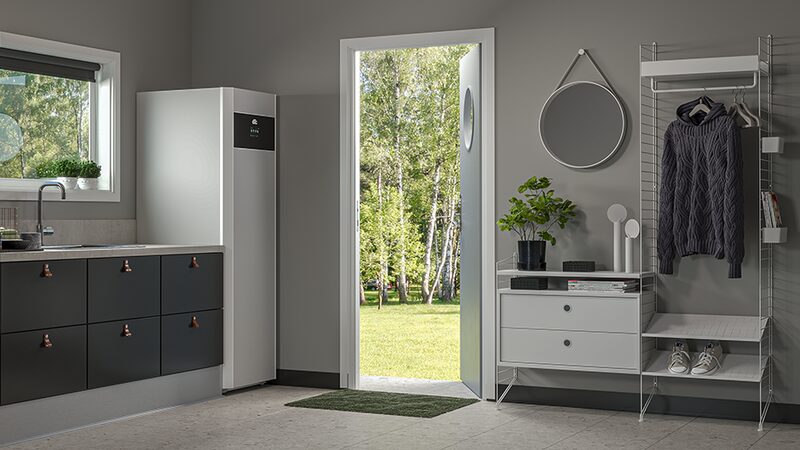
The dependence this creates is worth naming. Local control at the unit continues without an internet connection, but scheduling from away, monitoring and remote diagnostics depend on a home broadband connection, the manufacturer's servers and an app. That is a supplier relationship layered on top of the electricity supply.
Where a CTC system has limits
The limits are the same ones that apply to heat pumps generally, plus a few that are specific to a multi-source design. The first is the electricity supply: a heat pump runs on electricity, and the household remains on the grid and with a supplier. The second is the hydronic circuit: without a suitable wet heating system and adequate emitters, the unit cannot deliver its rated performance. The third is sizing, where an undersized unit may struggle to meet demand and an oversized one may cycle on and off often and lessen efficiency21.
The fourth is documentation. CTC's own compatibility paperwork for EcoLogic is split across two designs, one for EcoAir 400 to 700M air-to-water units and one for EcoPart 400 to 600M geothermal units, and the documents do not resolve which applies where. A household specifying a CTC system should have the exact control compatibility confirmed for the specific models in the quote.
The fifth is the supply chain. CTC is a Swedish brand with European manufacturing, and Europe accounts for 15% of all heat pumps sold globally6. Parts, spares and technical support therefore travel further than they would for a UK-assembled product.
None of this makes a CTC system a poor choice. It makes it a system that has to be specified properly, by someone who has done the heat loss calculation and checked the emitters, and supported by a UK chain that can supply parts. The heat pumps and household energy independence page sets out what a heat pump does and does not change about a home's exposure to fuel markets, and the full UK heat pump guide covers the wider picture.
Sources30 cited
- CTC air-to-water heat pumps, CTC, 2026-09-17
- Electric heating, Centre for Sustainable Energy, 2026-06
- CTC EcoAir 600M, CTC, 2026-09-17
- Heat pump transition report, UK Government, 2026-05
- Introduction to water source heat pumps, Renewables First, 2026-04-08
- Plugging heat in: smart policy can help electrify household heating in Europe, Ember, 2025-12-17
- Air source heat pumps, Electricity North West, 2026-09-19
- Planning for your boiler's replacement, Which?, 2026-02-27
- How a heat pump can cool your home, Which?, 2026-07-17
- Heat pumps vs boilers, Which?, 2025-09-22
- VAT energy saving materials and grant funded heating supplies, HMRC, 2026-09-17
- Heat pumps, Planning Portal, 2026-09-17
- Energy Act 1994, Schedule 8, Part II, Chapter 23, legislation.gov.uk, 2026-09-17
- Boiler Upgrade Scheme guidance for installers V5, Ofgem, 2026-04-28
- Heat pumps campaign, CIBSE, 2026-09-17
- Reduce the cost of heat pumps, Nesta, 2022-03-02
- Solar thermal panels, nidirect, 2024-10-22
- Heat pumps, Energy Saving Trust, 2026-06-11
- Approved Document L Volume 1: Dwellings, UK Government, 2026
- Approved Document L Volume 1: Dwellings, 2021 edition incorporating 2023 amendments, UK Government, 2026-09-17
- Heat pumps, nidirect, 2025-02-24
- Measuring the invisible: HTC and the future of retrofit, Stroma, 2026-09-20
- An Introduction to Low-Temperature Hydronic Heating Systems, CIPHE, 2026-09-17
- I'm a sustainability expert, here's why I'm not getting a heat pump, Which?, 2026-02-12
- Air source heat pumps, Energy Saving Trust, 2026-07-16
- Heat pumps vs boilers, CPA, 2025-02-18
- Energy UK explains the Clean Heat Market Mechanism, Energy UK, 2025-04-01
- Heat pumps explained: experts answer your questions, UK Government, 2024-03-28
- Smart homes: lower carbon footprint, Energy Saving Trust, 2026-01-21
- Guide to smart meters, Energy Saving Trust, 2026-07-15
 CTC heatingThinking about a CTC heat pump for your home?
 CTC Heating ControlsWhich controls work with a CTC heat pump, and can you add wireless room sensors?
 CTC EcoHeat 300 ground source heat pumpOwn a CTC EcoHeat 300 and need the manual or help with a fault?
 CTC solar thermalCan a CTC EcoSol system heat your water, work alongside your existing boiler or cylinder, and keep running costs down?