
In this guide
The CTC EcoSol range is a solar thermal product line from CTC, part of Enertech AB, which issued the EcoSol declaration of conformity on 13 September 2007. That declaration states conformity with the Pressure Equipment, EMC and Low Voltage directives and lists the EN standards used for checking conformity. The range is built around collectors on the roof, a pump station that moves the heat transfer fluid, and a cylinder that stores the hot water.
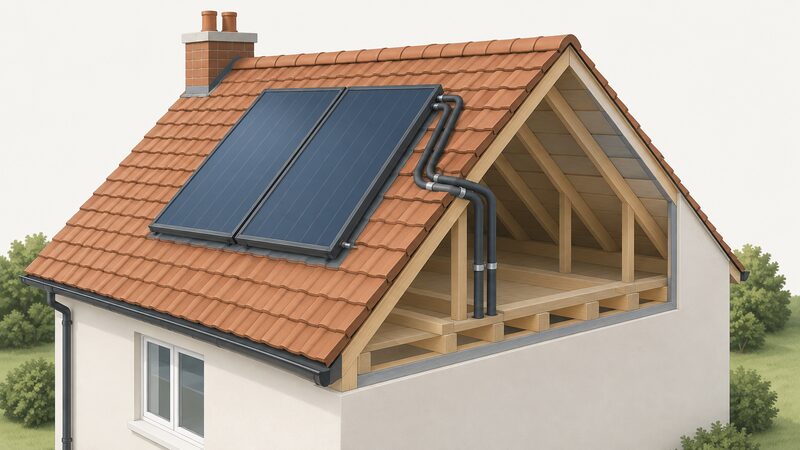
The pump station is the part most often asked about. CTC describes it as a compact solar pump station for solar heating1. Official guidance groups that kind of unit with the associated pipework and equipment that sits alongside solar collectors, such as evacuated tube or flat plate systems, together with circulation systems, pump, storage cylinder, control panel and heat exchangers2.
For a household, the appeal is straightforward: solar thermal uses the sun's energy to heat water and needs roof space with good sun exposure3. The dependence that remains is equally clear. A solar thermal system does not replace a boiler or a cylinder's conventional heat source, it works alongside one, and the pump station, controller and any remote monitoring tie the installation to a manufacturer's parts and settings.
What the CTC EcoSol range is
The EcoSol name covers CTC's solar thermal offer: the collectors that sit on the roof, the pump station that circulates fluid through them, and the controls and cylinder connections that turn the array into a working hot water system. CTC is a heating brand whose wider product documentation sits alongside its heat pump controls, and the EcoSol declaration of conformity was issued by Enertech AB on 13 September 2007, covering the Pressure Equipment, EMC and Low Voltage directives and listing the EN standards used for checking conformity.
That 2007 date is the single most useful fact about the range for a UK householder today. It tells you the product line is long established rather than current, and it means the paperwork a buyer or installer needs is a historical document rather than a live certificate. It does not by itself say the range has been withdrawn, and no source here states that it has. What it does mean is that anyone specifying an EcoSol system now is working with a design that predates the current generation of solar thermal controls.
Solar thermal as a category is well understood. Official Welsh Government guidance describes these systems as using the sun's energy to heat water and requiring roof space with good sun exposure3. The same guidance notes that different collector types will have different efficiencies and will come in different sizes, and that east or west installations can also provide good performance4. That matters for the EcoSol question because it means a roof that faces east or west is not automatically ruled out, and because collector choice, not the pump station, is what sets the ceiling on how much heat the array can gather.
For a household, the range sits in the same place as any solar thermal system: it reduces the amount of gas, oil or electricity needed to bring a cylinder up to temperature, and it does nothing at all about space heating or about the electricity supply. The sections below set out what each part does and what the certification position actually is.
The CTC solar pump station: what it does
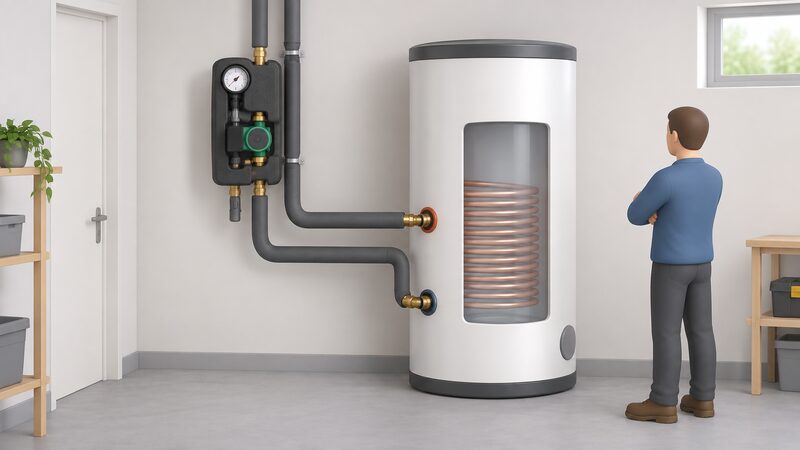
The pump station is the mechanical heart of a solar thermal system. CTC's own description is short: a compact solar pump station for solar heating1. In practice that unit sits between the collectors on the roof and the cylinder below, circulating the heat transfer fluid through the array and back to the coil or heat exchanger that transfers the gathered heat into stored water.
Official guidance sets the pump station in its proper context. It describes solar collectors, such as evacuated tube or flat plate systems, together with associated pipework and equipment, such as circulation systems, pump, storage cylinder, control panel and heat exchangers, as the assembly that makes up a solar water heating installation2. The pump station is one of those associated parts. It is not a collector and it is not a cylinder; it is the circulation and control hardware that connects the two.
That framing answers the question of whether a pump station is tied to one collector brand. Because the guidance treats the circulation system, pump, storage cylinder, control panel and heat exchangers as associated equipment rather than as collector-specific items, matching a pump station to a collector array is a matter of system design and controller settings. The practical constraints are the ones any installer would check: flow rate and pressure drop across the array, the fluid volume the system holds, the temperature the collectors reach under stagnation, and whether the controller's sensor inputs and pump outputs suit the array being fitted.
"Compact solar pump station for solar heating"
What the pump station does not do is generate anything. It moves heat that the collectors have already gathered, and it stops when there is no useful heat to move. Its energy use is a small parasitic load on the system, and its reliability matters more than its efficiency, because a failed circulation pump on a sunny day is what allows a collector array to stagnate at high temperature.
EcoSol components and how a system fits together
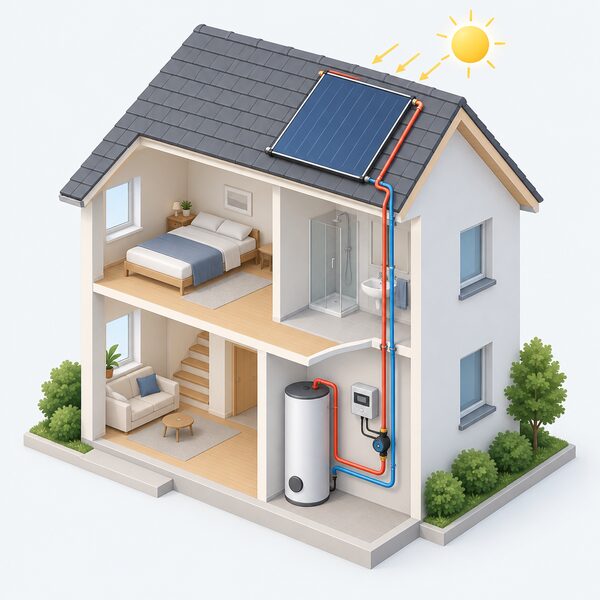
A solar thermal installation is a small plumbing and control system, and the EcoSol range follows the same pattern as any other. The components official guidance lists are the collectors, the circulation system and pump, the storage cylinder, the control panel and the heat exchangers2. Each has a job, and the system only works when they are sized to each other.
The collectors are the part that varies most. Guidance distinguishes evacuated tube from flat plate systems and notes that different types will have different efficiencies and will come in different sizes4. Orientation is more forgiving than many householders expect: east or west installations can also provide good performance, not only due south4. Roof space and exposure remain the binding constraints, since the system needs roof space with good sun exposure3.
The cylinder is where the gathered heat ends up, and it is the component that decides how much of the solar gain a household can actually use. A solar thermal cylinder stores water heated by the array and topped up by the conventional heat source when the sun does not deliver. The control panel decides when the pump runs, comparing collector temperature with cylinder temperature so that the system only circulates when there is a genuine gain to be had.
CTC's wider control range shows how the company approaches multi-source heating. The CTC EcoLogic range is described as able to combine different energy sources within a single system, for example ground source heating and air-to-water1. The EcoLogic L is documented for larger installations, supporting up to ten heat pumps, with functions such as pool control and cooling1. That is a heat pump controller rather than a solar thermal controller, but it indicates the design philosophy the EcoSol controls sit within: one panel arbitrating between several heat sources rather than a standalone solar unit.
For a household, the practical consequence is that the solar thermal array is a contributor, not a replacement. It reduces run hours on the boiler or heat pump across the sunnier half of the year and does very little in midwinter. The system's independence value is measured in avoided fuel, not in autonomy.
Certification and the declaration of conformity
The EcoSol declaration of conformity was issued by Enertech AB on 13 September 2007. It states conformity with the Pressure Equipment, EMC and Low Voltage directives and lists the EN standards used for checking conformity. Those three directives cover the pressure side of the system, electromagnetic compatibility and electrical safety, which are the areas a solar thermal appliance with a pump and controller touches.
For solar thermal products more broadly, the certification landscape runs through two routes. The Microgeneration Certification Scheme requires thermal solar systems and components to comply with BS EN 12975-15. Separately, Solar Keymark certificates are awarded by an empowered certification body, which is the organisation responsible for awarding Solar Keymark certificates6. MCS product certification is described as ensuring compliance with UK regulations7, and certification on the installer side shows that a chosen contractor is competent to install and maintain low carbon technologies8.
On the market side, Energy Related Products that carry the CE Mark can currently be sold in Great Britain if they comply with GB ecodesign standards, without the need to also affix a UK Conformity Assessment marking9. The same position is restated in later consultation material: CE marked products can be sold in Great Britain if they are compliant with GB ecodesign standards, without also affixing a UKCA marking10. The extended CE marking recognition applies to England, Scotland and Wales9.
What this means for an EcoSol owner is that the declaration of conformity is the document to hold, and that it is a 2007 document. It evidences the directives the product was checked against at the time. It is not a current MCS certificate, and no source here states that the EcoSol range holds one. Where a household needs an MCS-certified installation, for a grant or for a scheme, that is a separate question from the declaration of conformity and should be checked against the MCS certification for solar route.
What EcoSol means for household energy independence
Solar thermal's contribution to independence is real but narrow. It displaces fuel that would otherwise be burned or bought to heat water, and it does so without any dependence on the electricity grid for the collection itself, since the collectors are passive and the pump is the only powered part. Official guidance describes the technology plainly: these systems use the sun's energy to heat water, requiring roof space with good sun exposure3.
The dependence that remains is worth stating as firmly as the benefit. A solar thermal system needs a cylinder, and that cylinder needs a conventional heat source for the months and the days when the array cannot keep up. It needs a pump station and a controller, which are manufactured parts with finite lives and brand-specific spares. It needs an installer who understands the system, and the certification framework that supports that is the same one that covers heat pumps and solar panels8. And it needs a household to be at home to use the hot water, or a cylinder large enough to hold it until they are.
The wider policy context is about reducing household energy costs and carbon emissions rather than about self-sufficiency. The Energy Company Obligation is described as helping to make homes more energy efficient by installing improvements, free of charge to eligible households11, and its stated aim is to reduce household energy costs and reduce carbon emissions12. ECO4 is described as a UK Government scheme offering free renewable energy installations, such as heat pumps and solar PV, to low-income and poorly-insulated homes13, and as designed to tackle fuel poverty while also reducing carbon emissions through supporting whole house energy efficiency improvements for eligible households14. The scheme is UK-wide, helping low income and vulnerable households make their homes more energy efficient15, and it targets improving the least efficient homes in Great Britain16.
Solar thermal is not the technology those schemes are built around. The measures named in the sources are heat pumps and solar PV, and the certification requirement for low carbon heat and microgeneration installations under ECO4 runs through the Microgeneration Certification Scheme or an equivalent scheme operated by a person accredited to ISO/IEC 17065:201217. A household weighing an EcoSol system against a grant-funded route should understand that the grant landscape points at other technologies. For the electricity side of independence, the solar PV pillar guide sets out what panels and inverters do, and solar water heating covers the collector technology in more depth.
Owning an EcoSol system in the UK: practical points
The practical questions for an EcoSol owner are spares, service and paperwork. The declaration of conformity dates from 13 September 2007, so the range is old enough that any installation in the UK is a legacy system rather than a recent one. No source here states that CTC has withdrawn support for it, and none states that support continues. That uncertainty should be treated as the central practical risk: a pump station or controller that fails on a 2007-era system may be repairable, replaceable with a current equivalent, or neither, and only the manufacturer or a specialist installer can say which.
The certification position is more settled. CE marked Energy Related Products can be sold in Great Britain if they comply with GB ecodesign standards, without also affixing a UKCA marking10, and that recognition applies to England, Scotland and Wales9. For thermal solar systems and components, the relevant standard is BS EN 12975-15, and Solar Keymark certificates are awarded by an empowered certification body6.
On cost, no published price for the EcoSol range appears in the sources here, so prices are installer-quoted. The same is true of service and spares. A household should expect any quote to depend on the state of the existing array, the cylinder and the pipework, and on whether the controller is being replaced alongside the pump station.
For households comparing routes, the useful context is that solar thermal is one of several ways to use a roof. Solar thermal vs solar PV sets out the trade-off between heat and electricity, solar thermal cylinders and controls covers the storage and control side in detail, and solar thermal roof space deals with the siting question. Where a household already has a boiler, can my boiler work with solar water heating explains how the two heat sources share the cylinder.
Sources17 cited
- CTC EcoLogic control for CTC heat pumps, CTC, 2026
- VAT Energy Saving Materials and Grant Funded Heating Supplies (VENS AV3060), HM Revenue & Customs, 2026
- Sustainable home energy solutions, Planning Portal, 2024
- Generating your own energy: solar water, Welsh Government, 2018
- MCS Microgeneration Certification, BSI, 2026
- Solar Keymark Network: certification, Solar Heat Europe, 2026
- Certifying your product, MCS Certified, 2026
- How heat pumps work: a guide for homeowners, NICEIC, 2025
- Extended CE marking recognition for Ecodesign regulations, Department for Business and Trade, 2025
- Extended CE marking recognition for Ecodesign regulations: consultation document, Department for Business and Trade, 2026
- ECO4 Flex open, South Cambridgeshire District Council, 2026
- Energy Company Obligation ECO4 scheme, Derbyshire County Council, 2026
- ECO4 consumer grants and incentives, MCS Certified, 2026
- ECO4 scheme, West Lindsey District Council, 2025
- Grants and funding for energy bills, StepChange, 2026
- ECO 4 and ECO Flexible Eligibility, Breckland Council, 2026
- Energy Company Obligation 4 and the Great British Insulation Scheme: mid-scheme changes, Department for Energy Security and Net Zero, 2024
 CTC heatingThinking about a CTC heat pump for your home?
 CTC heat pumpsThinking about a CTC heat pump for your home?
 CTC Heating ControlsWhich controls work with a CTC heat pump, and can you add wireless room sensors?
 CTC EcoHeat 300 ground source heat pumpOwn a CTC EcoHeat 300 and need the manual or help with a fault?