
In this guide
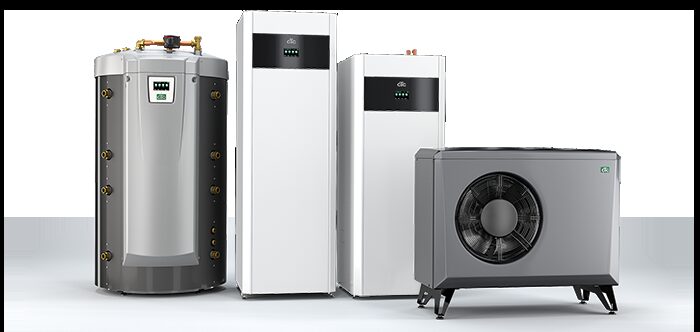
CTC Heating sells air-to-water and ground source heat pumps, accumulator tanks, mixing valve groups and a heat pump water heater into the UK market. The range is built around the EcoAir and CombiAir air-to-water heat pumps, the EcoHeat 400 ground source unit, the EcoLogic control system and the CTC Water Heater, which its datasheet lists with a COP of 3.15 and an XXL draw profile1.
The brand sits in a small part of the UK heating market. Independent research published in July 2026 puts heat pump ownership at around 2 to 3% of UK households, so a CTC installation is still an early-adopter choice rather than a mainstream one5. The direction of travel is set out in official projections: the Climate Change Committee's CB7 Balanced Pathway Scenario estimates approximately half of UK homes being heated by heat pumps, and from 2035 onwards it projects that all new heating systems installed in homes will be low carbon6.
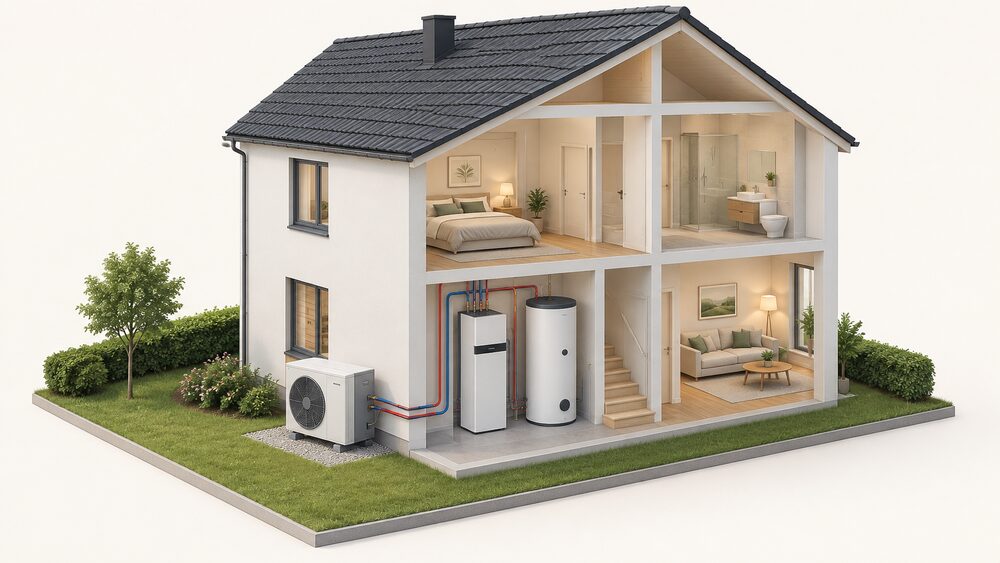
For a household, the appeal is fuel switching. A heat pump runs on electricity rather than gas, which removes the gas supply from the equation but replaces it with a larger electricity demand and, in most cases, a continued reliance on the grid and a supplier. The sections below set out what each part of the CTC range does, what the paperwork covers, and where the dependencies remain.
CTC in the UK: who makes the range and what it covers
The declarations of conformity in CTC's own document library identify Enertech AB, based in Ljungby, Sweden, as the issuing company for most of the range. The earliest dated declaration covers the CTC 1100 Family 25, 1100 Family 40 and 1100 Miljö boilers, issued by Bentone AB in September 1998. Enertech AB then issued the manufacturer declaration for the CTC EcoLogic on 21 February 2005, signed the CTC EcoAir manufacturer declaration in Ljungby on 4 May 2005, and declared CTC EcoEl compliant with the listed directives and standards on 12 May 20064.
That history matters for a UK buyer because it shows a long product line rather than a single appliance. The current catalogue spans air-to-water heat pumps, ground source heating, accumulator tanks, volume tanks, mixing valve groups and a domestic hot water heat pump. The EcoLogic control system is described as monitoring and controlling CTC's heat pumps, additional heating, buffer tanks, pools, cooling and more, and is listed as compatible with CTC EcoAir 600M existing installations2.
The UK context is one of low but rising deployment. Around 2 to 3% of UK households heat their homes with a heat pump, according to independent research, against a policy projection of roughly half of homes on heat pumps under the CCC's balanced pathway5. The Heating and Hotwater Industry Council states that its membership base covers approximately 94 per cent of heating and hot water solutions available in the UK, which is the trade body landscape any manufacturer sells into9.
Heat pumps: EcoAir and CombiAir, heating and cooling from one unit
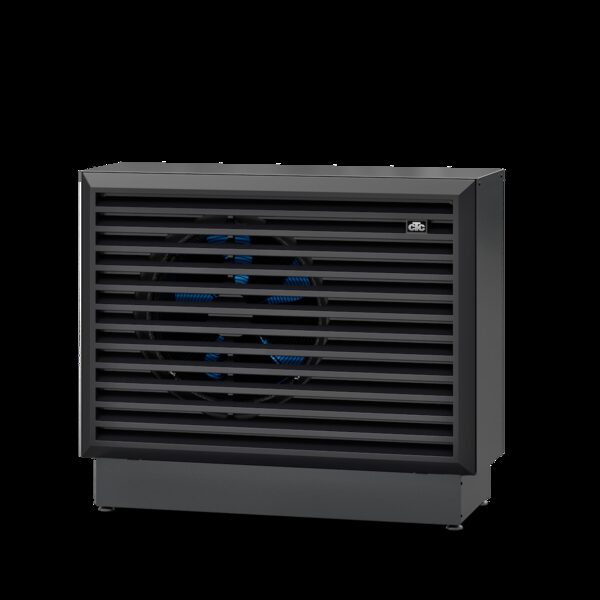
The CombiAir is a series of speed-controlled air-to-water heat pumps that use outdoor air as the energy source and are intended to be connected to water-borne heating systems. CTC states that the series can produce both hot water and cooling, and that when installed with the CTC EcoZenith i360 indoor module the result is a complete heating, cooling and hot water system. Control runs through that indoor module, listed as the EcoZenith i360 H/L1.
The EcoAir 600M is described as a series of ultra-efficient, speed-controlled air-to-water heat pumps that convert energy in the air into heating and hot water, producing hot water of up to 65 °C2. The two families therefore overlap in function but differ in how the system is assembled: the CombiAir pairs with an indoor module that also handles hot water and cooling, while the EcoAir line is controlled through the EcoLogic system alongside buffer tanks and other components1.
Cooling is the feature that separates this range from a conventional gas boiler replacement. A water-borne system that can circulate chilled water gives a household a summer function from the same equipment, though it depends on the emitters and controls being specified for it. The EcoHeat 400 ground source unit can also be supplemented with CTC Comfort for cooling3.
On the wider evidence base, independent guidance describes air-to-water heat pumps as typically achieving a COP of around 3, meaning three units of heat for every unit of electricity used10. That is a general figure for the technology rather than a rating for any CTC model, and it sits close to the 3.15 the maker lists for its water heater4.
Boilers and hot water: the EcoHeat, EcoPart and EcoLogic lines
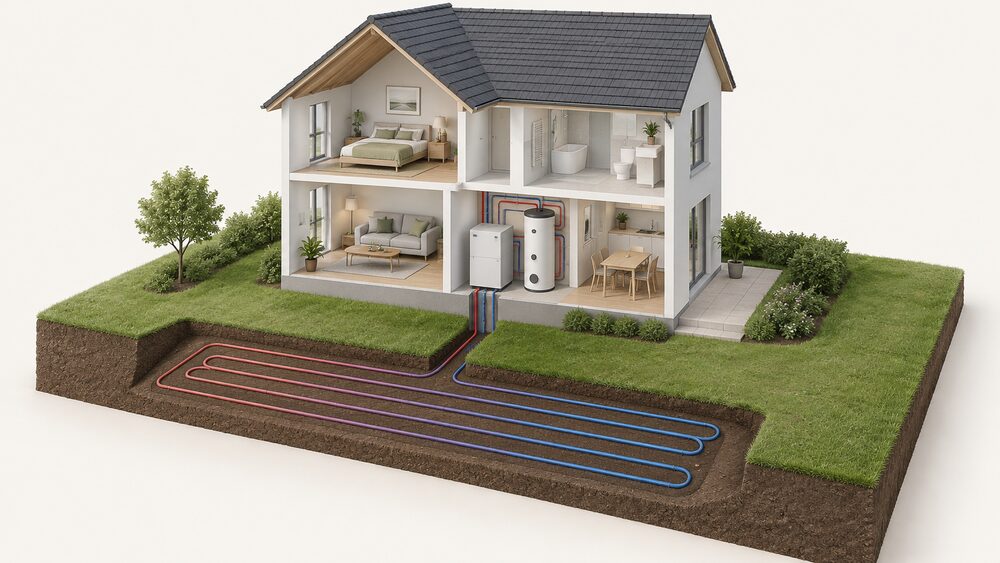
The EcoHeat 400 is a ground source heat pump rather than a combustion boiler, and CTC describes its hot water behaviour plainly: it produces fresh hot water in step with your use, and is suitable for households with slightly lower hot water requirements3. That is a different proposition from a stored cylinder, and it means the unit's hot water performance is tied to how it is sized and how the household draws water.
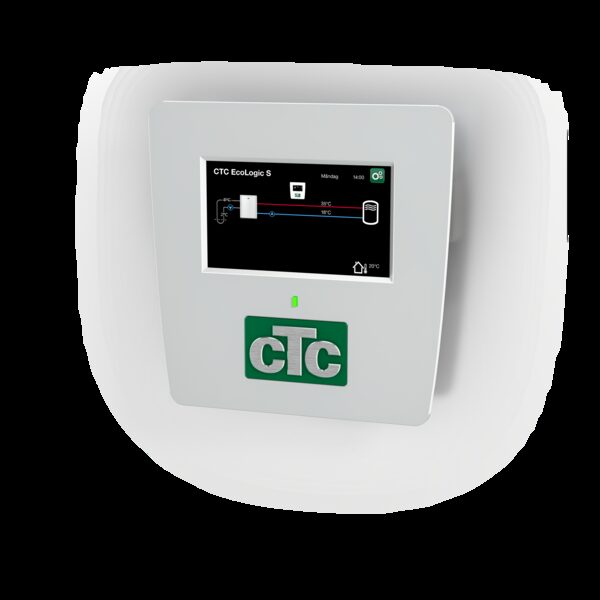
The EcoLogic control system is the hub for the wider range. CTC describes it as a unique control system that monitors and controls CTC's heat pumps, additional heating, buffer tanks, pools, cooling and more, and lists it as compatible with CTC EcoAir 600M existing installations2. The EcoLogic S compatibility is documented in two different ways: one maker page ties it to CTC EcoPart 400-600M geothermal heat pumps, another to CTC EcoAir 400-700M air-to-water heat pumps.
The EcoPart line appears in the conformity paperwork rather than the current product pages. Enertech AB issued a declaration of conformity on 7 May 2012 covering CTC EcoPart models 406, 408, 410, 412, 414, 417, 424 and 4344. The EcoHeat 300 manual is dated 8 April 2013 and covers models 306 I, 308 I, 310 I and 312, while the conformity declaration for the EcoHeat 306, 308, 310 and 312 is dated 12 August 20114.
For a household, the practical point is that the EcoHeat and EcoPart lines are established products with dated documentation, and the EcoLogic controller is the piece that ties them together. A system built this way is a heat pump system with a control layer, not a boiler with a programmer.
Water heating: the CTC Water Heater with a COP of 3.15 and an XXL draw profile
The CTC Water Heater is a heat pump for producing domestic hot water, and its datasheet gives the figures a household would want to check. The listed COP is 3.15, the heat pump input power is 714 Watt WP and the delivered output power is 3290 Watt WP. Water temperature is adjustable to a maximum of 62 °C, and the unit operates on outside air from -10 °C to +35 °C4.
The draw profile is listed as XXL. Draw profile describes how much hot water a unit can deliver across a defined pattern of use, so a larger profile indicates capacity for heavier simultaneous demand rather than a larger tank alone. The same datasheet gives a minimum ceiling height of 2300 mm, a minimum fuse rating of 13 A and an adjustable air volume4.
"COP 3.15"
A COP of 3.15 means the unit delivers 3.15 units of heat for each unit of electricity consumed. Running cost therefore tracks the price of electricity rather than the price of gas, and the figure is a laboratory or declared value rather than a guarantee of in-home performance. Independent guidance puts air-to-water heat pumps at a COP of around 3 as a general expectation, which gives a sense of where 3.15 sits10.
The EcoAir 600M produces hot water of up to 65 °C, and the EcoZenith i360 indoor module produces over 300 litres of hot water when combined with a CTC heat pump1. Those figures describe different parts of the system, so a household comparing hot water capacity should look at the combination rather than a single number.
System components: accumulator tanks, shunt groups and why they matter
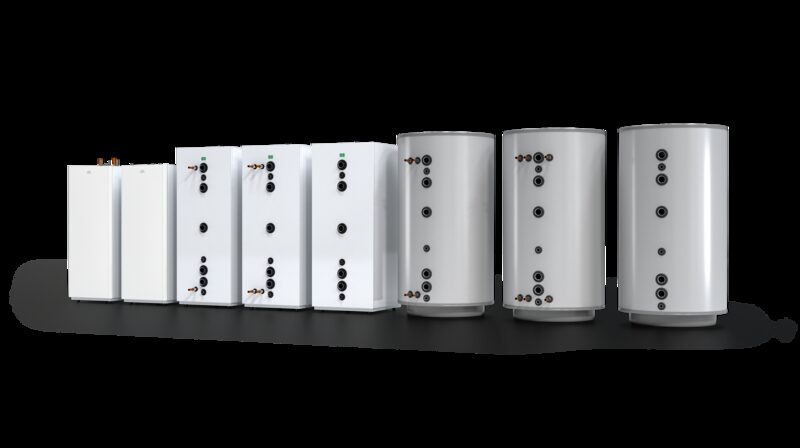
Accumulator tanks store heat until it is needed, and CTC describes the principle as working like a large thermos. The tanks connect to a heat pump or wood-fired boiler from CTC, and the AT range can be combined with a ground source heat pump or air-to-water heat pump. The range includes coil tanks for efficient domestic hot water heating and accumulation tanks designed for hot water storage and energy optimisation, and CTC states the intended use is homes with high heating and domestic hot water demand8.
Sizing is not fixed. CTC states that the size of the tank needed depends on the size of the home and the type of heat source installed8. That makes the tank a design decision rather than an off-the-shelf addition, and it is the component that lets a heat pump run in longer, steadier cycles instead of short bursts.
The VT volume tanks serve a different purpose: they are volume tanks specially designed for heat pump systems, described as a flexible solution for a wide range of heating installations, and they reduce unwanted noise in the heating system8.
The mixing valve groups handle multiple circuits. CTC states that with the Extra Mixing Valve Group or Mixing Valve Group 2 accessories, two separate heating systems can be controlled from the EcoHeat 400, and the Mixing Valve Group 2 is listed for installing an additional heating circuit3. That suits a property with radiators in one zone and underfloor heating in another, each needing its own flow temperature.
Declarations of conformity: what the paperwork covers and why it matters
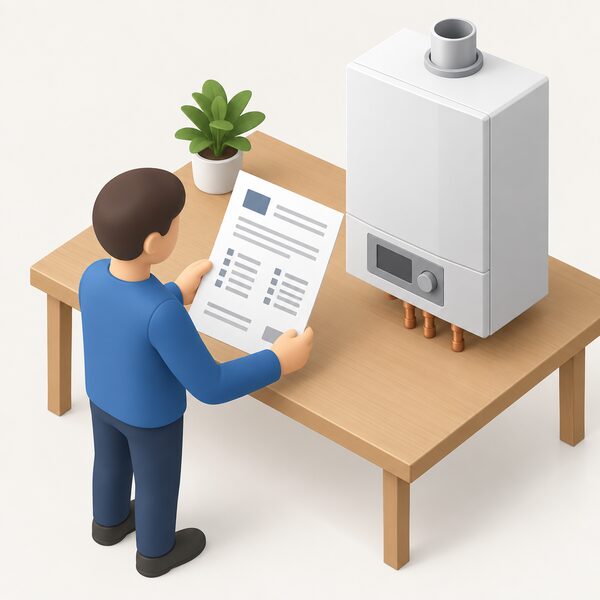
CTC's document library holds dated declarations of conformity and manufacturer declarations going back to 1998. The pattern is consistent: a named company, a place of issue, a date and a list of the directives and standards the product was checked against. Enertech AB issued the CTC EcoSol declaration on 13 September 2007, stating conformity with the Pressure Equipment, EMC and Low Voltage directives and listing the EN standards used. The CTC EcoAir declaration followed on 20 November 2009, and the CTC 950 Condens declaration is dated 8 December 20104.
The CE and UKCA mark and the Declaration of Conformity can only be applied to a product once specific requirements have been met, including provision of the necessary technical documentation11. That is the framework the CTC documents sit inside, and it is why the paperwork names standards rather than simply asserting compliance.
For a household, the declaration is part of the installation record. A suitable commissioning certificate must confirm compliance with all aspects of the design, installation and commissioning requirements and be supplied to the SAP assessor where a low-temperature domestic heating system is being assessed12. Government has cited the need to provide a commissioning checklist as evidence that commissioning has been carried out correctly, referencing MCS and Heat Pump Association documents as examples13. Where a heating system is altered or replaced, a certificate should be issued to show that the necessary checks have been carried out14.
The grant route reinforces this. Warm Homes: Local Grant rules state that MCS certification is required for low carbon heating measures, with the exception of high heat retention storage heaters covered by PAS 203015. Heat pump installations must have metering information added to the MCS Certificate16. MCS 007 is the certification route for heat pumps17.
What owning CTC equipment means for household energy independence
A CTC heat pump changes what a home depends on. It removes the gas supply and the gas meter from the heating equation, and replaces them with electricity, which in most UK homes still comes from the grid and a supplier. The household gains control over the fuel source only if it also generates its own electricity, and even then the heat pump's controls, pumps and any remote functions draw power.
The maker's own claims are the most favourable figures available and should be read as such. CTC states that the EcoHeat 400 produces up to 80 % lower heating costs, and the water heater datasheet states it makes it possible to save up to 75 % of the cost of heating water3. Both are maker claims rather than independently verified results, and both depend on what the system is replacing and how electricity and the alternative fuel are priced.
The wider evidence points the same way as the policy. Independent analysis states that insulating homes and running electric heat pumps and cars on an even mix of wind and solar would boost energy independence19. The Climate Change Committee estimates that £20.5 billion of capital investment in low-carbon heating is needed by 2030 to reach the Balanced Pathway20. From 2035 onwards, official projections have all new heating systems installed in homes being low carbon7.
Consumer confidence is a live issue. More than two thirds (71%) of homeowners would be more likely to have domestic energy-efficiency measures such as heat pumps installed if the trader was independently approved and certified21. A household considering a CTC system should therefore weigh the equipment against the installer's certification and the commissioning paperwork as much as the product specification.
The dependencies that remain are concrete: the electricity grid and a supplier, the manufacturer for parts and controls, and the installer for commissioning and any warranty work. A property installing more than one low carbon technology, for example an electric car charger and a heat pump, may need to check the connection arrangements with the network operator22. Independence, on this evidence, is a matter of degree rather than a switch.
Sources22 cited
- CTC CombiAir air-to-water heat pumps, CTC Heating, 2026-09-17
- CTC EcoAir 600M, CTC Heating, 2026-09-17
- CTC EcoHeat 400 ground source heating, CTC Heating, 2026-09-17
- CTC Water Heater datasheet, CTC Heating, 2026-09-17
- Beyond affordability: why heat pumps feel like a gamble, Which?, 2026-07-02
- Energy innovation needs assessment: heat and buildings, UK Government, 2025-06
- Energy Security and Net Zero Committee report, UK Parliament, 2035
- CTC accumulator tanks, CTC Heating, 2026-09-17
- HHIC consultation response, Heating and Hotwater Industry Council, 2026-09-17
- Air source heat pumps (air to water), Nesta, 2025-02-03
- HPA statement on R290 safety zone, Heat Pump Association, 2025-10-06
- SAP low temperature heating guidance, NCM PCDB, 2026-09-17
- Future Homes and Buildings Standards consultation response, UK Government, 2026-03
- Building regulations: boilers and heating, Welsh Government, 2026-09-17
- Warm Homes: Local Grant policy guidance, UK Government, 2026-07
- Domestic RHI: eligible heating systems, Ofgem, 2026-09-17
- MCS microgeneration certification, BSI Group, 2026-09-17
- Building regulations and heating installation work, OFTEC, 2026-09-20
- Household energy buying British, Energy and Climate Intelligence Unit, 2024-04-15
- Clean heat: financing the transition, Energy UK, 2030
- Energy efficiency pledges undermined by lack of consumer confidence, Chartered Trading Standards Institute, 2024-05
- Multiple low carbon technologies at the same property, UK Power Networks, 2026-09-17
 CTC heat pumpsThinking about a CTC heat pump for your home?
 CTC Heating ControlsWhich controls work with a CTC heat pump, and can you add wireless room sensors?
 CTC EcoHeat 300 ground source heat pumpOwn a CTC EcoHeat 300 and need the manual or help with a fault?
 CTC solar thermalCan a CTC EcoSol system heat your water, work alongside your existing boiler or cylinder, and keep running costs down?