
In this guide
The CTC EcoHeat 300 is a Swedish-built ground source heat pump from CTC, documented in a manual dated 8 April 2013 that covers the 306 I, 308 I, 310 I and 312 models1. It is no longer the current model in CTC's ground source line: the maker's ground source pages now describe the EcoHeat 400, which CTC calls a ground source heat pump producing fresh hot water in step with use and suitable for households with slightly lower hot water requirements2.
That distinction matters more than any single specification. Anyone searching the EcoHeat 300 by name is usually holding one of three positions: they own an installed unit and need documentation or a fault route, they are buying a property that has one, or they are comparing it against the current range. The third is the hardest to answer directly, because CTC's published compatibility lists name the EcoHeat 400 rather than the 3003.
No full technical datasheet for the 300 itself is published. There is no published output range, no COP or SCOP figure, no refrigerant type and no price for the 300. Where a figure is given below for a CTC ground source product, it belongs to the EcoHeat 400 or to a related CTC component, and it is labelled as such. Treat any number attached to the 300 by name with caution unless it comes from the unit's own manual.
What the CTC EcoHeat 300 is
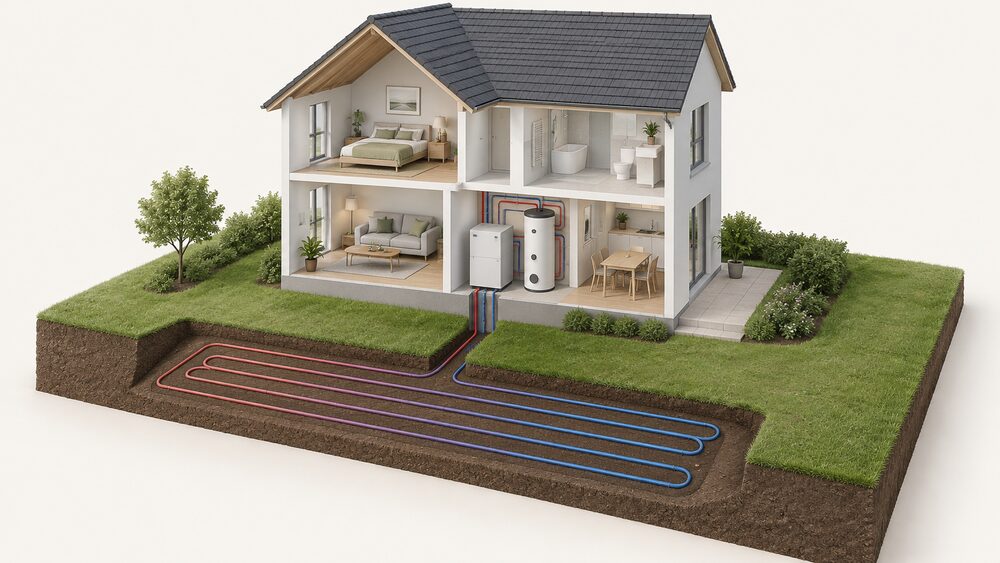
The EcoHeat 300 is a ground source heat pump, a type that takes low-grade heat from the ground through a loop or borehole and raises it to a temperature usable by radiators, underfloor heating or a hot water cylinder. CTC's own description of the current EcoHeat 400 sets out what the family does: it produces fresh hot water in step with use, suits households with slightly lower hot water requirements, and is SmartGrid-ready2. The 300 sits earlier in that lineage.
The manual is the anchor document. It identifies itself with the date 2013-04-08 and covers the CTC EcoHeat 300 models 306 I, 308 I, 310 I and 3121. The same file also carries the conformity declaration that Enertech AB dated for the CTC EcoHeat 306, 308, 310 and 312 models on 12 August 20111. The model numbering is therefore consistent across the manual and the declaration: four outputs, with the "I" suffix distinguishing the indoor variants.
Ground source differs from air source in ways that shape everything else on this page. The collector is buried, so there is no outdoor fan unit and no defrost cycle, and the heat source temperature is stable across the year rather than tracking air temperature. That stability is the reason ground source systems are often specified where land is available for a loop or a borehole can be drilled. The trade-off is that the ground works are a separate, disruptive and site-specific cost, and no figure for them is published.
Who makes it: CTC of Ljungby, Sweden

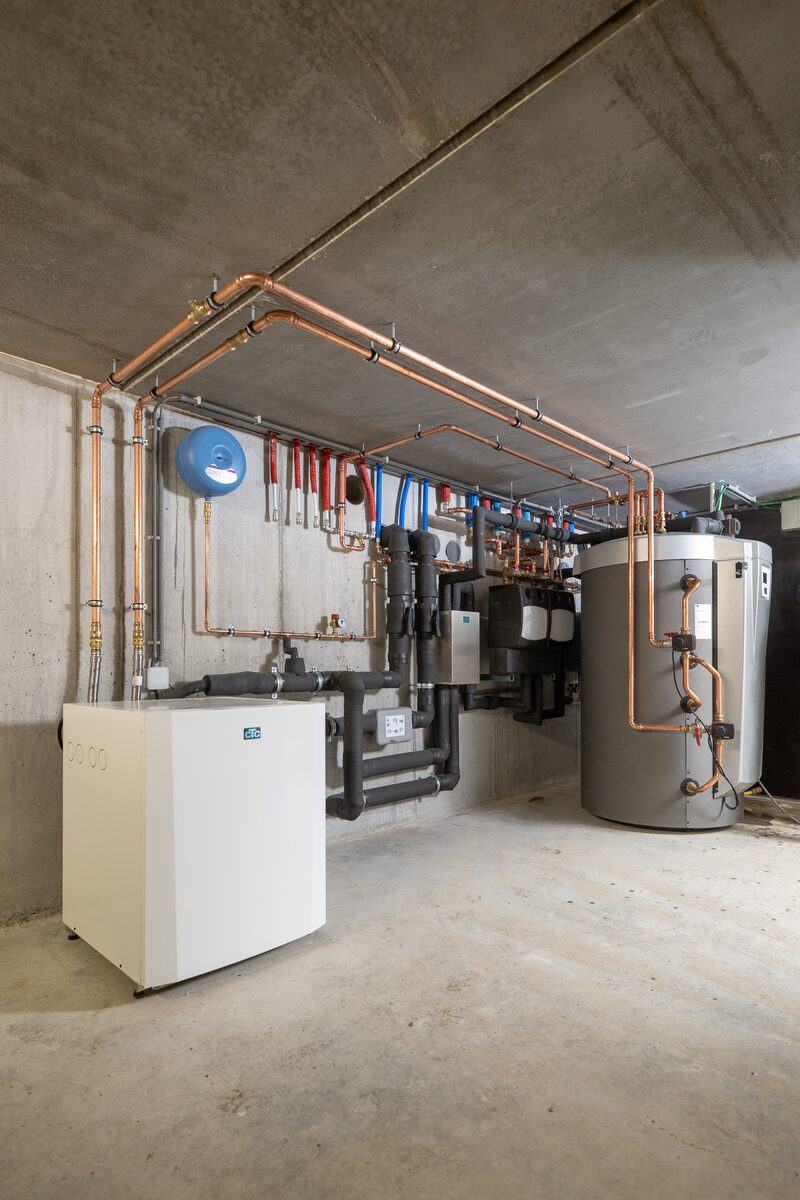
CTC is a Swedish manufacturer. The Heat Pump Keymark certificate for a CTC product records the manufacturing site as Ljungby, Sweden4, and CTC states that development and manufacture of its indoor modules take place at its factory in Småland6. Ljungby is in Småland, so the two statements describe the same operation.
The corporate history visible in the documentation runs through Enertech AB. The manufacturer declaration for CTC EcoLogic is dated 21 February 2005 and identifies Kent Karlsson as technical manager, and the CTC EcoAir manufacturer declaration was signed by Enertech in Ljungby on 4 May 2005. Enertech AB also issued the declaration of conformity for CTC EcoAir products on 20 November 2009, and the declaration covering CTC EcoPart models 406, 408, 410, 412, 414, 417, 424 and 434 on 7 May 2012. The EcoHeat declaration of 12 August 2011 is in the same series1.
For a household, the practical reading is that the EcoHeat 300 is a Swedish-engineered product from a manufacturer with a long documented conformity trail, and that the paperwork trail is the thing to keep. Declarations of conformity are what an installer, a building control officer or a future buyer will ask for when the unit changes hands. Whether CTC has a UK subsidiary, a UK distribution arrangement or a UK spares operation is not stated, so the support position for an installed 300 cannot be confirmed.
Where it sits in CTC's ground source range
CTC's current ground source line is described across several product pages. The EcoHeat 400 is the direct successor to the 300 and is described by the maker as a ground source heat pump2. The GSi 600 is described as CTC's most efficient ground source heat pump, and the GS 600 as a slightly simpler ground source heat pump for villas and terraced houses7. The EcoPart range appears in CTC's compatibility lists and in the EcoZenith i360 page, where CTC states that "CTC EcoPart is the ideal choice" as the ground source partner for that indoor module8.
| CTC ground source product | Maker's description | Source |
|---|---|---|
| EcoHeat 400 | Ground source heat pump; fresh hot water in step with use; SmartGrid-ready | 2 |
| GSi 600 | CTC's most efficient ground source heat pump | 7 |
| GS 600 | Slightly simpler ground source heat pump for villas and terraced houses | 7 |
| EcoPart range | Named by CTC as the ideal choice with the EcoZenith i360 | 8 |
| EcoHeat 300 | Earlier line, 306 I to 312, manual dated 2013 | 1 |
The EcoHeat 400's published item numbers show how the range is structured: 406, 408, 410 and 412, each also offered in a 1x230V variant, with item numbers 586610001 to 586610004 and 586611002 to 5866110042. The 300's four models, 306 I to 312, follow the same output-led naming. The 300's outputs in kW are not published, so the numbering cannot be mapped to a heating capacity.
What the range position means in practice is that the 300 is a legacy product. Parts, accessories and control compatibility are published for the current line, and the compatibility lists are explicit about which products they cover. A household with an installed 300 is therefore working from the manual and from whatever the installer holds, not from the current accessory catalogue.
Documentation and declarations of conformity
The EcoHeat 300's paperwork is unusually well dated for a product of its age. The manual carries the date 2013-04-08 and covers models 306 I, 308 I, 310 I and 312, and the conformity declaration for the 306, 308, 310 and 312 is dated 12 August 20111. Both documents sit in the same file, which is why the model list appears twice.
Conformity documentation is not a formality. The routes an installer can use to demonstrate that a heat pump installation meets the relevant standard are set out in official guidance: PAS 2030 and 2035:2019, MCS, Heat Trust, or another standard certified by an organisation accredited to ISO 170659. A manufacturer's declaration of conformity is the document that supports the product side of that chain. The Heat Pump Keymark certificate for a CTC product shows the same principle at product level, stating that the certificate entitles the holder to use the mark of conformity in conjunction with the specified registration number4.
"This certificate entitles the holder to use the mark of conformity shown above in conjunction with the specified registration number."
Two further documentation points bear on any heat pump, including this one. First, cyber security requirements for energy smart appliances are being formalised, and conformity with EN 18031-3:2024 will be accepted as an equivalent route to compliance alongside ETSI EN 303 64510. That applies to connected appliances rather than to a 2013 ground source unit, but it indicates the direction for any replacement controls. Second, scheme rules for heat pump work are maintained separately: the Flexi-Orb Heat Pump Scheme assesses to the requirements of ISO/IEC 17067:201311, and the MCS solar heating installation standard MIS 3001 was updated to V5.1 with document reference 1053865 on 17 April 202512.

Specifications and what to check in the manual
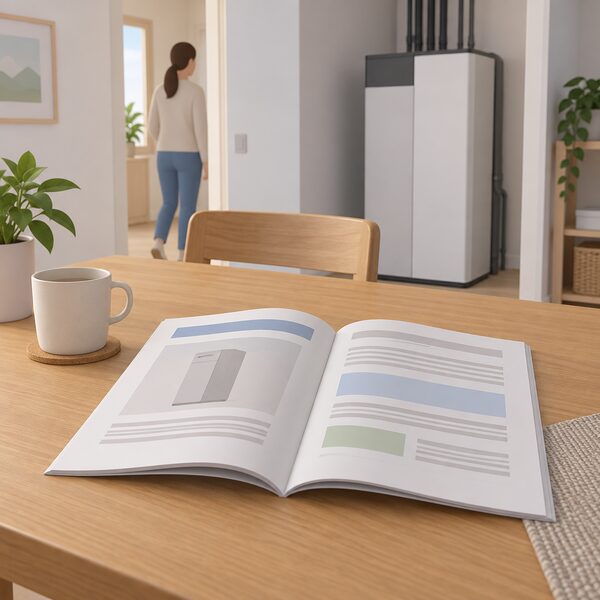
No specification table for the EcoHeat 300 is published. There is no published output in kW, no COP or SCOP, no refrigerant designation and no declared sound power for the 300. Anyone quoting those figures for this model is quoting from somewhere else.
What can be said with a source behind it is narrower. The model line covers 306 I, 308 I, 310 I and 3121. The EcoHeat 400, the current equivalent, is SmartGrid-ready and can be supplemented with CTC Comfort2. CTC's EcoLogic control system is described as monitoring and controlling CTC's heat pumps, additional heating, buffer tanks, pools, cooling and more13. A CTC water heater datasheet in the same documentation set gives a COP of 3.15, a draw profile of XXL, energy class A and a 2000 Watt/230 V heating element14. Those figures belong to that water heater, not to the EcoHeat 300, and should not be transferred.
The manual is where the model-specific numbers live, and it is worth reading for four things in particular: the declared heating output for the specific model, the electrical supply requirement, the minimum and maximum flow temperatures, and the ground loop or borehole specification the unit expects. The last of these is the one most often lost when a property changes hands, because the ground works are invisible once backfilled.
How it fits a household's energy independence
A ground source heat pump changes where a home's heat comes from. Instead of a gas or oil supply, the household draws heat from its own ground and pays for electricity to move it. That is a real shift in dependence: no flue, no fuel delivery, no gas standing charge, and no exposure to the gas price. The electricity still comes from a supplier and the grid, so the dependence does not disappear, it changes shape.
The scale of the shift depends on the efficiency of the unit and the system around it. No SCOP for the EcoHeat 300 is published, so the running cost position for this specific model cannot be stated. What independent guidance does say is that efficiency in practice is a function of how the system is set up and run: the Energy Saving Trust advises on ensuring a heat pump runs efficiently, and its guidance is the practical reference for flow temperature, controls and commissioning5. A ground source unit with a stable source temperature has an advantage over air source in cold spells, but that advantage is realised only if the emitters and controls are right.
The dependence that remains is worth naming plainly. The household depends on an electricity supplier and on the grid, on a functioning ground loop that cannot easily be inspected, on the control system, and on the availability of parts and service for a discontinued model. Where the EcoHeat 400 is SmartGrid-ready2, the 300 predates that labelling, so any time-of-use or smart tariff optimisation would depend on what controls are fitted alongside it. For a wider view of what heat pumps do and do not change, heat pumps and household energy independence sets out the position, and ground source heat pumps explained covers the technology itself.
Owning one: installation kit, accessories and pairing with other CTC products
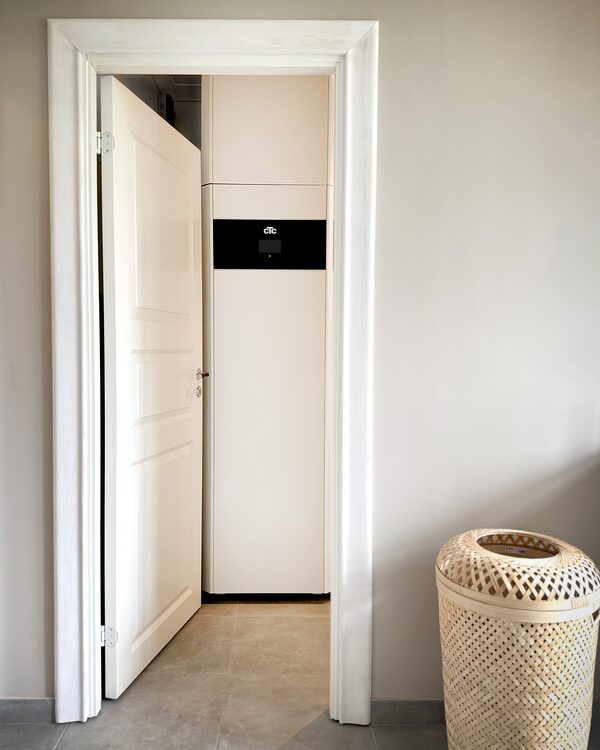
CTC publishes an accessory compatibility list, and it is the clearest signal about the 300's position. The list names the EcoHeat 400 repeatedly and does not name the EcoHeat 3003. Accessories listed as compatible with the EcoHeat 400 include the CTC Installation Kit EcoHeat 400, described by CTC as "Everything you need to install your CTC EcoHeat 400"2, the CTC Raised base II, the CTC Raised Base 168 mm, the CTC DHW button, the CTC Mixing Valve Group 2, the CTC Housing cover 488 mm, the CTC EcoComfort, the CTC Extra Shunt Group, the CTC SmartControl Gateway, the CTC SmartControl Repeater, the CTC SmartControl Multi-button and the CTC SmartControl Room Sensor3.
The EcoHeat 400 also appears in the compatibility lists for the CTC Expansion EnergyFlex II and the CTC EnergyFlex Kit 400, the latter alongside the EcoZenith i2553. On the control side, CTC states that with the Extra Mixing Valve Group or Mixing Valve Group 2 accessories, two separate heating systems can be controlled2, and that the unit is equipped for connection to Alexa, Google Home and similar platforms2.
Pairing with an indoor module is where the 300's age shows most. The EcoZenith i360 is described by CTC as a stylish, smart and economical series of indoor modules with built-in heat pump control, equipped for connection to Alexa, Google Home and similar, and able to produce over 300 litres of hot water when combined with CTC EcoAir or CTC EcoPart8. CTC recommends the EcoZenith i360 for control and hot water with the EcoAir 600M13. The EcoZenith i255 is described as a flexible indoor module combined with a heat pump, suitable for households with slightly smaller hot water needs, and the EcoZenith i555 Pro as suitable for larger houses with high hot water demand or the small rental house6. None of these pages lists the EcoHeat 300 as a compatible partner.
Faults, support and where to take a complaint
For an appliance fault, independent guidance is straightforward: check the fault log and see whether recurring fault messages appear, then speak to the installer and the manufacturer to find out what is happening5. That route applies to any heat pump, and for a discontinued model it is the installer who is most likely to hold the commissioning record and the ground loop details.
Where the problem is not the appliance but a heat network, a different route applies. The Energy Ombudsman handles heat network complaints, and consumers should first notify their heat supplier and try to resolve the issue15. The heat supplier has eight weeks to resolve the complaint15. The Energy Ombudsman can be reached on 0330 440 1624, pressing option 3 for Heat Networks when prompted16, and where a heat network is not registered on the Ombudsman's website, the same number is the route to raise a dispute17.
For installations delivered under a government scheme, the complaint route follows the scheme. Complaints about an ECO installation go through Ofgem's complaints process page18. The Boiler Upgrade Scheme works differently: the installer applies for the grant on the householder's behalf through Ofgem, and a quote is obtained through the MCS find a heat pump installer tool or from an energy supplier19. The Centre for Sustainable Energy's Energy Choices Tool is free and is intended to help households navigate smart energy options9.

Sources19 cited
- CTC EcoHeat 300 manual and conformity declaration, CTC, 2013
- CTC EcoHeat 400, CTC, 2026
- CTC accessories and compatibility, CTC, 2026
- Heat Pump Keymark certificate, CTC product, Heat Pump Keymark, 2018
- How to ensure a heat pump runs efficiently, Energy Saving Trust, 2026
- CTC indoor modules, CTC, 2026
- CTC ground source heating range, CTC, 2026
- CTC EcoZenith i360, CTC, 2026
- ECO4 guidance: new measures and products, Ofgem, 2022
- Smart Secure Electricity Systems programme: energy smart appliances regulations interim response, GOV.UK, 2026
- Flexi-Orb heat pump scheme, Flexi-Orb, 2026
- MCS publishes update to solar heating installation standard MIS 3001, MCS Certified, 2025
- CTC EcoAir 600M, CTC, 2026
- CTC water heater datasheet, CTC, 2026
- Heat networks regulation: consumer protection guidance decision, Ofgem, 2026
- Raise a dispute with the Energy Ombudsman, Energy Ombudsman, 2026
- Heat networks affected by the Energy Prices Act 2022, Energy Ombudsman, 2026
- Energy Company Obligation: contacts, guidance and resources, Ofgem, 2026
- Get a heat pump grant, GOV.UK, 2026
 CTC heatingThinking about a CTC heat pump for your home?
 CTC heat pumpsThinking about a CTC heat pump for your home?
 CTC Heating ControlsWhich controls work with a CTC heat pump, and can you add wireless room sensors?
 CTC solar thermalCan a CTC EcoSol system heat your water, work alongside your existing boiler or cylinder, and keep running costs down?