
In this guide
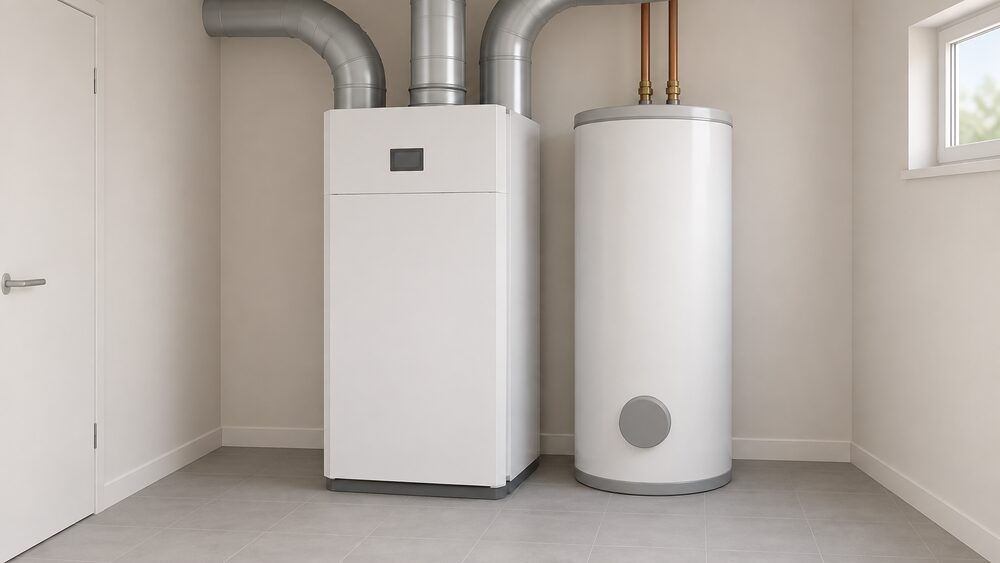
Nilan is a Danish maker of combined ventilation and heat pump units, sold in the UK as exhaust air heat pumps. The idea is one box doing several jobs at once: independent guidance describes exhaust air heat pumps as units that "combine ventilation, heating, and hot water in a single unit"1. A documented Nilan Compact P installation gathers heat, hot water, ventilation and cooling systems together, with a 180L domestic hot water store and an air/air heat pump module2.
That combination is the whole proposition. A Nilan unit replaces the extract ventilation a modern home needs anyway, recovers heat from the air it expels, and uses it for space heating and hot water. For a household, the appeal is fewer boxes on the wall and a single system to understand. The trade-off is that the heat source is the air leaving your home, so the amount of heat available is tied to how much air the building moves and how well it is insulated.
On the numbers that matter most: independent guidance puts the heat pump itself at 20 years or more, longer than the average gas or oil boiler3. Most current heat pump models work fine down to about -25°C, with some advanced cold-climate models working in temperatures as low as -35°C4. Heat pumps are able to deliver more than 3 units of heat for every unit of energy input5, and they can provide both space and water heating, which significantly lowers fuel bills6.
What Nilan makes and where the company stands in the UK
Nilan's UK position changed in September 2024, when SL Services (SLS) Ltd and TVS merged into Nuenta Ltd, a Compro Renewables company, which now holds the transferred UK trading agreement for Nilan units8. That is the practical fact a household needs: the brand is still sold and supported in the UK, but through a different company than before. Anyone holding an older quote, warranty document or service arrangement should check which entity it names.
The product itself is a Danish design, and the documented UK example is the Nilan Compact P, a technical 4-in-1 module described as an air/air heat pump with a 180L domestic hot water capacity2. The "4-in-1" label is the clearest summary of what the unit is: heat, hot water, ventilation and cooling in one appliance rather than four separate ones.
Where the company sits in the wider UK market is harder to pin down from published figures. There is no UK sales or installation figure for Nilan in the public record, and no Nilan model appears among the heat pumps carrying noise certification on the UK market9. That absence is not a judgement on the product, but it does mean a householder will find less third-party UK documentation than for the larger air source brands. The relevant comparison pages are exhaust air heat pumps and air-to-air heat pumps, since a Nilan unit sits between the two.
The range: ventilation heat pumps and what they combine
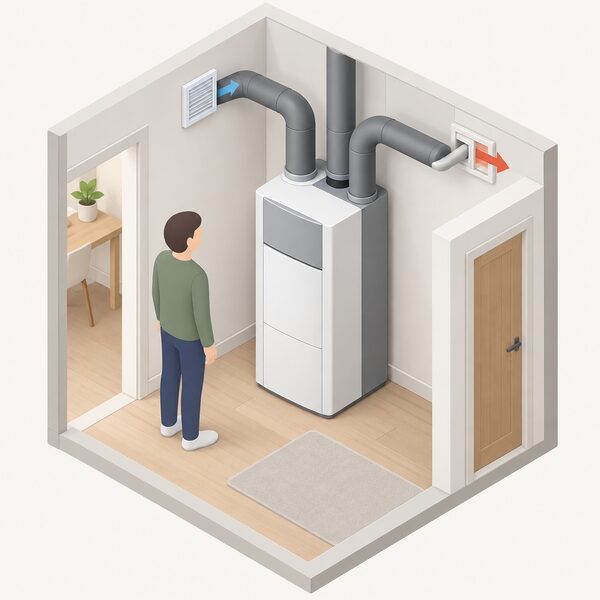
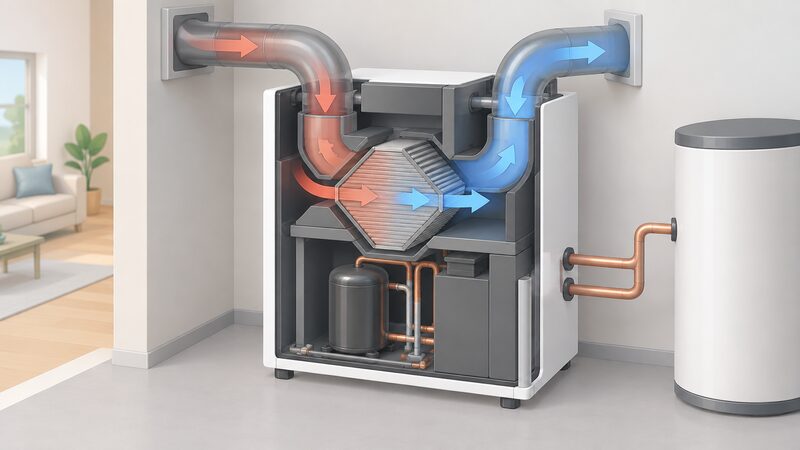
The core of the range is the exhaust air heat pump, and the defining feature is that it does several jobs at once. Independent guidance is explicit that these units "combine ventilation, heating, and hot water in a single unit"1. That is a different proposition from an air source heat pump, which sits outside and serves a wet heating system, and from a standalone mechanical ventilation unit, which only moves air.
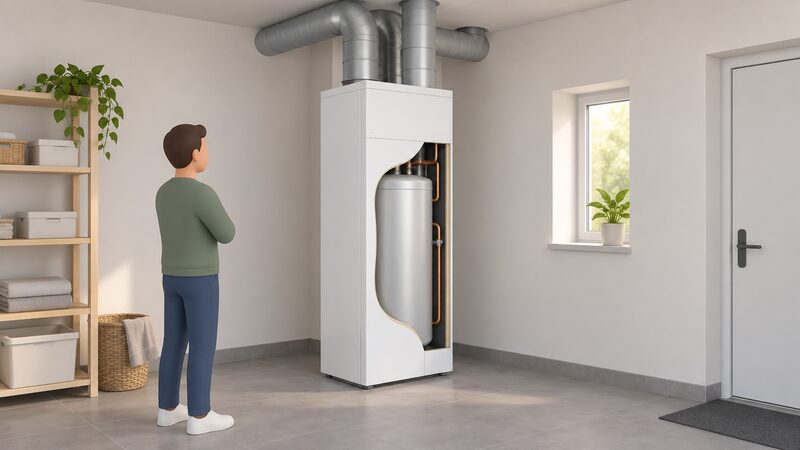
The documented Nilan model in the UK is the Compact P, described as a technical 4-in-1 module and an air/air heat pump, with a 180L domestic hot water store2. The four functions named in that case study are heat, hot water, ventilation and cooling2. In practice that means the unit handles the extract side of a whole-house ventilation system, recovers heat from the air it removes, and delivers that heat into the home and the hot water cylinder.
| Function | What the unit does | Source |
|---|---|---|
| Space heating | Delivers recovered heat into the home | 1 |
| Hot water | 180L domestic hot water store | 2 |
| Ventilation | Handles the extract side of whole-house ventilation | 1 |
| Cooling | Listed among the four functions the unit gathers | 2 |
Combination products of this kind are recognised in certification. The Heat Pump KEYMARK scheme states that it "can apply to all heat pumps, combination heat pumps and hot water heaters"9, so a combined ventilation and heat pump unit falls within the scope of European heat pump testing and certification rather than sitting outside it.
What the range does not do is replace a boiler in the way a full air-to-water heat pump does. A ventilation heat pump's heating output is limited by the air it can extract, so it is generally paired with a well-insulated, airtight home where ventilation heat loss is a meaningful share of the total. For homes where that is not the case, the wider options are set out in air-to-water heat pumps and hybrid heat pumps.
Efficiency, noise and comfort: what the specifications say
Efficiency for heat pumps generally is well documented. The government states that heat pumps are "more efficient to run, able to deliver more than 3 units of heat for every unit of energy input"5. That is a general figure for the technology, not a Nilan-specific test result, and no Nilan efficiency figure appears in the published record. What can be said is that a ventilation heat pump recovers heat that would otherwise be expelled, so the energy it captures is heat the household has already paid for once.
Noise is the specification point where a ventilation heat pump differs most from an outdoor unit. Independent guidance notes that "indoor units can be noisier than other heat pumps"10, and a Nilan unit is an indoor unit by design. That is the honest position: the compressor and fans sit inside the building rather than outside it, so the noise question is about a utility room or plant cupboard rather than a garden boundary.
Owner experience is more encouraging than that caveat suggests. In a survey of heat pump owners in Wales, 85 per cent were satisfied with noise levels7. For context on what quiet looks like in this market:
- Trianco Activair Pro R290: 38 dB(A) for the 12kW model and 39 dB(A) for the 17kW model11
- Mitsubishi Ecodan R290: Quiet Mark Certified for flexible product placement12
- Vaillant flexoTHERM ground source: noise levels comparable to a modern fridge13
- Ground source heat pumps generally: noted in an official consultation as quieter and offering increased energy efficiency14
No equivalent published figure exists for a Nilan unit.
Comfort covers both directions. Independent guidance describes heat pumps that "keep your home warm and cosy in the winter and cool and comfortable in the summer"15, and the Compact P case study lists cooling among the four functions the unit gathers2. For a household, that means summer cooling is part of the design rather than an add-on, which is covered further in using a heat pump for cooling.
Reliability by design: how the units are built to avoid common failures
The reliability of any heat pump rests less on the badge than on how the system around it was designed. Official guidance is unambiguous that heat pumps "should be selected to meet the full space heating requirement at the design condition chosen for heat loss calculations"16, and the same requirement appears in Approved Document L for England17 and in the Scottish building services compliance guide18. A unit sized to the actual heat loss of the building is the single biggest determinant of whether it runs comfortably or struggles.
Sizing errors cut both ways. Official guidance warns that an undersized unit may struggle to meet demand, while an oversized unit may cycle on and off often and lessen efficiency19. Independent commentary makes the consequence plain: without proper design, households risk "inefficient performance, higher running costs, and potential comfort or moisture issues"20. That last point matters more for a ventilation heat pump than for most, because the unit is also the building's ventilation, so moisture handling is part of its job.
The success factors are set out in the same independent commentary: "careful design, correct system sizing, appropriate installation, commissioning, and ongoing operation"20. For a combined ventilation and heat pump unit, commissioning covers both the wet side and the air side, and ongoing operation includes the filters and the balance of the ventilation system.
Looking further ahead, official statistics identify an innovation need across the sector for "integration of standardised or modular components and systems that can be mass produced", with cost reduction and barrier reduction named as priorities for the 2030 to 2035 period21. Combined units of the Nilan type are already an expression of that idea: fewer components, one appliance, one installation.
Cost, rebates and what owning one means for energy bills

No published UK price exists for a Nilan unit, so any figure a household sees will be installer-quoted after a survey. That is normal for combined ventilation and heat pump systems, where the quote covers ducting, the wet side and commissioning as well as the appliance. The wider cost picture for heat pumps is covered in how much does a heat pump cost in the UK.
On running costs, the general case for heat pumps is documented. Independent guidance states that heat pumps "can also provide both space and water heating, which significantly lowers fuel bills"6, and the government's efficiency figure of more than 3 units of heat per unit of energy input is the mechanism behind that5. For a ventilation heat pump there is an additional effect: the heat recovered from extract air is heat the household already paid to produce, so it is captured rather than lost through a vent.
Rebates are where the picture gets specific. In Northern Ireland, NISEP scheme rules require that for schemes installing air source heat pumps, an EPC will be carried out by an accredited domestic energy assessor before and after installation22. That is a condition attached to the scheme rather than to the appliance, and it applies to air source installations under NISEP. Support schemes differ across England, Scotland, Wales and Northern Ireland, and the current position is set out in heat pump grants and funding across the UK.
One further point on eligibility: a consultation proposed that heat pump installations in non-domestic properties would be allowable under the relevant policy, provided other installation and appliance criteria are met23. That is about non-domestic buildings, but it shows how scheme rules attach conditions to the installation rather than to the brand.
Lifespan, warranty and maintenance
Independent guidance puts the heat pump itself at 20 years or more, noting that this is longer than the average gas or oil boiler3. That figure is for heat pumps generally rather than Nilan units specifically, and it assumes correct sizing, commissioning and maintenance. For a combined ventilation unit, the moving parts and filters that handle air are the items likely to need attention sooner than the heat pump circuit itself.
Warranty terms in this market vary widely, which is useful context when comparing any quote:
| Brand and model | Warranty term | Condition | Source |
|---|---|---|---|
| Ariston Thermo Nimbus | 10 years | MCS certified air-to-water ASHP | 24 |
| NIBE S2125-12 | 7 years | Installed by a NIBE Pro installer | 25 |
| NIBE F2050-6 | 7 years | Installed by a NIBE Pro installer | 26 |
| NIBE F2050-10 | 7 years | Installed by a NIBE Pro installer | 27 |
No Nilan warranty term appears in the published record, so the term on any given unit is a question for the supplier and should be confirmed in writing before purchase.
Maintenance expectations are modest. Independent guidance states that "in general, heat pumps need about as much maintenance as a gas boiler"3. For a ventilation heat pump, add the air side: filters and ductwork are part of the system, and their condition affects both air quality and how well the unit recovers heat. The general servicing picture is covered in heat pump servicing and maintenance, and the question of whether servicing affects cover is dealt with in does servicing a heat pump affect the warranty.
Sizing, installation and choosing a model
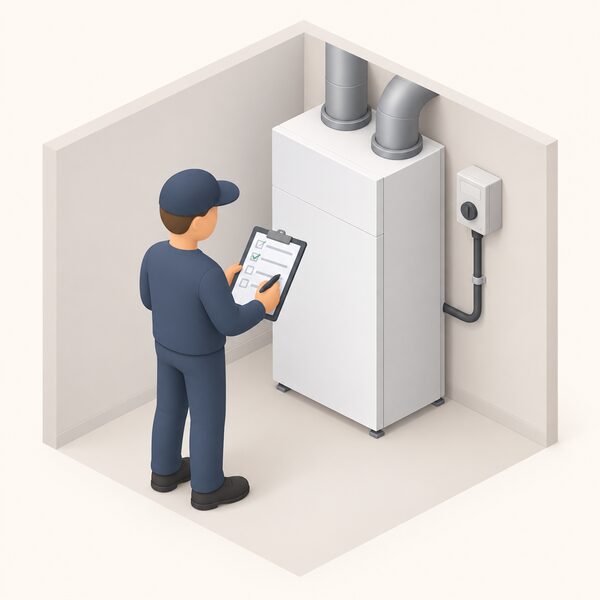
Sizing is the decision that determines everything else. Official guidance requires that heat pumps "should be selected to meet the full space heating requirement at the design condition chosen for heat loss calculations"16, and the Scottish compliance guide adds the condition that this is with no heat from additional electric heaters within the design external temperature range18. In other words, the unit has to cover the design load on its own, not with a top-up heater covering the shortfall.
Official guidance for Northern Ireland puts the same point in plain terms: make sure the heat pump is properly sized for the building's heating needs, because an undersized unit may struggle to meet demand and an oversized unit may cycle on and off often and lessen efficiency19. For a ventilation heat pump, sizing has a second dimension, because the air volume the unit handles is set by the ventilation requirement as well as the heating load.
Installation standards are specified. Heat pumps should be designed and installed in accordance with the technical standards given in the Microgeneration Installation Standard MIS 300518. On the electrical side, official guidance states that "a certified installer signs off any electrical works"28. In Northern Ireland, NISEP rules require an EPC by an accredited domestic energy assessor before and after installation of an air source heat pump22.
Choosing a model comes down to the building. A Nilan unit suits a well-insulated, reasonably airtight home where mechanical ventilation is needed anyway, so the ventilation cost is being spent regardless. Homes that are leaky, or that need a high flow temperature to radiators, are better served by other designs, and the fit between building and system is covered in which homes suit a heat pump and heat pump sizing and heat loss calculations.
Where Nilan fits in a household independence setup
A Nilan unit changes what a household depends on, and it is worth being precise about how. It runs on electricity, so it moves the home off gas or oil for the heat it provides and onto the electricity grid and an electricity supplier. That is a real shift in fuel, and it is the same shift any heat pump makes, covered in heat pumps and household energy independence.
What it does not do is make the home self-sufficient. The unit needs mains power, and its controls and any monitoring sit with the manufacturer and the supplier. There is no published Nilan figure for how the unit behaves in a power cut, and no published statement on whether it can run from a battery or a standalone inverter. Those are questions for the supplier rather than assumptions to make.
Where the design does help is in reducing waste. Recovering heat from air that would otherwise be expelled through a vent means the household gets more useful heat from energy it has already bought. Independent guidance on solar thermal panels notes that they "can be installed alongside other renewable or traditional heating systems (although they aren't so easy to combine with a combi boiler)"29. A Nilan unit is not a combi boiler, so that particular obstacle does not apply, and the pairing question is covered in should I get solar panels and a battery with my heat pump.
The dependence that remains is ordinary and worth stating plainly: the electricity grid, an electricity supplier, the company that now holds the UK trading agreement, and whoever services the unit. A ventilation heat pump reduces how much energy a home wastes. It does not remove the home from the networks it relies on.
Sources29 cited
- Exhaust air heat pumps, Energy Saving Trust, 2025-06-05
- The domestic retrofit challenge, CIBSE, 2022-10
- Heat pump questions answered, Energy Saving Trust, 2026-05-27
- Heat pump fact check, Energy Saving Trust, 2026-07-01
- Ditching costly gas and oil is cheaper thanks to heat pump scheme, GOV.UK, 2022-05-23
- Heat pumps, REA, 2026-09-17
- Specialist heat pumps for homeowners, Development Bank of Wales, 2024-11-07
- Nilan UK, Nilan UK, 2024-09
- Heat Pump KEYMARK, EHPA, 2026-08-19
- Air to air heat pumps, Energy Saving Trust, 2026-09-11
- Trianco Activair Pro R290 Heat Pump, Quiet Mark, 2026-09-17
- Mitsubishi Ecodan R290 Air Source Heat Pump 8.5kW, Quiet Mark, 2026-09-17
- Vaillant flexoTHERM Ground Source Heat Pump, Quiet Mark, 2026-09-17
- HFC phasedown reform de minimis assessment, Defra, 2025-09-02
- Level up your lifestyle with a heat pump, Plymouth Energy Community, 2026-09-20
- Approved Document L Volume 1 Dwellings, MHCLG, 2026
- Approved Document L Volume 1 Dwellings 2021 edition incorporating 2023 amendments, MHCLG, 2026-09-17
- Domestic Building Services Compliance Guide 2022, Scottish Government, 2022-06
- Heat pumps, nidirect, 2025-02-24
- CIBSE highlights importance of informed decision making in heat pump transition, CIBSE, 2026-05-07
- EINAS 2025 heat and buildings, DESNZ, 2030
- NISEP List of Schemes 2026-27, UREGNI, 2026-04
- Heat Market Mechanism Consultation Final, BEIS, 2021-10
- ECO4 Innovation Approved Innovation Measures, Ofgem, 2026-02
- NIBE S2125-12 Heat Pump, Quiet Mark, 2026-09-17
- NIBE F2050-6 Heat Pump, Quiet Mark, 2026-09-17
- NIBE F2050-10 Heat Pump, Quiet Mark, 2026-09-17
- Living with heat pumps, Local Energy Scotland, 2026-09-20
- Heating your home with renewable energy, Which?, 2025-09-22