In this guide
The NIBE F2040 is an inverter-controlled air source heat pump from a Swedish manufacturer that has been building heat pumps for over 40 years1. It is sold in the UK in 8kW, 12kW and 16kW sizes, all of which NIBE describes as carrying an A*** energy rating, and it is designed to keep working at outdoor temperatures as low as -20°C2. It is an air-to-water machine, so it feeds a wet central heating system and a hot water cylinder rather than blowing warm air.
The F2040 has been superseded at the top of the range. NIBE announced the F2050 as an upgrade, with the F2040-12 and F2040-16 sizes still on the market3. That matters for anyone searching the model by name: the F2040 is a current but older line, and the F2050 is the newer machine with R32 refrigerant and compatibility with NIBE's S-series indoor modules3.
For a household, the F2040 does one large thing and leaves one large dependence. It moves space heating and hot water off gas, oil or LPG and onto electricity, which removes the gas grid and the gas supplier from the equation. It does not remove the grid itself, and it adds a dependence on an MCS certified installer for grant eligibility and on NIBE's own support and servicing arrangements for the life of the unit4.
A Swedish heat pump specialist, and what that means for the F2040
NIBE is a Swedish company that has manufactured heat pumps in Sweden for over 40 years, and describes itself as a heat pump manufacturer rather than a boiler or air conditioning maker pushed into the market by legislation1. Its products are designed and manufactured in Sweden to suit what it calls the tough Nordic climate, and the company states it has extensive experience with inverter technology9.
That background is the substance behind the F2040's cold weather claim. A machine designed for a Nordic winter is built around a different set of assumptions from one designed for a mild climate: defrost behaviour, compressor modulation and the ability to hold output as the outdoor temperature falls. NIBE's own figure for the F2040 is operation down to -20°C while still providing sufficient hot water and the required indoor temperature4. The F2050, its successor, is quoted at the same -20°C threshold3.
The company also has a longer history in climate products generally, describing almost 70 years of manufacturing energy-efficient and sustainable climate solutions9. For a household, the practical reading is that NIBE is a specialist with a long product lineage rather than a general heating brand with a heat pump added to a boiler catalogue. What that does not change is the dependence: the F2040 is still a machine that needs a competent installer, a commissioning visit and a service route, and those are UK-side relationships regardless of where the unit was built.
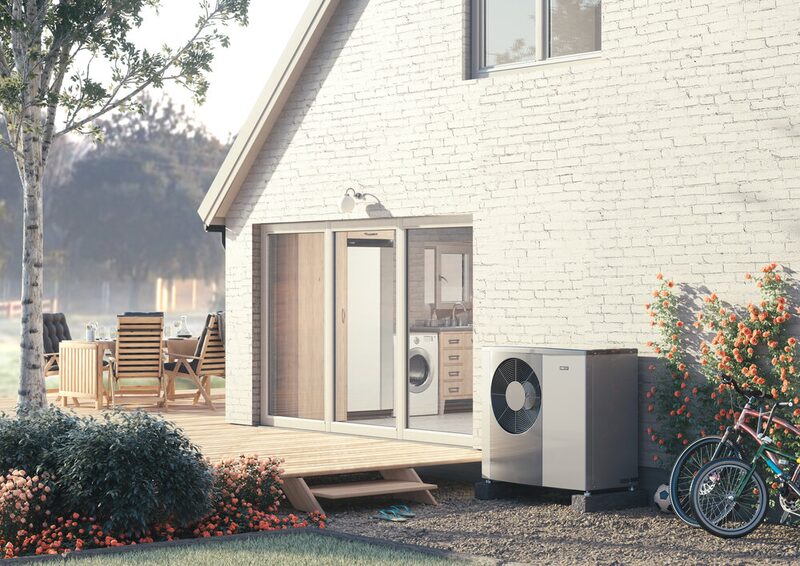
The F2040 range: 8, 12 and 16 kW variants
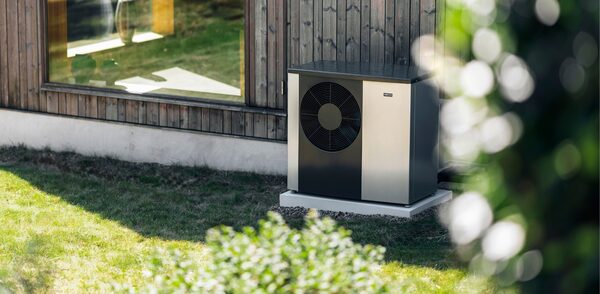
The F2040 line is sold in three outputs. NIBE's case study material describes the 8kW unit as also available in 8kW, 12kW and 16kW, all with an A*** energy rating2. The 12kW variant appears in a barn conversion installation where two F2040 12kW units were specified4, and the 16kW variant appears in a care home project where six F2040-16kW units were installed on a reinforced flat roof to heat a 46-bedroom extension, giving a combined 96kW output10.
| Variant | Output | Where it appears |
|---|---|---|
| F2040-8 | 8kW | Domestic case study, radiators resized to 50°C5 |
| F2040-12 | 12kW | Barn conversion, two units specified4 |
| F2040-16 | 16kW | Care home, six units, 96kW combined10 |
Sizing is not a matter of picking the largest number. The 8kW unit suits a well-insulated house with a modest heat load; the 16kW unit appears in projects where the demand is large or the building fabric is demanding. In the 8kW case study, the installation resized bedroom radiators to run at a maximum temperature of 50°C, which is the kind of work that lets a smaller unit do the job properly5. A heat loss calculation is what determines which of the three is right, and that calculation is done by the installer, not chosen from a table.
Specifications: inverter control, -20°C operation and A*** rating
The F2040 is an inverter-controlled air source heat pump, which means the compressor modulates its speed rather than switching on and off at full power4. That matters for running cost and for comfort: a modulating machine can match output to the actual heat loss of the house at any given moment, which is how a heat pump achieves its efficiency figures in practice rather than on a test bench.
The headline ratings are straightforward. NIBE describes the 8kW, 12kW and 16kW variants as enjoying an A*** energy rating2. The operating range extends to -20°C outdoor temperature, at which point NIBE states the unit still provides sufficient hot water and the correct indoor temperature4. The F2050, the newer model, is quoted at the same -20°C figure3.
The F2050 also brings R32 refrigerant, which NIBE describes as climate-friendly and chosen to minimise global warming potential3. Independent product listings for the F2050-6 and F2050-10 repeat the R32 specification and note reduced environmental impact11. The F2040 predates that change, so a household comparing the two is comparing an older refrigerant specification with a newer one, alongside the S-series module compatibility that the F2050 adds3.
Cost: what drives the installed price of an F2040
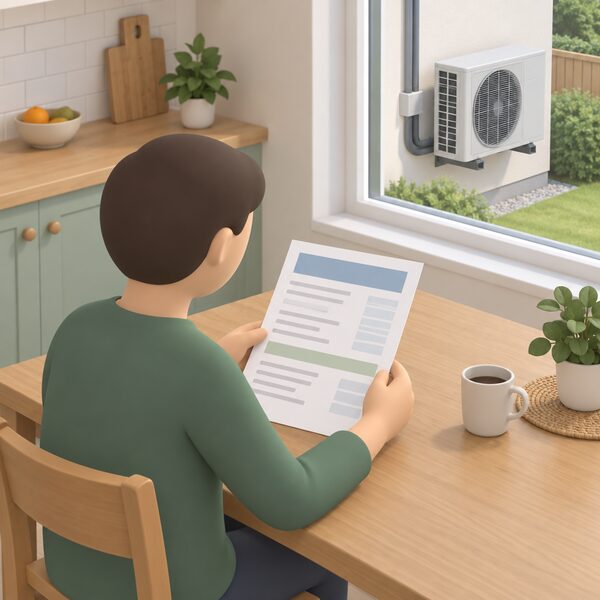
There is no published NIBE list price for a supplied and fitted F2040. Prices are installer-quoted, and the figures that exist in the public record are indicative rather than a schedule. One UK case study reports each flat fitted for £6,000 in a multi-property project6. Broader independent work on heat pump costs puts the median installation cost across four property types, bungalows, detached, semi-detached and flats, at £9,550 to £13,79013.
The gap between those two figures is the point. A flat-by-flat installation in a single development, with repeated access and shared design work, is a different commercial proposition from a one-off retrofit of a detached house. What moves a quote for an F2040 specifically:
- The output variant, since an F2040-16 costs more than an F2040-8 in equipment terms.
- Whether the property needs new or resized radiators, as in the 8kW case study where bedroom radiators were resized to run at 50°C5.
- Whether a hot water cylinder is being added or replaced, and where it can be sited.
- Electrical work, siting and the route for pipework and cabling.
- Whether the installer is MCS certified, which is a condition of Boiler Upgrade Scheme eligibility5.
On grant support, NIBE's own F2050 pages state that model can save an extra £7,500 off the cost with the Boiler Upgrade Scheme grant, and independent listings for the F2050-6 and F2050-10 repeat the eligibility3. The scheme's own rules are clear that eligibility rests on the installer being MCS certified and meeting MCS standards5. For the F2040, the same installer-led route applies. The grant is claimed by the installer, not by the householder, so the certification of the company doing the work is the operative fact.
Real-world performance: what UK case studies show
The F2040's performance evidence comes from installations rather than from a laboratory. In a 1950s property restoration, an F2040 8kW was installed and the house was brought up to standard alongside the heat pump, with bedroom radiators resized to run at a maximum of 50°C5. In a barn conversion, two F2040 12kW units were specified4. At Normanton Lodge, six F2040-16kW units with a combined 96kW output were installed on a reinforced flat roof to serve a 46-bedroom extension10.
Those projects show the range being used across very different building types, from a restored 1950s house to a care home extension. They do not, on their own, give a bill saving figure for the F2040 specifically. What the wider evidence shows is the direction of travel. Independent analysis of clean heat support reports a household reducing its energy bill from £2,586 to £1,854, and another household's annual fuel bill of £3,083 reduced by 44% down to £1,72614. Those are modelled household figures across retrofit measures, not F2040-specific readings, and they should be read as such.
At the system level, the Climate Change Committee's pathway has electrification and low-carbon electricity supply making up the largest share of emissions reductions, 60% by 2040, with household low-carbon choices contributing one-third of emissions reduction in 204016. Scottish analysis puts 10% of emissions reductions to 2040 from energy efficiency and 66% from low-carbon heating17. A heat pump is the appliance end of that shift.
Where the F2040 fits: wet heating, accessories and hot water
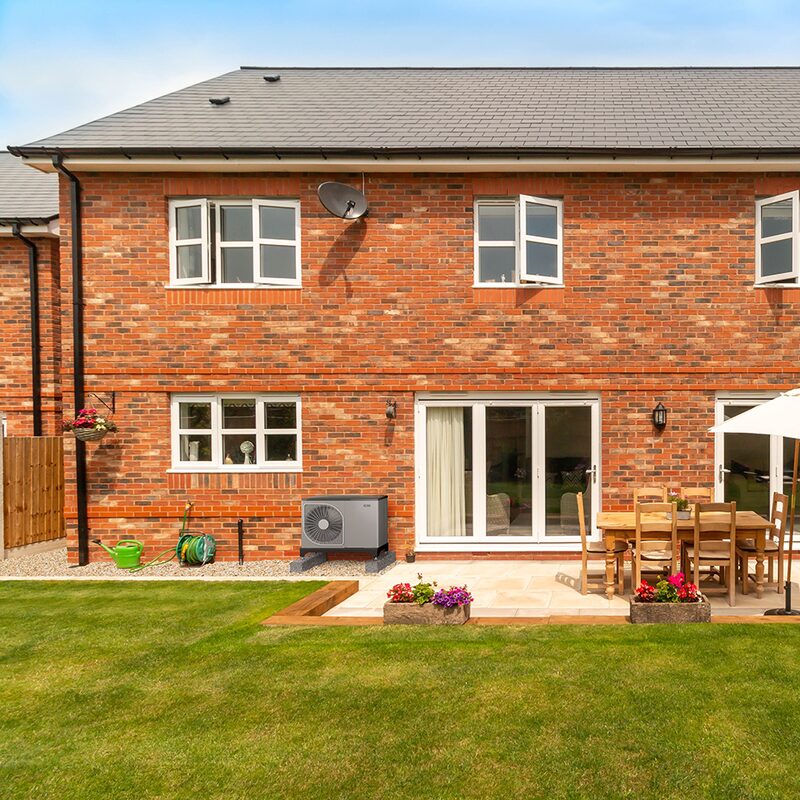
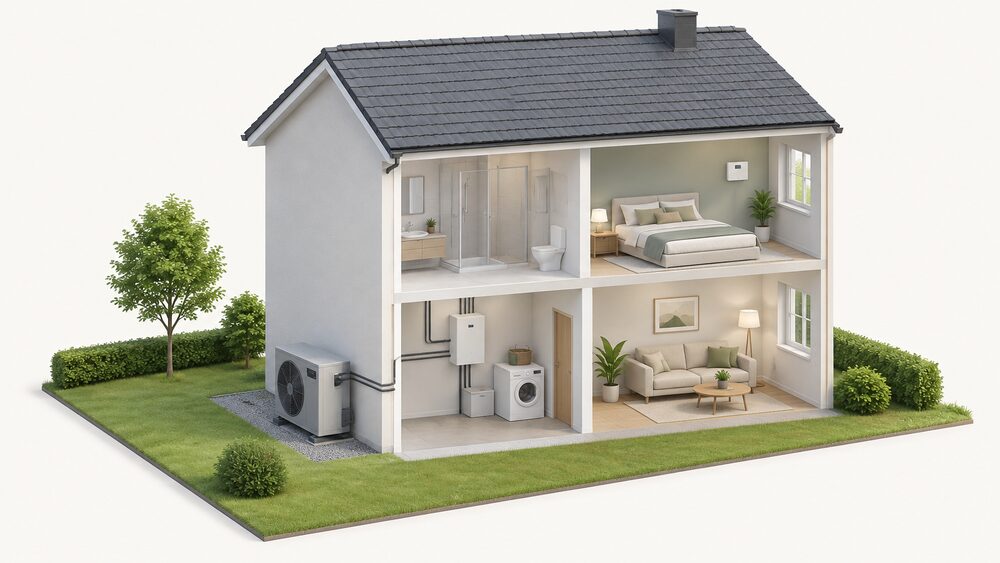
The F2040 is an air-to-water heat pump, so it works with a wet central heating system: radiators, underfloor heating or a mix, plus a hot water cylinder. NIBE describes its air source heat pumps as ideal for meeting all heating and hot water requirements, and notes they can be coupled with various accessories, such as comfort cooling and ventilation4. That accessory route is how a household extends the system beyond basic heating, for example adding cooling in summer.
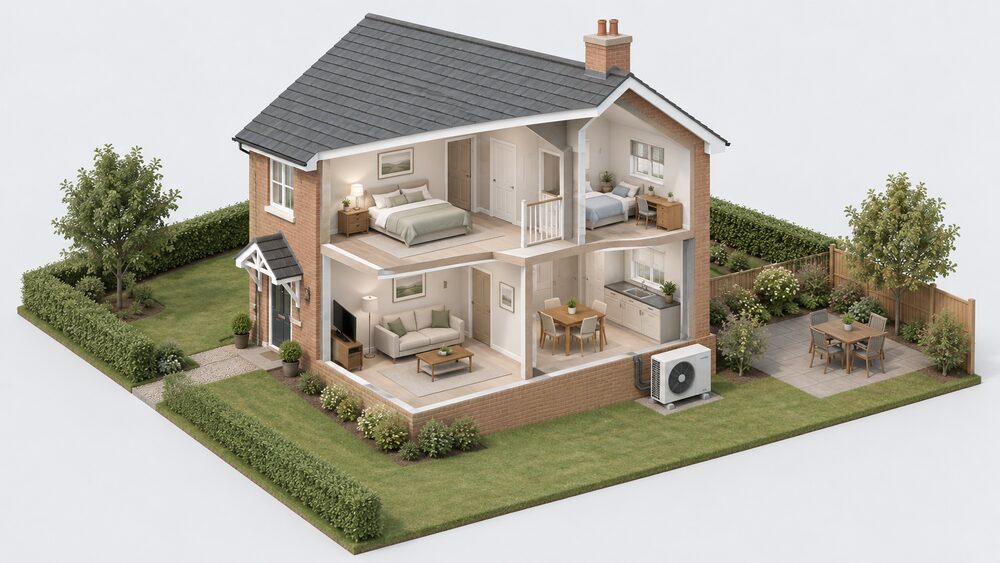
The outdoor unit is the visible part. In one development case study, the collector unit was installed externally to the garage in the majority of cases7. NIBE quotes a total footprint of 3.65m² for its S2060 outdoor unit, which gives a sense of the space this class of machine occupies18. For the F2050-6, NIBE publishes dimensions of 993mm wide and 383mm deep3, and an independent listing gives height, depth and width as 791 x 383 x 993mm11. The F2120, a different NIBE air-to-water model, is listed at 1130mm wide19.
Hot water is handled by a cylinder, not by the outdoor unit alone. That is the same architecture as any air-to-water heat pump, and it is why the F2040 installation includes an indoor side: the cylinder, the controls and the connections to the heating circuit. More on how that side of the system is put together is covered in hot water cylinders for heat pumps and in radiators and emitters for heat pumps.
NIBE in the UK: availability, installers and NIBE Home
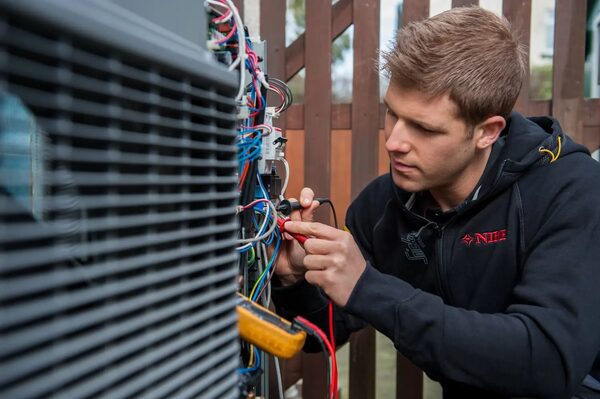
NIBE sells through a partner and installer network that handles both new installations and replacements9. In one case study the F2040 8kW was installed by Better Planet5. The company also runs its own direct installation route: NIBE Energy Systems Limited launched NIBE Home, a fully managed heat pump installation service available in England and Wales, in May 20267. That is a notable development for a manufacturer in this market, since it puts NIBE in the position of both equipment maker and installation provider for households that choose that route.
Availability is through NIBE's UK product pages and through retailers, with independent listings for the F2050-6 and F2050-10 pointing buyers to purchasing options via a retailer link11. The F2050 is eligible for FlexiServ coverage, NIBE's servicing and support package3, and the same servicing logic applies across the range.
On support, NIBE's serial number guide lists the F2040 and F2050 together under air source heat pumps, separate from its exhaust air models such as the S735, F470 and F73020. The company asks that you have the serial number for the unit in question to hand when calling for help20. Registered manufacturer details include a Swedish telephone number and an email address21. For most households the first point of contact is the installing company, and where NIBE Home carried out the work, NIBE itself.
What owning an F2040 means for household energy independence
The F2040 changes what a house is connected to. A gas, oil or LPG boiler ties a household to a fuel supply, a supplier and a delivery or network arrangement. An air source heat pump takes its energy from the air and from electricity, so the fuel dependence becomes an electricity dependence. That is a real shift: it removes the gas grid, the oil tank and the LPG contract from the property, and it makes the heating system compatible with a home's own generation if solar panels are added later.
What remains is substantial and worth stating plainly. The F2040 runs on mains electricity, so the household still depends on the grid and on an electricity supplier. It depends on an installer for commissioning and on a service route for maintenance. Where the F2050's S-series controls and app-based features are used, there is an additional dependence on a home network and on the manufacturer's platform. And the grant that often makes the economics work depends on using an MCS certified installer5.
The independence gain is therefore partial but genuine: the household stops buying a combustible fuel and starts buying electricity, with the option to generate some of that electricity itself. The wider policy direction points the same way, with electrification and low-carbon electricity supply making up the largest share of emissions reductions in the Climate Change Committee's pathway, 60% by 204016. For a household weighing the F2040 against a boiler replacement, the honest summary is that it trades one dependence for another, and the new one is at least capable of being met partly from the roof. More on that trade is set out in heat pumps and household energy independence and in heat pump running costs.
Sources21 cited
- Heat pumps product range, NIBE, 2026
- 1950s property restored with a NIBE heat pump, NIBE, 2026
- NIBE F2050 air source heat pump, NIBE, 2026
- Barn conversion, Honeybourne, Worcester, NIBE, 2026
- Anthracite fired heating system replaced by heat pump, NIBE, 2026
- Rivermead House case study, Heat Pump Association, 2026
- Chipping homes case study, NIBE, 2026
- Get installed, NIBE, 2026
- Why choose a heat pump from NIBE, NIBE, 2026
- NIBE Normanton Lodge, Alfreton, Heat Pump Association, 2026
- NIBE F2050-6 heat pump, Quiet Mark, 2026
- NIBE F2050-10 heat pump, Quiet Mark, 2026
- Future subsidies for heat pumps, statement 4, Nesta, 2026
- Clean heat: supporting low-income households, Energy UK, 2026
- Clean heat: financing the transition, Energy UK, 2025
- The Seventh Carbon Budget, Climate Change Committee, 2025
- Balancing investment in clean heat and energy efficiency in Scottish housing retrofit, ClimateXChange, 2026
- NIBE S2060 air source heat pump, NIBE, 2026
- NIBE F2120 air/water heat pump, NIBE, 2026
- Find my serial number, NIBE, 2026
- Boiler Upgrade Scheme, Ofgem, 2026
 NIBE Heat Pump ControlsYour NIBE heat pump controls decide how warm your home gets and how much it costs to run.
 NIBE heat pumps for UK homesThinking about a NIBE heat pump for your home?