
In this guide
iDM Energiesysteme is an Austrian manufacturer of heat pumps, and its products reach the UK through specialist installers rather than a mass-market retail channel. The range covers air source and ground source machines, sold under the AERO, TERRA, iPump and MAX names, and the company publishes unusually detailed technical guidance on its own site, from the four-stage vapour-compression cycle to the operating boundaries of a heat pump system.
For a UK household, the appeal is a heat pump that runs on electricity rather than gas, oil or LPG, with the running emissions set by the electricity mix rather than by a fuel burned in the home. Heating homes accounts for around 14% of the UK's total greenhouse gas emissions1, and heat pumps are the main route policy assumes for reducing that. Around 1% of UK homes have a heat pump installed2, against a Climate Change Committee estimate that approximately 10% of existing homes will need to be heated by one by 20303.
The dependence that remains is real and worth stating plainly. An iDM heat pump keeps a home on the electricity grid and on an electricity supplier. A ground source unit depends on a borehole or ground loop that cannot be moved. The controls depend on the manufacturer's own platform, and the documentation is largely published in German. This page sets out what the range covers, how the technology works, what it can and cannot do with existing radiators, and what owning one means for a household's energy independence.
iDM Energiesysteme: an Austrian maker with a long heat pump history
iDM Energiesysteme GmbH is based in Austria and has a long history in heat pump technology. That history matters less for the badge than for what it implies about the engineering: a company that has spent decades building ground source machines has had time to work through the control logic, the hydraulic design and the commissioning routines that decide whether a heat pump performs in a real house.
The company publishes its technical material directly rather than leaving it to distributors. On 25 August 2026 it published a guidance page explaining the four-stage vapour-compression cycle, the performance metrics that describe it, and where its own product families sit6. On 9 July 2026 it published guidance on initial parameterisation, setting out commissioning parameters, typical values, an eleven-step commissioning procedure and the standards and funding documentation requirements for heat pumps in the DACH region7. On 16 September 2026 it published a security vulnerability reporting page, establishing a central reporting point, a handling process and a Coordinated Vulnerability Disclosure policy8.
That last page is a signal about how the company now sees its products: a heat pump with connectivity is a networked device, and iDM treats it as one. The company's iNTELLiGENTE platform, described on pages updated on 10 July 2026, covers the NAVIGATOR controller, cascade management and connectivity, with optional iON and iVIS add-ons9.
For a UK buyer, the practical consequence is that the technical documentation exists and is thorough, but much of it is published in German on an Austrian site. The English-language sections cover the thermodynamic cycle, CO2 emissions, electricity mix, limitations and boundaries, and safety reporting. The AERO product and heat distribution pages are in German.
The range: AERO, TERRA, iPump and MAX
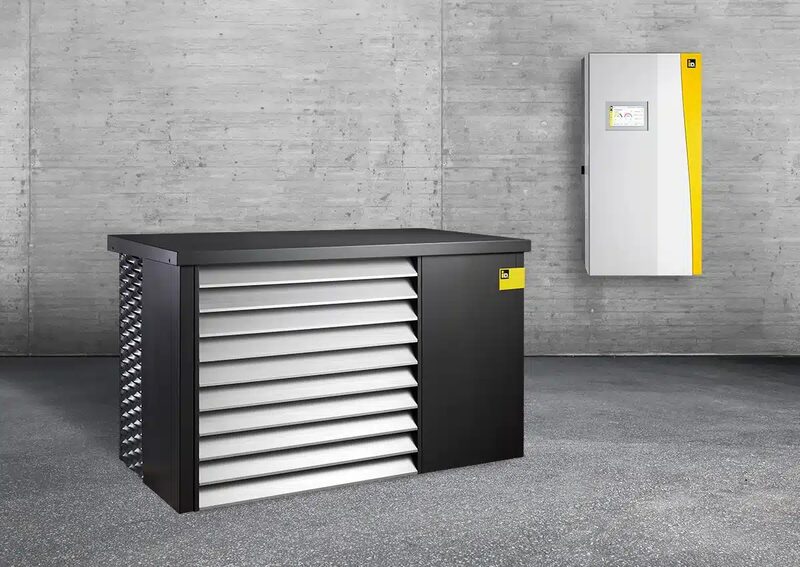
iDM's air source line is the AERO family. An overview page updated on 13 July 2026 presents the AERO ALM range, the ALM 10-50 MAX and the AL TWIN, with capacities, costs and efficiency guidance4. A companion page published on 17 July 2026 explains air as a heat source, covering air source categories, siting rules and corrosion risks, and lists the output ranges of the AERO ALM, SLM, ALM 10-50 MAX and AL TWIN11.
The naming repays a moment's attention. ALM and SLM are the two main AERO variants, the MAX designation marks the larger 10 to 50 unit, and AL TWIN describes a twin-fan arrangement for higher outputs. The TERRA family covers ground source, drawing on the stable temperature of the earth rather than the outdoor air, and iPump and MAX complete the range across the company's ground and air offerings.
| Family | Source | Notes |
|---|---|---|
| AERO ALM | Air | Main air source line4 |
| AERO SLM | Air | Second air source variant11 |
| AERO ALM 10-50 MAX | Air | Larger output unit4 |
| AERO AL TWIN | Air | Twin-fan arrangement4 |
| TERRA | Ground | Ground source range4 |
| iPump | Ground or air | Range family4 |
| MAX | Ground or air | Range family4 |
Which suits which home turns on the heat source available. A property with land for a borehole or a horizontal loop can use a TERRA ground source unit, which draws on earth at a relatively stable temperature year round. A property without that land uses an AERO air source unit, which needs outdoor space for the unit, clearance for airflow and attention to siting and corrosion risk11. The MAX and AL TWIN units exist for larger heat loads, where a single smaller unit would struggle.
How iDM heat pumps work: earth, air or water as the heat source
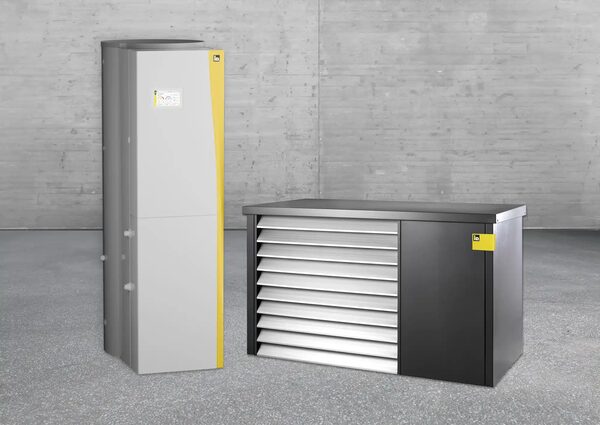
A heat pump extracts energy from the air, ground or water and converts it into heat, working through the underlying process known as the refrigerant cycle5. The cycle has four stages, and iDM's own explainer sets them out alongside the performance metrics used to describe them6. Some thermally driven heat pumps use heat or an engine to drive the compression cycle instead, but the vapour-compression arrangement is the standard domestic one12.
The source determines the rest of the installation. Air source heat pumps use the air as a source of heat13, and air-to-water models source their heat from the air outside14. Ground source heat pumps transfer energy from the natural heat stored in the earth to heat the home and domestic hot water13, and the extracted heat is usually distributed around the home through the hot water system, just like an air-to-water model14. Water source heat pumps use the energy stored in ground water, surface water, or sea or sewage water12, a route that needs a suitable body of water and is rare in domestic settings.
A heat pump is a versatile system capable of providing heating, cooling and hot water for homes, commercial buildings and industrial applications5. That breadth is the point: the same refrigerant circuit can move heat in either direction, which is why cooling comes almost free with the heating function.
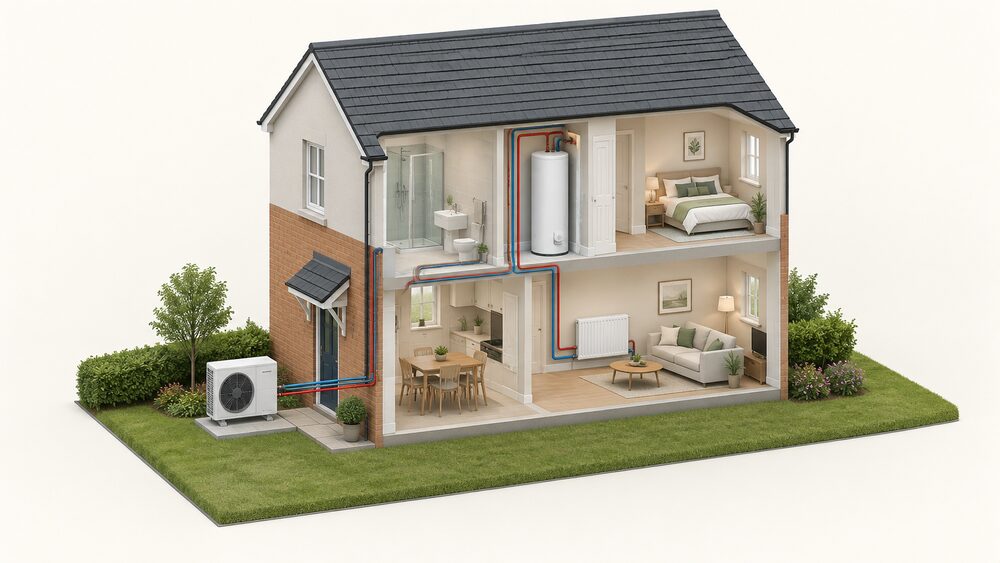
For a household, the source choice is the single biggest determinant of what the installation involves. An air source unit is a box on a wall or a plinth, connected by pipework to the existing heating circuit. A ground source unit needs a borehole drilled or a loop buried, which is groundworks rather than plumbing, and it cannot be relocated afterwards. The ground loops and boreholes page covers what that work involves, and the ground source heat pumps page sets out the wider case for the technology.
Heating and cooling from one unit
Cooling is a standard capability rather than an add-on. Air source heat pumps can give both heating and cooling, making them versatile15, and air-to-air units can be configured for cooling as well as heating14. Air-to-air heat pumps usually have one unit outside and at least one unit inside, connected by pipes carrying a refrigerant between them14.
For iDM's AERO range, the cooling function runs through the same wet circuit as the heating, which means the emitters have to be able to handle it. A radiator circuit designed for heating can carry chilled water, but condensation control matters, and not every emitter or control arrangement is set up for it. The using a heat pump for cooling page covers the conditions.
The distinction between air-to-air and air-to-water matters here. An air-to-air unit delivers cooling and heating directly to room air through indoor units, with no water circuit and no hot water cylinder. An air-to-water unit, which is what the AERO range is, heats water and distributes it through radiators, underfloor pipes or a cylinder, and can also run that circuit cool. The air-to-air vs air-to-water heat pumps comparison sets out the trade-offs, and the air-to-air heat pumps page covers the direct-to-air route in full.
One consequence of a combined heating and cooling unit is worth noting for anyone weighing independence. A unit that provides both functions replaces two appliances, which reduces the number of separate systems a household depends on, but it also concentrates that dependence into one machine and one manufacturer's control platform.
Flow temperatures and existing radiators: what can stay
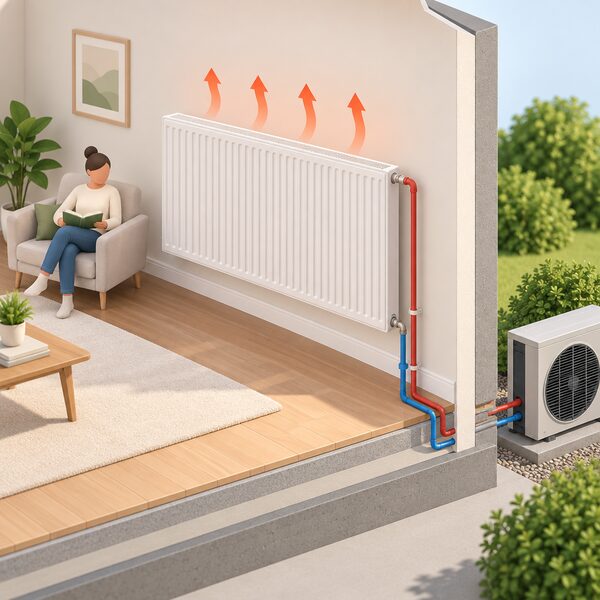
The question of whether existing radiators can stay turns on flow temperature, not on the age of the building. Air-to-water heat pumps work well in combination with large radiators and underfloor pipes14, and the extracted heat is usually distributed around the home through the hot water system14. Large, generously sized radiators are the ones that can give up their heat at a lower water temperature, which is exactly what a heat pump wants.
The numbers that matter are published. Product Characteristics Database records for heat pumps provide values at three declared flow temperatures16, and those are the points at which heat pump performance is normally compared. Independent guidance for a radiator-sized system suggests setting the minimum heat pump flow temperature to around 30oC and ideally sizing the radiator circuit to a maximum of around 45oC17. The underlying condition is simple: radiators can remain compatible if the system is designed to deliver the required room heat at lower water temperatures, which is a sizing question rather than a question about the heat pump itself.
That condition is where most retrofit decisions sit. A house with generously sized radiators and reasonable insulation can often run at the lower end of the range, keeping the existing emitters. A house with small radiators sized for a gas boiler running far hotter will usually need some emitters replaced or added, because the same radiator gives up noticeably less heat at a heat pump flow temperature. The radiators and emitters for heat pumps page covers the sizing work, and the what flow temperature do heat pumps use page sets out the range in more detail.
Where iDM heat pumps reach their limits
Every heat pump has operating boundaries, and iDM published guidance defining them on 6 August 2026, setting out boundary categories and the relevant European standards20. A longer guide published on 24 August 2026 defines the technical, legal and economic operating limits for heat pump systems and the relevant European standards21. These are the company's own statements of where its products stop being the right answer.
The most concrete limit is electrical. A heat pump installation with a new Maximum Demand of 60A or less, meeting all other relevant requirements, falls under a connect and notify arrangement, where the installer notifies the distribution network operator via the heat pump connection form within 28 days of installation22. Between 60A and 100A inclusive, the household must apply to connect prior to installation using the same form22. Above that, the supply itself may need work, and the who pays if my electricity supply needs upgrading page covers that question.
Two further limits are worth knowing. Heat pumps up to a capacity of 45kW are in scope of the deployment statistics, which marks the boundary of what is counted as a domestic-scale installation23. And where a heat pump provides both space heating and water heating, the heat pump will not provide any space heating until water heating demand is satisfied24, which is a scheduling characteristic rather than a fault, but it shapes how a system behaves on a cold morning after a long shower.
UK availability and what owning one means for energy independence
iDM heat pumps reach the UK through specialist installers rather than a national retail or energy-supplier channel, and the company's own documentation is published on its Austrian site. Support is available for installers and manufacturers to expand supply chains25, which is the policy route by which a smaller European brand reaches UK households at all.
The independence case for any heat pump is straightforward: the heat comes from the air, the ground or water rather than from a fuel delivered by tanker or pipe, and the running cost depends on electricity rather than on gas or oil. What remains is a dependence on the electricity grid and an electricity supplier, plus the manufacturer for controls, spares and firmware. A ground source unit adds a dependence on the ground loop, which is fixed in place and cannot be taken to another house.
The UK policy context is one of slow progress against targets. Around 1% of UK homes have a heat pump installed2, and the Climate Change Committee has said the UK is off track for net zero26. Approximately 10% of existing homes in the UK will need to be heated by a heat pump by 2030, compared with only approximately 1% today3. Around 20,000 domestic heat pumps are installed every year17, a figure well short of what that 10% implies.
For a household, the practical route runs through the Boiler Upgrade Scheme. The installer applies for the grant on the householder's behalf through Ofgem, and quotes come via the MCS find a heat pump installer tool or an energy supplier27. Urban and rural properties in England or Wales are eligible, on or off the gas grid, and a self-build can qualify28. In England, permitted development rights were amended to remove the rule that a heat pump must be installed at least one metre from the property boundary29. In Wales, permitted development rights apply to air source, ground source and water source heat pumps30. The heat pump grants page covers the schemes across the four nations, and the heat pumps and household energy independence page sets out the wider picture.
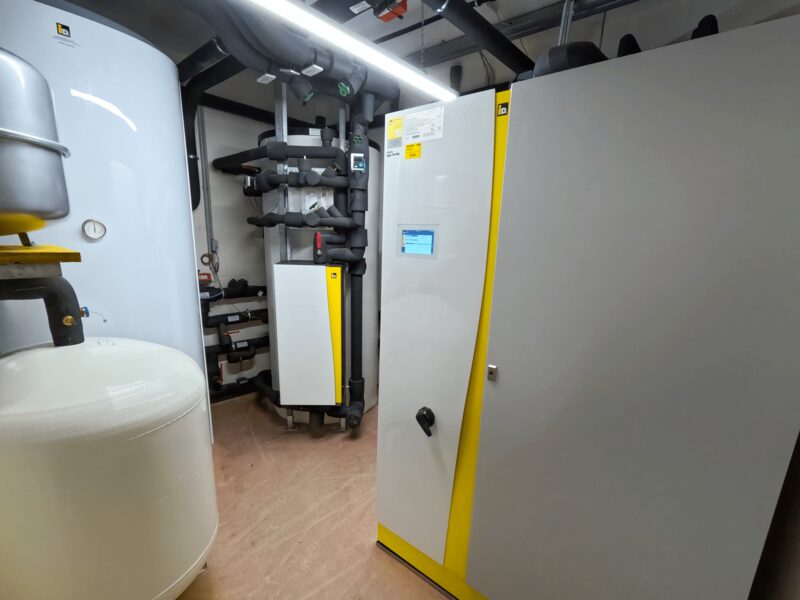
Environmental credentials and the electricity mix

A heat pump's climate case rests on two things: the efficiency with which it moves heat, and the carbon intensity of the electricity it runs on. iDM treats the electricity mix as the upstream data entity for heat pump emissions, primary energy factors and green electricity claims, and published an explainer on that basis on 17 July 202631. A companion page published the same day explains direct, indirect, embodied and avoided emissions for heat pumps and their regulatory context32.
The UK figures give the scale. Heating homes accounts for around 14% of the UK's total greenhouse gas emissions1. The Climate Change Committee found that heat pump retrofits would deliver around an additional 0.1 MtCO2e of emissions savings in 202533, a modest figure that reflects how few heat pumps are installed rather than how much each one saves. The same committee has said the UK is off track for net zero26.
iDM has also published a fact-check of 17 common environmental myths, on 24 August 2026, separating verifiable technical facts from assumptions about heat pump energy use, emissions, refrigerants, noise, cold weather operation and grid impact34. A wider environmental guidance page published the same day covers the climate, refrigerant, regulatory and grid aspects of heat pump impact35.
Certification matters for both funding and planning. MCS certification is a requirement for heat pump installations made under the Domestic Renewable Heat Incentive, the Green Homes Grant and the Clean Heat Grant36. Heat pumps included in the deployment statistics are MCS certified and have a capacity of less than or equal to 45kW23. For permitted development, the heat pump must comply with the Microgeneration Certification Scheme Planning Standards or equivalent37. A heat pump claiming the Domestic RHI must also be metered for performance if installed on or after 22 May 201838. The heat pump standards and certification page covers what each scheme requires.
Sources38 cited
- Domestic RHI Annual Report Scheme Year 11, Ofgem, July 2025
- Heat pump deployment statistics: June 2025, Department for Energy Security and Net Zero, 4 September 2025
- UK off track for net zero, say country's climate advisors, Climate Change Committee, 18 July 2024
- AERO air source heat pump overview, iDM Energiesysteme, 13 July 2026
- How heat pumps work: a guide for homeowners, NICEIC, 17 September 2026
- Heat pump thermodynamic cycle, iDM Energiesysteme, 25 August 2026
- Heat pump initial parameterisation, iDM Energiesysteme, 9 July 2026
- Report a safety issue, iDM Energiesysteme, 16 September 2026
- The intelligent iDM heat pump, iDM Energiesysteme, 10 July 2026
- myiDM Energy, iDM Energiesysteme, 10 July 2026
- Air as a heat source for AERO heat pumps, iDM Energiesysteme, 17 July 2026
- About heat pumps, European Heat Pump Association, 24 April 2026
- VAT energy saving materials and grant funded heating supplies, HM Revenue and Customs, 17 September 2026
- Air to air heat pumps, Energy Saving Trust, 11 September 2026
- Heat pumps, nidirect, 24 February 2025
- Low temperature heating, NCM Product Characteristics Database, 17 September 2026
- Domestic Heat Pump Guide, MCS Certified, 2 April 2024
- Approved Document L Volume 1: Dwellings, Ministry of Housing, Communities and Local Government, April 2026
- Building Regulations Approved Document L Volume 1, Welsh Government, April 2026
- Heat pump limitations and boundaries, iDM Energiesysteme, 6 August 2026
- Operating limits and framework conditions, iDM Energiesysteme, 24 August 2026
- Building regulations renewables guidance, Bedford Borough Council, 17 September 2026
- Heat pump methodology, Department for Energy Security and Net Zero, 17 September 2026
- Raising minimum standards for heat pumps: options assessment, Department for Energy Security and Net Zero, 27 November 2024
- Heat pumps, House of Commons Environmental Audit Committee, 2021
- Heat pumps, House of Commons Environmental Audit Committee, 2026
- Get a heat pump, Department for Energy Security and Net Zero, 10 September 2026
- Air and ground source heat pumps, Croydon Council, 17 September 2026
- Approved Document L Volume 1 consultation version, Welsh Government, August 2025
- Amendments to the Boiler Upgrade Scheme: government response, Department for Energy Security and Net Zero, November 2025
- Electricity mix, iDM Energiesysteme, 17 July 2026
- CO2 emissions in heat pump environments, iDM Energiesysteme, 17 July 2026
- Progress in reducing emissions: 2026 report to Parliament, Climate Change Committee, 2026
- Common environmental myths, iDM Energiesysteme, 24 August 2026
- Heat pump environment, iDM Energiesysteme, 24 August 2026
- Heat pump deployment statistics: March 2026, Department for Energy Security and Net Zero, 11 June 2026
- Planning permission for heat pumps, Welsh Government, 17 September 2026
- Heat pump deployment quarterly statistics: United Kingdom 2025 Q2, Department for Energy Security and Net Zero, 4 September 2025